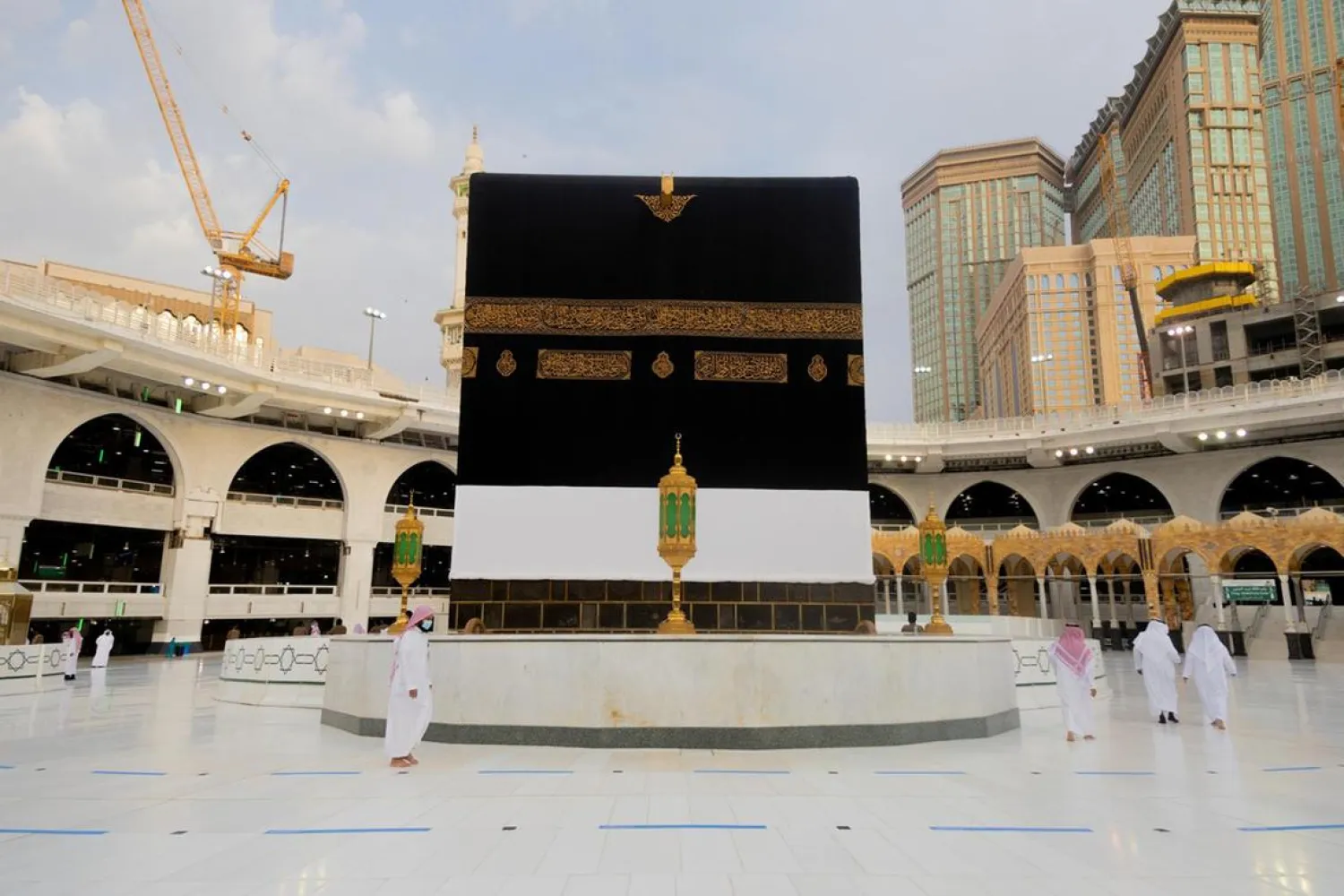

The vast, white-marble floors surrounding Islam’s holiest site, the Kaaba in Makkah, would normally be packed with hundreds of thousands of pilgrims from around the world the day before the Hajj.
On Tuesday, however, only a few officials and workers putting last-minute preparations in place were seen at the Grand Mosque housing the Kaaba.
In place of the 2.5 million pilgrims who performed the Hajj last year, only a very limited number of faithful – around 1,000 - are being allowed to take part in this year’s pilgrimage due to the ongoing coronavirus pandemic.
The select few approved for this year's Hajj have been tested for the virus and are self-isolating in hotel rooms in Makkah before embarking on their holy journey.
Amr Al-Maddah, the chief planning officer at the Ministry of Hajj and Umrah, is helping incorporate the latest technology into the pilgrimage such as thermal scanners and electronic ID cards.
"Right now, technology is our black horse to developing the whole Hajj journey," said al-Maddah, an electronics engineer with a Ph.D. in robotics and artificial intelligence.
"We are taking every step possible to make sure that this Hajj will end with zero cases of COVID-19 and also with zero deaths in our total Hajj numbers," he told The Associated Press.
Before pilgrims could even enter Makkah, they were given wristbands by the Saudi Health Ministry to monitor their movements and ensure the mandatory quarantine was observed. Thermal scanners are being used across the holy sites to monitor people's temperatures.
Each pilgrim is assigned to a group of around 20 others. A group leader will guide them throughout the Hajj to each destination at a specified time, to avoid crowding in places like the Grand Mosque, where Muslims circle the Kaaba and follow a path traveled by the Prophet Ibrahim's wife, Hagar, who ran between two hills searching for water for her dying son.
While on Mount Arafat, where the Prophet Mohammad delivered his final sermon nearly 1,400 years ago and where pilgrims will spend Thursday in deep prayer and repentance, the pilgrims will be wearing high-tech ID cards that connect to an application on their phones.
The card and app allow the government to easily monitor the pilgrims, and gives them a way to reach out to their group leader and make special meal requests.
The card stores the pilgrims’ personal information, health status, residence and other Hajj-related details. In the future, al-Maddah said the cards will be fitted with a location tracker to follow individual pilgrims’ movements. The tracker will be managed by a control room, and can be used as a pay card in place of cash.
Pilgrims have also been given special attire to wear during the Hajj laced with silver nano technology that helps kill bacteria and makes clothes water resistant. Al-Maddah said the measure is a precaution, "even if it can affect almost nothing" or has a minimal chance of "improving health conditions."
It's all part of the special treatment pilgrims are receiving this year. Other perks - all meals, hotel accommodation, transportation and health care is paid for by the Saudi government. Typically, the Hajj can cost thousands of dollars for pilgrims who save for a lifetime for the journey.
This year marks the first time in nearly a century of Saudi rule over Makkah that people from outside the Kingdom will not take part in the five-day Hajj, which is a once in a lifetime requirement of Muslims.
Al-Maddah, who sits on the Hajj planning committee, said allowing people to enter Saudi Arabia from abroad would have posed a global health risk.
Two-thirds of pilgrims this year are foreigners already residing in Saudi Arabia from among the 160 different nationalities that would have normally been represented at the Hajj. The other one-third are Saudi security personnel and medical staff who have recovered from the coronavirus.
All pilgrims had to be between the ages of 20 and 50 with no terminal illnesses and showing no symptoms of the coronavirus.
"For us, safety comes first," al-Maddah said. "We are employing technology to make sure that these services and these precautions are met and delivered in the highest standard."