First US Recipient of Partial Face Transplant Dead at 57

Doctors at the Cleveland Clinic -- (L-R) Dr. Risal Djohan, Dr. Daniel Alam, Dr. Francis Papay and Dr. Maria Siemionow -- completed the operation on Connie Culp in December 2008. (AFP)
TT

First US Recipient of Partial Face Transplant Dead at 57

Doctors at the Cleveland Clinic -- (L-R) Dr. Risal Djohan, Dr. Daniel Alam, Dr. Francis Papay and Dr. Maria Siemionow -- completed the operation on Connie Culp in December 2008. (AFP)

Connie Culp, the first US recipient of a partial face transplant, has died at age 57, according to Ohio's Cleveland Clinic, where she underwent the delicate operation nearly 12 years ago.

The health center listed no cause of death in its tweet on Friday, quoting one of her doctors, Frank Papay, as saying she was a "great pioneer."

"Her decision to undergo a sometimes-daunting procedure is an enduring gift for all humanity," added Papay, head of the clinic's dermatology and plastic surgery institute.

Culp was grievously wounded in 2004 when her husband shot her and then turned the gun on himself.

The gun blast shattered Culp's nose and cheeks, the roof of her mouth and her right eye.

His wounds were far less extensive than hers, and he was later jailed for seven years over the attack.

Culp had 30 surgeries before undergoing transplant surgery in 2008 at the Cleveland Clinic -- an intensely complex procedure that took 22 hours over two days.

The mother of two went on to speak out about domestic violence and to offer encouragement to others who underwent face transplants, including Charla Nash, the Connecticut woman who was mauled by a pet chimpanzee.

A transplant can help recipients -- often victims of accidents, violence or rare genetic disorders -- to resume basic tasks such as breathing, eating and speaking, and it restores important non-verbal communication through smiles and frowns.

But the operation, performed around the world only a few dozen times, can mean a life-long struggle to stop the body rejecting the implanted organ.

Immunosuppressant drugs, which help stop such a rejection, can leave the person vulnerable to infections and cancers.

Dallas Wiens, a Texas man whose face was gravely burned by a high-voltage wire while he was working on a church roof, underwent the first US full-face implant in 2011. Though permanently blinded, he is now able to speak on the phone and has regained his sense of smell.

The recipient of the world's first partial face transplant, Isabelle Dinoire of France, died of cancer in April 2016, 11 years after her groundbreaking operation.

Doctors said her body had rejected the transplant.


Study Reveals Why Cats Meow More Around Humans

The findings confirm that meowing is not simply an involuntary expression of emotion, but can be an audience-directed form of communication. (Getty Images)
TT

Study Reveals Why Cats Meow More Around Humans

The findings confirm that meowing is not simply an involuntary expression of emotion, but can be an audience-directed form of communication. (Getty Images)

Domestic cats meow differently depending on whether their human caretakers are present in the room or not, scientists confirm in a new study published by The Independent.

Cats meow for a variety of reasons, mostly when they are hungry or excited, and communicate through non-verbal cues like slow blinking or brushing themselves against their caregivers.

But, according to a 2020 study, humans are bad at telling apart food meows from other types of cat vocalizations.

“The domestic cat uses the meow more frequently in interactions with humans than with other cats,” researchers noted in the new study published in the journal Animal Behaviour. “However, it remains unclear whether this vocalisation serves a truly communicative purpose.”

The research confirms that cats tend to meow far more when their human companions are around than when they are alone or just surrounded by other cats.

For the study, researchers from the University of Sao Paulo in Brazil recruited 38 domestic cats known to be particularly vocal around food.

They presented each cat with their favorite treat sealed inside a small plastic container that they could see and smell, but not reach. Scientists then observed each for a minute under two conditions: with an attentive human present and with no one in the room.

They found that each cat made about 20 meows when it was alone, but over four times as many when a human companion was present.

The study concluded that the odds of cats meowing were several times higher with a person present.

Cats also frequently looked directly at the present caregiver, alternating their gaze between the person and the inaccessible treat.

This form of communication called “gaze alternation” is observed in several animals, including dogs and primates.

In contrast, cats simply spent more time standing still when they were alone.

“In the human-absent condition, cats stood still and gazed at the door significantly more, suggesting they discriminated which behavior was more effective with an audience,” scientists noted.

The findings confirm that meowing is not simply an involuntary expression of emotion, but can be an audience-directed form of communication.

“These results are consistent with meowing playing a communicative role in cat–human interactions,” researchers said.

Meowing also appears to be a flexible toolkit for cats that is shaped by their immediate surroundings and needs.

Scientists said that living alongside humans likely favored cats to evolve more flexible meows across different situations.


This Beirut Family Has Sold Falafel for 100 Years, Through War and Crisis. It Has No Plan to Stop

 Ziad Tabarra, right, holds falafel sandwiches made with finely ground fava beans at his family's shop in Beirut's Hamra district, Lebanon, Wednesday, Nov. 11, 2026. (AP)
Ziad Tabarra, right, holds falafel sandwiches made with finely ground fava beans at his family's shop in Beirut's Hamra district, Lebanon, Wednesday, Nov. 11, 2026. (AP)
TT

This Beirut Family Has Sold Falafel for 100 Years, Through War and Crisis. It Has No Plan to Stop

 Ziad Tabarra, right, holds falafel sandwiches made with finely ground fava beans at his family's shop in Beirut's Hamra district, Lebanon, Wednesday, Nov. 11, 2026. (AP)
Ziad Tabarra, right, holds falafel sandwiches made with finely ground fava beans at his family's shop in Beirut's Hamra district, Lebanon, Wednesday, Nov. 11, 2026. (AP)

For more than a century, the Tabbara family has been serving up falafel to Beirut’s residents.

Their business, which predates Lebanon’s founding, has survived two world wars and a series of local conflicts in the small Mediterranean nation.

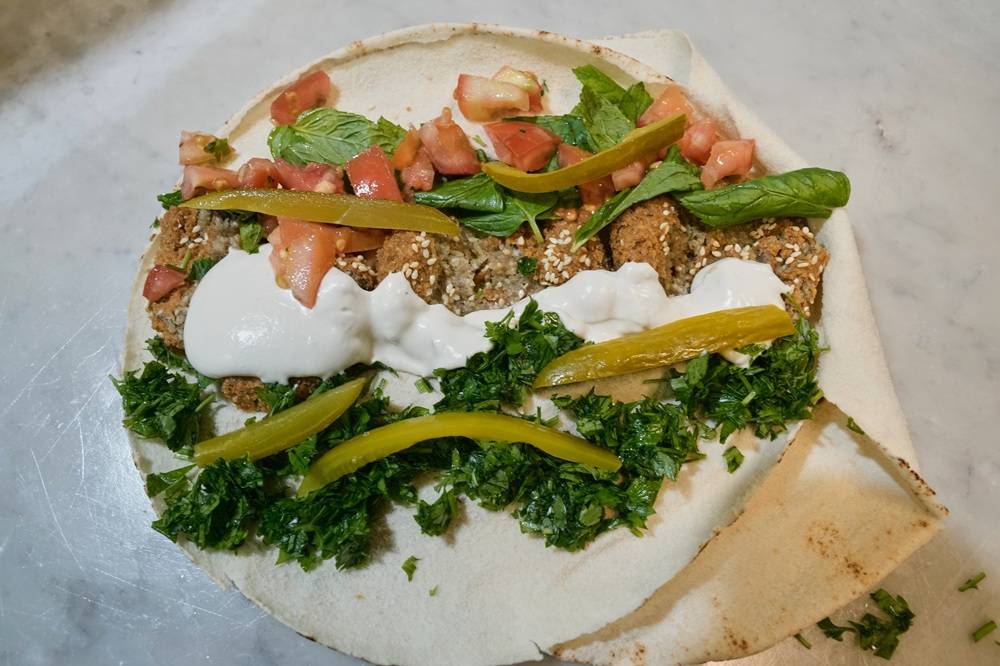
Now, a fourth generation is getting ready to take over the modest shop, where customers can get $3 sandwiches of small, doughnut-shaped patties of deep-fried ground fava beans wrapped in flat Lebanese bread with pickled cucumber, tomatoes, parsley, thick tahini sauce and homemade dark red-hot pepper paste for the spice lovers.

“I have clients spread all over the world,” 82-year-old Mohammed Tabbara said as a European customer waited for a sandwich in Beirut’s busy Hamra district that's packed with cafes, clothing shops and two major universities.

“They all come to eat falafel because they know the flavor and the taste,” Tabbara added.

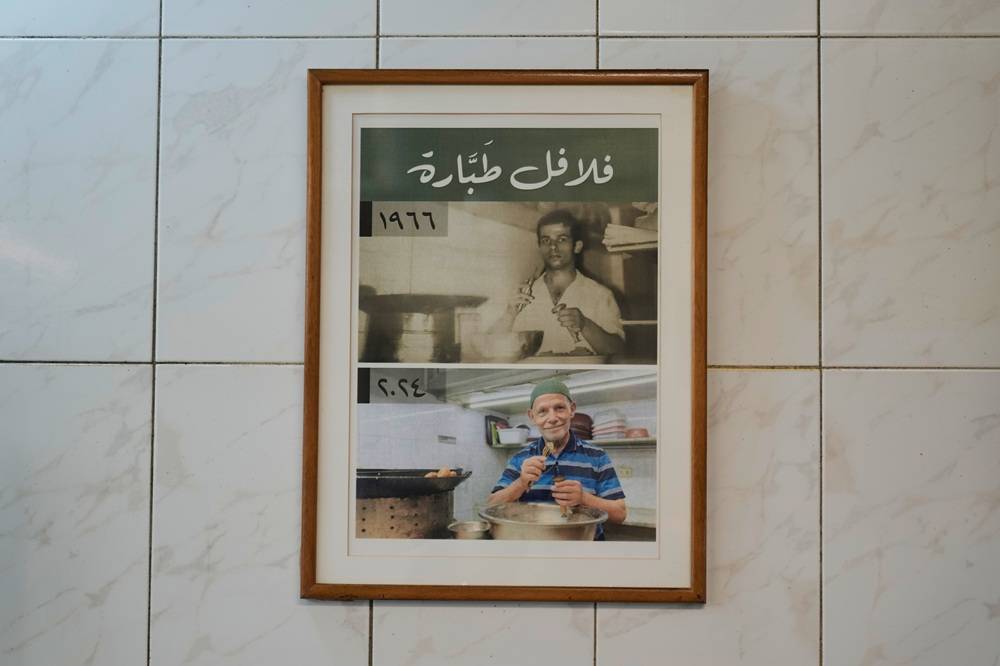
Photographs of Mohammed Tabarra taken in 1966, top, and 2024 hang at his family's shop in Beirut's Hamra district, Lebanon, Wednesday, Nov. 11, 2026. (AP)

He is passing down the culinary craft to his 40-year-old son, Ziad Tabbara, a former accountant who has spent the last six years working full time with his dad.

“This is a flavor that made history and heritage passed down through generations,” said Ziad Tabbara, who as a child helped his father in the shop during summer vacations.

Ziad has no children of his own to pass on the tradition to — a sore point with his father who wants to see him married with children.

Beirut was still part of the Ottoman Empire when Ziad's great-grandfather Kamel Tabbara opened the family’s first falafel shop in the city’s central Bab Idriss district in 1914. It would be six years before the state of Greater Lebanon was established after World War I.

Kamel passed the business to his son Ahmad. Since 1950, the business has been mostly run by Kamel’s grandson Mohammed. It was around that time that the family moved its business from central Beirut. The current shop in a narrow street has been in place since 1979.

“I have been through 40 wars,” Mohammed Tabbara said, referring to two civil wars, Israel's 1982 invasion of Lebanon, multiple Israel-Hezbollah wars, and several conflicts involving Palestinian groups and the Syrian army.

Mohammed Tabbara, who began working with his dad at the shop when he was just 6 years old, still mans the counter, taking orders from clients and assembling sandwiches. Always smiling, Mohammed knows many customers by name. Some have been getting falafel there for decades.

A falafel sandwich made with finely ground fava beans is prepared at the Tabarra family's shop in Beirut's Hamra district, Lebanon, Wednesday, Nov. 11, 2026. (AP)

Beirut is known throughout the Middle East for its cuisine, from fine restaurants to street food.

Small falafel spots can be found throughout Lebanon. A sandwich is a filling, affordable meal for people in a nation that's been experiencing a historic economic meltdown since 2019, rooted in decades of corruption and mismanagement.

Mohammed Tabbara's shop is decorated with two photos of him: A black-and-white one taken in 1966 and another taken two years ago in which he wears his trademark skull cap.

He takes pride in the shop's cleanliness. They change the cooking oil every day and wash the vegetables with vinegar and salt.

Jean Matta, 60, works in the neighborhood and has been eating falafel at Tabbara since 1992. “It’s crunchy, tasty and clean,” Matta said.

Ziad has learned his father's special secret recipe for falafel, which is made of Australian fava beans, soaked in water the night before, then ground before being mixed with salt and an array of spices, including coriander.

Mohammed said chickpeas, used in many falafel recipes, are heavier and take more time to digest than fava beans alone. He also said he was the first in Lebanon to introduce a falafel patty covered with sesame seeds and with a hole in the middle, making it well-cooked inside and crunchy on the outside.

“The sandwich you take from here is light and 100% healthy,” Mohammed said as he wrapped a sandwich while his son dropped falafel patties into a giant frying pot.

“God willing, I will continue to offer the same flavor,” Ziad said.


Missing Teen Found Alive After 6 Days in Australian Woodlands

In this image made from video and provided by the Victoria State Police 17-year-old William, center right, is embraced by his mother Elizabeth, only first names were provided by police, while in a helicopter in Cowwarr, Australia, Thursday, Nov. 12, 2026, after William spent six days lost in eastern Australian woodlands. (Victoria Police via AP)
TT

Missing Teen Found Alive After 6 Days in Australian Woodlands

In this image made from video and provided by the Victoria State Police 17-year-old William, center right, is embraced by his mother Elizabeth, only first names were provided by police, while in a helicopter in Cowwarr, Australia, Thursday, Nov. 12, 2026, after William spent six days lost in eastern Australian woodlands. (Victoria Police via AP)

A 17-year-old boy with autism was found alive Thursday after six days lost in eastern Australian woodlands.

The boy, whom police identified only as William, had begun camping with a teenage friend when he disappeared last Friday near Walhalla, a former gold-mining town 185 kilometers (115 miles) east of Melbourne, police said.

A police helicopter crew found him surrounded by wilderness lying asleep on a flat rock beside a creek, and he was later reunited with his mother. William was in good spirits and mostly in good health, the police statement said.

Video shot from the rescue helicopter showed he was shirtless and sunburned. He was wearing shorts and boots and was using towels as blankets.

“I’m just over the moon that he’s alive,” his mother, Elizabeth, told reporters.

The AP has decided not to provide her family name to avoid identifying her son.

“And he’s never leaving the house again. He’s grounded for life. He’s not going anywhere ever again,” she joked.

William was later taken to a hospital for his health to be monitored, police said.

William's family have said he has Level 2 autism. That requires “substantial support,” according to the Australian advocacy group Autism360.

Such a person may have marked deficits in verbal and non-verbal social communication and rely heavily on routines and predictable activities.

Disruption can cause significant distress.

The Southern Hemisphere spring weather had been mild for the past week in the alpine region where William was lost and there had been little rain.

Elizabeth had dropped off her son and his friend last Friday for a weekend of camping. William walked a short distance from the campsite to the drop-off location to collect more camping equipment but never returned to his friend, police said.

After becoming lost, William trekked for days up and down “some very steep terrain,” Acting Police Inspector Jason Benbow said.

He spent the last two days where he was found at the creek, trapped by the steepness of his surrounds 2 kilometers (1.2 miles) from his camp site, Benbow said.

“He woke up to the sound of the helicopter, gave them a thumbs up and they winched him to safety,” Benbow told reporters.

The extensive police search for him involved more than 100 emergency services personnel and volunteers.