


Rod Laver Climbed Tennis's Sporting Everest Twice, Without Asterisks

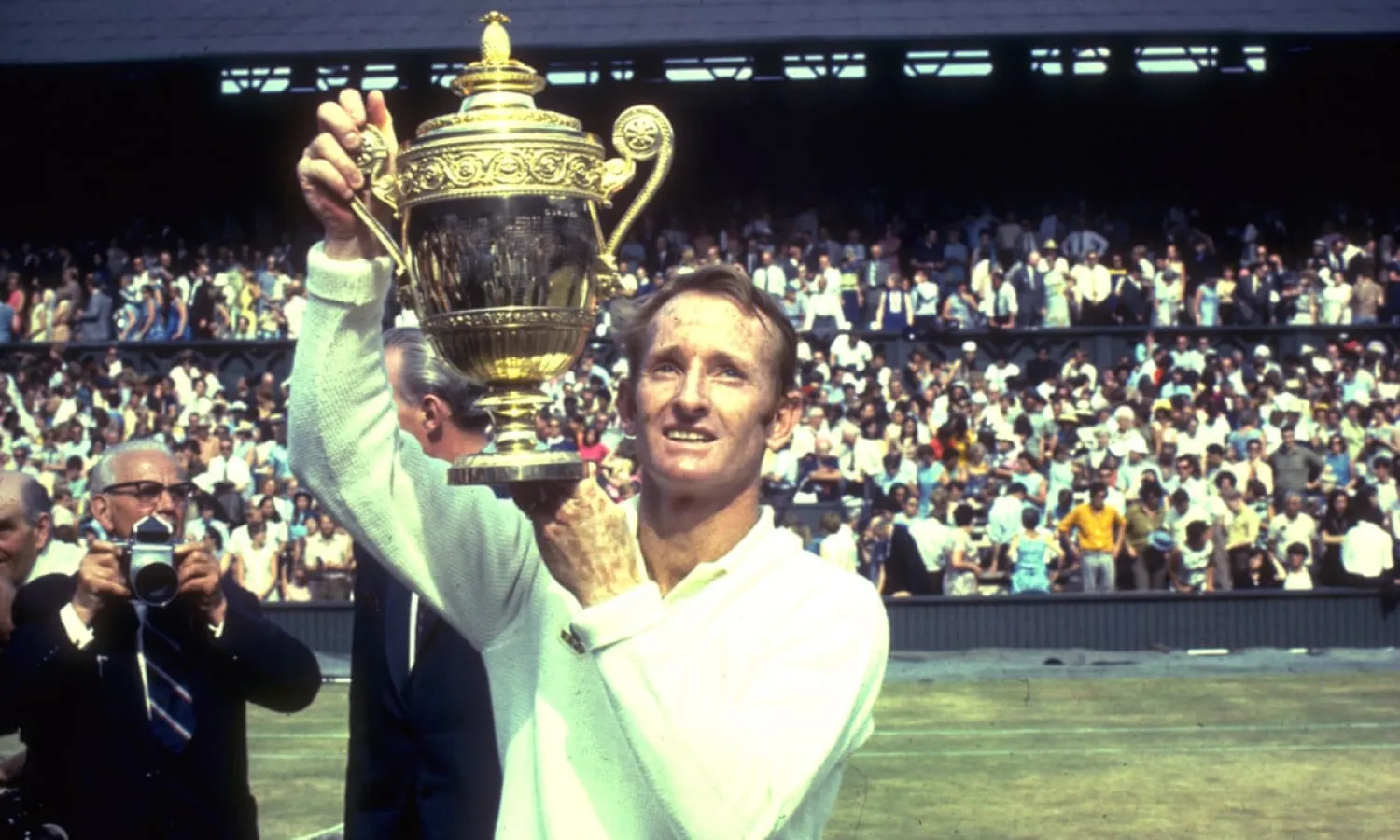
Rod Laver lifts the men’s singles trophy at Wimbledon after beating his great rival and fellow Australian John Newcombe in 1969, the year he completed his second grand slam.
Photograph: Getty Images
Rod Laver lifts the men’s singles trophy at Wimbledon after beating his great rival and fellow Australian John Newcombe in 1969, the year he completed his second grand slam. Photograph: Getty Images
TT

Rod Laver Climbed Tennis's Sporting Everest Twice, Without Asterisks

Rod Laver lifts the men’s singles trophy at Wimbledon after beating his great rival and fellow Australian John Newcombe in 1969, the year he completed his second grand slam.
Photograph: Getty Images
Rod Laver lifts the men’s singles trophy at Wimbledon after beating his great rival and fellow Australian John Newcombe in 1969, the year he completed his second grand slam. Photograph: Getty Images

Rod Laver recognises the apples/oranges element inherent in comparing records across eras, but the player acknowledged as the finest of his generation and voted as the best of the 20th century did something no other tennis great ever has: win the grand slam, twice. Repeat: all four majors in the same year. Twice.

The first, in 1962, was from a so-called amateur field already weakened by the defection to the professional ranks of players such as Lew Hoad, Ken Rosewall and Pancho Gonzales. The second – and most significant – followed Laver’s own 21-slam exile while touring with the pros. The year, 1969, was the first full season of Open tennis. A towering achievement. With chronic elbow soreness. Without asterisks. A sporting Everest climbed.

Only the 1930s champion Don Budge had completed the feat before; no man has done it since. Jimmy Connors, Mats Wilander, Roger Federer, Rafael Nadal and Novak Djokovic have subsequently won three majors in a calendar year, while eight men own career grand slams. One of them, Andre Agassi, has described Laver’s accomplishments as “God-like’’. Amen to that.

My most recent interview with the diminutive Queenslander – in January, the day after his arrival for the Australian Open – was conducted in the Melbourne hotel from where there is a view across the Yarra to the physical monument that has borne his name since 2000. Discussing Laver’s legacy, which humility insists he always does reluctantly, the 81-year-old eventually mentions it: “My record. Just leave that out there. Whatever people think. Winning the grand slam certainly was a feather in my cap.’’

The second slam, in particular, given the full-strength fields once the pros had returned from the cold. “I think ‘69 counts for more. A lot more,’’ says John Newcombe, the seven-time slam winner revealing he had collected every draw sheet from those four majors and once sat down with Laver to analyse them. The Australian Open in Brisbane, for example, included an epic 90-game semi-final against Tony Roche.

“There was probably four or five times that he was in a lot of trouble but he got out of every one,’’ says Newcombe. “It’s not easy to achieve that, and he did it, so you’ve got to rate it as a fantastic achievement. There was a lot of good players around at that time who had won grand slams, and Rod was the best of the best.’’

As to what made him so, Newcombe points to his fellow Australian’s remarkable ability to come up with the big shot at the right time. Indeed, hot was often scalding, such as the freakish cross-court backhand winner when Newcombe had an early break in the third set of the 1969 Wimbledon final and, he estimates, 99% of the court covered. “I turned around and looked at him and just gave him the nod to say: ‘That was bloody great.’’’ Laver in four.

Rosewall, who lost the 1969 French Open final in what is acknowledged as one of Laver’s finest matches on clay, points to his great rival’s competitiveness and fearless, audacious shot-making, while applauding a remarkable, sustained ability to win matches in which he had seemed beaten. (Author’s note: Newcombe suggests Rosewall is being overly modest here, considering how little separated the pair over more than 150 contests, and nominating the 1968 French final and the two ground-breaking WCT finals Rosewall won).

Fred Stolle recalls Laver as an opponent who would never retreat; for whom having his serve broken was merely a signal to attack even more. Despite standing only 172cm, by utilising the power in his famously muscular left forearm, a fierce topspin backhand was a revolutionary point of difference in the days of so-called “low ball hitters” that included the other great Australians. In that grass-dominated era, Laver’s ability to take the ball on the rise was ahead of its time.

Physically fit and fast, Laver’s unflappable big-match temperament was borne out by results, notably that “absolutely phenomenal” record in 1962 and 1969, according to Stolle. If his 11 career singles majors (including at least two of each, plus nine more in doubles and mixed and five Davis Cup triumphs) are dwarfed by the modern giants, his good friend Fred has little doubt that a player who lost more than five of his prime major-winning years – from 24 to almost 30 – to the gruelling pro ranks from which he returned a tougher, more complete player would have won many, many more.

Indeed, during Laver’s absence, Stolle reached eight slam finals and lost to Roy Emerson – fifth on the all-time list, asterisk required – in five of them. “I wouldn’t have won the two that I did win had I been playing against the pros of the time. Rod won 11 and didn’t play 21 and he was the best when he turned pro, and he was the best when he came back. So if we give him half of those, that puts him at 21.’’ (Note No 2: Rosewall missed more than twice as many and still won eight. Perhaps even more noteworthy – and often overlooked – too).

Yet just as we will never know, Laver – who played only a limited schedule from 1970 until his retirement in 1978 – has always maintained it has never mattered. Any regret is a small one: when he won that history-making match on the damp Forest Hills grass to reach the summit on 9 September 1969, an uncharacteristic celebration saw the expectant father jump the net before shaking hands with the vanquished Arthur Ashe.

Not an act Laver would repeat, just like his achievement from more than half a century ago is yet to be. Maybe it never will.

(The Guardian)


Mbappe Calls for Prestianni Ban over Alleged Racist Slur at Vinicius

TOPSHOT - Real Madrid's French forward #10 Kylian Mbappe talks with SL Benfica's Portuguese head coach Jose Mourinho during the UEFA Champions League knockout round play-off first leg football match between SL Benfica and Real Madrid CF at Estadio da Luz in Lisbon on February 17, 2026. (Photo by PATRICIA DE MELO MOREIRA / AFP)
TT

Mbappe Calls for Prestianni Ban over Alleged Racist Slur at Vinicius

TOPSHOT - Real Madrid's French forward #10 Kylian Mbappe talks with SL Benfica's Portuguese head coach Jose Mourinho during the UEFA Champions League knockout round play-off first leg football match between SL Benfica and Real Madrid CF at Estadio da Luz in Lisbon on February 17, 2026. (Photo by PATRICIA DE MELO MOREIRA / AFP)

Real Madrid forward Kylian Mbappe said Benfica's Gianluca Prestianni should be banned from the Champions League after the Argentine was accused of directing a racist slur at Vinicius Jr during the Spanish side's 1-0 playoff first-leg win on Tuesday.

Denying the accusation, Prestianni said the Brazilian misheard him.

The incident occurred shortly after Vinicius had curled Real into the lead five minutes into the second half in Lisbon.

Television footage showed the Argentine winger covering his mouth with his shirt before making a comment that Vinicius and nearby teammates interpreted as a racial ‌slur against ‌the 25-year-old, with referee Francois Letexier halting the match for ‌11 ⁠minutes after activating ⁠FIFA's anti-racism protocols.

The footage appeared to show an outraged Mbappe calling Prestianni "a bloody racist" to his face, Reuters reported.

The atmosphere grew hostile after play resumed, with Vinicius and Mbappe loudly booed by the home crowd whenever they touched the ball. Despite the rising tensions, the players were able to close out the game without further interruptions.

"I want to clarify that at no time did I direct racist insults to Vini Jr, ⁠who regrettably misunderstood what he thought he heard," Prestianni wrote ‌on his Instagram account.

"I was never racist with ‌anyone and I regret the threats I received from Real Madrid players."

Mbappe told reporters he ‌heard Prestianni direct the same racist remark at Vinicius several times, an allegation ‌also levelled by Real's French midfielder Aurelien Tchouamen.

Mbappe said he had been prepared to leave the pitch but was persuaded by Vinicius to continue playing.

"We cannot accept that there is a player in Europe's top football competition who behaves like this. This guy (Prestianni) doesn't ‌deserve to play in the Champions League anymore," Mbappe told reporters.

"We have to set an example for all the children ⁠watching us at ⁠home. What happened today is the kind of thing we cannot accept because the world is watching us.

When asked whether Prestianni had apologized, Mbappe laughed.

"Of course not," he said.

Vinicius later posted a statement on social media voicing his frustration.

"Racists are, above all, cowards. They need to cover their mouth with their shirt to show how weak they are. But they have the protection of others who, theoretically, have an obligation to punish them. Nothing that happened today is new in my life or my family's life," Vinicius wrote.

The Brazilian has faced repeated racist abuse in Spain, with 18 legal complaints filed against racist behavior targeting Vinicius since 2022.

Real Madrid and Benfica will meet again for the second leg next Wednesday at the Bernabeu.


Second Season of ‘Kings League–Middle East' to Kick off in March in Riyadh 

The second season of the Kings League-Middle East will kick off in Riyadh on March 27. (Kings League-Middle East on X)
TT

Second Season of ‘Kings League–Middle East' to Kick off in March in Riyadh 

The second season of the Kings League-Middle East will kick off in Riyadh on March 27. (Kings League-Middle East on X)

The Kings League-Middle East announced that its second season will kick off in Riyadh on March 27.

The season will feature 10 teams, compared to eight in the inaugural edition, under a format that combines sporting competition with digital engagement and includes the participation of several content creators from across the region.

The Kings League-Middle East is organized in partnership with SURJ Sports Investments, a subsidiary of the Public Investment Fund (PIF), as part of efforts to support the development of innovative sports models that integrate football with digital entertainment.

Seven teams will return for the second season: DR7, ABO FC, FWZ, Red Zone, Turbo, Ultra Chmicha, and 3BS. Three additional teams are set to be announced before the start of the competition.

Matches of the second season will be held at Cool Arena in Riyadh under a single round-robin format, with the top-ranked teams advancing to the knockout stages, culminating in the final match.

The inaugural edition recorded strong attendance and wide digital engagement, with approximately a million viewers following the live broadcasts on television and digital platforms.


Shakhtar Boss Pays Ukrainian Racer $200,000 After Games Disqualification

Ukrainian President Volodymyr Zelenskiy holds helmet as he meets with a Ukrainian skeleton racer Vladyslav Heraskevych , who was disqualified from the Olympic skeleton competition over his "helmet of remembrance" depicting athletes killed since Russia's invasion and his father and coach, Mykhailo Heraskevych, amid Russia's attack on Ukraine, in Munich, Germany February 13, 2026. (Ukrainian Presidential Press Service/Handout via Reuters)
TT

Shakhtar Boss Pays Ukrainian Racer $200,000 After Games Disqualification

Ukrainian President Volodymyr Zelenskiy holds helmet as he meets with a Ukrainian skeleton racer Vladyslav Heraskevych , who was disqualified from the Olympic skeleton competition over his "helmet of remembrance" depicting athletes killed since Russia's invasion and his father and coach, Mykhailo Heraskevych, amid Russia's attack on Ukraine, in Munich, Germany February 13, 2026. (Ukrainian Presidential Press Service/Handout via Reuters)

The owner of ‌Ukrainian football club Shakhtar Donetsk has donated more than $200,000 to skeleton racer Vladyslav Heraskevych after the athlete was disqualified from the Milano Cortina Winter Games before competing over the use of a helmet depicting Ukrainian athletes killed in the war with Russia, the club said on Tuesday.

The 27-year-old Heraskevych was disqualified last week when the International Bobsleigh and Skeleton Federation jury ruled that imagery on the helmet — depicting athletes killed since Russia invaded Ukraine in 2022 — breached rules on athletes' expression at ‌the Games.

He ‌then lost an appeal at the Court ‌of ⁠Arbitration for Sport hours ⁠before the final two runs of his competition, having missed the first two runs due to his disqualification.

Heraskevych had been allowed to train with the helmet that displayed the faces of 24 dead Ukrainian athletes for several days in Cortina d'Ampezzo where the sliding center is, but the International Olympic Committee then ⁠warned him a day before his competition ‌started that he could not wear ‌it there.

“Vlad Heraskevych was denied the opportunity to compete for victory ‌at the Olympic Games, yet he returns to Ukraine a ‌true winner," Shakhtar President Rinat Akhmetov said in a club statement.

"The respect and pride he has earned among Ukrainians through his actions are the highest reward. At the same time, I want him to ‌have enough energy and resources to continue his sporting career, as well as to fight ⁠for truth, freedom ⁠and the remembrance of those who gave their lives for Ukraine," he said.

The amount is equal to the prize money Ukraine pays athletes who win a gold medal at the Games.

The case dominated headlines early on at the Olympics, with IOC President Kirsty Coventry meeting Heraskevych on Thursday morning at the sliding venue in a failed last-minute attempt to broker a compromise.

The IOC suggested he wear a black armband and display the helmet before and after the race, but said using it in competition breached rules on keeping politics off fields of play. Heraskevych also earned praise from Ukraine President Volodymyr Zelenskiy.
