

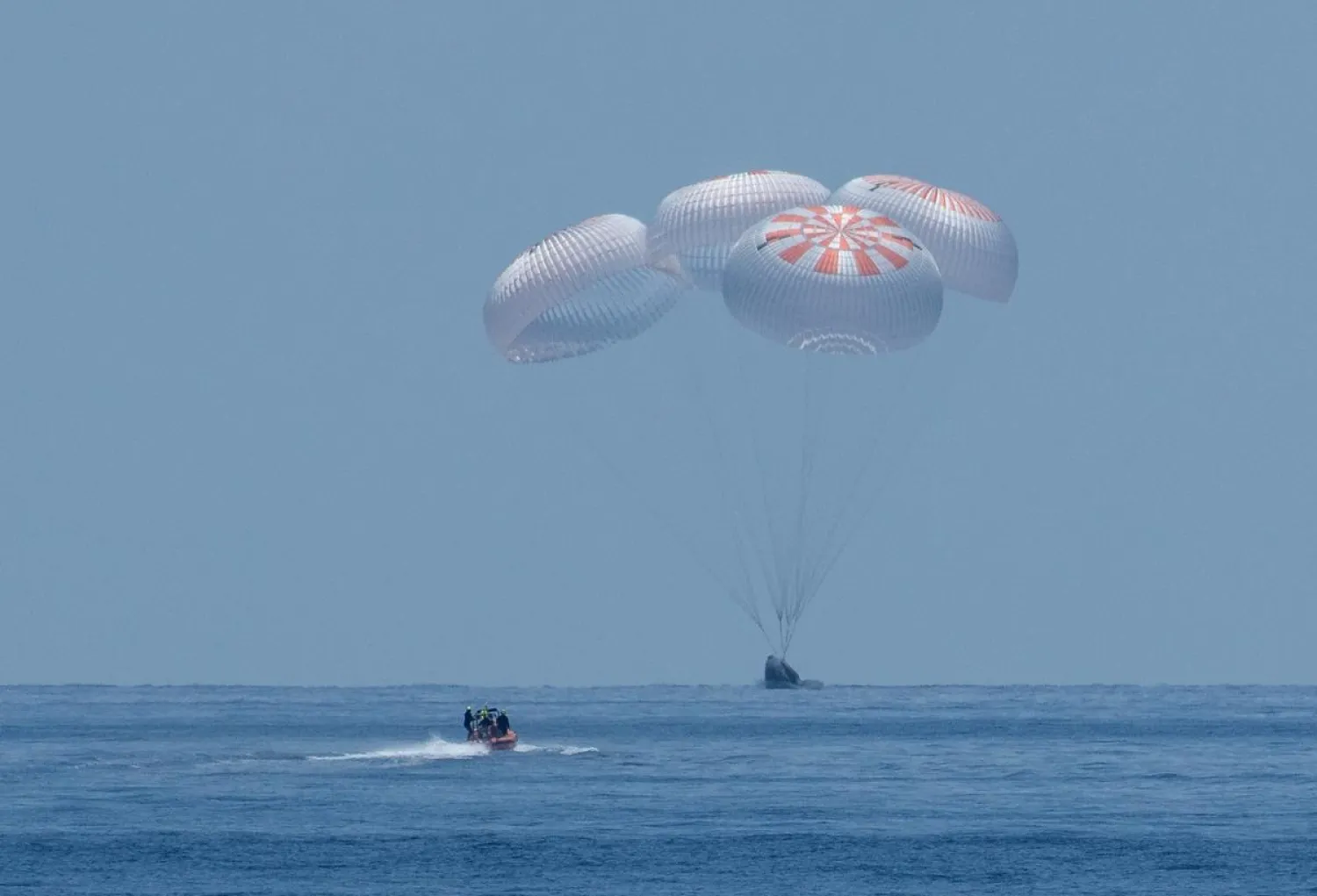

NASA Astronauts Cap Historic ‘Odyssey’ aboard SpaceX Crew Dragon Capsule

The SpaceX Crew Dragon Endeavour spacecraft lands in the Gulf of Mexico off the coast of Pensacola, Florida, US, August 2, 2020. (NASA via Reuters)
TT

NASA Astronauts Cap Historic ‘Odyssey’ aboard SpaceX Crew Dragon Capsule

The SpaceX Crew Dragon Endeavour spacecraft lands in the Gulf of Mexico off the coast of Pensacola, Florida, US, August 2, 2020. (NASA via Reuters)

US astronauts Bob Behnken and Doug Hurley, who flew to the International Space Station in SpaceX’s new Crew Dragon, splashed down in the Gulf of Mexico on Sunday after a two-month voyage that was NASA’s first crewed mission from home soil in nine years.

Behnken and Hurley, tallying 64 days in space, undocked from the station on Saturday and returned home to land their capsule in calm waters off Florida’s Pensacola coast on schedule at 2:48 pm ET following a 21-hour overnight journey aboard Crew Dragon “Endeavor.”

“This has been quite an odyssey,” Hurley told senior NASA and SpaceX officials at a homecoming ceremony at NASA’s Johnson Space Center in Houston, Texas. “To be where we are now, the first crewed flight of Dragon, is just unbelievable.”

The successful splash-down, the first of its kind by NASA in 45 years, was a final test of whether SpaceX Chief Executive Elon Musk’s spacecraft can transport astronauts to and from orbit — a feat no private company has accomplished before.

“This day heralds a new age of space exploration,” Musk said. “I’m not very religious, but I prayed for this one.”

NASA administrator Jim Bridenstine said the successful mission marked “a new era of human spaceflight where NASA is no longer the purchaser, owner and operator of all the hardware” but one of many future customers of space travel.

“Today we really made history,” Bridenstine told an earlier press conference.

Despite Coast Guard restrictions and safety risks, spectators in private boats surrounded the splash-down site dozens of miles from shore as SpaceX and NASA recovery teams used a crane to hoist the spacecraft out of the water and onto a boat.

The crew’s retrieval from Crew Dragon was delayed slightly as the teams worked to flush its fuel tanks after sensing traces of nitrogen tetroxide fumes outside the capsule, a toxic gas from one the spacecraft’s flammable fuels.

Hurley, giving a thumbs up as he was wheeled out of the spacecraft on a stretcher, a normal procedure as astronauts adjust to Earth’s gravity, said, “I’m just proud to be a small part of this whole effort to get a company and people to and from the space station.”

“Thanks for doing the most difficult parts and the most important parts of human spaceflight - getting us into orbit and bringing us home,” Behnken told SpaceX mission control in Hawthorne, California, as the hatch door was opened.

For the return sequence, on-board thrusters and two sets of parachutes worked autonomously to slow the acorn-shaped capsule, bringing Behnken and Hurley’s speed of 17,500 miles per hour in orbit down to 350 mph upon atmospheric re-entry, and eventually 15 mph at splash-down.

The pair were to undergo medical checks onshore in Pensacola ahead of a flight to NASA’s Johnson Space Center in Houston, Texas.

Flag captured
NASA officials have said Crew Dragon, a pod with seven astronaut seats, was in a “very healthy” condition while docked at the space station, where astronauts conducted tests and monitored how the spacecraft performs in space.

Behnken and Hurley undocked from the orbital station late on Saturday to begin their trip home, waking at 7:40 am Sunday to a recorded wakeup call from their sons.

“Good morning Dragon Endeavor,” Hurley’s son said in a recorded message sent to the capsule. “I’m happy you went into space but I’m even happier that you’re coming back home.”

NASA, aiming to galvanize a commercial space marketplace, awarded nearly $8 billion to SpaceX and Boeing Co collectively in 2014 to develop dueling space capsules, experimenting with a contract model that allows the space agency to buy astronaut seats from the two companies.

Billionaire entrepreneur Musk’s SpaceX became the first private company to send humans to orbit with the launch of Behnken and Hurley.

“Congratulations SpaceX & NASA on completing first crewed Dragon flight!!,” Musk wrote on Twitter after the splash-down, adding a US flag emoji followed by “returned” — referring to a rivalry with Boeing Co over which company’s astronaut crew would be the first to retrieve an American flag left on the space station in 2011, when the last crewed mission launched from US soil.

Behnken and Hurley brought the flag back to Earth, stowed as cargo in Crew Dragon.

The landmark mission, which took off from NASA’s Kennedy Space Center on May 31, marked the first time the US space agency launched humans from American soil since its shuttle program retired in 2011. Since then, the United States has relied on Russia’s space program to launch its astronauts to the space station.

“It was a great relief when I saw Bob and Doug come out of the capsule, smiling, thumbs up, looking very cheerful,” SpaceX President Gwynne Shotwell told reporters. “That was the good moment.”



Google Says to Build New Subsea Cables from India in AI Push

A logo of Google is on display at Bharat Mandapam, one of the venues for AI Impact Summit, in New Delhi, India, February 17, 2026. REUTERS/Bhawika Chhabra
TT

Google Says to Build New Subsea Cables from India in AI Push

A logo of Google is on display at Bharat Mandapam, one of the venues for AI Impact Summit, in New Delhi, India, February 17, 2026. REUTERS/Bhawika Chhabra

Google announced Wednesday it would build new subsea cables from India and other locations as part of its existing $15 billion investment in the South Asian nation, which is hosting a major artificial intelligence summit this week.

The US tech giant said it would build "three subsea paths connecting India to Singapore, South Africa, and Australia; and four strategic fiber-optic routes that bolster network resilience and capacity between the United States, India, and multiple locations across the Southern Hemisphere".


Mark Zuckerberg Set to Testify in Watershed Social Media Trial 

Meta's CEO Mark Zuckerberg testifies during the Senate Judiciary Committee hearing on online child sexual exploitation at the US Capitol in Washington, US, January 31, 2024. (Reuters)
TT

Mark Zuckerberg Set to Testify in Watershed Social Media Trial 

Meta's CEO Mark Zuckerberg testifies during the Senate Judiciary Committee hearing on online child sexual exploitation at the US Capitol in Washington, US, January 31, 2024. (Reuters)

Mark Zuckerberg will testify in an unprecedented social media trial that questions whether Meta's platforms deliberately addict and harm children.

Meta's CEO is expected to answer tough questions on Wednesday from attorneys representing a now 20-year-old woman identified by the initials KGM, who claims her early use of social media addicted her to the technology and exacerbated depression and suicidal thoughts. Meta Platforms and Google’s YouTube are the two remaining defendants in the case, which TikTok and Snap have settled.

Zuckerberg has testified in other trials and answered questions from Congress about youth safety on Meta's platforms, and he apologized to families at that hearing whose lives had been upended by tragedies they believed were because of social media.

This trial, though, marks the first time Zuckerberg will answer similar questions in front of a jury. and, again, bereaved parents are expected to be in the limited courtroom seats available to the public.

The case, along with two others, has been selected as a bellwether trial, meaning its outcome could impact how thousands of similar lawsuits against social media companies would play out.

A Meta spokesperson said the company strongly disagrees with the allegations in the lawsuit and said they are “confident the evidence will show our longstanding commitment to supporting young people.”

One of Meta's attorneys, Paul Schmidt, said in his opening statement that the company is not disputing that KGM experienced mental health struggles, but rather that Instagram played a substantial factor in those struggles.

He pointed to medical records that showed a turbulent home life, and both he and an attorney representing YouTube argue she turned to their platforms as a coping mechanism or a means of escaping her mental health struggles.

Zuckerberg's testimony comes a week after that of Adam Mosseri, the head of Meta's Instagram, who said in the courtroom that he disagrees with the idea that people can be clinically addicted to social media platforms.

Mosseri maintained that Instagram works hard to protect young people using the service, and said it's “not good for the company, over the long run, to make decisions that profit for us but are poor for people’s well-being."

Much of Mosseri's questioning from the plaintiff's lawyer, Mark Lanier, centered on cosmetic filters on Instagram that changed people’s appearance — a topic that Lanier is sure to revisit with Zuckerberg.

He is also expected to face questions about Instagram’s algorithm, the infinite nature of Meta’ feeds and other features the plaintiffs argue are designed to get users hooked.


US Tech Giant Nvidia Announces India Deals at AI Summit

FILED - 04 February 2026, Bavaria, Munich: The NVIDIA logo is seen during a press conference at the opening of Telekom and NVIDIA's AI factory "Industrial AI Cloud". Photo: Sven Hoppe/dpa
TT

US Tech Giant Nvidia Announces India Deals at AI Summit

FILED - 04 February 2026, Bavaria, Munich: The NVIDIA logo is seen during a press conference at the opening of Telekom and NVIDIA's AI factory "Industrial AI Cloud". Photo: Sven Hoppe/dpa

US artificial intelligence chip titan Nvidia unveiled tie-ups with Indian computing firms on Wednesday as tech companies rushed to announce deals and investments at a global AI conference in New Delhi.

This week's AI Impact Summit is the fourth annual gathering to discuss how to govern the fast-evolving technology -- and also an opportunity to "define India's leadership in the AI decade ahead", organizers say.

Mumbai cloud and data center provider L&T said it was teaming up with Nvidia, the world's most valuable company, to build what it touted as "India's largest gigawatt-scale AI factory".

"We are laying the foundation for world-class AI infrastructure that will power India's growth," said Nvidia boss Jensen Huang in a statement that did not put a figure on the investment.

L&T said it would use Nvidia's powerful processors, which can train and run generative AI tech, to provide data center capacity of up to 30 megawatts in Chennai and 40 megawatts in Mumbai.

Nvidia said it was also working with other Indian AI infrastructure players such as Yotta, which will deploy more than 20,000 top-end Nvidia Blackwell processors as part of a $2 billion investment.

Dozens of world leaders and ministerial delegations have come to India for the summit to discuss the opportunities and threats, from job losses to misinformation, that AI poses.

Last year India leapt to third place -- overtaking South Korea and Japan -- in an annual global ranking of AI competitiveness calculated by Stanford University researchers.

But despite plans for large-scale infrastructure and grand ambitions for innovation, experts say the country has a long way to go before it can rival the United States and China.

The conference has also brought a flurry of deals, with IT minister Ashwini Vaishnaw saying Tuesday that India expects more than $200 billion in investments over the next two years, including roughly $90 billion already committed.

Separately, India's Adani Group said Tuesday it plans to invest $100 billion by 2035 to develop "hyperscale AI-ready data centers", a boost to New Delhi's push to become a global AI hub.

Microsoft said it was investing $50 billion this decade to boost AI adoption in developing countries, while US artificial intelligence startup Anthropic and Indian IT giant Infosys said they would work together to build AI agents for the telecoms industry.

Nvidia's Huang is not attending the AI summit but other top US tech figures joining include OpenAI's Sam Altman, Google DeepMind's Demis Hassabis and Microsoft founder Bill Gates.

Indian Prime Minister Narendra Modi and other world leaders including French President Emmanuel Macron and Brazil's Luiz Inacio Lula da Silva are expected to deliver a statement at the end of the week about how they plan to address concerns raised by AI technology.

But experts say that the broad focus of the event and vague promises made at previous global AI summits in France, South Korea and Britain mean that concrete commitments are unlikely.

Nick Patience, practice lead for AI at tech research group Futurum, told AFP that nonbinding declarations could still "set the tone for what acceptable AI governance looks like".

But "the largest AI companies deploy capabilities at a pace that makes 18-month legislative cycles look glacial," Patience said.

"So it's a case of whether governments can converge fast enough to create meaningful guardrails before de facto standards are set by the companies themselves."