


Priced Out of Services, Venezuelans Turn Creative for Water and Gas

Photo: REUTERS
Photo: REUTERS
TT

Priced Out of Services, Venezuelans Turn Creative for Water and Gas

Photo: REUTERS
Photo: REUTERS

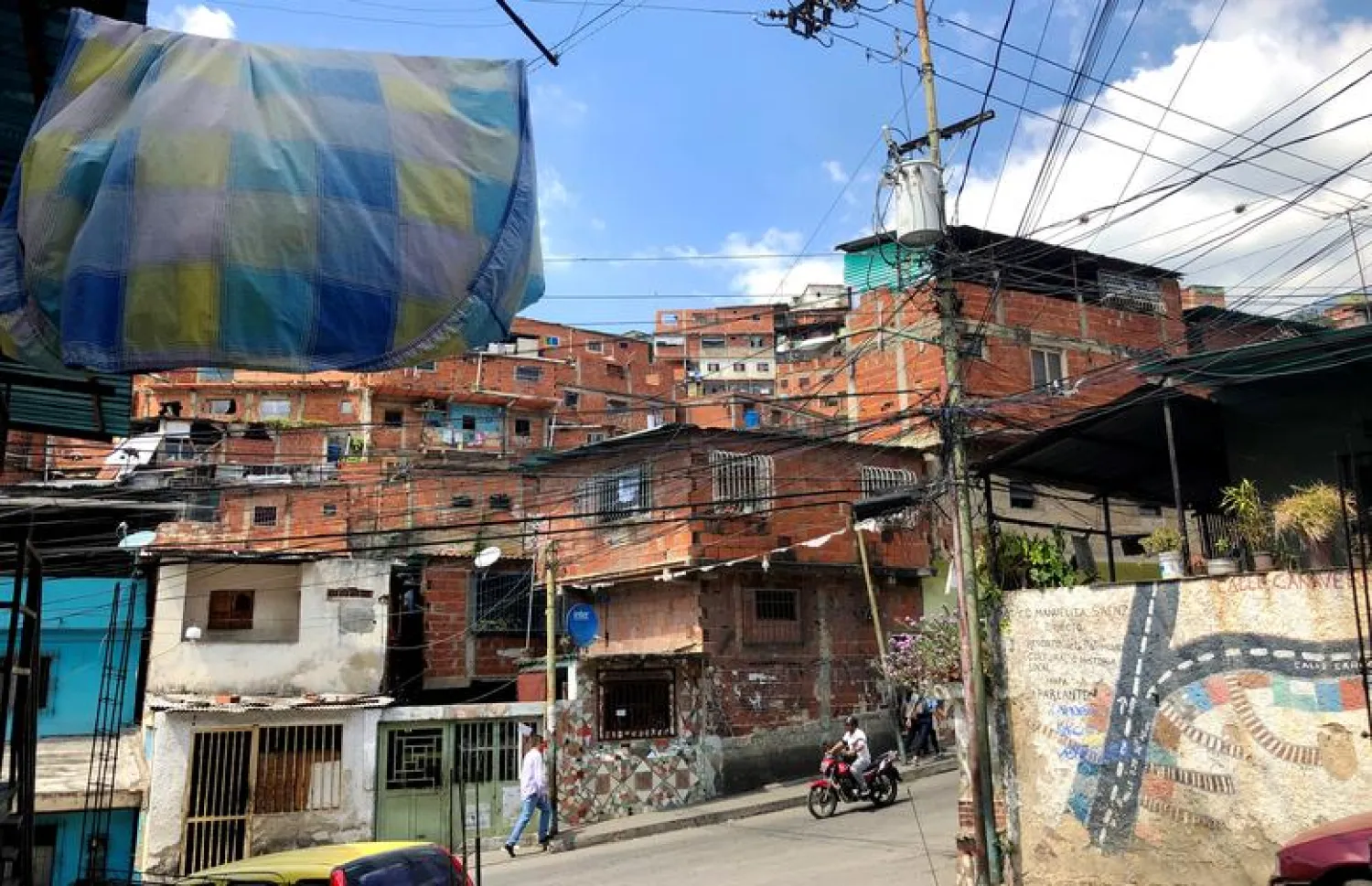
Venezuelans are steadily losing access to cheap basic services from water to cooking gas that have helped them survive economic crisis, forcing many to find creative solutions and adding pressure during the coronavirus quarantine.

Services have long been near-free due to heavy subsidies by the ruling Socialist Party, which has overseen a six-year economic collapse despite Venezuela's oil wealth.

But as the decay of state-run utilities has led to constant shortages, Venezuelans now have to pay the equivalent of several months' salary for a few days of water, gas or telephone because private alternatives are priced in dollars.

For those without the money, workaround solutions abound: from wood-burning stoves and long walks to find cellular coverage to improvised pipes for siphoning water off a mountain.

Others simply do without.

"Every week, we adjust to what happens," said Geraldine Escalante, a cook in a coastal area of Vargas state.

She went for a month-and-a-half without water until April, when she paid $20 for a cistern with 2,000 liters (529 gallons) which lasted a week. At other times, she and other residents link hoses between different communities to share water or carry bottles back-and-forth for several kilometers.

Access to running water is particularly crucial to curb the COVID-19 disease, which is running rampant around South America.

The generous oil-financed subsidies begun under late socialist leader Hugo Chavez have gradually disappeared under his successor President Nicolas Maduro. He has eliminated years of price and currency controls amid U.S. sanctions that have further weakened an already foundering economy.

The Information Ministry and state service companies did not reply to requests for comment.

'FELT LIKE CRYING'

Yusbel Castro, a community leader in Caracas' poor west end, was driving around the city trying to find subsidized gas to fill a 20 kg propane tank for less than $1 to fuel stoves at a communal soup kitchen she runs.

But during one recent search in June, she only found black market resellers charging $7, equivalent to more than two months of minimum wage salary.

Unable to afford it, Castro could not cook lunch for the 110 children who rely on the soup kitchen. It frequently serves beans or soups, which cook for longer than other foods and therefore require more gas.

"It would be $14 every six days, and I get paid in bolivars," she said. "I felt like crying."

Just 3 in 10 Venezuelans in May could obtain gas at regulated prices while only 1 in 10 received running water, according to data from the non-profit watchdog Venezuelan Observatory of Public Services (OVSP).

While water costs less than a dollar per month at subsidized rates, cisterns can cost $100.

Service interruptions now affect both wealthy neighborhoods and the slums. "The crisis in public services has put the poor and rich on equal footing" in that respect, said economist Luis Pedro Espana during a presentation of a demographic study last month that showed poverty reached 65% of households.

"That is the paradox of the Venezuelan state: it remains powerful in social control but is fading away as a provider of public goods and services," added Asdrubal Oliveros, head of the local Ecoanalitica consultancy, to Reuters.

'FINDING SOLUTIONS'

A group of Caracas residents in June built a system to use water accumulated at a stalled tunnel construction project near the El Avila mountain bordering Caracas.

They used 1,300 meters of hoses for the network and the residents contributed 10 dollars each to buy parts.

"We can't spend our whole lives complaining," said Wilfredo Moscoso, one of the project's leaders. "We are finding solutions."

In some places, Venezuelans have to walk for kilometers to find a cellular signal.

"The only one way I manage to get even a bit of coverage is when I get up on the roof of the house," said Jose Atacho, a pharmacy manager in the western city of Punto Fijo, who has lines with three different operators to improve the odds.

Working and studying from home during coronavirus quarantine while struggling with faulty connections has led families to rely on pricey mobile phone data services.

In some cases, residents pay up to $30 per month for additional services, compared with the notoriously faulty state-provided internet that costs $2 per month.

In the western city of Maracaibo, Argenis Linares paid for a satellite internet service and charges people several dollars per month for access. "Some neighbors asked me, especially the friends of my kids, to do their homework," he said. "Two are in a tough situation and they just pay what they can."



Energy Secretary: US to Stop Iran's Nuclear Ambitions 'One Way or the Other'

US Secretary of Energy Chris Wright speaks during a press conference after a meeting with Venezuela's acting president Delcy Rodriguez at the Miraflores Presidential Palace in Caracas on February 11, 2026. (Photo by Juan BARRETO / AFP)
TT

Energy Secretary: US to Stop Iran's Nuclear Ambitions 'One Way or the Other'

US Secretary of Energy Chris Wright speaks during a press conference after a meeting with Venezuela's acting president Delcy Rodriguez at the Miraflores Presidential Palace in Caracas on February 11, 2026. (Photo by Juan BARRETO / AFP)

The United States will deter Iran from acquiring nuclear weapons "one way or the other", US Energy Secretary Chris Wright warned on Wednesday.

"They've been very clear about what they would do with nuclear weapons. It's entirely unacceptable," Wright told reporters in Paris on the sidelines of meetings of the International Energy Agency.

"So one way or the other, we are going to end, deter Iran's march towards a nuclear weapon," Wright said.

US and Iranian officials held talks in Geneva on Tuesday aimed at averting the possibility of US military intervention to curb Tehran's nuclear program.

Iran said following the talks that they had agreed on "guiding principles" for a deal to avoid conflict.

US Vice President JD Vance, however, said Tehran had not yet acknowledged all of Washington's red lines.


Iran, Russia to Conduct Joint Drills in the Sea of Oman 

This handout photo released by Iran's Revolutionary Guards Corps (IRGC)'s official website Sepanews on February 17, 2026, shows boats maneuvering around a tanker vessel during a military exercise by members of the IRGC and navy in the Strait of Hormuz. (Sepahnews / AFP)
TT

Iran, Russia to Conduct Joint Drills in the Sea of Oman 

This handout photo released by Iran's Revolutionary Guards Corps (IRGC)'s official website Sepanews on February 17, 2026, shows boats maneuvering around a tanker vessel during a military exercise by members of the IRGC and navy in the Strait of Hormuz. (Sepahnews / AFP)

Iran and Russia will conduct naval maneuvers in the Sea of Oman on Thursday, following the latest round of talks between Tehran and Washington in Geneva, Iranian media reported.

On Monday, the Revolutionary Guards, the ideological arm of Iran's military, also launched exercises in the strategic Strait of Hormuz, a challenge to US naval forces deployed in the region.

"The joint naval exercise of Iran and Russia will take place tomorrow (Thursday) in the Sea of Oman and in the northern Indian Ocean," the ISNA agency reported, citing drill spokesman, Rear Admiral Hassan Maghsoudloo.

"The aim is to strengthen maritime security and to deepen relations between the navies of the two countries," he said, without specifying the duration of the drill.

The war games come as Iran struck an upbeat tone following the second round of Oman-mediated negotiations in Geneva on Tuesday.

Previous talks between the two foes collapsed following the unprecedented Israeli strike on Iran in June 2025, which sparked a 12-day war that the United States briefly joined.

US President Donald Trump has deployed a significant naval force in the region, which he has described as an "armada."

Iranian officials have repeatedly threatened to block the Strait of Hormuz, particularly during periods of tension with the United States, but it has never been closed.

A key passageway for global shipments of oil and liquefied natural gas, the Strait of Hormuz has been the scene of several incidents in the past and has returned to the spotlight as pressure has ratcheted amid the US-Iran talks.

Iran announced on Tuesday that it would partially close it for a few hours for "security" reasons during its own drills in the strait.


First European Flight Lands in Venezuela Since Maduro’s Ouster 

A man holds up a Venezuelan flag while taking part in a march calling for amnesty for political prisoners and to mark Youth Day, in Caracas, Venezuela, February 12, 2026. (Reuters)
TT

First European Flight Lands in Venezuela Since Maduro’s Ouster 

A man holds up a Venezuelan flag while taking part in a march calling for amnesty for political prisoners and to mark Youth Day, in Caracas, Venezuela, February 12, 2026. (Reuters)

A plane from Spain's Air Europa landed in Venezuela Tuesday, according to a flight tracking monitor, the first European commercial flight to arrive in the country since the United States toppled president Nicolas Maduro.

A slew of international carriers stopped flying to Venezuela after the United States warned of possible military activity there in late November -- a prelude to its surprise attack on January 3.

The Boeing 787-9 Dreamliner landed at Simon Bolivar International Airport, which serves the Venezuelan capital Caracas, at 9:00 pm (0100 GMT).

Since US forces raided Venezuela and captured Maduro, US President Donald Trump has struck a cooperative relationship with interim president Delcy Rodriguez.

Late last month he called for flights to resume to the country.

Spanish airline Iberia is evaluating security guarantees before announcing a return, according to the Spanish press.

Portugal's TAP has said it will resume flights. Colombian airline Avianca and Panama's Copa have already restarted operations.

Hoping to prompt US flights, the Trump administration has lifted a 2019 ban on US airlines flying to the country.