


UN Chief: Pandemic Threatens Peace and Risks New Conflicts

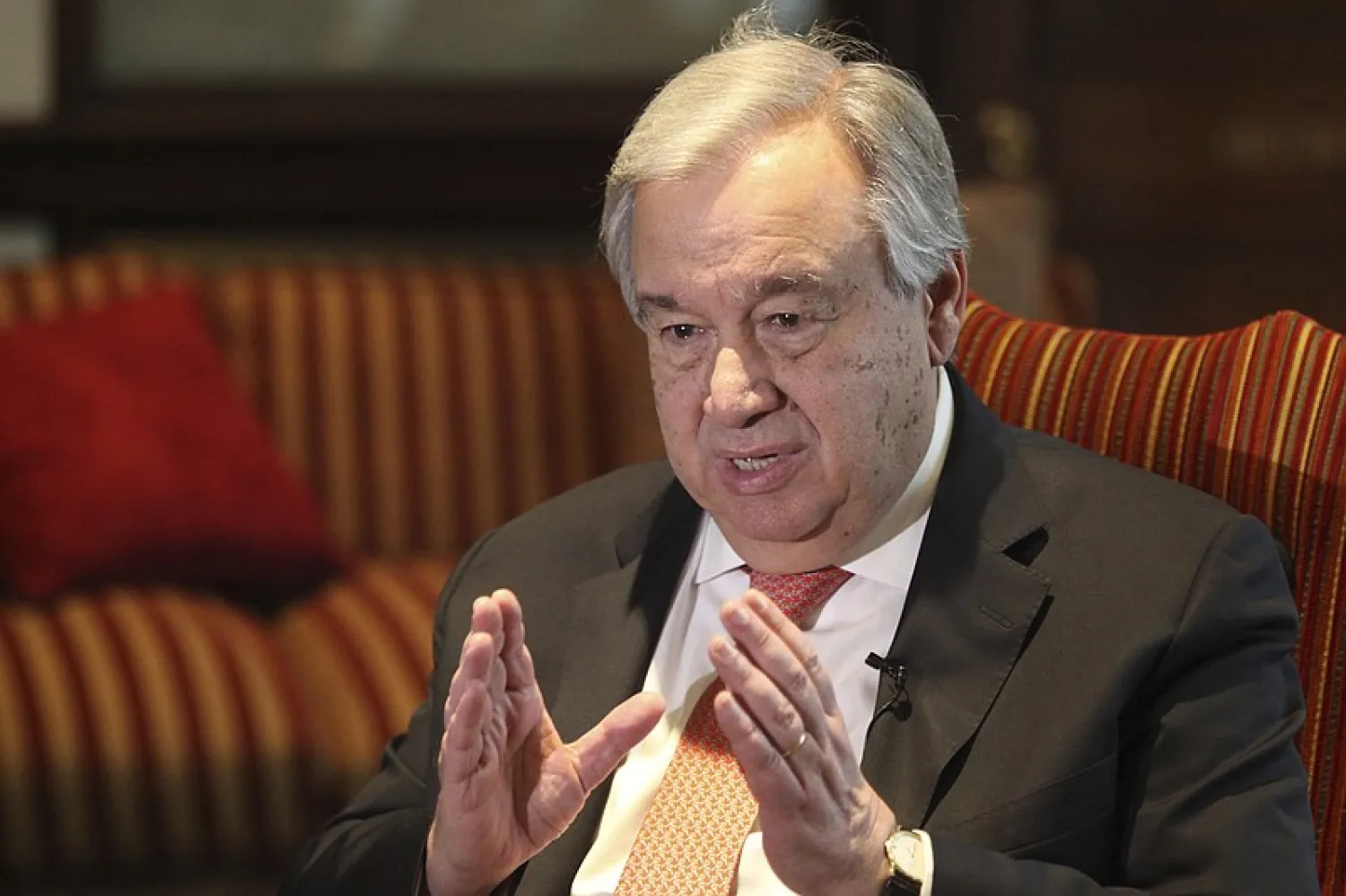
 In this Feb. 18, 2020, file photo, UN Secretary-General Antonio Guterres speaks during an interview with The Associated Press in Lahore, Pakistan. (AP Photo/K.M. Chaudhry, File)
In this Feb. 18, 2020, file photo, UN Secretary-General Antonio Guterres speaks during an interview with The Associated Press in Lahore, Pakistan. (AP Photo/K.M. Chaudhry, File)
TT

UN Chief: Pandemic Threatens Peace and Risks New Conflicts

 In this Feb. 18, 2020, file photo, UN Secretary-General Antonio Guterres speaks during an interview with The Associated Press in Lahore, Pakistan. (AP Photo/K.M. Chaudhry, File)
In this Feb. 18, 2020, file photo, UN Secretary-General Antonio Guterres speaks during an interview with The Associated Press in Lahore, Pakistan. (AP Photo/K.M. Chaudhry, File)

UN Secretary-General Antonio Guterres warned Wednesday that the COVID-19 pandemic not only threatens gains in fighting global poverty and building peace but risks exacerbating existing conflicts and generating new ones.

The UN chief told a Security Council meeting on the challenge of sustaining peace during the pandemic that his March 23 call for an immediate cease-fire in conflicts around the world to tackle the coronavirus led a number of warring parties to take steps to de-escalate and stop fighting.

"Yet, regrettably, in many instances, the pandemic did not move the parties to suspend hostilities or agree to a permanent ceasefire," Guterres said.

His predecessor as secretary-general, Ban Ki-moon, told the council: "It is truly astonishing that in response to this pandemic, the world has placed billions of people under lock-down, closed international borders, suspended trade and migration, and temporarily shut down a whole variety of industries - but has not managed to suspend armed conflicts."

Ban criticized the UN Security Council for wasting valuable months "in arguments over the details of the text" and not adopting a resolution until July 1 demanding an "immediate cessation of hostilities" in key conflicts including Syria, Yemen, Libya, South Sudan, and Congo to tackle COVID-19.

"This has weakened the message that this council needs to send to all warring parties: now is the time to confront our common enemy," Ban said.

And he said delayed council action "further aggravated the current volatile global security situations."

"The impact of COVID-19 on conflict-affected settings has been much worse than initially thought," said Ban, who is a co-chair of the group of prominent world leaders founded by Nelson Mandela known as The Elders.

He pointed to health and humanitarian ramifications, social cohesion, governance, the rule of law and threats to multilateralism which are jeopardizing ongoing efforts to sustain peace, "or may even cause a reversal in hard-won peace and security gains to date."

While governments try to confront the pandemic, some groups have seen an opportunity to ramp up violence, Ban said, citing as examples Boko Haram and other militants in Nigeria, growing mob violence in Congo and murders by drug cartels in Mexico.

He also warned that the economic impacts of the pandemic "will be both long-lasting and severe, with ripple effects for many fragile and conflict-affected states."

As examples, Ban said Lebanon´s political and economic crisis, exacerbated by last week´s deadly explosion at Beirut´s port, is being compounded by COVID-19´s impact on two key money-earners, tourism and trade, while Iraq´s budget is being stretched thin because of the collapse in oil prices.

Secretary-General Guterres said the pandemic has raised growing questions about the effectiveness of health systems, social services, trust in institutions and systems of governance.

"All of this means that our commitment to sustaining peace is more urgent than ever," he said.

Guterres pointed to three key dangers: erosion of public trust, destabilization of the global economic order, and weakening of "the social fabric."

"The perception that authorities are mishandling the crisis, or not being transparent or favoring political allies can lead to public disillusion in government and its institutions," he said.

The UN chief also warned that "without concerted action, inequalities, global poverty, and the potential for instability and violence could grow for years."

While there have been many peaceful protests, Guterres said, "in a number of countries, COVID-19 has been an excuse for harsh crackdowns and a spike in state repression."

Guterres stressed the importance of leadership.

"The world is looking to all leaders - including the council -- to address this epic crisis in ways that make a concrete, meaningful, and positive contribution to the lives of people," he said.

Guterres called for all sectors of society to engage in building peace and preventing and ending conflicts.



Fire Breaks out Near Iran's Capital Tehran, State Media Says

Smoke rises from a fire caused by an explosion in Tehran (File photo - Reuters)
TT

Fire Breaks out Near Iran's Capital Tehran, State Media Says

Smoke rises from a fire caused by an explosion in Tehran (File photo - Reuters)

A fire broke out in Iran's Parand near the capital city Tehran, state media reported on Wednesday, publishing videos of smoke rising over the area which is close to several military and strategic sites in the country's Tehran province, Reuters reported.

"The black smoke seen near the city of Parand is the result of a fire in the reeds around the Parand river bank... fire fighters are on site and the fire extinguishing operation is underway", state media cited the Parand fire department as saying.


Pakistan PM Sharif to Seek Clarity on Troops for Gaza in US Visit

US President Donald Trump looks at Pakistan's Prime Minister Shehbaz Sharif speaking following the official signing of the first phase of the Gaza ceasefire agreement between Israel and Hamas, during a world leaders' summit on ending the Gaza war, in Sharm El-Sheikh, Egypt, October 13, 2025. REUTERS/Evelyn Hockstein/File Photo
TT

Pakistan PM Sharif to Seek Clarity on Troops for Gaza in US Visit

US President Donald Trump looks at Pakistan's Prime Minister Shehbaz Sharif speaking following the official signing of the first phase of the Gaza ceasefire agreement between Israel and Hamas, during a world leaders' summit on ending the Gaza war, in Sharm El-Sheikh, Egypt, October 13, 2025. REUTERS/Evelyn Hockstein/File Photo

Before Pakistan commits to sending troops to Gaza as part of the International Stabilization Force it wants assurances from the United States that it will be a peacekeeping mission rather than tasked with disarming Hamas, three sources told Reuters.

Pakistan's Prime Minister Shehbaz Sharif is set to attend the first formal meeting of President Donald Trump's Board of Peace in Washington on Thursday, alongside delegations from at least 20 countries.

Trump, who will chair the meeting, is expected to announce a multi-billion dollar reconstruction plan for Gaza and detail plans for a UN-authorized stabilization force for the Palestinian enclave.

Three government sources said during the Washington visit Sharif wanted to better understand the goal of the ISF, what authority they were operating under and what the chain of command was before making a decision on deploying troops.

"We are ready to send troops. Let me make it clear that our troops could only be part of a peace mission in Gaza," said one of the sources, a close aide of Sharif.

"We will not be part of any other role, such as disarming Hamas. It is out of the question," he said.

Analysts say Pakistan would be an asset to the multinational force, with its experienced military that has gone to war with arch-rival India and tackled insurgencies.

"We can send initially a couple of thousand troops anytime, but we need to know what role they are going to play," the source added.

Two of the sources said it was likely Sharif, who has met Trump earlier this year in Davos and late last year at the White House, would either have an audience with him on the sidelines of the meeting or the following day at the White House.

Initially designed to cement Gaza's ceasefire, Trump sees the Board of Peace, launched in late January, taking a wider role in resolving global conflicts. Some countries have reacted cautiously, fearing it could become a rival to the United Nations.

While Pakistan has supported the establishment of the board, it has voiced concerns against the mission to demilitarize Gaza's militant group Hamas.


Türkiye Pleased with Alignment Steps by Syria, Kurdish Forces, Erdogan Says

Turkish President Tayyip Erdogan delivers a speech during the opening ceremony of male and female dormitories at Bogazici University, in Istanbul, Türkiye, February 13, 2026. REUTERS/Umit Bektas
TT

Türkiye Pleased with Alignment Steps by Syria, Kurdish Forces, Erdogan Says

Turkish President Tayyip Erdogan delivers a speech during the opening ceremony of male and female dormitories at Bogazici University, in Istanbul, Türkiye, February 13, 2026. REUTERS/Umit Bektas

Turkish President Tayyip Erdogan said he is pleased to see steps taken in neighbouring Syria to integrate the Kurdish-led Syrian Democratic Forces (SDF) into state structures, after a US-backed ceasefire deal late last month between the sides.

In a readout on Wednesday of his comments to reporters on a return flight from Ethiopia, Erdogan was cited as saying Ankara is closely monitoring the Syrian integration steps and providing guidance on implementing the agreement.

Meanwhile, a Turkish parliamentary commission voted overwhelmingly on Wednesday to approve a report envisaging legal reforms alongside the militant Kurdistan Workers Party's (PKK) disarmament, advancing a peace process meant to end decades of conflict.

The PKK - designated a terrorist organization by Türkiye, the United States and European Union - halted attacks last year and said it would disarm and disband, calling on Ankara to take steps to let its members participate in politics.

The roughly 60-page report proposes a roadmap for the parliament to enact laws, including a conditional legal framework that urges the judiciary to review legislation and comply with European Court of Human Rights and Constitutional Court rulings.

The pro-Kurdish DEM Party, which has been closely involved in the process and held several meetings with PKK leader Abdullah Ocalan in prison, objected to the report's presentation of the Kurdish issue as a terrorism problem but generally welcomed the report and called for rapid implementation.

“We believe legal regulations must be enacted quickly,” senior DEM lawmaker Gulistan Kilic Kocyigit told Reuters. Parts of the report offered “a very important roadmap for the advancement of this process," she said.

Erdogan signaled that the legislative process would begin straight away. “Now, discussions will begin in our parliament regarding the legal aspects of the process,” he said.