


Families of Lebanese Blast Victims Plead for Outside Inquiry

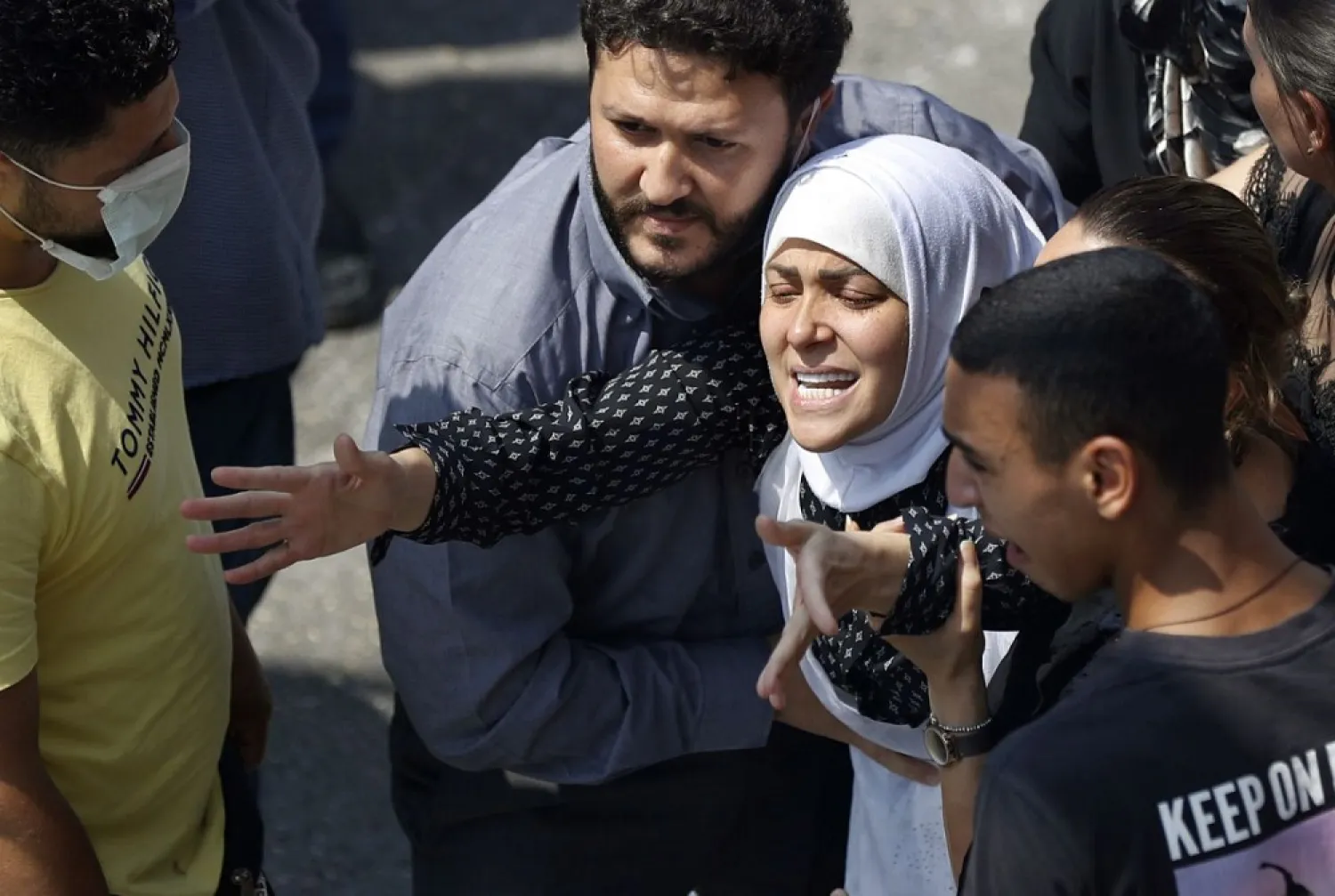
The wife of Rami Kaaki, one of ten firefighters who were killed in the blast, tries to reach her husband's coffin during his funeral, at the firefighter headquarters in Beirut, Lebanon, Aug. 11, 2020. (AP)
TT

Families of Lebanese Blast Victims Plead for Outside Inquiry

The wife of Rami Kaaki, one of ten firefighters who were killed in the blast, tries to reach her husband's coffin during his funeral, at the firefighter headquarters in Beirut, Lebanon, Aug. 11, 2020. (AP)

Lebanon’s judicial investigation of the Beirut port explosion started with political wrangling over the naming of a lead investigator, military threats to jail leakers and doubts over whether a panel appointed along sectarian lines could be fully impartial.

So for many Lebanese, their greatest hope for credible answers about the blast that wrecked much of their capital may lie with outsiders. Families of the dead and survivors on Friday asked the UN Security Council for an international investigation. Others pin their hopes on the French forensic police who have joined the probe and FBI investigators are expected to take part.

“We are not lawyers or politicians, we are families and people, our appeal today is to the people of the international community," said Paul Najjar, a survivor of the explosion. “Is it acceptable today that people would find their homes shattered, their families killed, their hopes and their dreams killed as well, with no justice, in all impunity?”

French teams have pressed ahead at their work, sending divers into the underwater crater, taking explosives samples and preparing recommendations for both French and Lebanese magistrates. Among the French judicial police on the case are men and women who responded after the 2004 tsunami in Japan, the 2010 earthquake in Haiti, and the November 2015 and Bastille Day 2016 terror attacks in France.

The Beirut explosion lies at the crossroads of a disastrous accident and a crime scene. It still was not known what sparked the fire that ignited nearly 3,000 tons of ammonium nitrate that were stored for years in Beirut’s port next to densely populated residential areas. Documents have emerged that show the country’s top leadership and security officials were aware of the stockpile.

Search and rescue crews flew in from around the world in the immediate aftermath and found themselves looking at a scene that was both familiar and yet strangely alien.

“In an earthquake, it’s easier because we can understand ... how it moves. But in this case, we didn’t have enough elements to understand what happened,” said Alberto Boanini, a member of the Italian rescue team. The team has seen its share of quakes and forest fires, but nothing quite like the port in Beirut, where he said it was hard to fathom what could level it so completely.

Many Lebanese want the probe taken out of the hands of their own government, having learned from past experience that the long-entrenched political factions, notorious for corruption, won’t allow any results damaging to their leadership to come to light. The explosion killed more than 175 people, injured at least 6,000 and left tens of thousands homeless.

Paris sent judicial police because a French architect was among the dead, and French law gives jurisdiction for an investigation if a citizen dies abroad under questionable circumstances.

But the French investigators work only at the invitation of the Lebanese, and their orders are confidential.

French officials say they have the access they need but will not say whether their inquiry extends to questioning witnesses or requesting documents. They hand over their findings to the Lebanese, but keep a mirror copy for a French inquiry. The FBI is also joining at Lebanese authorities’ invitation.

Top Lebanese officials, including President Michel Aoun, have rejected calls for an independent probe, describing it as “a waste of time” and suggesting it would be politicized. Nonetheless, Nada Abdelsater-Abusamra, a lawyer representing victims, said a letter was submitted to the UN Security Council asking for an international investigation.

In its last decision before resigning under pressure, six days after the explosion, Prime Minister Hassan Diab’s government referred the port explosion case to the Higher Judicial Council, Lebanon’s highest justice authority, to carry out the investigation.

An argument then ensued with the outgoing justice minister over the investigation’s lead judge. After public wrangling, they compromised on Judge Fadi Sawwan, a former military investigating judge.

The Council itself is made up of 10 people, eight of whom are appointed according to the interests of the various political factions and religious sects in line with Lebanon’s sectarian power-sharing system.

The authorities have so far arrested at least 19 people, including the head of the Customs Department and his predecessor, as well as the head of the port.

Lebanese say they want to see investigations into top officials who knew about the ammonium nitrate.

“They will blame the small guys while the ones who are really responsible will get away with their crime, that’s what will happen,” said Jad, a 38-year-old computer engineer who declined to give his full name in line with his company’s regulations not to discuss politics.

“If this time there is no credible, serious investigation that will lead to the punishment of everyone responsible for this disaster, it is goodbye Lebanon. No one will ever want to live in this country again,” he said, standing on a bridge overlooking the decimated port.

Lebanese forensics expert Omar Nachabe said the public infighting about the name of the lead investigator is a bad sign that casts doubt on the credibility of any local investigation.

“If I am a Lebanese citizen, my capital (city) has been destroyed. I want a quick and serious investigation, yet the government has not shown until now that it is up to the task,” he told the local channel LBCI.

Explosions have marked a grim timeline in Lebanon’s modern history and have killed presidents, prime ministers and countless journalists and activists during the country’s 1975-90 civil war and beyond.

Almost none of the perpetrators were ever arrested or tried, and the truth was invariably buried. Lebanese had high hopes that the UN-backed tribunal investigating the 2005 killing of Prime Minister Rafik Hariri would be a chance to end impunity in Lebanon. But it took 15 years and was marred by doubts, politics and more deaths. The tribunal is to issue verdicts Tuesday.

International involvement in the investigation might bring some truth, but bringing justice is more complicated. Dov Jacobs, an international legal scholar based in the Netherlands, said the shooting down of Malaysia Airlines Flight 17 over eastern Ukraine six years ago might be the closest analogy.

In that case, international experts had full access to the site, and international prosecutors charged three Russians and a Ukrainian with involvement in bringing down the plane and the murder of all on board. The men are on trial in a Dutch court in absentia, since none have been extradited.

But in Lebanon, Jacobs said, “the investigation itself is a tool of political influence. It’s one of those frustrating moments where immediate calls for justice are faced with a wall which is the political reality on the ground.”



Israel Military Says Soldier Killed in Gaza 

A drone view shows the destruction in a residential neighborhood, after the withdrawal of the Israeli forces from the area, amid a ceasefire between Israel and Hamas in Gaza, in Gaza City, October 21, 2025. (Reuters)
TT

Israel Military Says Soldier Killed in Gaza 

A drone view shows the destruction in a residential neighborhood, after the withdrawal of the Israeli forces from the area, amid a ceasefire between Israel and Hamas in Gaza, in Gaza City, October 21, 2025. (Reuters)

The Israeli military announced that one of its soldiers had been killed in combat in southern Gaza on Wednesday, but a security source said the death appeared to have been caused by "friendly fire".

"Staff Sergeant Ofri Yafe, aged 21, from HaYogev, a soldier in the Paratroopers Reconnaissance Unit, fell during combat in the southern Gaza Strip," the military said in a statement.

A security source, however, told AFP that the soldier appeared to have been "killed by friendly fire", without providing further details.

"The incident is still under investigation," the source added.

The death brings to five the number of Israeli soldiers killed in Gaza since a ceasefire took effect on October 10.


Syria: SDF’s Mazloum Abdi Says Implementation of Integration Deal May Take Time

People sit outdoors surrounded by nature, with the Tigris river flowing in the background, following a long atmospheric depression, near the Syrian-Turkish border in Derik, Syria, February 16, 2026 REUTERS/Orhan Qereman
TT

Syria: SDF’s Mazloum Abdi Says Implementation of Integration Deal May Take Time

People sit outdoors surrounded by nature, with the Tigris river flowing in the background, following a long atmospheric depression, near the Syrian-Turkish border in Derik, Syria, February 16, 2026 REUTERS/Orhan Qereman

Mazloum Abdi, commander of the Syrian Democratic Forces, said the process of merging the SDF with Syrian government forces “may take some time,” despite expressing confidence in the eventual success of the agreement.

His remarks came after earlier comments in which he acknowledged differences with Damascus over the concept of “decentralization.”

Speaking at a tribal conference in the northeastern city of Hasakah on Tuesday, Abdi said the issue of integration would not be resolved quickly, but stressed that the agreement remains on track.

He said the deal reached last month stipulates that three Syrian army brigades will be created out of the SDF.

Abdi added that all SDF military units have withdrawn to their barracks in an effort to preserve stability and continue implementing the announced integration agreement with the Syrian state.

He also emphasized the need for armed forces to withdraw from the vicinity of the city of Ayn al-Arab (Kobani), to be replaced by security forces tasked with maintaining order.


Israeli Far-Right Minister to Push for ‘Migration’ of West Bank, Gaza Palestinians 

A Palestinian man checks leather belts as people prepare for Ramadan, in the old city of Hebron in the Israeli-occupied West Bank, February 17,2026. (Reuters)
TT

Israeli Far-Right Minister to Push for ‘Migration’ of West Bank, Gaza Palestinians 

A Palestinian man checks leather belts as people prepare for Ramadan, in the old city of Hebron in the Israeli-occupied West Bank, February 17,2026. (Reuters)

Israel's far-right Finance Minister Bezalel Smotrich said he would pursue a policy of "encouraging the migration" of Palestinians from the occupied West Bank and Gaza Strip, Israeli media reported Wednesday.

"We will eliminate the idea of an Arab terror state," said Smotrich, speaking at an event organized by his Religious Zionism Party late on Tuesday.

"We will finally, formally, and in practical terms nullify the cursed Oslo Accords and embark on a path toward sovereignty, while encouraging emigration from both Gaza and Judea and Samaria.

"There is no other long-term solution," added Smotrich, who himself lives in a settlement in the West Bank.

Since last week, Israel has approved a series of measures backed by far-right ministers to tighten control over the West Bank, including in areas administered by the Palestinian Authority under the Oslo Accords, in place since the 1990s.

The measures include a process to register land in the West Bank as "state property" and facilitate direct purchases of land by Jewish Israelis.

The measures have triggered widespread international outrage.

On Tuesday, the UN missions of 85 countries condemned the measures, which critics say amount to de facto annexation of the Palestinian territory.

"We strongly condemn unilateral Israeli decisions and measures aimed at expanding Israel's unlawful presence in the West Bank," they said in a statement.

"Such decisions are contrary to Israel's obligations under international law and must be immediately reversed.

"We underline in this regard our strong opposition to any form of annexation."

UN Secretary-General Antonio Guterres on Monday called on Israel to reverse its land registration policy, calling it "destabilizing" and "unlawful".

The West Bank would form the largest part of any future Palestinian state. Many on Israel's religious right view it as Israeli land.

Israeli NGOs have also raised the alarm over a settlement plan signed by the government which they say would mark the first expansion of Jerusalem's borders into the occupied West Bank since 1967.

The planned development, announced by Israel's Ministry of Construction and Housing, is formally a westward expansion of the Geva Binyamin, or Adam, settlement situated northeast of Jerusalem in the West Bank.

The current Israeli government has fast-tracked settlement expansion, approving a record 52 settlements in 2025.

Excluding Israeli-annexed east Jerusalem, more than 500,000 Israelis live in West Bank settlements and outposts, which are illegal under international law.