

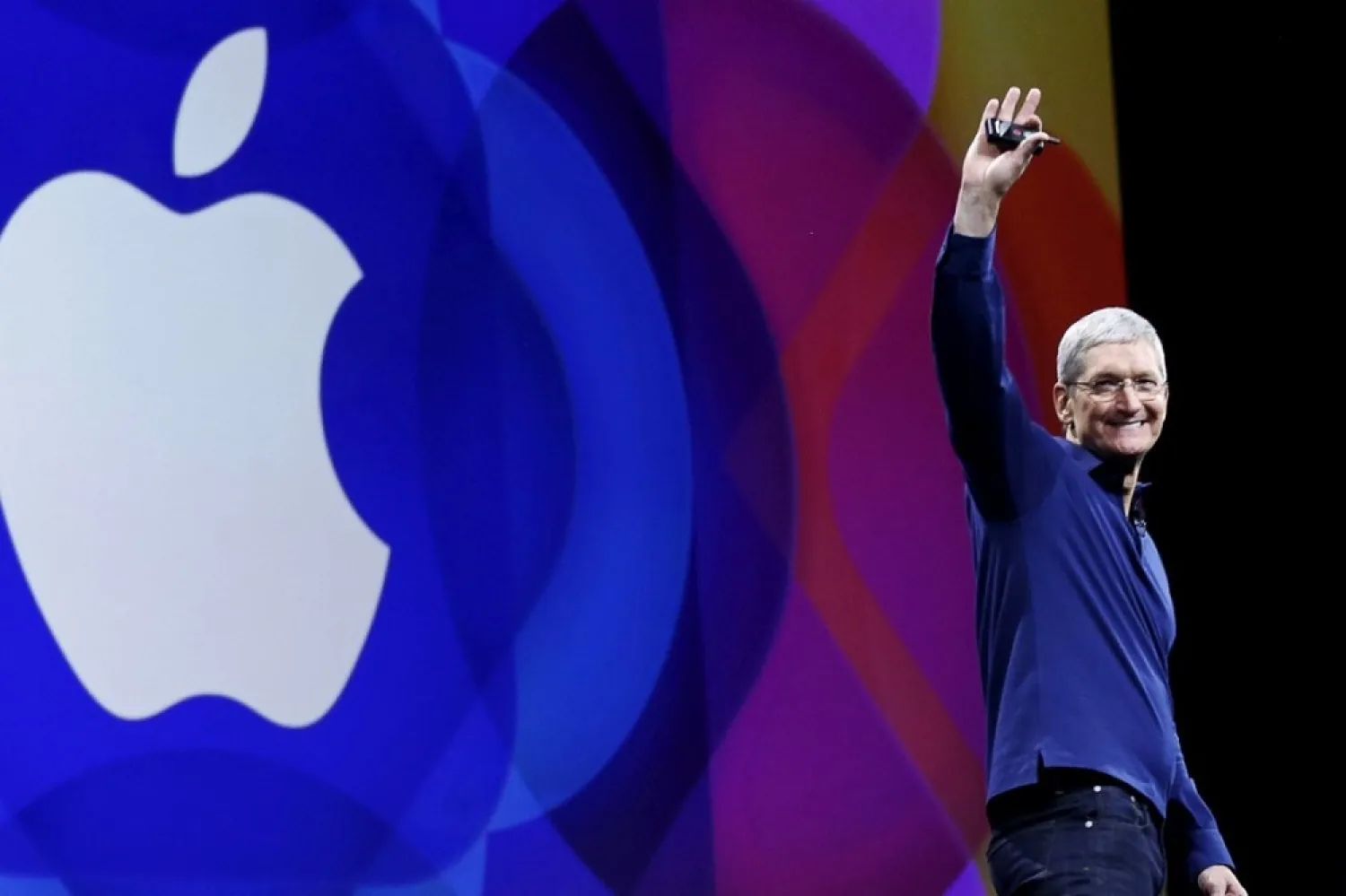

Apple CEO Tim Cook is Fulfilling Another Steve Jobs Vision

Apple CEO Tim Cook. (Reuters)
TT

Apple CEO Tim Cook is Fulfilling Another Steve Jobs Vision

Apple CEO Tim Cook. (Reuters)

Apple co-founder Steve Jobs, who died in 2011, was a tough act to follow. But Tim Cook seems to be doing so well at it that his eventual successor may also have big shoes to fill.

Initially seen as a mere caretaker for the iconic franchise that Jobs built before his 2011 death, Cook has forged his own distinctive legacy. He will mark his ninth anniversary as Apple’s CEO Monday -- the same day the company will split its stock for the second time during his reign.

Grooming Cook as heir apparent was “one of Steve Jobs’ greatest accomplishments that is vastly underappreciated,” said long-time Apple analyst Gene Munster, who is now managing partner of Loup Ventures.

The upcoming four-for-one stock split, a move that has no effect on share price but often spurs investor enthusiasm, is one measure of Apple's success under Cook. The company was worth just under $400 billion when Cook the helm; it's worth five times more than that today, and has just become the first US company to boast a market value of $2 trillion. Its share performance has easily eclipsed the benchmark S&P 500, which has roughly tripled in value during the past nine years.

But it hasn't always been easy. Among the challenges Cook has faced: a slowdown in iPhone sales as smartphones matured, a showdown with the FBI over user privacy, a US trade war with China that threatened to force up iPhone prices and now a pandemic that has closed many of Apple's retail stores and sunk the economy into a deep recession.

Cook, 59, has also struck out in into novel territory. Apple now pays a quarterly dividend, a step Jobs resisted partly because he associated shareholder payments with stodgy companies that were past their prime. Cook also used his powerful perch to become an outspoken advocate for civil rights and renewable energy, and on a personal level came out as the first openly gay CEO of a Fortune 500 company in 2014.

Apple declined to make Cook available for an interview. But it did point to 2009 comments Cook made to financial analysts when he was running the company while Jobs battled pancreatic cancer.

Asked what the company might look like under his management, Cook said that Apple needs “to own and control the primary technologies behind the products we make." It has doubled down on that commitment, becoming a major chip producer in order to supply both iPhones and Macs. He added that Apple would resist exploring most projects “so that we can really focus on the few that are truly important and meaningful to us."

That laser focus has served Apple well. At the same time, though, under Cook's stewardship, Apple has largely failed to come up with breakthrough successors to the iPhone. Its smartwatch and wireless ear buds have emerged as market leaders, but not game-changers.

Cook and other executives have dropped hints that Apple wants make a big splash in the field of augmented reality, which uses phone screens or high-tech eyewear to paint digital images into the real world. Apple has yet to deliver, although neither have other companies that have hyped the technology.

Apple also remains a laggard in artificial intelligence, particularly in the increasingly important market for voice-activated digital assistants. Although Apple's Siri is widely used on Apple devices, Amazon's Alexa and Google’s digital assistant have made major inroads in helping people manage their lives, particularly in homes and offices.

Apple also has stumbled a few times under Cook's leadership.

In 2017, it alienated customers by deliberately but quietly slowing the performance of older iPhones via a software update, ostensibly to spare the life of aging batteries. Many consumers, though, viewed it as a ploy to boost sales of newer and more expensive iPhones. Amid the furor, Apple offered to replace aging batteries at a steep discount; later it paid $500 million to settle a class-action lawsuit over the matter.

Apple has also faced government investigations into its aggressive efforts to minimize its corporate taxes and complaints that it has abused control of its app store to charge excessive fees and stifle competition to its own digital services. On the tax front, a court ruled in July that Apple did nothing wrong.

Cook has turned the app store into the cornerstone of a services division that he set out to expand four years ago. At the time, it was growing clear that sales of the iPhone -- Apple’s biggest money maker -- were destined to slow down as innovations grew sparse and consumers kept their old devices for longer.

To help offset that trend, Cook began to emphasize recurring revenue from app commission, warranty programs and streaming subscriptions to music, video, games and news sold for the more 1.5 billion devices already running on the company’s software.

Apple’s services division now generates $50 billion in annual revenue, more than all but 65 companies in the Fortune 500. Ives estimates Apple’s services division by itself is worth about $750 billion -- about the same as Facebook currently is in its entirety.

That division could be worth even more now had Cook done something many analysts believe Apple should have done at least five years ago by dipping into a hoard of cash that at one point surpassed $260 billion to buy Netflix or a major movie studio to fuel its video streaming ambitions.

Buying Netflix seemed like within the realm of possibility five years ago when the video streaming service was valued at around $40 billion. Now that Netflix is worth more than $200 billion today, that idea seems off the table, even for a company with Apple's vast resources.



Google Says to Build New Subsea Cables from India in AI Push

A logo of Google is on display at Bharat Mandapam, one of the venues for AI Impact Summit, in New Delhi, India, February 17, 2026. REUTERS/Bhawika Chhabra
TT

Google Says to Build New Subsea Cables from India in AI Push

A logo of Google is on display at Bharat Mandapam, one of the venues for AI Impact Summit, in New Delhi, India, February 17, 2026. REUTERS/Bhawika Chhabra

Google announced Wednesday it would build new subsea cables from India and other locations as part of its existing $15 billion investment in the South Asian nation, which is hosting a major artificial intelligence summit this week.

The US tech giant said it would build "three subsea paths connecting India to Singapore, South Africa, and Australia; and four strategic fiber-optic routes that bolster network resilience and capacity between the United States, India, and multiple locations across the Southern Hemisphere".


Mark Zuckerberg Set to Testify in Watershed Social Media Trial 

Meta's CEO Mark Zuckerberg testifies during the Senate Judiciary Committee hearing on online child sexual exploitation at the US Capitol in Washington, US, January 31, 2024. (Reuters)
TT

Mark Zuckerberg Set to Testify in Watershed Social Media Trial 

Meta's CEO Mark Zuckerberg testifies during the Senate Judiciary Committee hearing on online child sexual exploitation at the US Capitol in Washington, US, January 31, 2024. (Reuters)

Mark Zuckerberg will testify in an unprecedented social media trial that questions whether Meta's platforms deliberately addict and harm children.

Meta's CEO is expected to answer tough questions on Wednesday from attorneys representing a now 20-year-old woman identified by the initials KGM, who claims her early use of social media addicted her to the technology and exacerbated depression and suicidal thoughts. Meta Platforms and Google’s YouTube are the two remaining defendants in the case, which TikTok and Snap have settled.

Zuckerberg has testified in other trials and answered questions from Congress about youth safety on Meta's platforms, and he apologized to families at that hearing whose lives had been upended by tragedies they believed were because of social media.

This trial, though, marks the first time Zuckerberg will answer similar questions in front of a jury. and, again, bereaved parents are expected to be in the limited courtroom seats available to the public.

The case, along with two others, has been selected as a bellwether trial, meaning its outcome could impact how thousands of similar lawsuits against social media companies would play out.

A Meta spokesperson said the company strongly disagrees with the allegations in the lawsuit and said they are “confident the evidence will show our longstanding commitment to supporting young people.”

One of Meta's attorneys, Paul Schmidt, said in his opening statement that the company is not disputing that KGM experienced mental health struggles, but rather that Instagram played a substantial factor in those struggles.

He pointed to medical records that showed a turbulent home life, and both he and an attorney representing YouTube argue she turned to their platforms as a coping mechanism or a means of escaping her mental health struggles.

Zuckerberg's testimony comes a week after that of Adam Mosseri, the head of Meta's Instagram, who said in the courtroom that he disagrees with the idea that people can be clinically addicted to social media platforms.

Mosseri maintained that Instagram works hard to protect young people using the service, and said it's “not good for the company, over the long run, to make decisions that profit for us but are poor for people’s well-being."

Much of Mosseri's questioning from the plaintiff's lawyer, Mark Lanier, centered on cosmetic filters on Instagram that changed people’s appearance — a topic that Lanier is sure to revisit with Zuckerberg.

He is also expected to face questions about Instagram’s algorithm, the infinite nature of Meta’ feeds and other features the plaintiffs argue are designed to get users hooked.


US Tech Giant Nvidia Announces India Deals at AI Summit

FILED - 04 February 2026, Bavaria, Munich: The NVIDIA logo is seen during a press conference at the opening of Telekom and NVIDIA's AI factory "Industrial AI Cloud". Photo: Sven Hoppe/dpa
TT

US Tech Giant Nvidia Announces India Deals at AI Summit

FILED - 04 February 2026, Bavaria, Munich: The NVIDIA logo is seen during a press conference at the opening of Telekom and NVIDIA's AI factory "Industrial AI Cloud". Photo: Sven Hoppe/dpa

US artificial intelligence chip titan Nvidia unveiled tie-ups with Indian computing firms on Wednesday as tech companies rushed to announce deals and investments at a global AI conference in New Delhi.

This week's AI Impact Summit is the fourth annual gathering to discuss how to govern the fast-evolving technology -- and also an opportunity to "define India's leadership in the AI decade ahead", organizers say.

Mumbai cloud and data center provider L&T said it was teaming up with Nvidia, the world's most valuable company, to build what it touted as "India's largest gigawatt-scale AI factory".

"We are laying the foundation for world-class AI infrastructure that will power India's growth," said Nvidia boss Jensen Huang in a statement that did not put a figure on the investment.

L&T said it would use Nvidia's powerful processors, which can train and run generative AI tech, to provide data center capacity of up to 30 megawatts in Chennai and 40 megawatts in Mumbai.

Nvidia said it was also working with other Indian AI infrastructure players such as Yotta, which will deploy more than 20,000 top-end Nvidia Blackwell processors as part of a $2 billion investment.

Dozens of world leaders and ministerial delegations have come to India for the summit to discuss the opportunities and threats, from job losses to misinformation, that AI poses.

Last year India leapt to third place -- overtaking South Korea and Japan -- in an annual global ranking of AI competitiveness calculated by Stanford University researchers.

But despite plans for large-scale infrastructure and grand ambitions for innovation, experts say the country has a long way to go before it can rival the United States and China.

The conference has also brought a flurry of deals, with IT minister Ashwini Vaishnaw saying Tuesday that India expects more than $200 billion in investments over the next two years, including roughly $90 billion already committed.

Separately, India's Adani Group said Tuesday it plans to invest $100 billion by 2035 to develop "hyperscale AI-ready data centers", a boost to New Delhi's push to become a global AI hub.

Microsoft said it was investing $50 billion this decade to boost AI adoption in developing countries, while US artificial intelligence startup Anthropic and Indian IT giant Infosys said they would work together to build AI agents for the telecoms industry.

Nvidia's Huang is not attending the AI summit but other top US tech figures joining include OpenAI's Sam Altman, Google DeepMind's Demis Hassabis and Microsoft founder Bill Gates.

Indian Prime Minister Narendra Modi and other world leaders including French President Emmanuel Macron and Brazil's Luiz Inacio Lula da Silva are expected to deliver a statement at the end of the week about how they plan to address concerns raised by AI technology.

But experts say that the broad focus of the event and vague promises made at previous global AI summits in France, South Korea and Britain mean that concrete commitments are unlikely.

Nick Patience, practice lead for AI at tech research group Futurum, told AFP that nonbinding declarations could still "set the tone for what acceptable AI governance looks like".

But "the largest AI companies deploy capabilities at a pace that makes 18-month legislative cycles look glacial," Patience said.

"So it's a case of whether governments can converge fast enough to create meaningful guardrails before de facto standards are set by the companies themselves."