Algeria, Turkey Discuss Situation in Libya

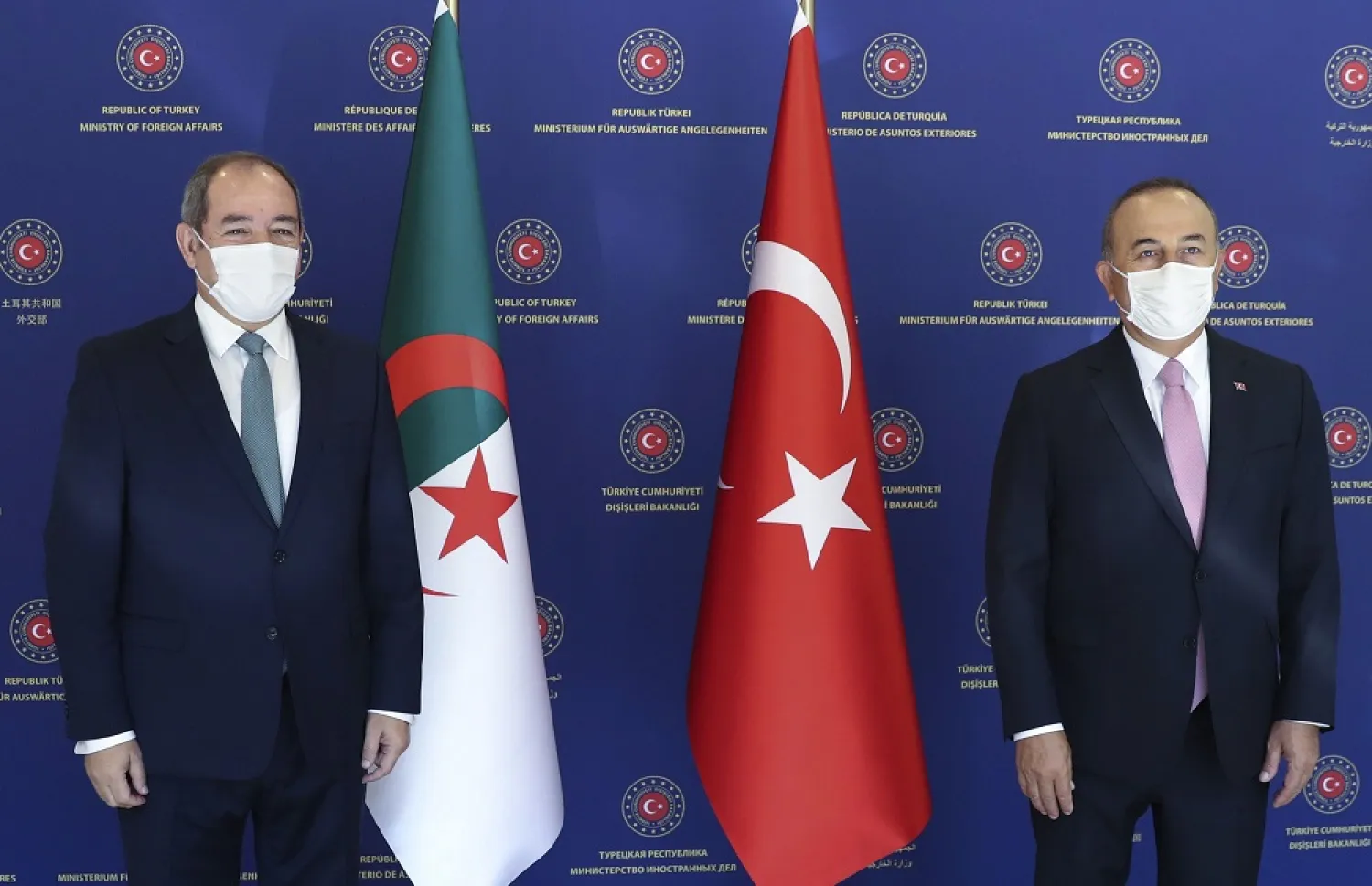
 Turkey's Foreign Minister Mevlut Cavusoglu, right, and Algeria's Foreign Minister Sabri Boukadoum pose for photos before their talks, in Ankara, Turkey, Sept. 1, 2020. (AP)
Turkey's Foreign Minister Mevlut Cavusoglu, right, and Algeria's Foreign Minister Sabri Boukadoum pose for photos before their talks, in Ankara, Turkey, Sept. 1, 2020. (AP)
TT

Algeria, Turkey Discuss Situation in Libya

 Turkey's Foreign Minister Mevlut Cavusoglu, right, and Algeria's Foreign Minister Sabri Boukadoum pose for photos before their talks, in Ankara, Turkey, Sept. 1, 2020. (AP)
Turkey's Foreign Minister Mevlut Cavusoglu, right, and Algeria's Foreign Minister Sabri Boukadoum pose for photos before their talks, in Ankara, Turkey, Sept. 1, 2020. (AP)

Turkish Foreign Minister, Mevlut Cavusoglu and his Algerian counterpart Sabri Boukadoum stressed the importance of a ceasefire and reaching a political solution to the conflict in Libya.

Speaking to the press after talks in Ankara, Cavusoglu said he discussed with Boukadoum regional issues, saying the developments in Libya affect neighboring Algeria

He reiterated the importance of a ceasefire to achieve a political solution in the country, adding that Turkey and Algeria have been working closely for some time to achieve that objective.

The Turkish minister also accused Libyan National Army (LNA) commander, Khalifa Haftar of pursuing a military solution to the conflict, instead of the political one.

For his part, Boukadoum stressed that his country supports a peaceful solution, adding that Algiers and Ankara will continue to work in coordination for peace and stability in Libya and the whole region.

“We are ready to provide all kind of support for a peaceful solution to the Libyan crisis.”

Meanwhile, ItaMilRadar website, which monitors military aircraft, revealed that Turkish flights to Libya are ongoing. It said two Turkish air force Lockheed C-130B/E (61-0963 & 71-01468) had unloaded cargo at Libya’s al-Watiya airbase.

The United Nations and the European Union have repeatedly accused Turkey of violating the arms embargo imposed on Libya. It has transported thousands of mercenaries from its loyal Syrian armed factions to western Libya to support the Government of National Accord (GNA), headed by Fayez al-Sarraj, against the LNA.

Turkey has continued its violations despite the ceasefire that was declared last month. Ankara has yet to officially comment on it.


Israel Carries Out Air Strikes in South Lebanon after Evacuation Warning

09 May 2026, Lebanon, Arnoun: Smoke billows from an Israeli airstrike on the southern Lebanese village of Arnoun. Photo: Stringer/dpa
TT

Israel Carries Out Air Strikes in South Lebanon after Evacuation Warning

09 May 2026, Lebanon, Arnoun: Smoke billows from an Israeli airstrike on the southern Lebanese village of Arnoun. Photo: Stringer/dpa

Lebanese state media reported Israeli strikes on the country's south on Saturday after Israel's army issued an evacuation warning to several villages, as well as in other areas despite a ceasefire with Hezbollah.

"In light of the terrorist Hezbollah's violation of the ceasefire agreement, the IDF is compelled to act against it forcefully," the Israeli military's Arabic-language spokesman Avichay Adraee posted on X, listing nine villages.

"For your safety, you must evacuate your homes immediately and stay away from the villages and towns by a distance of no less than 1,000 meters to open areas," he added.

Israeli warplanes "launched a strike on the town of Zrariyeh after the morning warning,” the state-run National News Agency said, also reporting strikes on several other areas included in the Israeli warning, in which the army said it would act against Hezbollah.

The agency also reported Israeli airstrikes and artillery shelling on other areas of the country's south not mentioned in the warning, along with casualties in several locations.


Syria Says Arabic Remains Sole Official Language after Hasakah Unrest

People gather as prisoners from the Syrian Democratic Forces (SDF) arrive after being released under an agreement between the SDF and the Syrian government, in Hasakah, Syria, April 11, 2026. REUTERS/Orhan Qereman
TT

Syria Says Arabic Remains Sole Official Language after Hasakah Unrest

People gather as prisoners from the Syrian Democratic Forces (SDF) arrive after being released under an agreement between the SDF and the Syrian government, in Hasakah, Syria, April 11, 2026. REUTERS/Orhan Qereman

Syrian authorities released a new group of SDF-linked detainees on Friday, in a sign that the government is pressing ahead with a prisoner release clause under an integration agreement with the Syrian Democratic Forces.

The move came as the government insisted Arabic remains Syria’s only official language under current laws, a position that drew renewed attention after SDF-affiliated Revolutionary Youth attacked the Justice Palace in Hasakah and its staff on Thursday.

The incident coincided with arrangements to hand the building over to the government and formally reopen it.

The detainees, SDF members held by the state after being arrested during law enforcement operations, left on Friday afternoon for the Melabiya area south of Hasakah ahead of their release.

The Hasakah Media Directorate said the move was supervised by the presidential team and came in implementation of the Jan. 29 agreement.

Sources had told the ANHA agency that the government was expected to release about 300 prisoners on Thursday or Friday. They said intensive preparations had been underway since Tuesday to speed up the release of a new batch.

At the time, ANHA quoted sources as saying the number of detainees still held by the government was estimated at between 500 and 600. No exchanges had been recorded since April 11.

The release went ahead despite Thursday’s disruption of the planned handover of the Justice Palace in Hasakah.

Members of the SDF-affiliated Revolutionary Youth attacked the building and its staff as arrangements were underway to hand it over to the government and reopen it.

Kurdish websites said dozens of residents had protested after Kurdish was removed from the Justice Palace sign, leaving only Arabic and English.

Hasakah Deputy Governor Ahmad al-Hilali, spokesman for the presidential team tasked with implementing the integration agreement, said in a Facebook statement that the Justice Palace is an official institution bound by Syrian state laws.

“Regarding what has been misunderstood about placing a sign on the Justice Palace building in Hasakah that does not include the Kurdish language, it is important to clarify that the Justice Palace represents an official institution that embodies justice and commitment to the laws in force in the Syrian state,” Hilali said.

He said Decree No. 13 recognizes Kurdish as a national language and allows it to be taught in public and private schools in areas where Kurds make up a notable share of the population, through optional curricula or cultural and educational activities.

But Hilali said Arabic remains the only official language of the Syrian Arab Republic under the constitution and current legislation, and must be used in official institutions, education, legal documentation, and state transactions.

He said protecting Arabic and using it exclusively in official correspondence and transactions were part of state sovereignty and public order.

These laws, he added, cannot be bypassed at this stage under the constitutional declaration except through future constitutional and legal amendments approved by the relevant legislative bodies, foremost among them the Syrian People’s Assembly, which is expected to convene soon.

The Justice Ministry strongly condemned the unrest and vandalism targeting the Justice Palace in Hasakah, saying in a statement on its official accounts that the acts violated public order, state authority and the rule of law.

It said it would take all necessary legal measures against those involved.

The integration of judicial institutions has been faltering since its implementation began in April.

Shalal Kedo, head of the Kurdish Left Party in Syria, said the attack by dozens of members of the Revolutionary Youth, affiliated with the SDF and the Autonomous Administration linked to the Democratic Union Party, pointed to divisions within that structure over the integration agreement.

Kedo, whose party is part of the Kurdish National Council, told Asharq Al-Awsat that some parties within the structure were moving toward implementing the agreement and integrating institutions, while others were trying to obstruct it.

“It is clear that there are parties within this structure moving toward implementing the agreement and integrating institutions, as we are seeing on the ground, while other parties, such as the Revolutionary Youth, are trying to create obstacles and put sticks in the wheels to disrupt the course of understandings,” he said.

Kedo said the Kurdish language issue, which sparked Thursday’s events in Hasakah, remains a natural and legitimate right for Syria’s Kurds. Kurdish, he said, should be the country’s second official language.

He said Decree No. 13 on Kurdish rights carries important implications that should be built on, developed and included in the new Syrian constitution.

“In all cases, the Kurdish language issue cannot be reduced to the integration agreement, because the Kurdish issue is much older and deeper than that. It has existed since the emergence of the modern Syrian state,” Kedo said.

“As for the SDF issue, that is a different matter. The SDF, as a military faction, signed an agreement to integrate into the Syrian army, while the institutions affiliated with the Autonomous Administration are being integrated into Syrian state institutions,” he said.

“For our part, we support normalization, the Jan. 29 agreement, and the integration of the Autonomous Administration’s institutions and its security and military formations into Syrian state institutions and the Syrian army,” Kedo added.

“At the same time, however, the demand to establish Kurdish as a second official language and as a language of education, culture and media is a legitimate demand.”


Sudan’s War Fuels Silent Disaster for Forests

Damage to Sudan’s forests caused by the war and indiscriminate tree cutting (Asharq Al-Awsat)
TT

Sudan’s War Fuels Silent Disaster for Forests

Damage to Sudan’s forests caused by the war and indiscriminate tree cutting (Asharq Al-Awsat)

As war tears through Sudan, the environment has been buried beneath the smoke of battle, mass displacement and hunger. Yet it is one of the sectors suffering the broadest and deepest losses.

Experts say what is unfolding in Sudan’s forests is no longer routine environmental degradation. It is a silent disaster threatening the country’s natural resources and climate balance, as the state’s ability to monitor and protect them weakens and living pressures grow.

The collapse of basic services, fuel shortages and soaring living costs have forced thousands of Sudanese families back to firewood and charcoal as alternative energy sources.

The result has been a surge in tree felling and the depletion of forest belts. Internal displacement has added to the pressure, with large numbers of people moving to safer areas and setting up temporary shelters in wooded zones, amid an almost total absence of environmental oversight and law enforcement.

A bitter reality

On the outskirts of Khartoum state, among acacia trees near the confluence of the two Niles, Aisha Abdullah collected firewood and described the choices now facing families.

“We used to rely on cooking gas, but the price of a cylinder has risen to about 90,000 Sudanese pounds, around $22.50, and we can no longer afford it,” she said. “We have no option left but firewood to cook food. We know that cutting trees harms the environment, but how can a family live without food?”

In Gezira state, Salah al-Tayeb said economic hardship has pushed many people toward the forests.

“The price of a sack of charcoal has reached about 105,000 Sudanese pounds, around $26.25, which is beyond the means of most families,” he said. “That is why firewood has become the only available option for many people to meet their daily needs.”

Saadia Abdullah, a tea seller on Nile Street in Omdurman, said the war has upended her work as fuel prices climbed and incomes fell.

“I used to use gas and charcoal in my work normally, but prices have become beyond our capacity,” she said. “Today I rely on firewood so I can prepare tea and continue working under these difficult conditions.”

Accelerating environmental damage

Moussa Suleiman Moussa, director general of the National Forestry Corporation, said forests have become an emergency energy source during the war because of power cuts and shortages of cooking gas.

Official data show about 60% of acacia forests in Gezira state have deteriorated, along with 45% in Sennar state. Other states have been affected to varying degrees.

In remarks to Asharq Al-Awsat, Moussa said Sudan’s forest area is estimated at about 30 million feddans after South Sudan’s secession in 2011, equal to around 12.5% of the country’s area. Plans had aimed to raise that figure to 25% , but the war halted that path and accelerated the depletion.

Bishra Hamed, former head of the Higher Council for Environment and Natural Resources in Khartoum state, said Sudan’s environmental resources are facing a “wide and multifaceted assault” as the effects of war intersect with economic, social and security crises.

He said the weakened role of the state and declining law enforcement have allowed the firewood, charcoal and timber trade to expand. Modern methods are being used to cut trees and move them quickly through networks operating inside and outside the country.

“Between 70% and 80% of the population depends directly on natural resources for their livelihoods, whether through farming, herding or firewood production. This makes environmental degradation a direct threat to economic and social stability in a country already suffering from structural fragility,” he said.

Hamed also warned that unregulated mining inside forests and natural reserves is deepening the crisis by stripping more vegetation and polluting soil and water, creating complex environmental challenges that will be hard to contain in the near term.

Environmental expert Awad Mohammed Siddig said the damage goes beyond temporary resource consumption. It amounts to the rapid dismantling of an entire ecosystem.

He said the loss of vegetation strips soil of its ability to retain moisture and allows desertification to spread in already fragile areas, while habitats disappear and biodiversity declines.

In remarks to Asharq Al-Awsat, Siddig said rural communities are paying the price directly through falling agricultural production, weaker protection from advancing sand and disruption to the water cycle.

Climate and environmental expert Noureldin Ahmed said forests are among Sudan’s most important natural resources because they help moderate the climate, protect soil and provide food and shelter for millions of living organisms.

He said wide areas have become barren after once serving as a natural lung that supplied oxygen and reduced the effects of desertification and climate change. He warned that the continued deterioration of vegetation cover threatens to multiply Sudan’s climate and humanitarian crises.

Mounting economic losses

Forestry expert Talaat Dafallah said the loss of dense vegetation contributes to rising temperatures and weakens the local environment’s ability to absorb carbon emissions.

He said the damage is also draining vital resources such as timber and gum arabic, with annual losses in the forestry sector estimated at about $500 million because of illegal tree cutting.

In remarks to Asharq Al-Awsat, Dafallah said the immediate priority is to reduce household dependence on firewood by providing cooking gas where possible, expanding the use of improved stoves and supporting solar energy in neighborhoods and displacement centers.

The damage has not stopped at the natural environment. It has reached key economic sectors. In Kordofan, one of the world’s most important gum arabic producing regions, production chains have been badly hit, affecting millions of people who depend on the sector as a main source of income.

With the war dragging on and state institutions retreating, Sudan’s environment is facing a real existential challenge. Depletion is accelerating without protection or recovery plans, while environmental, economic and humanitarian losses deepen day by day, raising the prospect of long-term consequences that could affect generations to come.