


Can Lost Boy James Rodríguez Break the Mould at Free-Spending Everton?

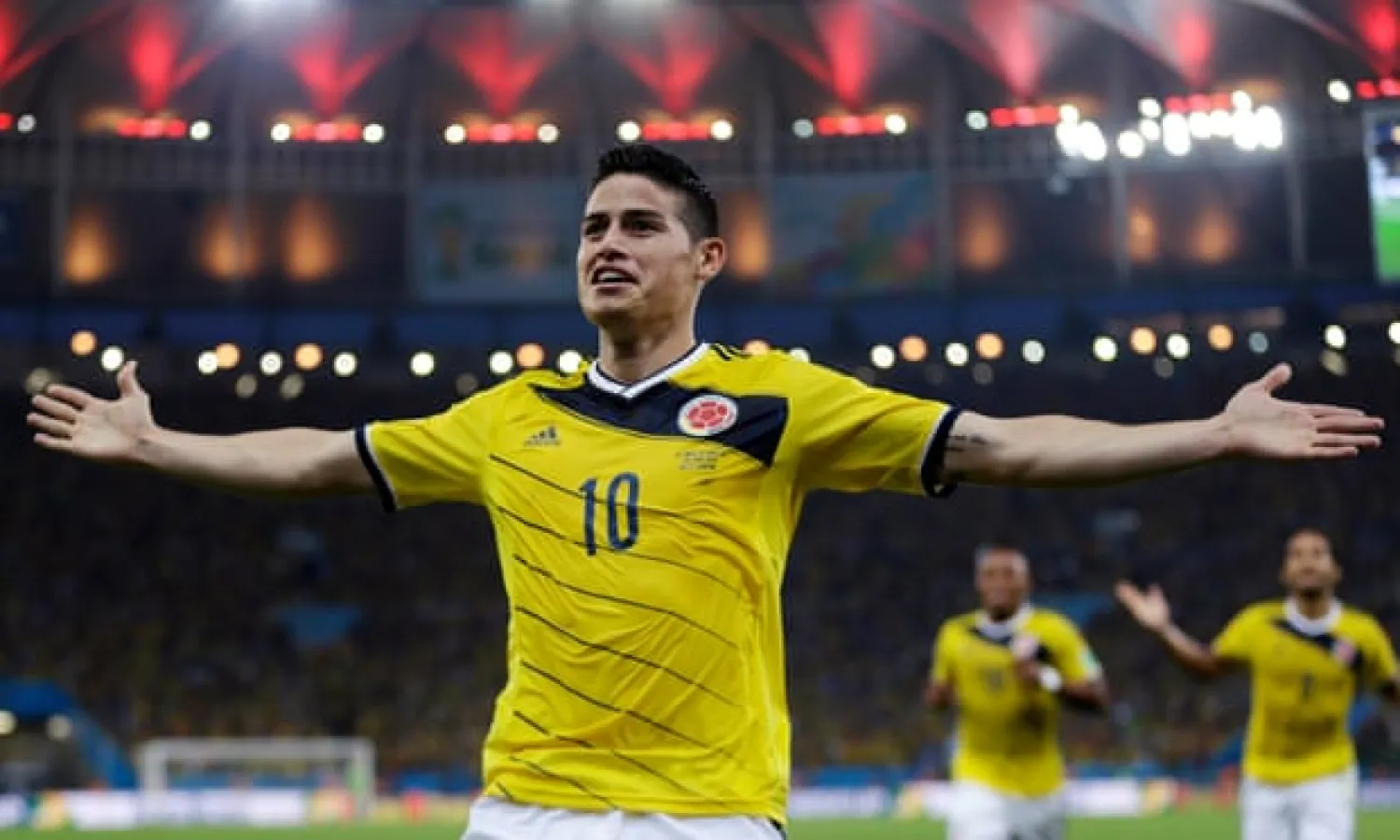
 James Rodríguez celebrates scoring the goal for Colombia against Uruguay at the 2014 World Cup that led to his transfer to Real Madrid. Photograph: Natacha Pisarenko/AP
James Rodríguez celebrates scoring the goal for Colombia against Uruguay at the 2014 World Cup that led to his transfer to Real Madrid. Photograph: Natacha Pisarenko/AP
TT

Can Lost Boy James Rodríguez Break the Mould at Free-Spending Everton?

 James Rodríguez celebrates scoring the goal for Colombia against Uruguay at the 2014 World Cup that led to his transfer to Real Madrid. Photograph: Natacha Pisarenko/AP
James Rodríguez celebrates scoring the goal for Colombia against Uruguay at the 2014 World Cup that led to his transfer to Real Madrid. Photograph: Natacha Pisarenko/AP

Potential can be a curse. Show too much too early and it will define you, so you are measured not by what you have done but against the future that once seemed within your grasp. And when age finally takes its toll, when the world stops waiting for you to become what it seemed you once could be, when you are written off with a dismissive shrug as a could-have-been then, in England at least, there are really only two places you can go: West Ham or Everton.

They are populated by the Lost Boys of the global game. When the elite will take you no more, there will still be a place in these Neverlands, clubs who will pay the wages of a player at their notional peak, even as time saps at them and reduces their value, even as hunger is spent and the drift into retirement has become inevitable.

Sensible economics dictate that clubs of Everton’s level should be picking up young players from Europe’s mid-ranking leagues and clubs – a 22-year-old midfielder from Augsburg, perhaps, a promising winger from Benfica or a rapid young defender from Metz – looking to develop them and selling them on at a profit three or four years later. But again and again the allure of players allowed to leave by the elite proves too great and so they end up with a squad populated by Theo Walcott, Moise Kean, Alex Iwobi, Gylfi Sigurdsson, Fabian Delph and Lucas Digne.

That’s not to say they are not good players. Kean, aged 20, and Iwobi, 24, have time on their side. It’s not to say they necessarily do not fit at Everton. It’s not to say they lack commitment. If they see Everton as a step down from where they were, well, what of it? A club such as Everton is always going to be a stepping-stone in one direction or the other; it will only rarely be a destination in itself. But it is to say they are expensive.

Everton’s finances are not in robust health. In 2018-19, they made a loss of £112m. As the Swiss Ramble Twitter feed showed, of the 20 wealthiest clubs in the world by revenue (Everton are 19th), none has a higher wages-to-turnover ratio than Everton’s 85%. Only three clubs in that list have a wages to turnover ratio above 65%. Everton are a huge outlier.

All convention would suggest there is need to trim the wage bill and offload some of the higher earners, to retrench as the pandemic gnaws at revenues, and yet money still appears to be available for signings, with Abdoulaye Doucouré, Allan and, the greatest of all the lost boys, James Rodríguez all having signed or being poised to sign.

It’s James who stands out. He exemplifies the dangers of what can happen when a club president sees a player during a major tournament and decides his brand must have him.

James had done well for Porto and Monaco. He was clearly a player of great promise. Then, aged 22, he scored a brilliant volley against Uruguay at the 2014 World Cup and finished as the tournament’s top scorer. Florentino Pérez was entranced and Real Madrid made James the fourth-most expensive signing in history at the time.

The Colombian’s first season at the Bernabéu, under Carlo Ancelotti, was relatively good. James scored 13 goals and registered 13 assists. But injuries ate away at him. A fractured metatarsal required surgery. He suffered a persistent thigh problem.

Ancelotti left after a year and his replacement, Rafa Benítez, never seemed to trust James’s work rate or tactical discipline. He was loaned for two years to Bayern, then managed by Ancelotti. Again his first season showed glimmers of promise: seven goals and 11 assists, but Ancelotti was sacked at the end of the September and James became, whether fairly or not, an emblem of his regime and its perceived softness.

An option to buy was not taken up so James returned to Madrid, where Zinedine Zidane, who is as pragmatic as Benítez in his own way, found no place for him. As he hit his late 20s and what should be his peak, James, who six years ago seemed the most exciting prospect of his generation, has started 18 league games in two seasons.

Where else would he go but Everton? No accountant would sign him, a diminishing asset on high wages who has just turned 29, even if his initial fee is £20m. It makes zero financial sense. And yet, there must also be a sense of thrill. There were questions about the appointment of Ancelotti and his suitability for Everton that have not yet been answered, but this is a clear upside: he gives the club access to players such as James and Allan who probably wouldn’t give Everton a second thought were it not for the opportunity to play for a manager they have worked with before.

Only the dourest of grown-ups, one who has long since forgotten how to fly, could not be inspired by the prospect of Ancelotti reigniting James’s talent so that he plays out a glorious autumn to his career at Goodison. It’s an audacious signing, one that services a fundamental but frequently overlooked demand of a mid-table side: fun.

James may succeed gloriously or he may fail, but at least it will have been worth watching to find out. Certainly with Allan and Doucouré, this appears a much more dynamic Everton midfield than the narrow and slightly sterile variant put out by Ancelotti for much of the second half of last season.

All of which would be promising were it not for that wage bill. James feels like a gamble that is justifiable, welcome even, but Everton could probably do with a few more 22-year-old midfielders from Augsburg, promising wingers from Porto or rapid young defenders from Metz. And perhaps, at last, James can escape the golden dreams of his youth to become something meaningful in the present.

The Guardian Sport


Saudi PIF and ATP Launch Program to Support Rising Talent

The program is aimed at supporting rising talent and widening opportunities for players from the Global South. Photo: PIF
TT

Saudi PIF and ATP Launch Program to Support Rising Talent

The program is aimed at supporting rising talent and widening opportunities for players from the Global South. Photo: PIF

Saudi Arabia’s Public Investment Fund (PIF) and the ATP launched the ATP Next Gen Accelerator on Thursday, a program aimed at supporting rising talent and widening opportunities for players from the Global South as they seek to break onto the ATP Tour.

Eligible players will gain access to ATP Tennis IQ Powered by PIF, ⁠an integrated performance technology ⁠platform, along with medical support, structured education and enhanced promotion across ATP platforms.

The initiative seeks to level the playing field for emerging players and provide greater stability ⁠for young professionals.

The launch aligns with PIF’s 2026–2030 strategy, under which the fund plans to focus investment across six key themes as it looks to diversify Saudi Arabia’s economy beyond oil.


Inspired by Nadal, Ruud Returns for Madrid Defense

Casper Ruud of Norway in action during his match against Felix Auger-Aliassime of Canada at the ATP Monte Carlo Masters tennis tournament in Roquebrune Cap Martin, France, 09 April 2026.  EPA/SEBASTIEN NOGIER
Casper Ruud of Norway in action during his match against Felix Auger-Aliassime of Canada at the ATP Monte Carlo Masters tennis tournament in Roquebrune Cap Martin, France, 09 April 2026. EPA/SEBASTIEN NOGIER
TT

Inspired by Nadal, Ruud Returns for Madrid Defense

Casper Ruud of Norway in action during his match against Felix Auger-Aliassime of Canada at the ATP Monte Carlo Masters tennis tournament in Roquebrune Cap Martin, France, 09 April 2026.  EPA/SEBASTIEN NOGIER
Casper Ruud of Norway in action during his match against Felix Auger-Aliassime of Canada at the ATP Monte Carlo Masters tennis tournament in Roquebrune Cap Martin, France, 09 April 2026. EPA/SEBASTIEN NOGIER

Casper Ruud hoped his short training stint at Rafa Nadal’s academy in Mallorca would reignite his season as the 27-year-old returns from an injury to defend his Madrid Open title this week.

Ruud, who lifted his maiden Masters 1000 title in the Spanish capital last year, sustained a leg injury and was forced to retire from his third-round match at the Monte Carlo Masters against Felix Auger-Aliassime earlier this month.

The Norwegian then ramped up his comeback under the close watch of ⁠22-times Grand Slam ⁠champion Nadal.

"I'm happy to say I'm fully recovered,” Reuters quoted Ruud as saying in Madrid.

"I was a bit worried at first, I thought Madrid would be tough. But I've had good days of recovery. I spent a week in Mallorca, training at Rafa's academy and ⁠working on fitness off the court. I'm really pleased to be here, ready to compete again."

Ruud said he was inspired by the now-retired Nadal’s determination during a glittering playing career that came to an end in 2024.

“If there's one thing you can learn from him, it's determination,” Ruud added.

“He never gave up, and he was able to win many matches without being at his best because he was ⁠so well ⁠prepared physically and mentally.

"There are so many things you can learn from Rafa. This time, we didn't spend much time together on court. He encouraged me to keep going and told me I have plenty to fight for in the coming weeks."

Ruud begins his Madrid campaign against Jaume Munar or Alexander Shevchenko in the second round.

The twice French Open runner-up is eyeing a strong run in the weeks leading up to Roland Garros, which begins on May 24.


Leipzig and Union's Bundesliga Clash Shows Changing Face of Football

Players of RB Leipzig celebrate with their supporters after winning the German Bundesliga soccer match between Eintracht Frankfurt and RB Leipzig in Frankfurt, Germany, 18 April 2026. EPA/CHRISTOPHER NEUNDORF
TT

Leipzig and Union's Bundesliga Clash Shows Changing Face of Football

Players of RB Leipzig celebrate with their supporters after winning the German Bundesliga soccer match between Eintracht Frankfurt and RB Leipzig in Frankfurt, Germany, 18 April 2026. EPA/CHRISTOPHER NEUNDORF

RB Leipzig's home Bundesliga clash with Union Berlin on Friday has the two sides chasing different season goals, while showing the changing face of the game.

Third-placed Leipzig can take a massive step towards returning to the Champions League with victory, after missing Europe for the first time this season.

For Union, victory would send the Berliners nine points clear of the relegation playoff spot with three matchdays remaining, all but ensuring they beat the drop for another season.

Coached by Marie-Louise Eta, the first woman to coach a men's side in a major European league, Union face RB Leipzig, whose CEO Tatjana Haenni is the first female club boss in German football history.

The only two top-flight clubs situated in the former East Germany, Leipzig and Union share few other similarities but the hirings reflect a focus on merit and competence, with both Eta and Haenni considered right for the job.

Henni, a former Swiss international with 23 caps who took over the club on January 1, told AFP and other media on Tuesday that Eta's appointment reflected where football -- and society -- were at.

"It's the most popular sport on the planet. It's about quality and it's about the right people at the right place," she said.

"It's a cultural shift which has to happen and it is happening. With me being here and Marie-Louise being the head coach at Union Berlin, it's just happening.

"It's about quality, expertise, trusting people and having the right mindset."

Eta's appointment captured global headlines and the 34-year-old recognised her pioneering role but seemed much more comfortable talking about the game itself.

"It creates a responsibility for me, whether I like it or not," Eta told Germany's Die Zeit on Wednesday.

"My primary goal was never to strengthen the role of women. I have always wanted to convince through performance. I want to be seen as a football coach."

Bayern Munich wrapped up the title last week but there's still plenty to play for at the other end of the table.

Wolfsburg's win over Union last week kept their hopes of avoiding a first relegation alive. Still second last, the victory took Wolfsburg two points behind St Pauli, who are on 26 points in the relegation playoff spot and play at last-placed Heidenheim on Saturday.

Wolfsburg face Borussia Moenchengladbach who are one of four teams locked on 31 points.

One to watch: Jackson Irvine (St Pauli)

Already a cult hero in Hamburg since arriving in 2021, St Pauli captain Jackson Irvine has been a key figure in the club's relegation fight.

Since the Australian reclaimed the captain's armband in February, St Pauli have won three matches -- as many as they had won all year until then -- and only lost three of nine games with him on the pitch.

St Pauli striker Abdoulie Ceesay praised Irvine's leadership in a media roundtable on Tuesday.
"He's a very good leader. He's always there to push us. Sometimes you think he's upset with you and he screams at you, telling you bad words. But afterwards he'll tell you he's doing it to help you, to make you better.

"He's there pushing us every single day to fight for everything and to stay in this league."

RB Leipzig's home Bundesliga clash with Union Berlin on Friday has the two sides chasing different season goals, while showing the changing face of the game.

Third-placed Leipzig can take a massive step towards returning to the Champions League with victory, after missing Europe for the first time this season.

For Union, victory would send the Berliners nine points clear of the relegation playoff spot with three matchdays remaining, all but ensuring they beat the drop for another season.
Coached by Marie-Louise Eta, the first woman to coach a men's side in a major European league, Union face RB Leipzig, whose CEO Tatjana Haenni is the first female club boss in German football history.

The only two top-flight clubs situated in the former East Germany, Leipzig and Union share few other similarities but the hirings reflect a focus on merit and competence, with both Eta and Haenni considered right for the job.

Henni, a former Swiss international with 23 caps who took over the club on January 1, told AFP and other media on Tuesday that Eta's appointment reflected where football -- and society -- were at.

"It's the most popular sport on the planet. It's about quality and it's about the right people at the right place," she said.

"It's a cultural shift which has to happen and it is happening. With me being here and Marie-Louise being the head coach at Union Berlin, it's just happening.

"It's about quality, expertise, trusting people and having the right mindset."

Eta's appointment captured global headlines and the 34-year-old recognised her pioneering role but seemed much more comfortable talking about the game itself.

"It creates a responsibility for me, whether I like it or not," Eta told Germany's Die Zeit on Wednesday.

"My primary goal was never to strengthen the role of women. I have always wanted to convince through performance. I want to be seen as a football coach."

Bayern Munich wrapped up the title last week but there's still plenty to play for at the other end of the table.

Wolfsburg's win over Union last week kept their hopes of avoiding a first relegation alive. Still second last, the victory took Wolfsburg two points behind St Pauli, who are on 26 points in the relegation playoff spot and play at last-placed Heidenheim on Saturday.

Wolfsburg face Borussia Moenchengladbach who are one of four teams locked on 31 points.

One to watch: Jackson Irvine (St Pauli)

Already a cult hero in Hamburg since arriving in 2021, St Pauli captain Jackson Irvine has been a key figure in the club's relegation fight.

Since the Australian reclaimed the captain's armband in February, St Pauli have won three matches -- as many as they had won all year until then -- and only lost three of nine games with him on the pitch.

St Pauli striker Abdoulie Ceesay praised Irvine's leadership in a media roundtable on Tuesday.

"He's a very good leader. He's always there to push us. Sometimes you think he's upset with you and he screams at you, telling you bad words. But afterwards he'll tell you he's doing it to help you, to make you better.

"He's there pushing us every single day to fight for everything and to stay in this league."
