

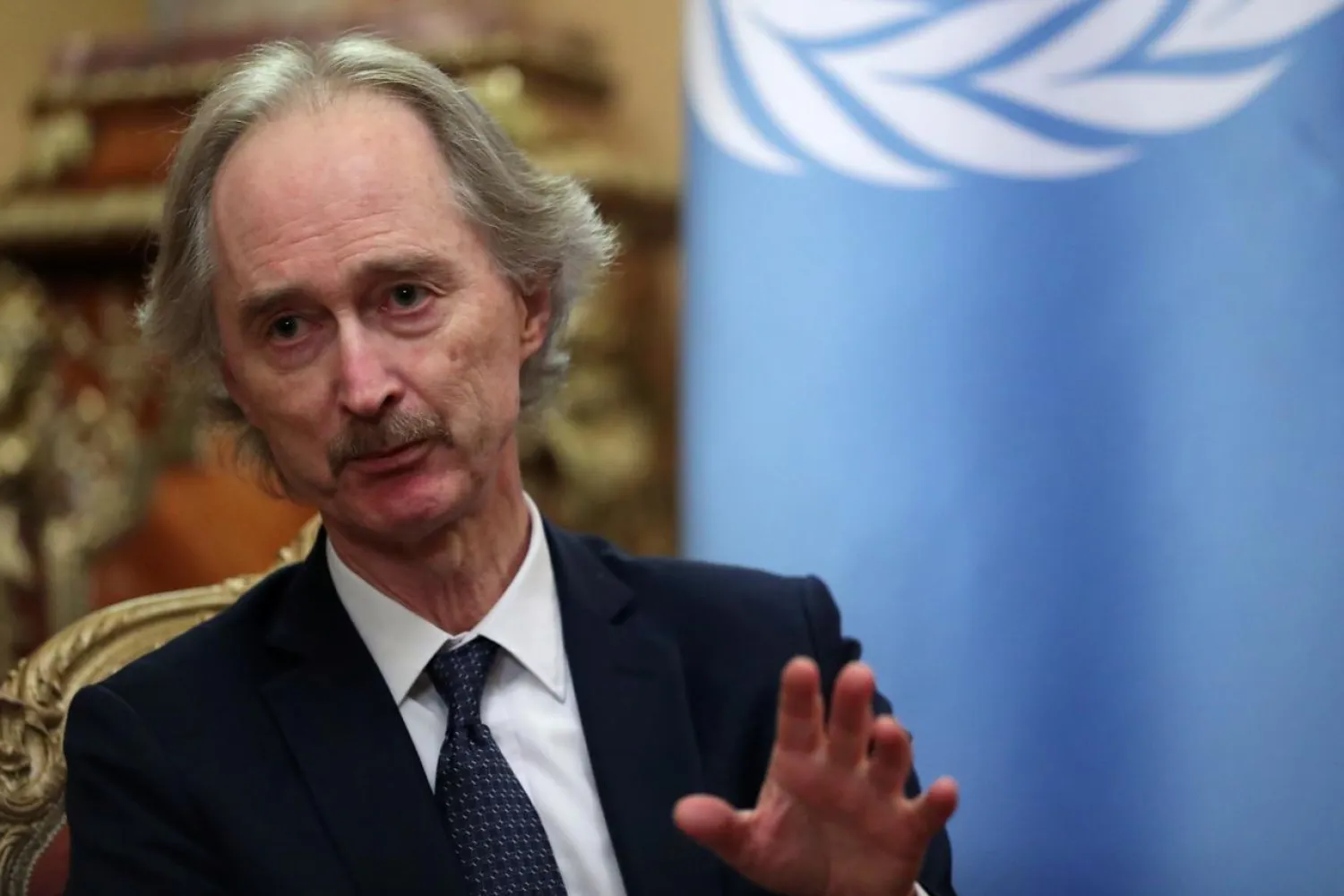

Pedersen: Faint but Real Ray of Hope on Syria Constitution Talks

FILE PHOTO: United Nations Special Envoy to Syria Geir Pedersen meets with Russian Foreign Minister Sergei Lavrov (not pictured), in Moscow, Russia January 24, 2020. REUTERS/Evgenia Novozhenina
TT

Pedersen: Faint but Real Ray of Hope on Syria Constitution Talks

FILE PHOTO: United Nations Special Envoy to Syria Geir Pedersen meets with Russian Foreign Minister Sergei Lavrov (not pictured), in Moscow, Russia January 24, 2020. REUTERS/Evgenia Novozhenina

UN Special Envoy to Syria Geir Pedersen has expressed hope that a new round of discussions on a new constitution for Syria would make progress.

In a briefing to the UNSC on the political situation in the war-torn country during a videoconference meeting on Friday, Pedersen said that against the hard realities, and the deep distrust among the Syrian parties, a faint but real ray of hope shone from Geneva “when, in the last week of August, we were able to convene, after a nine-month hiatus, a Third Session of the Small Body of the Syrian Constitutional Committee.”

He said the Co-Chairs of the Committee informed him that they sensed that some common ground was emerging on some subjects.

“There were practical suggestions from members on how to identify such common ground and how the discussion could move forward. I was very pleased with this,” the UN envoy noted.

However, Pedersen announced there were real differences on substance even at the quite general level of the discussions.

He said the Co-Chairs were not able to agree while in Geneva on an agenda for the next session.

“We need to finalize the agenda without further delay if we are to meet in early October as we had hoped,” the UN official added.

Pedersen reminded participants that the delegations are nominated by the Syrian government and the opposition Syrian Negotiations Commission, in addition to the Middle Third civil society delegation, and that the mandate of the Committee is to prepare and draft a constitutional reform.

He also said the Committee may review and amend the 2012 constitution or draft a new constitution.

“The constitutional draft must embody the 12 living principles which emerged from the Geneva process and were approved in Sochi.”

According to the UN envoy, Syria remains a highly internationalized environment, with five foreign armies active in the theater, and Syria’s sovereignty compromised.

“Militarily, however, existing arrangements continue to sustain broad calm across Syria, relative to the intense violence of recent years. Indeed, the frontlines have barely shifted for half a year – the longest in the Syrian conflict – and a basic military status quo seems to be emerging,” he said.

He added that while Syria is calmer than before, worrying incidents could destabilize that calm, including a vehicle altercation between Russian and US forces that left four US soldiers injured, and mutual accusations of breaches of existing deconfliction arrangements, in addition to further rounds of airstrikes, attributed to Israel by the Syrian government, on military positions in Syria.

Pedersen added that despite the March agreement between Russia and Turkey continues to sustain broad calm in the northwest, “we have also seen escalations, including mutual rocket and artillery fire and airstrikes, hitting near the frontlines as well as deep into Idlib.”

Meanwhile, the Netherlands announced Friday its decision to hold Syria accountable under international law for gross human rights violations and torture in particular.

“The Assad regime has committed horrific crimes time after time. The evidence is overwhelming. There must be consequences,” said Minister of Foreign Affairs Stef Blok.

The Netherlands says that over the past decade nearly 200,000 Syrian civilians have died in the conflict in Syria, and many more even, according to some sources.

According to Blok, “the Assad regime has not hesitated to crack down hard on its own population, using torture and chemical weapons, and bombing hospitals.”



Israel Military Says Soldier Killed in Gaza 

A drone view shows the destruction in a residential neighborhood, after the withdrawal of the Israeli forces from the area, amid a ceasefire between Israel and Hamas in Gaza, in Gaza City, October 21, 2025. (Reuters)
TT

Israel Military Says Soldier Killed in Gaza 

A drone view shows the destruction in a residential neighborhood, after the withdrawal of the Israeli forces from the area, amid a ceasefire between Israel and Hamas in Gaza, in Gaza City, October 21, 2025. (Reuters)

The Israeli military announced that one of its soldiers had been killed in combat in southern Gaza on Wednesday, but a security source said the death appeared to have been caused by "friendly fire".

"Staff Sergeant Ofri Yafe, aged 21, from HaYogev, a soldier in the Paratroopers Reconnaissance Unit, fell during combat in the southern Gaza Strip," the military said in a statement.

A security source, however, told AFP that the soldier appeared to have been "killed by friendly fire", without providing further details.

"The incident is still under investigation," the source added.

The death brings to five the number of Israeli soldiers killed in Gaza since a ceasefire took effect on October 10.


Syria: SDF’s Mazloum Abdi Says Implementation of Integration Deal May Take Time

People sit outdoors surrounded by nature, with the Tigris river flowing in the background, following a long atmospheric depression, near the Syrian-Turkish border in Derik, Syria, February 16, 2026 REUTERS/Orhan Qereman
TT

Syria: SDF’s Mazloum Abdi Says Implementation of Integration Deal May Take Time

People sit outdoors surrounded by nature, with the Tigris river flowing in the background, following a long atmospheric depression, near the Syrian-Turkish border in Derik, Syria, February 16, 2026 REUTERS/Orhan Qereman

Mazloum Abdi, commander of the Syrian Democratic Forces, said the process of merging the SDF with Syrian government forces “may take some time,” despite expressing confidence in the eventual success of the agreement.

His remarks came after earlier comments in which he acknowledged differences with Damascus over the concept of “decentralization.”

Speaking at a tribal conference in the northeastern city of Hasakah on Tuesday, Abdi said the issue of integration would not be resolved quickly, but stressed that the agreement remains on track.

He said the deal reached last month stipulates that three Syrian army brigades will be created out of the SDF.

Abdi added that all SDF military units have withdrawn to their barracks in an effort to preserve stability and continue implementing the announced integration agreement with the Syrian state.

He also emphasized the need for armed forces to withdraw from the vicinity of the city of Ayn al-Arab (Kobani), to be replaced by security forces tasked with maintaining order.


Israeli Far-Right Minister to Push for ‘Migration’ of West Bank, Gaza Palestinians 

A Palestinian man checks leather belts as people prepare for Ramadan, in the old city of Hebron in the Israeli-occupied West Bank, February 17,2026. (Reuters)
TT

Israeli Far-Right Minister to Push for ‘Migration’ of West Bank, Gaza Palestinians 

A Palestinian man checks leather belts as people prepare for Ramadan, in the old city of Hebron in the Israeli-occupied West Bank, February 17,2026. (Reuters)

Israel's far-right Finance Minister Bezalel Smotrich said he would pursue a policy of "encouraging the migration" of Palestinians from the occupied West Bank and Gaza Strip, Israeli media reported Wednesday.

"We will eliminate the idea of an Arab terror state," said Smotrich, speaking at an event organized by his Religious Zionism Party late on Tuesday.

"We will finally, formally, and in practical terms nullify the cursed Oslo Accords and embark on a path toward sovereignty, while encouraging emigration from both Gaza and Judea and Samaria.

"There is no other long-term solution," added Smotrich, who himself lives in a settlement in the West Bank.

Since last week, Israel has approved a series of measures backed by far-right ministers to tighten control over the West Bank, including in areas administered by the Palestinian Authority under the Oslo Accords, in place since the 1990s.

The measures include a process to register land in the West Bank as "state property" and facilitate direct purchases of land by Jewish Israelis.

The measures have triggered widespread international outrage.

On Tuesday, the UN missions of 85 countries condemned the measures, which critics say amount to de facto annexation of the Palestinian territory.

"We strongly condemn unilateral Israeli decisions and measures aimed at expanding Israel's unlawful presence in the West Bank," they said in a statement.

"Such decisions are contrary to Israel's obligations under international law and must be immediately reversed.

"We underline in this regard our strong opposition to any form of annexation."

UN Secretary-General Antonio Guterres on Monday called on Israel to reverse its land registration policy, calling it "destabilizing" and "unlawful".

The West Bank would form the largest part of any future Palestinian state. Many on Israel's religious right view it as Israeli land.

Israeli NGOs have also raised the alarm over a settlement plan signed by the government which they say would mark the first expansion of Jerusalem's borders into the occupied West Bank since 1967.

The planned development, announced by Israel's Ministry of Construction and Housing, is formally a westward expansion of the Geva Binyamin, or Adam, settlement situated northeast of Jerusalem in the West Bank.

The current Israeli government has fast-tracked settlement expansion, approving a record 52 settlements in 2025.

Excluding Israeli-annexed east Jerusalem, more than 500,000 Israelis live in West Bank settlements and outposts, which are illegal under international law.