


Azerbaijan Says Armenia Attacks City, Threatens Retaliation

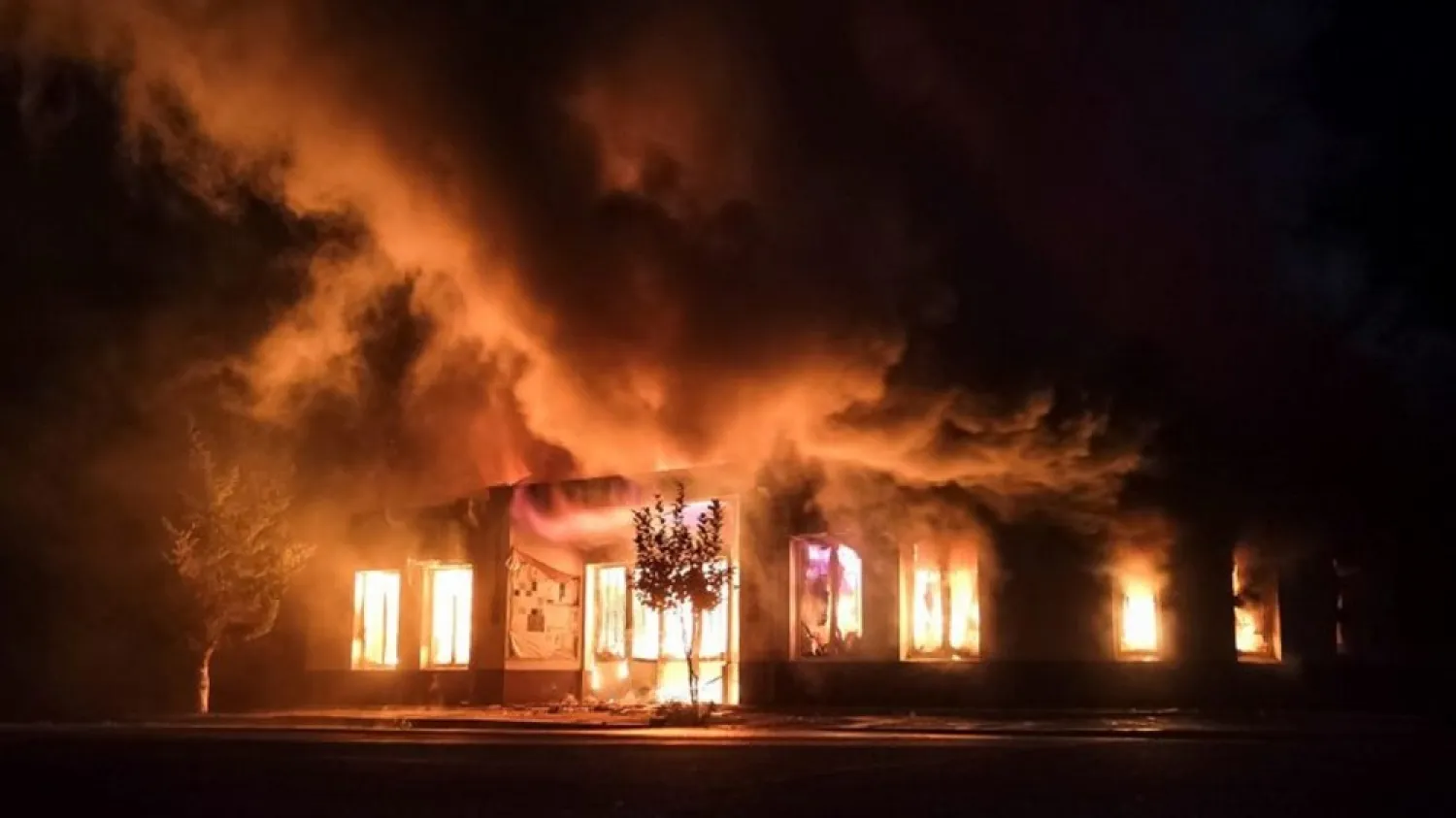
A shop is seen on fire following recent shelling during a military conflict over the breakaway region of Nagorno-Karabakh in Stepanakert October 3, 2020. (Reuters)
TT

Azerbaijan Says Armenia Attacks City, Threatens Retaliation

A shop is seen on fire following recent shelling during a military conflict over the breakaway region of Nagorno-Karabakh in Stepanakert October 3, 2020. (Reuters)

Azerbaijan said on Sunday that Armenian forces had fired rockets at its second city of Ganja, killing one civilian and wounding four, and threatened to retaliate by destroying military targets inside Armenia.

The developments marked a sharp escalation of the war in the South Caucasus that broke out one week ago.

Until now, the main fighting has been between Azerbaijan and Nagorno-Karabakh, an ethnic Armenian enclave inside Azerbaijan, but it now threatens to spill over into a direct war with Armenia itself.

"Azerbaijan will destroy military targets directly inside Armenia from which shelling of its population centers is taking place," presidential aide Hikmet Hajiyev said.

He said there were also civilian casualties in another Azeri region, Beylagan, which borders Nagorno-Karabakh.

Armenia denied it had directed fire "of any kind" towards Azerbaijan. The leader of Nagorno-Karabakh said his forces had targeted a military airbase in Ganja but later stopped firing in order to avoid civilian casualties.

The conflict threatens to drag in other regional powers as Azerbaijan is supported by Turkey, while Armenia has a defense pact with Russia. Turkey's Foreign Ministry said: "The attacks of Armenia targeting the civilians in Ganja...are a new manifestation of Armenia's unlawful attitude. We condemn these attacks."

Fighting that broke out one week ago between Azeri and ethnic Armenian forces has intensified in the past two days and spread far beyond the breakaway Karabakh region.

Ganja, with a population of 335,000, is about 100 km (60 miles) north of the Karabakh capital Stepanakert and 80 km from the Armenian city of Vardenis. Azerbaijan has previously accused Armenia of firing into its territory from Vardenis, and Yerevan has denied it.

Armenia says Azerbaijan has used the airport in Ganja as a base for its warplanes to carry out bombing raids on Nagorno-Karabakh.

Nagorno-Karabakh leader Arayik Harutyunyan said his forces would target Azeri cities.

"Permanent military units located in the large cities of Azerbaijan from now on become the targets of the defense army," he said.

Heavy casualties
Casualties from the past week's fighting have run into the hundreds, although precise figures are impossible to obtain.

Armenia said the Karabakh cities of Stepanakert and Martakert were under attack by Azerbaijan's air force and from long-range missiles.

Each side accused the other of targeting civilians.

Ignoring appeals from Russia, the United States, France and the EU to call a ceasefire, the opposing sides have stepped up hostilities over the weekend, with an accompanying rise in aggressive rhetoric.

Armenia said on Saturday it would use "all necessary means" to protect ethnic Armenians from attack by Azerbaijan, and its prime minster compared the struggle with a 20th century war against Ottoman Turkey.

Azerbaijan said on Saturday its forces had captured a string of villages. Armenia acknowledged that ethnic Armenian fighters were under pressure in some places and said the situation on the ground was fluctuating.

The clashes are the worst since the 1990s, when some 30,000 people were killed. They have raised international concern about stability in the South Caucasus, where pipelines carry Azeri oil and gas to world markets.



Zelensky Says Has Had Talks on Ukraine with US Envoys

This handout photograph taken on December 23, 2025 and released by the Ukrainian Presidential Office on December 24, 2025 shows Ukraine's President Volodymyr Zelensky during a meeting with journalists in Kyiv. (Handout / Ukrainian Presidential Office/ AFP)
TT

Zelensky Says Has Had Talks on Ukraine with US Envoys

This handout photograph taken on December 23, 2025 and released by the Ukrainian Presidential Office on December 24, 2025 shows Ukraine's President Volodymyr Zelensky during a meeting with journalists in Kyiv. (Handout / Ukrainian Presidential Office/ AFP)

Ukraine's President Volodymyr Zelensky said Thursday he had had "very good" talks with US President Donald Trump's envoys Steve Witkoff and Jared Kushner, focused on ending the "brutal Russian war".

"We discussed certain substantive details of the ongoing work," he said in a post on social media.

"There are good ideas that can work toward a shared outcome and the lasting peace," he added.

Zelensky thanked the two envoys for their "constructive approach, the intensive work, and the kind words."

"We are truly working 24/7 to bring closer the end of this brutal Russian war against Ukraine and to ensure that all documents and steps are realistic, effective, and reliable," he added.

They had also agreed during the conversation that Ukrainian negotiator Rustem Umerov would speak with the two envoys again Thursday.

Zelensky's post came a day after having said that Ukraine had won some limited concessions in the latest version of a US-led draft plan to end the Russian invasion.

The 20-point plan, agreed on by US and Ukrainian negotiators, is being reviewed by Moscow. But the Kremlin has previously not shown a willingness to abandon its territorial demands for full Ukrainian withdrawal from the east.

Zelensky conceded on Wednesday that there were some points in the document that he did not like.

But he said Kyiv had succeeded in removing immediate requirements for Ukraine to withdraw from the Donetsk region or that land seized by Moscow's army would be recognized as Russian.


King Charles Calls for More Compassion in Christmas Speech

Britain's King Charles, along with members of the royal family, arrives to attend the Royal Family's Christmas Day service at St. Mary Magdalene's church, as the royals take residence at the Sandringham estate in eastern England, Britain, December 25, 2025. REUTERS/Hannah McKayg Rights
TT

King Charles Calls for More Compassion in Christmas Speech

Britain's King Charles, along with members of the royal family, arrives to attend the Royal Family's Christmas Day service at St. Mary Magdalene's church, as the royals take residence at the Sandringham estate in eastern England, Britain, December 25, 2025. REUTERS/Hannah McKayg Rights

Britain's King Charles III called for "compassion and reconciliation" at a time of "division" across the world in his annual Christmas Day message broadcast on Thursday.

The 77-year-old monarch said he found it "enormously encouraging" how people of different faiths had a "shared longing for peace".

In the year of the 80th anniversary of end of World War II, the king said the courage of servicemen and women and the way communities came together back then carried "a timeless message for us all".

"As we hear of division both at home and abroad, they are the values of which we must never lose sight," Charles said in a pre-recorded message from Westminster Abbey, broadcast on British television at 1500 GMT.

"With the great diversity of our communities, we can find the strength to ensure that right triumphs over wrong. It seems to me that we need to cherish the values of compassion and reconciliation the way our Lord lived and died."

In October, Charles became the first head of the Church of England to pray publicly with a pope since the schism with Rome 500 years ago, in a service led by Leo XIV at the Vatican.

A few days earlier Charles met survivors of a deadly attack on a synagogue and members of the Jewish community in the northern English city of Manchester.

This is the second time in succession that the king has made his festive address from outside a royal residence.

Last year he spoke from a former hospital chapel as he thanked medical staff for supporting the royal family in a year in which he announced his cancer diagnosis.


Lebanon Says 3 Dead in Israeli Strikes

A photograph shows the wreckage of a vehicle targeted by an Israeli airstrike on the road linking the southern Lebanese border village of Odeisseh to Markaba, on December 16, 2025. (AFP)
TT

Lebanon Says 3 Dead in Israeli Strikes

A photograph shows the wreckage of a vehicle targeted by an Israeli airstrike on the road linking the southern Lebanese border village of Odeisseh to Markaba, on December 16, 2025. (AFP)

Lebanon said Israeli strikes near the Syrian border and in the country's south killed three people on Thursday, as Israel said it targeted a member of Iran's elite Quds Force and a Hezbollah operative. 

Despite a November 2024 ceasefire that was supposed to end more than a year of hostilities between Israel and the Iran-backed Hezbollah group, Israel has kept up strikes on Lebanon and has maintained troops in five areas it deems strategic. 

"An Israeli enemy strike today on a vehicle in the town of Hawsh al-Sayyed Ali in the Hermel district killed two people," the health ministry said, referring to a location in northeast Lebanon near the Syrian border. 

It later reported one person was killed in an Israeli strike in Majdal Selm, in the country's south. 

Separately the Israeli military said it killed Hussein Mahmud Marshad al-Jawhari, "a key terrorist in the operational unit of the Quds Force", the foreign operations arm of the Revolutionary Guards. 

It said he "was involved in terror activities, directed by Iran, against the state of Israel and its security forces" from Lebanon and Syria. 

The Israeli military also said it killed "a Hezbollah terrorist" in an area near Majdal Selm. 

Under heavy US pressure and fears of expanded Israeli strikes, Lebanon has committed to disarming Hezbollah, starting with the south. 

Lebanon's army plans to complete the disarmament south of the Litani River -- about 30 kilometers (19 miles) from the border with Israel -- by year's end. 

Israel has questioned the Lebanese military's effectiveness and has accused Hezbollah of rearming, while the group itself has rejected calls to surrender its weapons. 

More than 340 people have been killed by Israeli fire in Lebanon since the ceasefire, according to an AFP tally of Lebanese health ministry reports. 

The NNA also reported Thursday that a man wounded in an Israeli strike last week south of Beirut had died of his injuries. 

It identified him as a member of Lebanon's General Security agency and said "he happened to be passing at the time of the strike as he returned from service" in the capital. 

The health ministry had said that strike targeted a vehicle on the Chouf district's Jadra-Siblin road, killing one person and wounding five others. 

On Tuesday, Lebanon's army said a soldier was among those killed in a strike this week and denied the Israeli military's accusation that he was a Hezbollah operative. 

Lebanese army chief Rodolphe Haykal told a military meeting on Tuesday "the army is in the process of finishing the first phase of its plan".