


Pakistan Officially Charges Ex-President Zardari for Graft

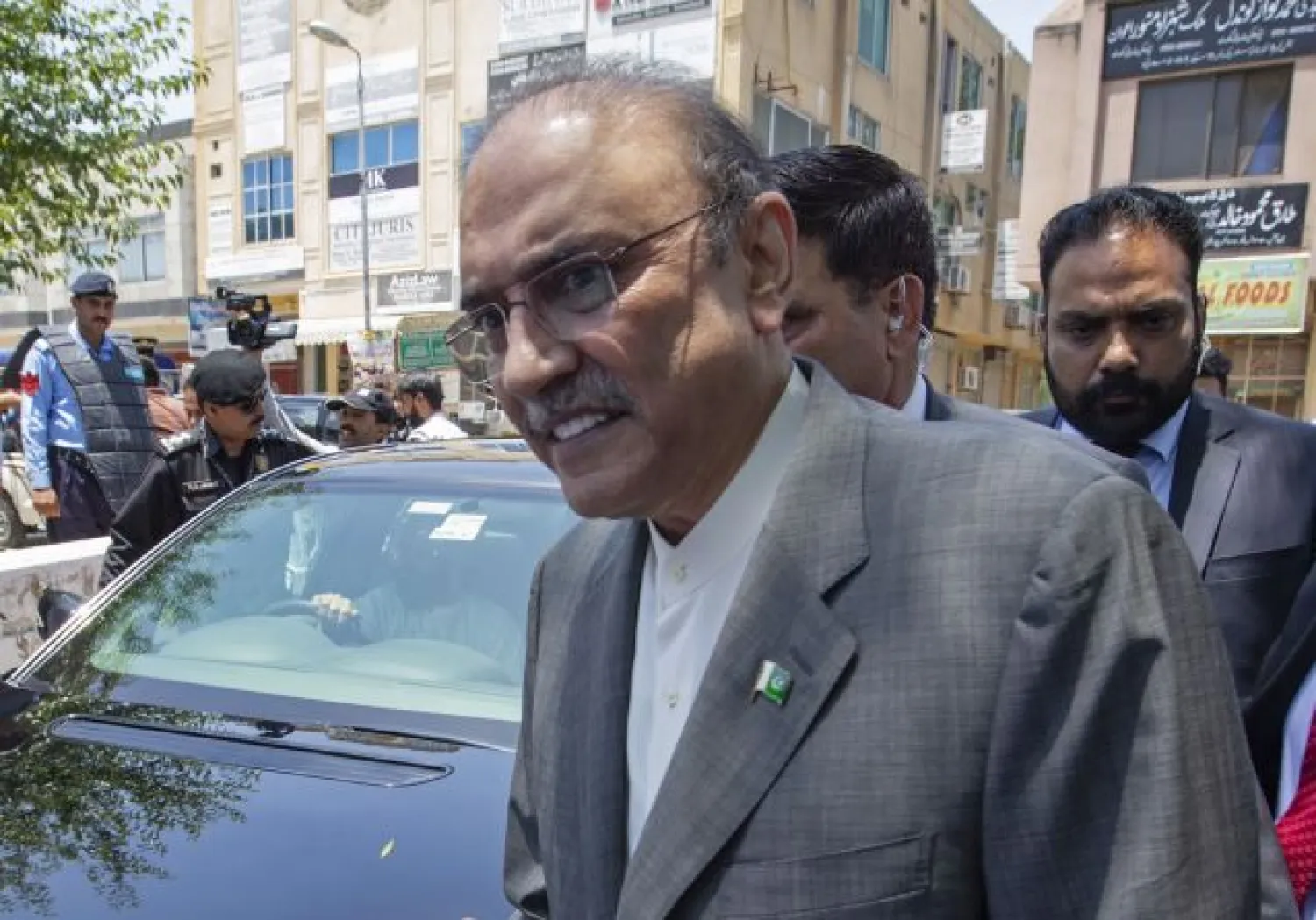
In this June 10, 2019 file photo, former Pakistani President Asif Ali Zardari leaves the High Court building, in Islamabad, Pakistan. On Monday, Oct. 5, 2020, a Pakistani court charged Zardari in two corruption cases, escalating the legal challenges facing the now leading opposition lawmaker and widower of assassinated former Pakistani Prime Minister Benazir Bhutto. The development came as Zardari's party and a key anti-government ally were preparing for a massive rally against Prime Minister Imran Khan later this month. (AP Photo/B.K. Bangash, File)
TT

Pakistan Officially Charges Ex-President Zardari for Graft

In this June 10, 2019 file photo, former Pakistani President Asif Ali Zardari leaves the High Court building, in Islamabad, Pakistan. On Monday, Oct. 5, 2020, a Pakistani court charged Zardari in two corruption cases, escalating the legal challenges facing the now leading opposition lawmaker and widower of assassinated former Pakistani Prime Minister Benazir Bhutto. The development came as Zardari's party and a key anti-government ally were preparing for a massive rally against Prime Minister Imran Khan later this month. (AP Photo/B.K. Bangash, File)

A Pakistani court on Monday officially charged the country's former President Asif Ali Zardari in two corruption cases, escalating the legal challenges facing the now leading opposition lawmaker and widower of assassinated former Pakistani Prime Minister Benazir Bhutto.

The development came as Zardari's party and a key anti-government ally were preparing for a massive rally against Prime Minister Imran Khan later this month. Zardari was released on bail on medical grounds last December, six months after his arrest.

Zardari became president in 2008, after Pakistan´s former military dictator Pervez Musharraf was forced to resign. Bhutto served twice as a prime minister before she was killed by the Taliban in a bomb and gun attack in 2007. Zardari served as Pakistan´s president until 2013.

During Monday's court appearance in the capital, Islamabad, Zardari pleaded not guilty to money laundering and corruption charges. He later told reporters he was not surprised by the indictment and that charges are something he routinely faces whenever he is in the opposition.

A member of parliament, Zardari is accused of having dozens of bogus bank accounts, a charge he denies, saying he has been politically victimized by Khan's government. Since coming to power, Khan has vowed to make good on his election campaign promise to eliminate corruption.

The government says the corruption cases against Zadari began during ex-Prime Minister Nawaz Sharif's tenure.

Zardari's Pakistan People's Parry and Sharif's Pakistan Muslim League party have called for a rally in the southwestern city of Quetta on Oct. 18. During his rule, Sharif was targeted by similar mass protests by Khan.

Last week, Sharif - speaking from his exile in London - accused Pakistan's powerful military of rigging the 2018 election that brought Khan to power. Khan has dismissed the allegations as baseless.

The 70-year-old Sharif, who served three times as prime minister, was ousted in 2017 over corruption allegations. Khan, a world-famous former cricket player, came to power in 2018.

Sharif was released on bail last year for four weeks, to seek medical treatment abroad, and has been in London since November. Last month, a court issued arrest warrants for Sharif, who was previously sentenced to seven years in prison on corruption and money laundering charges stemming from disclosures in the Panama Papers.

Pakistani police on Monday initiated another legal case against Sharif over his latest remarks about the military.



Top Israel Court Hears Petitions to Oust Far-Right Minister

Israeli Supreme Court judges assemble on the day of the hearing for a petition to force Israeli Prime Minister Benjamin Netanyahu to oust Israeli National Security Minister Itamar Ben-Gvir from his position, following allegations Ben-Gvir used his role to intervene in investigations and operational matters, at the Supreme Court in Jerusalem April 15, 2026. (Reuters)
TT

Top Israel Court Hears Petitions to Oust Far-Right Minister

Israeli Supreme Court judges assemble on the day of the hearing for a petition to force Israeli Prime Minister Benjamin Netanyahu to oust Israeli National Security Minister Itamar Ben-Gvir from his position, following allegations Ben-Gvir used his role to intervene in investigations and operational matters, at the Supreme Court in Jerusalem April 15, 2026. (Reuters)

Israel's High Court was on Wednesday hearing four petitions backed by the country's attorney general that seek to oust hardline National Security Minister Itamar Ben-Gvir.

The case is the latest example of the tension between the judiciary and one of the most right-wing governments in Israel's history, and has been sharply criticized by several other ministers.

The petitions seek Ben-Gvir's removal on the grounds that he has undermined the independence of the police.

The petitions won the support of Attorney General Gali Baharav-Miara, who in January asked the court to order Prime Minister Benjamin Netanyahu to explain why he was not dismissing the cabinet member.

In her request, Baharav-Miara accused Ben-Gvir of "abusing his position to improperly influence the activities of the Israel Police in the most sensitive areas of law enforcement and investigations, and of violating basic democratic principles".

Ahead of the hearing, Ben-Gvir was defiant, calling for the "arrest and investigation" of the attorney general.

"(She) says I set policy and change the police -- she's right. She says I interfere in appointments, and appointed more than 1,000 people in order to implement my policy -- she's right about that too," he said, flanked by supporters.

"Attempts to interfere with a minister's appointment and his powers is dangerous for democracy. Democracy will not fall; the judicial dictatorship will fall," he vowed.

Justice Minister Yariv Levin also weighed in, denouncing the hearing as "illegal" and saying "the judges' decision will have no validity".

And Foreign Minister Gideon Saar, a former justice minister, urged the court "to refrain from harming democracy", saying the case -- which seeks to compel Netanyahu to dismiss Ben-Gvir -- "goes too far," he wrote on Telegram.

On Monday, Netanyahu submitted his 129-page response to the bid to oust Ben-Gvir, arguing it was an "unconstitutional demand" and that the court lacked authority to interfere in government decisions or in the appointment of ministers.

Last month, he described the attorney general's request as "inconceivable... in the midst of an existential war", saying her call to dismiss a senior minister, against whom no criminal investigation had been opened, "harms the foundations of democracy".


UN Nuclear Chief Urges Strict Iran Checks in Any Deal to End War

01 November 2004, Austria, Vienna: The flag of the International Atomic Energy Agency (IAEA) flies in front of the UN seat in Vienna. (dpa)
TT

UN Nuclear Chief Urges Strict Iran Checks in Any Deal to End War

01 November 2004, Austria, Vienna: The flag of the International Atomic Energy Agency (IAEA) flies in front of the UN seat in Vienna. (dpa)

The head of the UN’s nuclear watchdog said Wednesday that “very detailed” measures to verify Iran’s nuclear activities must be included in a potential US-Iran agreement to end their war in the Middle East.

International Atomic Energy Agency Director General Rafael Grossi stressed the need for the thorough verification regime for Iran’s nuclear program, as US President Donald Trump said Tuesday that a second round of talks with Iran could happen over the next two days.

The Trump administration has said that preventing Iran from gaining a nuclear weapon is a key war aim. Iran has previously said it isn't developing such weapons but rejected limits on its nuclear program.

Last weekend in Pakistan, an initial round of talks between the two countries failed to produce an agreement. The White House said Iran’s nuclear ambitions were a central sticking point. But an Iranian diplomatic official, speaking on the condition of anonymity because of the sensitivity of the closed-door talks, denied that negotiations had failed over Iran’s nuclear ambitions.

“Iran has a very ambitious, wide nuclear program so all of that will require the presence of IAEA inspectors,” Grossi told reporters in Seoul. “Otherwise, you will not have an agreement. You will have an illusion of an agreement.”

He said that any agreement on nuclear technology “requires very detailed verification mechanisms.”

Iran has not allowed the IAEA access to its nuclear facilities bombed by Israel and the United States during a 12-day war in June, according to a confidential IAEA report circulated to member states and seen by The Associated Press in February.

The report stressed that it “cannot verify whether Iran has suspended all enrichment-related activities,” or the “size of Iran’s uranium stockpile at the affected nuclear facilities.”

Iran has long insisted its program is peaceful, but the IAEA and Western nations say Tehran had an organized nuclear weapons program up until 2003.

The IAEA has maintained Iran has a stockpile of 440.9 kilograms (972 pounds) of uranium enriched up to 60% purity, a short, technical step away from weapons-grade levels of 90%.

That stockpile could allow Iran to build as many as 10 nuclear bombs, should it decide to weaponize its program, Grossi said earlier.

Such highly enriched nuclear material should normally be verified every month, according to the IAEA’s guidelines.


North Korea Boosting Ability to Make Nuclear Arms, Says UN Watchdog

 Director General of the International Atomic Energy Agency (IAEA) Rafael Grossi speaks during a press conference in Seoul, South Korea, Wednesday, April 15, 2026. (Kim Hong-Ji/Pool Photo via AP)
Director General of the International Atomic Energy Agency (IAEA) Rafael Grossi speaks during a press conference in Seoul, South Korea, Wednesday, April 15, 2026. (Kim Hong-Ji/Pool Photo via AP)
TT

North Korea Boosting Ability to Make Nuclear Arms, Says UN Watchdog

 Director General of the International Atomic Energy Agency (IAEA) Rafael Grossi speaks during a press conference in Seoul, South Korea, Wednesday, April 15, 2026. (Kim Hong-Ji/Pool Photo via AP)
Director General of the International Atomic Energy Agency (IAEA) Rafael Grossi speaks during a press conference in Seoul, South Korea, Wednesday, April 15, 2026. (Kim Hong-Ji/Pool Photo via AP)

North Korea is showing a "very serious increase" in its ability to produce atomic weapons, the head of the UN nuclear watchdog said Wednesday on a visit to Seoul.

The diplomatically isolated north is believed to operate multiple facilities for enriching uranium, a key step in making nuclear warheads, South Korea's spy agency has said.

They include one at the Yongbyon nuclear site, which Pyongyang purportedly decommissioned after talks but later reactivated in 2021.

"In our periodic assessments, we have been able to confirm that there's a rapid increase in the operations" of the Yongbyon reactor, International Atomic Energy Agency (IAEA) chief Rafael Grossi told reporters in Seoul.

The agency also observed a rise in operations at Yongbyon's reprocessing unit and light-water reactor, as well as the activation of other facilities, Grossi said.

"All that points to a very serious increase in the capabilities of (the) DPRK in the area of nuclear weapons production, which is estimated at a few dozen warheads," he said, using North Korea's official name.

North Korea, which conducted its first nuclear test in 2006, is under rafts of UN sanctions for its banned weapons programs.

It has declared that it will never surrender its nuclear weapons, and cut off access to IAEA inspectors in 2009.

The agency has noted the construction of a "new facility similar to the enrichment facility in Yongbyon", Grossi said.

It was "not easy to calculate" any production increases without visiting the site.

However, "we consider, looking at external features of the facility, that there will be significant increase in the enrichment capacity of the DPRK", he said.

Asked whether Russia was assisting North Korea's nuclear development, Grossi said the IAEA had not seen "anything in particular in that regard".

North Korea has sent ground troops and artillery shells to support Russia's invasion of Ukraine, and observers say Pyongyang is receiving military technology assistance from Moscow in return.