Is It Too Late To Halt Football’s Final Descent Into a Dystopian Digital Circus?

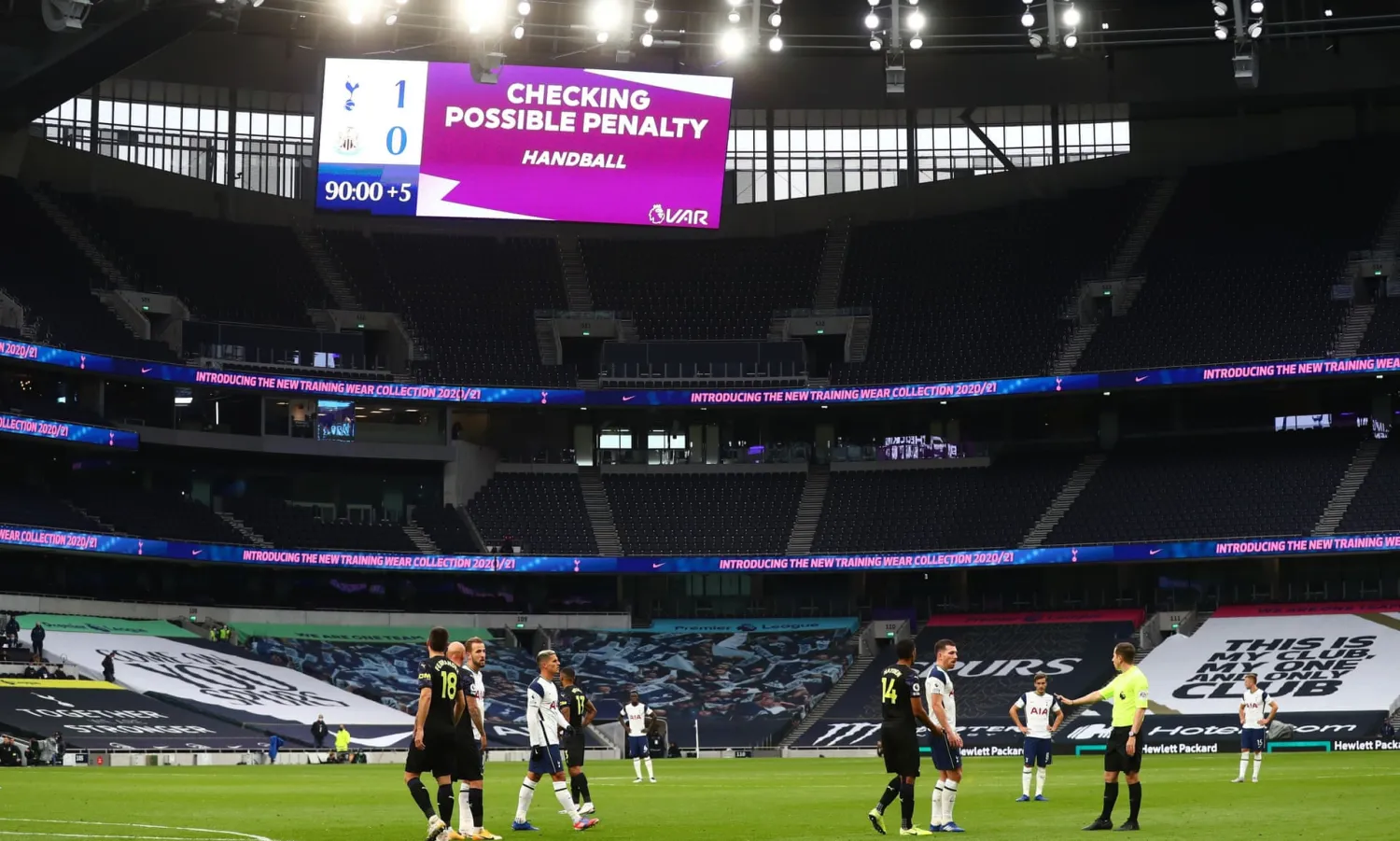
Empty stands at Tottenham v Newcastle as television stops and rewinds the play and Eric Dier is on your TV screen again. Photograph: Clive Rose/Reuters
TT

Is It Too Late To Halt Football’s Final Descent Into a Dystopian Digital Circus?

Empty stands at Tottenham v Newcastle as television stops and rewinds the play and Eric Dier is on your TV screen again. Photograph: Clive Rose/Reuters

Gradually, then suddenly. This is how history tends to work, a process in which most of the time things don’t happen, or almost happen, or seem like they probably won’t happen – right up until the moment they suddenly do.

Football has always seemed like an industry in search of its final form. The last 25 years have brought such fevered textural change it has been tempting to marvel at the clanking pistons, the gusts of steam, the unceasing revolutions.

How Covid returned English football's resources debate to centre stage
Read more
And yet it seems increasingly likely this was the gradual part. Welcome to football in 2020, an industry that might just have reached its tipping point, ready for the descent into sudden, radical, dystopian change. And it’s live!

There is no doubt the current global crisis has also presented a wonderful opportunity for those in positions of power, whose plans might otherwise have met resistance.

At Fifa’s most recent congress Gianni Infantino – who seems to have spent the last eight months trying very hard to maintain an expression of grave concern while secretly longing to boast at length about his brand new jetpack – spoke about reimagining the football calendar completely, moving every single competition to its own distinct time period, before getting a little bored of that and talking instead about some other vision of dictatorial inanity.

Advertisement
Nobody really seemed to mind, or to have the mental bandwidth to raise any concerns. Yep, Gianni. You go ahead. Now if you’ll excuse me the world is on fire and my hang-glider appears to be crashing into a lake of boiling oil.

This is the most urgent note of concern right now. If the last quarter-century has been notable for the pace of change, it has also been defined by resistance, by the squealing of brakes, by things that haven’t happened.

Football has been defined by its own ritual obsessions, by lines that cannot be crossed, by the sense of itself as something noble and protected. Well, right now the shields are down. Ground is being conceded, structural change whisked through. How much of this will we get back?

In the past resistance has tended to focus on two main areas. First, the primacy of supporters, the idea the game exists in its most authentic form as an immediate emotional experience, that football without fans is nothing.

Well … you say that. In reality this notion has simply evaporated, flushed out into the light by economic necessity. The general public can go to Selfridges or the local Wetherspoon or Manchester airport but not to a football match – and there is no lack of logic in this.

It turns out that real-life fans, while important, just aren’t central enough to football’s business model. Not at the top end anyway, where the real money and power is located. The secret is out. We, the owners of football, appreciate your presence. But we do not require it.

This is a transformative moment, not just tonally but practically. As the Premier League runs to catch up with itself, terrified of reneging on those broadcast contracts, its output has morphed into an interchangeable entertainment product. Last weekend it was possible to watch live Premier League football from midday to 10 pm, all of it basically the same homogenized, unceasing, geographically nonspecific substance.

Is this sustainable? After Bayern Munich’s Super Cup final victory, Robert Lewandowski let slip that the players didn’t celebrate because they were “all too exhausted”. Eric Dier appears to be playing football on your TV screen more or less constantly. Brave new world that has such indomitable one-paced utility defenders in it.

But this is a product being stretched thin, the glorious shared obsession recast as moving shapes on a screen cheered on by an algorithm, a digital circus on endless repeat while outside the world burns.

At the same time ground is being conceded. Late-night kick-off times, for example: will broadcasters give way on this when actual humans are allowed, grudgingly, to provide their own crowd noises?

Never mind all those fan-run issues and campaigns, from twenty-is-plenty to the idea of community engagement, of access for everyone, of the vital importance of the bond between club and supporters. All of this has simply come to a stop. Will it still be there on the other side?

Meanwhile, left alone in the ground, television has taken total control of the staging. Television stops and rewinds the play. Television countermands the referee. Television even decides now how players will stand and run and collide with one another.

The transition to a remote spectacle feels complete, to the extent it is perhaps easier simply to abandon the real-life experience and watch it all on TV, where a quarter of the action happens in any case, and where it is at least possible to understand the end result.

So profound is the direction of travel it is tempting to wonder if this will become a more lasting change. Following a football team is an act of faith, loyalty and great expense. How many will come back? How strong is that bond?

Nothing lasts forever. Things fall apart. In the shadow of all this women’s football, a growth industry but not profitable enough right now, continues to fight for air. Even the international game looks as if it may start to run up against the cold, hard economic dictatorship of elite club football.

This is the second element under threat. It is no secret that clubs in the lower leagues are skirting close to collapse. At the same time it has become a truism to state that elite football will not survive without the grand old Victorian pyramid, and that the cavalry must, of necessity, come to the rescue.

In reality the top clubs have no interest in this process. Where does your best version of the immediate future lie? With Sunderland, Gillingham, and those cobwebbed ancestral bonds? Or with SoftBank, Saudi, venture capitalism, and the new leisure economy overclass?

The European Club Association has predicted €4bn losses this season in the top-tier leagues. In a world where the bottom line is the only line, this is the real driver of change ahead.

Arsène Wenger has long maintained a borderless “super league” is inevitable because it is what those in power want. Nobody really knows what form this might take. But should it happen change is likely to come at a greater pace, with attention diluted, and with a global economic catastrophe to blur the lines.

It is of course tempting to zone out on all this, to become comfortingly enraged by the detail of the handball laws, by Manchester City’s transfer failings, by Manchester United’s travails under a manager who increasingly resembles a fond sad childhood toy found on a shelf in the attic.

But this is happening right in front of us. If the world beyond sport has begun to feel like some horrendous category mistake, a collapse into powerlessness, 30 years of structural change compacted across six months of confusion, then football is as ever in the lead, running on ahead of the tideline.

The real danger is that the new abnormal becomes the normal, that power will be grabbed, land occupied, flags planted. As ever, the only available path is resistance, in whatever form still remains.

(The Guardian)


‘Not Competitive’ Brazil Can Improve, Insists Ancelotti

Brazil's head coach Carlo Ancelotti looks on before the Mizuho Blue Challenge – The Kallang Football Series international friendly match between Japan and Brazil at the National Stadium in Singapore, 14 November 2026. (EPA)
TT

‘Not Competitive’ Brazil Can Improve, Insists Ancelotti

Brazil's head coach Carlo Ancelotti looks on before the Mizuho Blue Challenge – The Kallang Football Series international friendly match between Japan and Brazil at the National Stadium in Singapore, 14 November 2026. (EPA)

Brazil coach Carlo Ancelotti on Monday promised an improved performance in the year-ending clash against Singapore, admitting that his squad was "currently not competitive."

The Selecao lost 3-2 against Japan in a friendly in Singapore on Saturday, where Ancelotti and skipper Raphinha were red-carded after Japan scored the dramatic clincher in stoppage time.

"Given that the team is currently not competitive, I want to do more," Ancelotti told reporters in Singapore, where Brazil play on Tuesday.

The Italian, Brazil's first-ever permanent foreign coach, said: "I want to do more because I enjoy being here, so that the team can become more competitive on the global stage.

"The priority is to play well first (tomorrow) and to do well."

Ancelotti, 67, is coming under increasing pressure, following a string of underwhelming performances including two defeats, two wins and a draw in Brazil's last five international outings.

Japan avenged a 2-1 defeat by Brazil in their previous meeting at this year's World Cup, when the South Americans beat them in a round-of-32 clash.

After Saturday's loss, Ancelotti faced a barrage of criticism, including from former Brazilian national team star Romario.

Ancelotti brushed off Romario's remarks, saying "like anyone he has the right to express an opinion."

But the former Real Madrid coach, who reacted with fury after Brazil appealed for a foul in the build-up to Japan's winning goal on Saturday -- which was upheld by VAR -- said that his team "didn't deserve to lose" against Japan.

Japan face Paraguay on Tuesday in the second match of the double-header at Singapore's National Stadium.


Vinicius Says Less Training and Transfer Distractions May Explain Dip in Form

 Brazil's Vinicius Junior celebrates after goal during a friendly soccer match between Japan and Brazil in Singapore, Saturday, Nov. 14, 2026. (AP)
Brazil's Vinicius Junior celebrates after goal during a friendly soccer match between Japan and Brazil in Singapore, Saturday, Nov. 14, 2026. (AP)
TT

Vinicius Says Less Training and Transfer Distractions May Explain Dip in Form

 Brazil's Vinicius Junior celebrates after goal during a friendly soccer match between Japan and Brazil in Singapore, Saturday, Nov. 14, 2026. (AP)
Brazil's Vinicius Junior celebrates after goal during a friendly soccer match between Japan and Brazil in Singapore, Saturday, Nov. 14, 2026. (AP)

Real Madrid winger Vinicius Junior says ‌his reduced training schedule, and transfer interest, may have affected his performances in an underwhelming start to his Real Madrid season.

The Brazilian signed a new contract until 2032 in August, but so far his output on the pitch has fallen short of his own previous standards. Press scrutiny in Spain has been intensified by the impressive start of Ivorian signing Yan Diomande, who has eclipsed Vinicius in his preferred left-sided role.

“I don’t think I prepared as well as I could have after the World Cup, because ‌the impact of ‌that tournament is so significant for all ‌Brazilians," ⁠he told a ⁠press conference in Singapore on Monday.

"Being knocked out so early was something we hadn’t expected. So, I took advantage of my holidays to enjoy myself, rest, relax, and spend more time with my family. I ended up training less than in previous years," he said.

“That may have affected my start to the season."

Vinicius' future ⁠at Real Madrid was a talking point in ‌Spain for months as he entered ‌the final year of his contract before re-signing in August. Premier ‌League champions Arsenal were said to be interested at the ‌time.

"On top of that, regarding my contract renewal, with so many clubs showing interest last summer, I felt truly overwhelmed, as with the situation at Real Madrid. But it’s a very long season.”

The 26-year-old said he ‌had a track record of hitting top form in the decisive moments of the season, ⁠and that he ⁠was on a positive trajectory.

“Maintaining such a high level for so long is always very difficult," said Vinicius.

"I think only Cristiano Ronaldo and (Lionel) Messi have managed to do this for so many years, reaching the same kinds of numbers."

"I am human, I often make mistakes, but I always try to improve.”

This season Vinicius has scored one goal and given three assists in his 12 Real Madrid appearances. Coach Jose Mourinho has only used him for a full 90 minutes on three occasions.

Nevertheless, he did score twice on Saturday in Brazil's 3-2 loss to Japan, and is likely to feature in another friendly against Singapore on Tuesday.


Belgium’s Lukaku Retires from International Football

Belgium's forward #09 Romelu Lukaku celebrates after scoring his team third goal during the UEFA Nations League, League A - Group 1, football match between Belgium and Turkey at the Maurice Dufrasne stadium, in Liege, eastern Belgium on October 2, 2026. (AFP)
TT

Belgium’s Lukaku Retires from International Football

Belgium's forward #09 Romelu Lukaku celebrates after scoring his team third goal during the UEFA Nations League, League A - Group 1, football match between Belgium and Turkey at the Maurice Dufrasne stadium, in Liege, eastern Belgium on October 2, 2026. (AFP)

Belgium forward Romelu Lukaku on Monday retired from international football after scoring 94 goals in 135 games for his country, saying he was "at peace" with his decision.

Lukaku featured in four World Cups for the Red Devils and helped them reach the quarter-finals of this year's tournament before losing to eventual winners Spain.

The 33-year-old, who now plays for Turkish club Fenerbahce, made his debut in 2010 as a teenager and was an unused substitute in Sunday's 4-1 Nations League win over Italy.

"These 16 years I gave all I had for the national team. It was a nice ride and I enjoyed every single moment," Belgium's record goal scorer said on Instagram.

"To the Belgium fans, thank you for the support you gave our team. I am proud to have represented my country in 4 World Cups and 3 European Championships.

"I will never forget those moments. I'm at peace with my decision to stop here," Lukaku said.

The former Chelsea, Manchester United and Inter Milan forward was part of Belgium's so-called "golden generation".

Lukaku, alongside Kevin De Bruyne, Thibaut Courtois and Eden Hazard, finished third at the 2018 World Cup, a best-ever finish for Belgium in the tournament but they failed to lift a trophy during the period.

"I played with amazing teammates that I will always be grateful for," Lukaku said.

"I want to thank them all. I want to thank all the coaches as well for pushing and trusting me to help the team," he added.

- 'Legend, my brother' -

A host of fellow Belgian players paid tribute to Lukaku.

"Legend, my brother," midfielder Axel Witsel said on Instagram.

"Thank you for everything my bro," Courtois said.

"So many amazing memories," the Real Madrid goalkeeper added.

Lukaku's last appearance for his country came in October's 4-1 loss to France.

"Beyond his exceptional performances on the pitch, he has been a true leader, with a strong personality and an essential role in the dressing room," Lukaku's former team-mate and now Belgium's technical director Simon Mignolet said in a statement from the Belgian football association.

"We respect his decision and are deeply grateful to him for everything he has brought to our national team," the former Liverpool goalkeeper added.

Belgium's first game without Lukaku will be a Nations League last-eight fixture in March.

"We must now turn our attention to the future and prepare for the Nations League quarter-finals," Mignolet said.

"With the ambition of continuing to make progress as a team," he added.