


Belarus' Authoritarian Leader Visits his Foes in Prison

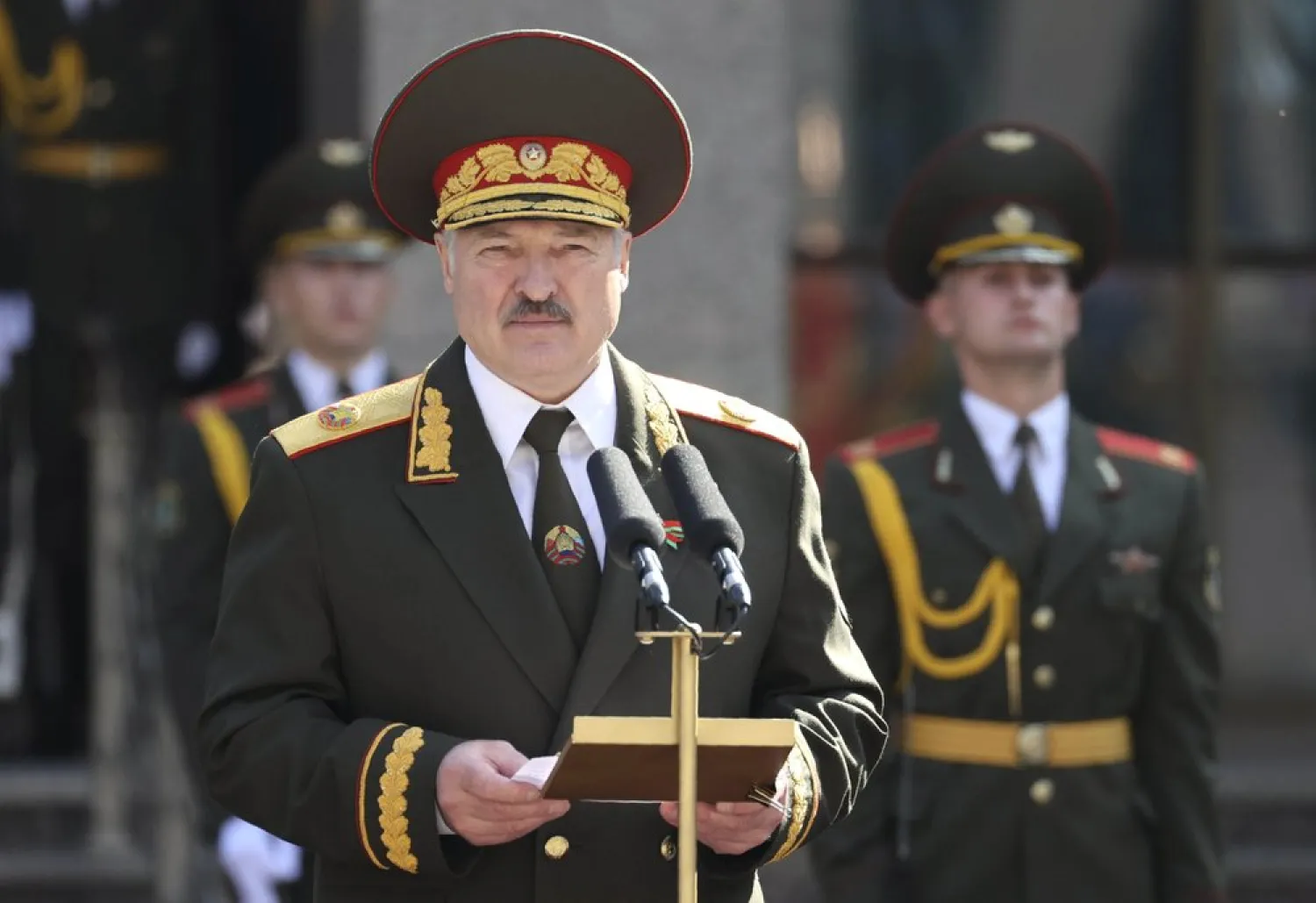
Belarusian President Alexander Lukashenko delivers a speech during his inauguration ceremony at the Palace of the Independence in Minsk, Belarus, Sept. 23, 2020. (AP)
TT

Belarus' Authoritarian Leader Visits his Foes in Prison

Belarusian President Alexander Lukashenko delivers a speech during his inauguration ceremony at the Palace of the Independence in Minsk, Belarus, Sept. 23, 2020. (AP)

Belarus' authoritarian president on Saturday visited a prison to talk to opposition activists, who have been jailed for challenging his re-election that was widely seen as manipulated and triggered two months of protests.

President Alexander Lukashenko spent more than four hours talking to his jailed political foes at the Minsk prison that belongs to Belarus' State Security Committee, which still goes under its Soviet-era name, KGB.

Lukashenko's office said that “the goal of the president was to hear everyone's opinion."

Among 11 jailed activists who attended the meeting were several members of the opposition's Coordination Council and Viktor Babariko, the former head of a major Russia-owned bank. Babariko aspired to challenge Lukashenko but was barred from the race and remained in jail since his arrest in May on charges he dismissed as political.

Lukashenko's landslide re-election in the Aug. 9 vote was widely seen as manipulated amid widespread public frustration with the Belarusian leader's 26-year authoritarian rule, his cavalier response to the coronavirus pandemic and the deteriorating economy.

A violent crackdown on peaceful demonstrators in the first days after the vote, in which thousands were arrested and hundreds were beaten by police, provoked international outrage and helped swell protesters’ ranks.

The European Union and the United States said the election was neither free nor fair. They have slapped scores of Belarusian officials with sanctions for their role in the alleged vote-rigging and the crackdown on protests, but didn’t target Lukashenko himself.

EU members Poland and Lithuania have been especially outspoken in their support for Belarusian opposition politicians, leading to diplomatic tensions that have included Belarus' government expelling Polish and Lithuanian diplomats. Those two countries responded by withdrawing their ambassadors to Minsk.

Late Friday, Britain temporarily recalled its ambassador to Belarus, Jacqueline Perkins, in response to the Belarusian government’s decision to expel the Polish and Lithuanian diplomats.

In a tweet, Foreign Secretary Dominic Raab condemned the decision, labeling it as “completely unjustified.” He said the temporary recall of the ambassador “for consultations on the situation in Belarus” was intended to show “solidarity” with the people in the country.

The government has sought to stifle protests by detaining hundreds of demonstrators, prosecuting some top activists and forcing others to leave the country. However, massive demonstrations have continued, reaching their peak numbers on Sundays when up to 100,000 flood the streets of the Belarusian capital, Minsk. Another big protest is planned for this Sunday.

Hundreds of women marched through the Belarusian capital on Saturday to protest against political repressions and demand a new election. Several participants in the rally were detained.

Pavel Latushko, a former culture minister and ambassador to France, who joined the opposition's Coordination Council and was pressured by authorities to leave the country, said that the meeting reflected the Belarusian leader's weakness.

“Lukashenko was forced to sit down at the negotiation table with the people whom he jailed,” Latushko said in a statement, demanding the release of all political prisoners.

Observers saw Lukashenko's visit to prison as part of his efforts to steal the protesters' thunder by offering vaguely-described reforms, such as his proposal to draft a new constitution. During the meeting in prison, Lukashenko emphasized that “the constitution can't be written in the streets,” his office said without offering other details of the meeting.

“After two months of protests and harsh repressions, Lukashenko is moving to de-escalate the situation,” said Valery Karbalevich, an independent Minsk-based political expert.

“The discussion of a new constitution is an attempt by the government to imitate a dialogue. It would allow Lukashenko to drown the protests in talks, reduce tensions and enforce his agenda both inside the country and to foreign players,” Karbalevich said.



Pope Leo Summons World's Cardinals for Key Assembly to Help him Govern the Church

A handout picture provided by the Vatican Media shows Pope Leo XIV presiding over the Jubilee Audience in St. Peter's Square, Vatican City, 20 December 2025.  EPA/VATICAN MEDIA HANDOUT
A handout picture provided by the Vatican Media shows Pope Leo XIV presiding over the Jubilee Audience in St. Peter's Square, Vatican City, 20 December 2025. EPA/VATICAN MEDIA HANDOUT
TT

Pope Leo Summons World's Cardinals for Key Assembly to Help him Govern the Church

A handout picture provided by the Vatican Media shows Pope Leo XIV presiding over the Jubilee Audience in St. Peter's Square, Vatican City, 20 December 2025.  EPA/VATICAN MEDIA HANDOUT
A handout picture provided by the Vatican Media shows Pope Leo XIV presiding over the Jubilee Audience in St. Peter's Square, Vatican City, 20 December 2025. EPA/VATICAN MEDIA HANDOUT

Pope Leo XIV has summoned the world’s cardinals for two days of meetings to help him govern the church, the Vatican said Saturday, in the clearest sign yet that the new year will signal the unofficial start of his pontificate.

The consistory, as such gatherings are called, will be held Jan. 7-8, immediately following the Jan. 6 conclusion of the 2025 Holy Year, a once-every-quarter century celebration of Christianity.

Leo’s first few months as pope have been dominated by fulfilling the weekly Holy Year obligations of meeting with pilgrimage groups and celebrating special Jubilee audiences and Masses. Additionally, much of his time has been spent wrapping up the outstanding matters of Pope Francis' pontificate.

As a result, the January consistory in many ways will mark the first time that Leo can look ahead to his own agenda following his May 8 election as the first American pope. It is significant that he has summoned all the world’s cardinals to Rome, The Associated Press reported.

Francis had largely eschewed the consistory tradition as a means of governance. He had instead relied on a small group of eight or nine hand-picked cardinal advisers to help him govern and make key decisions.

The Vatican said Saturday that Leo’s first consistory “will be oriented toward fostering common discernment and offering support and advice to the Holy Father in the exercise of his high and grave responsibility in the government of the universal Church.”

Other types of consistories include the formal installation of new cardinals. But no new cardinals will be made at this meeting, which is purely consultative.


Iran, UK Foreign Ministers in Rare Direct Contact

Iranian Foreign Minister Abbas Araghchi gestures during a joint news conference with Russian Foreign Minister Sergei Lavrov at Zinaida Morozova's Mansion in Moscow, Wednesday, Dec. 17, 2025. (Ramil Sitdikov/Pool Photo via AP)
TT

Iran, UK Foreign Ministers in Rare Direct Contact

Iranian Foreign Minister Abbas Araghchi gestures during a joint news conference with Russian Foreign Minister Sergei Lavrov at Zinaida Morozova's Mansion in Moscow, Wednesday, Dec. 17, 2025. (Ramil Sitdikov/Pool Photo via AP)

Iran's Foreign Minister Abbas Araghchi has spoken by phone with his British counterpart Yvette Cooper, an Iranian foreign ministry statement said on Saturday, in a rare case of direct contact between the two countries.

The ministry said that in Friday's call the ministers "stressed the need to continue consultations at various levels to strengthen mutual understanding and pursue issues of mutual interest."

According to AFP, a UK government source said Cooper "emphasized the need for a diplomatic solution on Iran's nuclear program and raised a number of other issues."

The source in London said Cooper raised the case of Lindsay and Craig Foreman, a British couple detained in Iran for nearly a year on suspicion of espionage.

The Iranian ministry statement did not mention the case of the two Britons.

It said Araghchi criticized "the irresponsible approach of the three European countries towards the Iranian nuclear issue", referring to Britain, France and Germany.

The three countries at the end of September initiated the reinstatement of UN sanctions against Iran because of its nuclear program.

The Foremans, both in their early fifties, were seized in January as they passed through Kerman, in central Iran, while on a round-the-world motorbike trip.

Iran accuses the couple of entering the country pretending to be tourists so as to gather information for foreign intelligence services, an allegation the couple's family rejects.

Before Friday's call, the last exchange between the two ministers was in October.


Netanyahu Plans to Brief Trump on Possible New Iran Strikes, NBC News Reports

Israeli Prime Minister Benjamin Netanyahu speaks at the plenum of the Knesset, Israel's parliament, in Jerusalem, November 10, 2025. REUTERS/Ronen Zvulun/File Photo
TT

Netanyahu Plans to Brief Trump on Possible New Iran Strikes, NBC News Reports

Israeli Prime Minister Benjamin Netanyahu speaks at the plenum of the Knesset, Israel's parliament, in Jerusalem, November 10, 2025. REUTERS/Ronen Zvulun/File Photo

US President Donald Trump is ​set to be briefed by Israel's Prime Minister Benjamin Netanyahu that any expansion ‌of ‌Iran's ‌ballistic ⁠missile ​program ‌poses a threat that could necessitate swift action, NBC News reported on Saturday.

Israeli ⁠officials are ‌concerned that Iran ‍is ‍reconstituting nuclear enrichment ‍sites the US bombed in June, and ​are preparing to brief Trump for options ⁠on attacking the missile program again, the NBC report added.

Reuters could not verify the report.

New satellite imagery shows recent activity at the Natanz nuclear facility that was damaged during June's 12-day war with Israel, according to the US-based Institute for Science and International Security (ISIS).

During the June conflict, the IAEA confirmed Israeli strikes hit Iran's Natanz underground enrichment plant.

The think tank said the satellite imagery from December 13 show panels placed on top of the remaining anti-drone structure at the Pilot Fuel Enrichment Plant (PFEP), providing cover for the damaged facility.

It suggested the new covering allows Iran to examine or retrieve materials from the rubble while limiting external observation.

The Natanz uranium enrichment facility, located some 250 km south of the Iranian capital Tehran, is one of Iran's most important and most controversial nuclear facilities in the Middle East.