

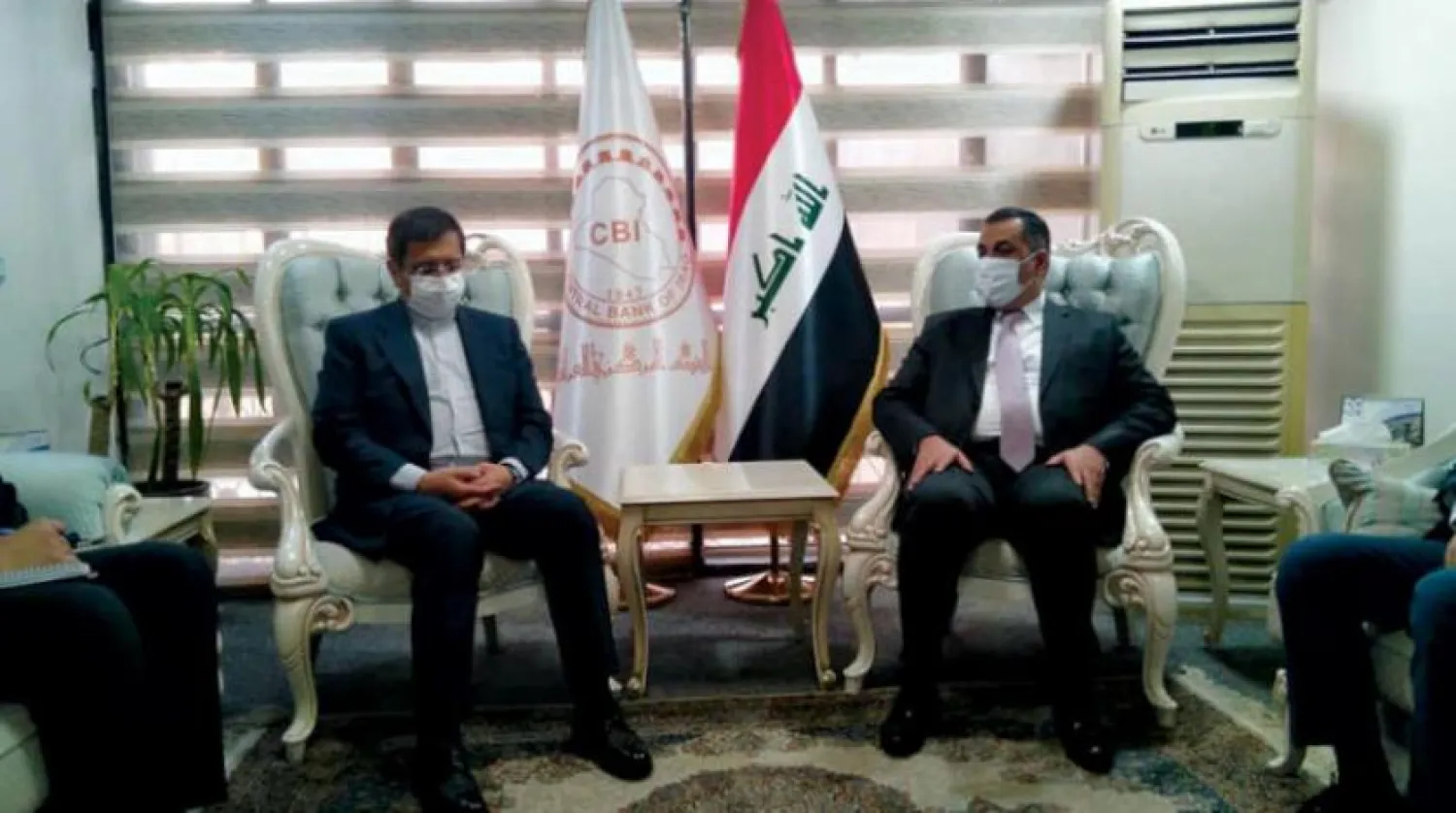

Iran Central Bank Announces Deal to Unlock Funds in Baghdad

Governor of Central Bank of Iran (CBI) Abdolnaser Hemmati holds talks with his Iraqi counterpart, Mustafa Ghalib Mukheef, in Baghdad on Monday, October 12, 2020 (IRNA)
TT

Iran Central Bank Announces Deal to Unlock Funds in Baghdad

Governor of Central Bank of Iran (CBI) Abdolnaser Hemmati holds talks with his Iraqi counterpart, Mustafa Ghalib Mukheef, in Baghdad on Monday, October 12, 2020 (IRNA)

Iran’s central bank chief said on Monday an agreement has been reached with Iraqi officials to unlock Iranian funds.

Governor of Central Bank of Iran (CBI) Abdolnaser Hemmati arrived in Baghdad on Monday for a one-day visit to develop banking and trade cooperation.

His remarks were made following talks with Governor of Iraq's Central Bank Mustafa Ghalib Mukheef and Chief of the Trade Bank of Iraq Salem Jawad Abdul Hadi al-Jalabi.

The official Iraqi and Iranian sides said the visit comes in line with bilateral banking cooperation. However, economists say the move aims to reduce the effects of the US sanctions against Tehran.

IRNA quoted Hemmati as saying that he had reached an agreement with officials of Iraq’s Central Bank and the Trade Bank of Iraq on the release of Iran’s financial assets to buy essential goods for the country.

He noted that his country has “significant” financial resources in Iraqi banks. The financial resources are Iran’s revenues derived from the export of electricity and gas to the neighboring country.

Hemmati also met with Iraqi Prime Minister Mustafa al-Kadhimi, who promised to follow up the implementation of the agreement during this week, IRNA reported.

Referring to its positive talks with Iraqi officials, the Governor expressed hope that the agreement would help both countries take positive steps toward developing economic and banking relations.

Fars News Agency of the Iranian Revolutionary Guard Corps said Mukheef proposed that both countries set up a joint committee to explore means to resolve financial issues.

Last week, the US Treasury Department’s Office of Foreign Assets Control (OFAC) sanctioned 18 major Iranian banks.

Secretary Steven T. Mnuchin said this action reflects the commitment to stop illicit access to US dollars.

“Our sanctions programs will continue until Iran stops its support of terrorist activities and ends its nuclear programs,” he stressed, adding that sanctions will continue to allow humanitarian transactions to support the Iranian people.

Commenting on the Iranian official’s visit, Economist and Professor at the Iraqi University Abdulrahman al-Mashhadani said it is very obvious that Iranians are looking for a way out of the crisis created by the US sanctions.

He told Asharq Al-Awsat that the new sanctions against Tehran have affected major Iranian banks that finance the country’s import and export processes.

Facing such a major issue forced Iran to seek, through the Iraqi banking sector, to circumvent these sanctions, especially that it is known to have many banks in Iraq that secretly operate to serve their interests, Mashhadani noted.

Monetary Policy Professor at Baghdad University Ihsan Jaber agreed with Mashhadani that the visit was aimed at facing US sanctions through Iraq.

Jaber told Asharq Al-Awsat that this visit is not beneficial to Iraq, and it may have dire consequences if the US discovers that Iraq has become a conduit for Iranian funds.

The US Treasury has previously enlisted some of the Iraqi banks for their dealings with the IRGC, Lebanese Hezbollah and other groups, he stressed.



US Slaps Sanctions on Sudan’s RSF Commanders over El-Fasher Killings

FILE - A Sudanese child, who fled el-Fasher city with family after Sudan's RSF attacked the western Darfur region, receives treatment at a camp in Tawila, Sudan, Nov. 2, 2025. (AP Photo/Mohammed Abaker, File)
TT

US Slaps Sanctions on Sudan’s RSF Commanders over El-Fasher Killings

FILE - A Sudanese child, who fled el-Fasher city with family after Sudan's RSF attacked the western Darfur region, receives treatment at a camp in Tawila, Sudan, Nov. 2, 2025. (AP Photo/Mohammed Abaker, File)

The United States announced sanctions on Thursday on three Sudanese Rapid Support Forces (RSF) commanders over their roles in the "horrific campaign" of the siege and capture of El-Fasher.

The US Treasury said the RSF carried out "ethnic killings, torture, starvation, and sexual violence" in the operation.

Earlier Thursday, the UN's independent fact-finding mission on Sudan said the siege and seizure of the city in Darfur bore "the hallmarks of genocide."

Its investigation concluded that the seizure last October had inflicted "three days of absolute horror," and called for those responsible to be brought to justice.

"The United States calls on the Rapid Support Forces to commit to a humanitarian ceasefire immediately," US Treasury Secretary Scott Bessent said in a statement.

"We will not tolerate this ongoing campaign of terror and senseless killing in Sudan."

The Treasury noted that the three sanctioned individuals were part of the RSF's 18-month siege of and eventual capture of El-Fasher.

They are RSF Brigadier General Elfateh Abdullah Idris Adam, Major General Gedo Hamdan Ahmed Mohamed and field commander Tijani Ibrahim Moussa Mohamed.

Bessent warned that Sudan's civil war risks further destabilizing the region, "creating conditions for terrorist groups to grow and threaten the safety and interests of the United States."

The UN probe into the takeover of El-Fasher -- after the 18-month siege -- concluded that thousands of people, particularly from the Zaghawa ethnic group, "were killed, raped or disappeared."


Rocket Re-entry Pollution Measured in Atmosphere for 1st Time

A SpaceX Falcon 9 rocket with the company's Dragon spacecraft on top launches from Space Launch Complex 40 for the Crew-12 mission at Cape Canaveral Space Force Station in Florida on February 13, 2026. (Photo by Jim WATSON / AFP)
TT

Rocket Re-entry Pollution Measured in Atmosphere for 1st Time

A SpaceX Falcon 9 rocket with the company's Dragon spacecraft on top launches from Space Launch Complex 40 for the Crew-12 mission at Cape Canaveral Space Force Station in Florida on February 13, 2026. (Photo by Jim WATSON / AFP)

When part of a SpaceX rocket re-entered Earth's atmosphere exactly a year ago, it created a spectacular fireball that streaked across Europe's skies, delighting stargazers and sending a team of scientists rushing towards their instruments.

The German team managed to measure the pollution the rocket's upper stage emitted in our planet's difficult-to-study upper atmosphere -- the first time this has been achieved, according to a study published on Thursday.

It is vital to learn more about this little-understood form of pollution because of the huge number of satellites that are planned to be launched in the coming years, the scientists emphasized.

In the early hours of February 19, 2025, the upper stage of a Falcon 9 rocket was tumbling back to Earth when it exploded into a fireball that made headlines from the UK to Poland.

"We were excited to try and test our equipment and hopefully measure the debris trail," the team led by Robin Wing and Gerd Baumgarten of the Leibniz Institute of Atmospheric Physics in Germany told AFP via email.

In particular, the scientists wanted to measure how the rocket polluted what they call the "ignorosphere" -- because it is so difficult to study.

This region between 50 to 100 kilometers (31 to 62 miles) above Earth includes the mesosphere and part of the lower thermosphere.

- 'Harbinger' -

The team used technology called LIDAR, which measures pollution in the atmosphere by shooting out lots of laser pulses and seeing which bounce back off something.

They detected a sudden spike in the metal lithium in an area nearly 100 kilometers above Earth. This plume had 10 times more lithium than is normal in this part of the atmosphere.

The team then traced the plume back to where the rocket re-entered the atmosphere, west of Ireland.

For the first time, this proves it is possible to study pollution from re-entering rockets at such heights before it disperses, the scientists said.

But the impact from this rocket pollution remains unknown.

"What we do know is that one ton of emissions at 75 kilometers (altitude) is equivalent to 100,000 tons at the surface," they said.

The study warned the case was a "harbinger" of the pollution to come, given how many rockets will be needed to launch all the satellites that Earth is planning to blast into space.

Currently, there are around 14,000 active satellites orbiting our planet.
In the middle of last month, China applied for permission to launch around 200,000 satellites into orbit.

Then at the end of January, billionaire Elon Musk's SpaceX applied for permission to launch one million more.

Eloise Marais, a professor of atmospheric chemistry at University College London not involved in the new study, told AFP the research was "really important".

"There is currently no suitable regulation targeting pollution input into the upper layers of the atmosphere," she explained.

"Even though these portions of the atmosphere are far from us, they have potentially consequential impacts to life on Earth if the pollutants produced are able to affect Earth's climate and deplete ozone in the layer protecting us from harmful UV radiation."

The study was published in the journal Communications Earth & Environment.


Israel's Netanyahu Says No Reconstruction of Gaza before Demilitarization

Israel’s Prime Minister Benjamin Netanyahu - File Photo/AFP
TT

Israel's Netanyahu Says No Reconstruction of Gaza before Demilitarization

Israel’s Prime Minister Benjamin Netanyahu - File Photo/AFP

Israeli Prime Minister Benjamin Netanyahu said on Thursday there would be no reconstruction of war-shattered Gaza before the disarmament of Hamas, as the "Board of Peace" convened for its inaugural meeting in Washington.

Around two dozen world leaders and senior officials met for the first meeting of the board, which was set up after the United States, Qatar and Egypt negotiated a ceasefire in October to halt two years of war in the Gaza Strip.

"We agreed with our ally the US there will be no reconstruction of Gaza before the demilitarization of Gaza," Netanyahu said during a televised speech at a military ceremony on Thursday, AFP reported.

The meeting in Washington will also look at how to launch the International Stabilization Force (ISF) that will ensure security in Gaza.

One of the most sensitive issues before the board is the future of the Islamist movement Hamas, which fought the war with Israel and still exerts influence in the territory.

Disarmament of the group is a central Israeli demand and a key point in negotiations over the ceasefire's next stage.

US officials including Steve Witkoff, Trump's friend and roving negotiator, have insisted that solid progress is being made and that Hamas is feeling pressure to give up weapons.

Israel has suggested sweeping restrictions including seizing small personal rifles from Hamas.

It remains unclear whether, or how, the Palestinian technocratic committee formed to handle day-to-day governance of Gaza will address the issue of demilitarization.

The 15-member National Committee for the Administration of Gaza (NCAG) will operate under the supervision of the "Board of Peace", and its head, Ali Shaath, is attending the meeting in Washington on Thursday.