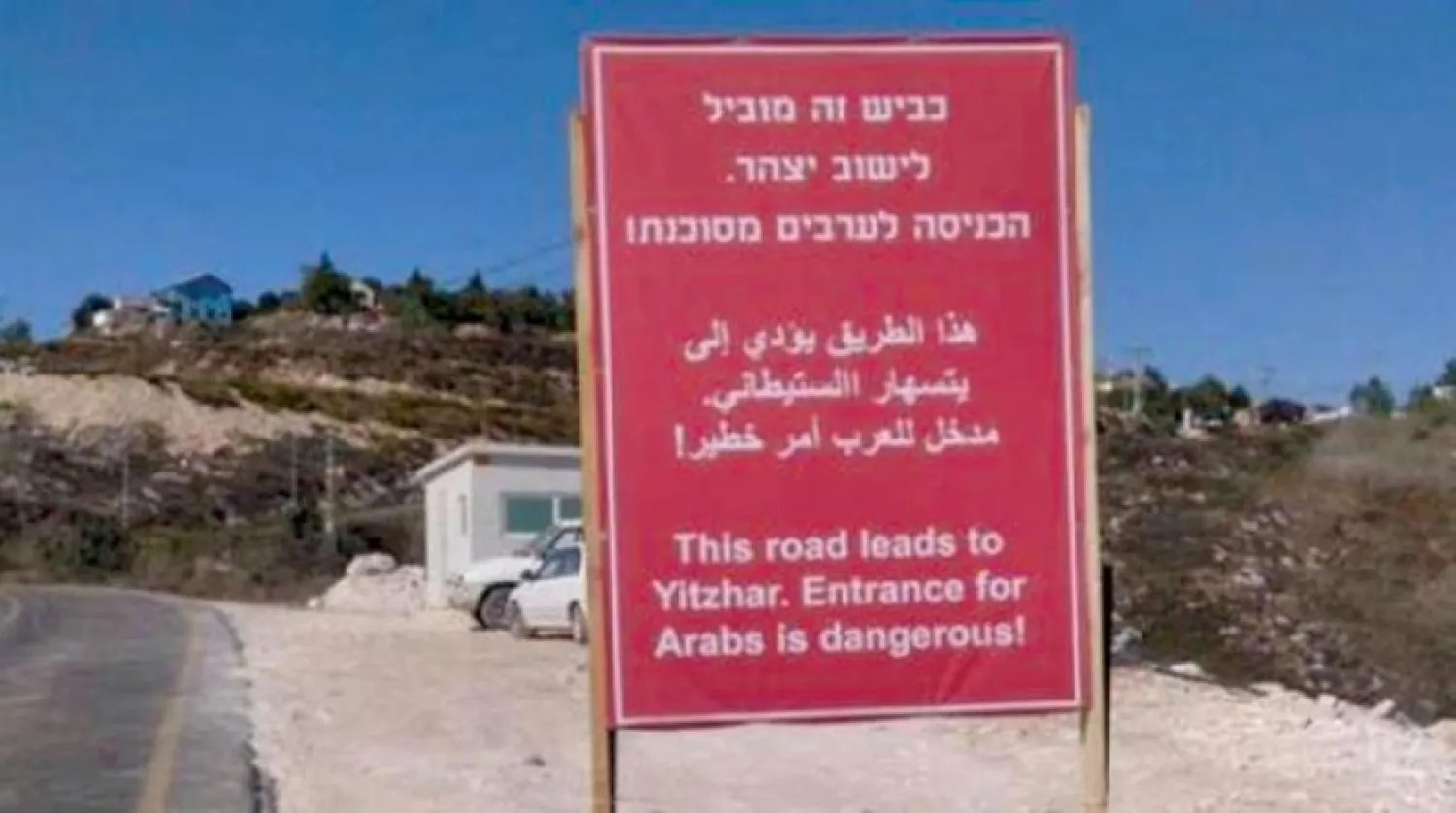
Anti-Arab Sign Sparks Dispute among Israeli Settlers

The anti-Arab racist sign at the entrance to Yitzhar settlement that was removed by Israeli police
TT

Anti-Arab Sign Sparks Dispute among Israeli Settlers

The anti-Arab racist sign at the entrance to Yitzhar settlement that was removed by Israeli police

An anti-Arab sign placed on the road outside the Israeli army-run Yitzhar settlement, near Nablus, has prompted accusations of racism among settlers.

Some settlement leaders launched a campaign against their allies, with a former general urging them to stop taking foolish decisions that would cause great harm to settlers and to the image of the Jewish State in the world.

The sign appeared after a dispute between the settlement and the army when the Ministry of Health sent a medical team for PCR tests. But settlers stopped the team for being headed by an Arab doctor.

An Israeli police official dubbed the racist decision “foolish.”

Human rights groups raised the issue with the area’s military commander, who said the action was illegal.

The sign included a phrase written in three languages, Hebrew, Arabic and English. “This road leads to Yitzhar. Entrance for Arabs in dangerous!” it read.

Police removed it, but the incident was highly criticized even by settlers and right-wing Israelis.

In 1983, the Gush Emunim settlement of Yitzhar was built by newcomers from the United States on top of a mountain located south of Nablus city.

Emerging from this settlement, a group of Israeli settlers affiliated with the “Price Tag” movement launched attacks against neighboring Palestinian villages and towns.

Every time Israeli authorities take action against their illegal practices, they take their revenge from Palestinians, by burning mosques, storming their towns, vandalizing cars and smashing windows.

In 2015, they carried out a deadly arson attack on the Palestinian Dawabsheh family in the village of Duma in the West Bank.

They also incite for killing Arabs by writing racist mottos on walls of Palestinian houses.

Every now and then, settlers throw stones on Palestinian vehicles, injuring passengers. In October 12, 2019, Aisha Rabi, 45, died after settlers threw stones at the car she was traveling in with her family in the West Bank.

In olive harvest seasons, these settlers enjoy burning olive trees or stealing olives from Palestinian lands.

Over the past few years, many Yitzhar settlers had carried out attacks against Israeli police forces, set their vehicles on fire and assaulted Israeli journalists.

On Tuesday, settlers attacked journalist Ohad Hemo by throwing stones at him at an olive grove in the West Bank while he was covering clashes between settler youth and Palestinian farmers in the area.


UN Mission Condemns Calls for Violence Against its Staff in Libya

Protesters gather outside the headquarters of the United Nations High Commissioner for Refugees (UNHCR), in Tripoli, Libya, June 4, 2026. Picture taken with a mobile phone. REUTERS/Ayman al-Sahili
TT

UN Mission Condemns Calls for Violence Against its Staff in Libya

Protesters gather outside the headquarters of the United Nations High Commissioner for Refugees (UNHCR), in Tripoli, Libya, June 4, 2026. Picture taken with a mobile phone. REUTERS/Ayman al-Sahili

The United Nations Support Mission in Libya denied on Friday that its refugee agency is seeking to resettle irregular migrants in the country, affirming that “allegations to the contrary are categorically false.”

UNSMIL said in a statement it took note of the demonstrations held in front of its premises and those of the Office of the United Nations High Commissioner for Refugees.

“The United Nations affirms the right of all Libyans to obtain accurate information, and their right to express their opinions peacefully in accordance with what is guaranteed by Libyan and international laws,” the mission said.

“UNSMIL is concerned about the spread of misinformation, disinformation and hate speech regarding the work of the UN in Libya, which has contributed to heightened tensions and incitement against UN national and international staff,” it added.

The UN in Libya reiterated that none of its agencies, including UNHCR, implement any resettlement programs to Libya. “Allegations to the contrary are categorically false,” the mission affirmed.

It said the Office works in cooperation with Libyan authorities and the international community, within the framework of full respect for Libya's sovereignty, to find solutions outside Libya for persons fleeing wars, conflicts, and persecution, including evacuations to third countries and voluntary returns to their home countries when circumstances permit.

The Mission condemned “any incitement to violence, threats against UN personnel, and acts of vandalism and/or attacks against United Nations staff, premises, and property.”

It called on all parties to respect the inviolability of UN premises, staff, property, and assets in accordance with international law.

The UN in Libya also expressed its appreciation to the relevant authorities in Tripoli for their efforts in maintaining public order and ensuring the safety and security of the demonstrators, as well as UN staff and facilities.

UNSMIL’s statement came amid heightened debate within Libya over the issue of irregular migration, and growing popular and official demands for tougher measures to address the trend.

On Thursday, angry Libyan demonstrators blocked off the office of the UN refugee agency in the capital Tripoli during a protest against migrants who have travelled to the country in search of work or passage to Europe.

They demanded the UN to shut down its offices in Libya, acting on reports that resettlement cards were being distributed by the UNHCR to refugees and illegal immigrants in Libya.

Later, other Libyan protesters who oppose the resettlement of migrants, stormed the mission’s headquarters in the Janzour area, west of Tripoli before Libyan security forces intervened, dispersed the crowds, and secured UN and local staff inside the compound.

On Friday night, the UN mission in Libya issued a statement affirming that a fruitful dialogue requires all parties to engage in good faith to achieve constructive and sustainable outcomes.

The mission again condemned any incitement to violence, saying, “There is no justification for violence or intimidation, which we know does not align with Libyan culture, traditions, and values.”


Illegal Gold Mining Puts Egypt Investment at Risk

Egypt’s petroleum minister tours the Sukari gold mine. (Petroleum Ministry)
TT

Illegal Gold Mining Puts Egypt Investment at Risk

Egypt’s petroleum minister tours the Sukari gold mine. (Petroleum Ministry)

Illegal gold mining in Egypt threatens “investment opportunities and the ability to benefit from the country’s reserves,” as “clashes among illegal prospectors” continue to recur.

Businessman Naguib Sawiris said Egypt’s mineral wealth was being continuously wasted because of random and illegal mining by outlaws, adding that most mining companies suffer from illegal practices that can include threats with weapons.

Commenting on a report on global gold and silver reserves on his X account, Sawiris said such practices, carried out by people, some of whom are not Egyptian, deprive Egypt of becoming one of the countries with the largest gold reserves.

Sawiris is among the businessmen who have long been enthusiastic about investing in gold. In late April, he spoke of injecting about $400 million into the gold mining company in which he is a shareholder, and has bet on gold prices even during periods of price turbulence.

Rahab al-Ghoul, a member of parliament’s Energy and Environment Committee, told Asharq Al-Awsat that illegal mining for gold and minerals threatens investment opportunities, adding that there have been significant efforts recently to confront it. She said that in some desert and mountainous areas, there is cooperation between state agencies and citizens to confront those prospecting for gold.

She added that the state can exercise its sovereignty over any area where foreign companies want to explore, and that the Petroleum Ministry is already holding exploration tenders and cooperating with companies with experience in the field. She stressed the government’s keenness to encourage investment and resolve any obstacles facing investors.

Early last month, the Interior Ministry announced the arrest of a man accused of killing eight others after a fight among a number of people illegally prospecting for gold in the Red Sea governorate in southeastern Egypt.

The incident came one day after one person was killed in similar clashes in the mountainous al-Baramiya area in Aswan governorate in southern Egypt.

There are no official statistics on illegal mining operations, which usually involve selling minerals at prices below their real value.

Economist Karim al-Omda spoke of the difficulties facing investors in gold and silver exploration, including illegal mining operations, or the lack of agreement on attractive shares and incentives for foreign companies, which at times demand high percentages of exploration revenues.

Al-Omda told Asharq Al-Awsat that there is a clear absence of a government investment vision for this sector, unlike the clear vision, for example, in the gas and oil sector. He said random mining wastes existing wealth by depleting it.

Egyptian Minister of Petroleum and Mineral Resources Karim Badawi said during a meeting with leaders of three global mining companies last Wednesday that reforms had been implemented to develop the role of the Mineral Resources Authority so that it becomes an independent economic entity capable of supporting investors with data and technical services, in addition to activating the one-stop-shop mechanism to facilitate dealings with government bodies.

He said at the time that the modern airborne survey project represented an important step toward providing more accurate geological data on promising areas, helping investors make better investment decisions and increasing the likelihood of new discoveries, especially since Egypt has significant mining potential that has not yet been fully exploited.

The government is seeking to launch a major international gold exploration tender covering more than 210 areas in the Eastern Desert, aiming to attract $1 billion in investments by 2030 to increase production.

This comes as part of a plan to raise the mining sector’s contribution to gross domestic product from less than 1% to about 6% by 2030, according to local media reports.

Late last year, the government approved several incentives in the mining sector, including lowering licensing fees and granting tax and customs exemptions on exploration equipment, supplies, and related services, according to repeated statements by the Petroleum Ministry.

Al-Ghoul said these decisions reflect the state's current investment priority in mineral exploration, including gold, adding that some obstacles are being overcome gradually to achieve the maximum benefit.


Iraq’s PMF Declares ‘Complete Split’ from Parties, Factions

PMF chief Faleh al-Fayyadh. (INA)
TT

Iraq’s PMF Declares ‘Complete Split’ from Parties, Factions

PMF chief Faleh al-Fayyadh. (INA)

The head of Iraq’s Popular Mobilization Forces announced the start of implementation of a government order by Prime Minister Ali al-Zaidi, who is also commander-in-chief of the armed forces, to form a committee tasked with reorganizing the relationship with armed factions.

The move is officially being presented as part of a broader effort to place all weapons under state control.

PMF chief Faleh al-Fayyadh said in a television interview that the new committee had begun work on mechanisms for the “complete disengagement” of the PMF from any political, factional, or partisan frameworks.

The aim was to turn the PMF into an institution governed by a unified system and linked to the commander-in-chief of the armed forces, he added.

Fayyadh said the effort was based on the 2016 law governing the PMF and on successive government orders. But he said the war against ISIS had prevented full implementation over the past years.

In a related development, Sabah al-Numan, spokesman for the commander-in-chief of the armed forces, confirmed that a government order had been issued to form a “sovereign” committee that would set binding mechanisms to end the possession of weapons outside state control.

He warned against what he described as the continued “politicization of the military institution,” saying national security required control over weapons.

Fayyadh rejects calls to dissolve PMF

At the same time, Fayyadh rejected local and diplomatic calls to dissolve the PMF after the end of “major battles”, describing such demands as “unrealistic.”

He said the need for security forces, including the PMF, was “permanent” as long as security threats continued.

Fayyadh said those who believed the PMF’s role had ended had a “superficial view,” referring to criticism he sees as driven by political opposition to his forces.

In a more sensitive file, Fayyadh revealed special arrangements involving brigades affiliated with Saraya al-Salam, which is linked to the Sadrist movement, in Samarra.

He said the brigades would be integrated into the PMF structure under new professional arrangements.

The Saraya al-Salam had handed over their security responsibilities to the Iraqi army in Samarra city on Thursday.

Fayyadh said these formations would be “received as individuals and restructured or redeployed in the field as needed.”

He said the objective was to end the idea of “areas belonging to certain factions” in favor of unified military administration.

In a notable statement, he added that some sites would be placed under temporary transitional arrangements supervised by the Iraqi army before being finally redistributed within the PMF.

The developments come as the head of the Security Media Cell, Lieutenant General Saad Maan, announced the start of steps to implement the decision to place weapons under state control.

He said a number of factions, including Asaib Ahl al-Haq and Kataib al-Imam Ali, had begun legal procedures to hand over heavy and medium weapons ahead of integration into official institutions.

Other factions, including Kataib Hezbollah, the Nujaba movement, and Kataib Sayyid al-Shuhada, continue to reject handing over their weapons.

They said disarmament depends on achieving the “goals for which they were formed,” particularly those linked to the presence of foreign forces in Iraq.

The security spokesman for Kataib Hezbollah, Abu Mujahid al-Assaf, said some current initiatives “do not represent the factions of the Islamic Resistance.” The Nujaba said in a statement that weapons were a “red line.”

‘Unified standards’

Fayyadh said the current stage represented a “starting point” for applying unified standards to all formations.

He warned against any political or partisan links within the military structure and said implementation would include all brigades without exception.

Local press reports said leaders of the Coordination Framework have received signals that Washington will not accept symbolic disarmament.

The reports said Washington is instead pushing for the “dissolution of the PMF” and firmly rejects its integration into other security institutions.

Separately, Numan denied on Friday reports of changes in senior leadership positions in the military and security institutions.

He said current commanders were continuing to perform their duties and national responsibilities normally.