Soyuz Delivers Astronauts to ISS in Three Hours

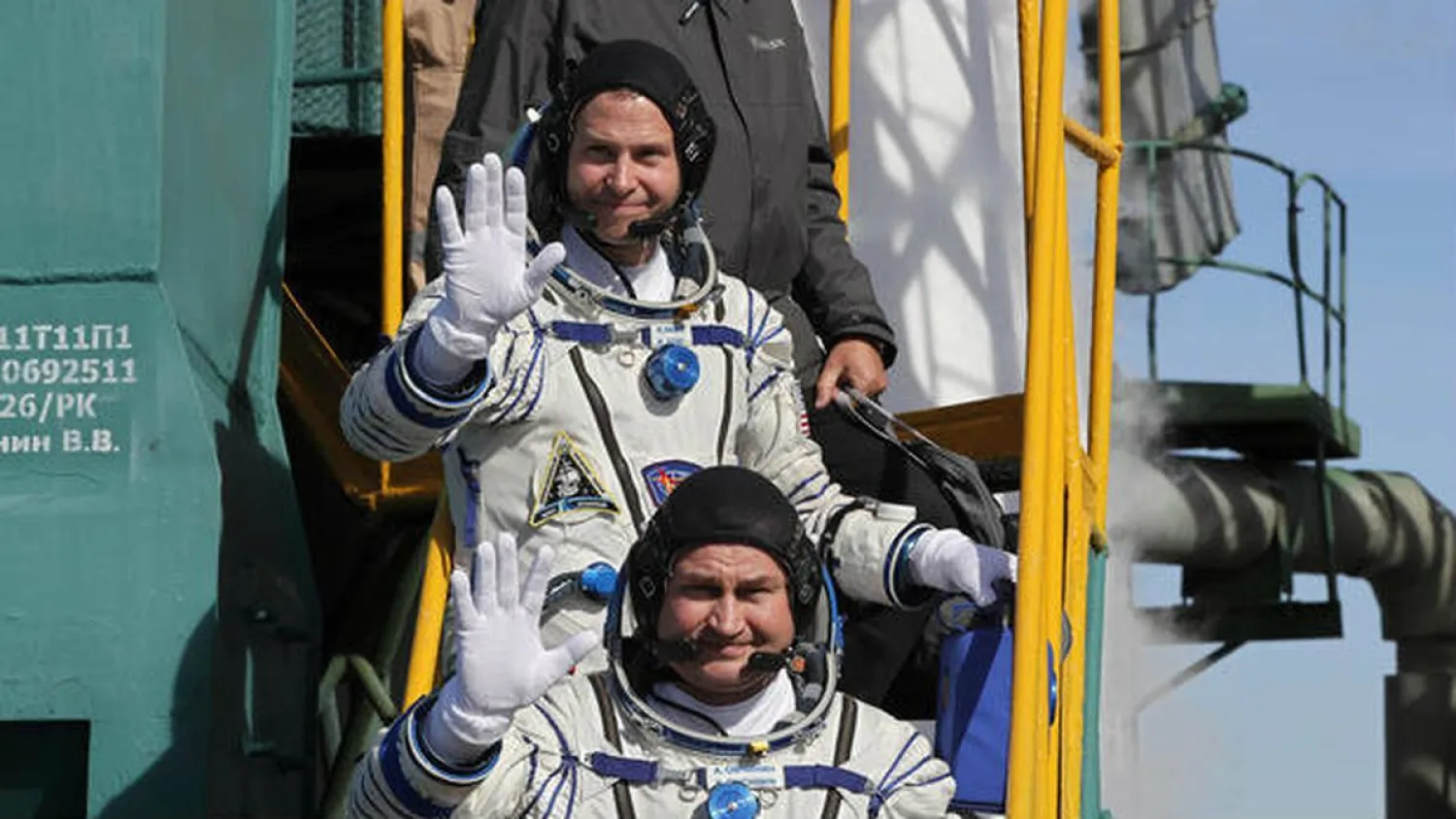
 International Space Station (ISS) crew members astronaut Nick
Hague of the U.S. (rear) and cosmonaut Alexey Ovchinin of Russia board
the Soyuz MS-10 spacecraft for the launch at the Baikonur Cosmodrome,
Kazakhstan October 11, 2018. REUTERS(WYMT)
International Space Station (ISS) crew members astronaut Nick Hague of the U.S. (rear) and cosmonaut Alexey Ovchinin of Russia board the Soyuz MS-10 spacecraft for the launch at the Baikonur Cosmodrome, Kazakhstan October 11, 2018. REUTERS(WYMT)
TT

Soyuz Delivers Astronauts to ISS in Three Hours

 International Space Station (ISS) crew members astronaut Nick
Hague of the U.S. (rear) and cosmonaut Alexey Ovchinin of Russia board
the Soyuz MS-10 spacecraft for the launch at the Baikonur Cosmodrome,
Kazakhstan October 11, 2018. REUTERS(WYMT)
International Space Station (ISS) crew members astronaut Nick Hague of the U.S. (rear) and cosmonaut Alexey Ovchinin of Russia board the Soyuz MS-10 spacecraft for the launch at the Baikonur Cosmodrome, Kazakhstan October 11, 2018. REUTERS(WYMT)

After just three hours on its launch, the Russian Soyuz spacecraft carrying two Russian cosmonauts and one NASA astronaut, docked with the International Space Station (ISS) according to the scheduled timetable, breaking a new speed record.

"The Soyuz MS-17 carrying NASA's Kathleen Rubins and Sergey Ryzhikov and Sergey Kud-Sverchkov from Russia, docked with the station," a statement by Roscosmos said.

The Russian space agency stated: "A new record for flights to the International Space Station was set – the total time from launch to docking of the Soyuz MS-17 was three hours and three minutes."

The three astronauts launched from the Russian-operated Baikonur cosmodrome in Kazakhstan, as shown in pictures shared by both the Russian and US agencies.

"The spacecraft entered the orbit successfully," Roscosmos wrote on Twitter.

In one of the few cooperation areas left between Russia and the West, the three astronauts have joined other colleagues on ISS, Chris Cassidy (NASA), Anatoly Ivanishin, and Ivan Vagner (Roscosmos), who are set to return to Earth on October 22.

The Soyuz mission is one of two launches to the International Space Station. The other will be carried out by SpaceX, which will enable the US to send astronauts again to space.

Before May 30, when US astronauts Robert Behnken and Doug Hurley arrived at the ISS, Russia and Baikonur had enjoyed a lucrative monopoly on manned missions to the ISS.

The two astronauts returned to Earth on August 2. The SpaceX upcoming mission is scheduled in November and will include four astronauts: three Americans and one Japanese.

The emergence of private players SpaceX and Boeing - part of NASA's Commercial Crew Program - has fuelled talk of a new space race between a number of countries.

But the men and women that fly to the space station have played down talk of competition and focused instead on space travel's ability to bring rival nations together for a common cause.

Speaking at a pre-launch press conference, Rubins did not directly refer to the SpaceX flight, saying "I feel incredibly lucky to be on station."


Oscar Statuette for 'Mr. Nobody Against Putin' Goes Missing on Flight

FILE PHOTO: File Photo: Pavel Talankin arrives at the Vanity Fair Oscars party after the 98th Academy Awards, in Beverly Hills, California, US, March 16, 2026. REUTERS/Danny Moloshok/File Photo/File Photo
TT

Oscar Statuette for 'Mr. Nobody Against Putin' Goes Missing on Flight

FILE PHOTO: File Photo: Pavel Talankin arrives at the Vanity Fair Oscars party after the 98th Academy Awards, in Beverly Hills, California, US, March 16, 2026. REUTERS/Danny Moloshok/File Photo/File Photo

The Oscar statuette belonging to Pavel Talankin, the Russian director who won best documentary this year for "Mr. Nobody Against Putin," has gone missing after he was forced to check the award into hold luggage on a flight from New York to Germany, his co-director said.

Talankin was due to fly from John F. Kennedy International Airport to Frankfurt on German carrier Lufthansa. But Transportation Security Administration (TSA) agents told him that the 8.5 lb (3.8 kg) statuette posed a potential security threat, his co-director David Borenstein said on Thursday.

"At the airport, a ⁠TSA agent stopped ⁠him and said the Oscar could be used as a weapon," Borenstein said on Instagram.

"Pavel didn’t have a bag to check it in, so the TSA put the Oscar in a box and sent it to the bottom of the plane," he said, posting a series of pictures, ⁠including of the box.

"It never arrived in Frankfurt."

Responding to Borenstein's Instagram post, Lufthansa said it was taking the matter seriously.

"We deeply regret this situation," a company spokesperson later said in response to a Reuters request for comment.

"Our team is handling this matter with the utmost care and urgency and we are conducting a comprehensive internal search to ensure that the Oscar is found and returned as soon as possible.”

Speaking to the online magazine Deadline.com after arriving in Germany on Thursday, ⁠Talankin ⁠said it was "completely baffling how they consider an Oscar a weapon."

On previous flights on various airlines, he had flown with it "in the cabin, and there never was any kind of problem," he told the outlet.

Talankin and Borenstein's documentary used two years of footage that Talankin recorded at a school where he worked in Russia's Chelyabinsk region, to show how students were exposed to pro-war messaging.

The 35-year-old Talankin, who fled Russia in 2024, has defended the film as a record for posterity to show how "an entire generation became angry and aggressive."


Russia Successfully Test Launches New Soyuz-5 Rocket from Kazakhstan, Space Agency Says

The ⁠new rocket is ‌capable of ‌carrying payloads of up to ‌17 metric tons. (AP file)
TT

Russia Successfully Test Launches New Soyuz-5 Rocket from Kazakhstan, Space Agency Says

The ⁠new rocket is ‌capable of ‌carrying payloads of up to ‌17 metric tons. (AP file)

Russia has test launched its new Soyuz-5 rocket for the first time, the country's space agency said late on Thursday, saying it had lifted off from the Baikonur cosmodrome in Kazakhstan without any issues.

The Soyuz-5, which Roscosmos, ‌Russia's space ‌agency, describes as a ‌launch ⁠vehicle equipped with ⁠the world's most powerful liquid-fueled engine, lifted off successfully at 2100 Moscow time (1800 GMT) on April 30, it said in a statement.

The ⁠new rocket is ‌capable of ‌carrying payloads of up to ‌17 metric tons, will significantly ‌reduce launch costs, and is more effective than its predecessors at placing objects like satellites in near ‌earth orbit, the agency said.

Dmitry Bakanov, the head ⁠of ⁠Roskosmos, said the rocket - which he hailed as a "new step in space exploration" - would create new jobs in Russia and Kazakhstan.

Bakanov has previously told President Vladimir Putin that the Soyuz-5 is the first new launch vehicle that Russia has developed since 2014.


Afghans Celebrate Spring in Bright Red Poppy Fields

This photograph taken on April 24, 2026 shows Afghan men taking a selfie as they stand among the common poppy flowers on a hillside in the Jalayer Valley of Northern Afghanistan’s Shirin Tagab district. (AFP)
TT

Afghans Celebrate Spring in Bright Red Poppy Fields

This photograph taken on April 24, 2026 shows Afghan men taking a selfie as they stand among the common poppy flowers on a hillside in the Jalayer Valley of Northern Afghanistan’s Shirin Tagab district. (AFP)

In the middle of a field filled with bright red poppies, Afghans frolic among the spring flowers in a tradition deeply rooted in the country's north.

Families flocked to the valleys of Shirin Tagab district, near the border with Turkmenistan, to be among thousands of flowers that appeared after abundant rain.

"There has been a drought for almost 10 years. No flowers or greenery grew," said Ghawsudin, who only uses one name.

"This year has been very good, and God is merciful," said the 79-year-old, who drove for three hours just to see the flowers.

Mohammad Ashraf, a 35-year-old visitor, said he hadn't seen so many poppies for more than a decade.

"Now there are so many red flowers, and you see people come here for picnics," he told AFP.

The landscape in Shirin Tagab is brightened by the common poppy, not the opium poppy that authorities have banned.

- 'Vitality and freshness' -

Many Afghans living in the north used to travel to see the poppies after celebrating Persian New Year, Nowruz, in the city of Mazar-i-Sharif.

The Taliban government, which applies a strict interpretation of religious law, has stopped such celebrations each spring.

But the tradition of visiting the poppies, which are widely revered in poems and songs, has endured.

Oriane Zerah, a photographer who published a book about Afghans and flowers, said they are an integral part of daily life.

"As soon as an Afghan has a little space in their garden, they plant a flower. Even in displacement camps, there'll be a flower somewhere. They put them on their pakol, one of their traditional hats, and there are desserts made with flowers," she told AFP.

The poppy has also been associated with wartime in the country, with the flower often placed on the coffins of fighters, according to Afghan writer Taqi Wahidi.

"Dying in the path of the homeland, or in the path of religion and faith, was considered a kind of new resurrection and entry into a new life," he told AFP.

The same flower is widely used in countries, such as Britain, Australia and New Zealand, where people wear artificial poppies to remember those killed in past conflicts.

Nowadays in Afghanistan, however, the poppy "symbolizes vitality and freshness", according to Wahidi.

"At the same time that nature is renewed, human beings also want to bring new colors into their lives," he said.