


GNA Officials Arrested on Charge of ‘Looting Public Funds’

A general view of a Misrata power plant during the long-lasting power blackouts, in Misrata, Libya July 14, 2020. REUTERS/Ayman Al-Sahili
TT

GNA Officials Arrested on Charge of ‘Looting Public Funds’

A general view of a Misrata power plant during the long-lasting power blackouts, in Misrata, Libya July 14, 2020. REUTERS/Ayman Al-Sahili

The public prosecutor in Libya has expanded investigation in crimes of ‘looting public funds’ to cover more officials and leaders from state institutions. He issued an order to refer several employees in the Ministry of Local Government and the General Electricity Company of Libya for trial on the charge of malfeasance in office.

The Mayor of Janzour Municipality, Faraj Aban, was among the officials to be questioned. However, several representatives of the civil community in the municipality expressed solidarity with Aban.

The municipal council defended itself saying that arresting the mayor is to clear his position on power cuts and load shedding.

The Investigation Department of the Office of Public Prosecution announced that a number of officials accused of obstructing the fair electric load-shedding have been brought to the Bab Bin Ghashir Court for trial.

The Office of the Public Prosecutor stated that the officials are all accused of abuse of power and resorting to intimidation to obstruct work.

In another context, the European Council on Thursday sanctioned senior aides to Russian President Vladimir Putin, including the man known as his chef, over the poisoning of opposition figure Alexei Navalny and the Kremlin meddling in Libya's civil war.

The EU said Yevgeny Prigozhin, nicknamed "Putin's chef" because his company has done catering for the Kremlin, was undermining peace in Libya by supporting the Russian-based Wagner Group, a private military company.

Prigozhin, a wealthy tycoon close to Putin, is already under US sanctions over his links to the Wagner mercenary outfit, which has been accused of interfering in various conflicts around Africa.

In its official listing, the EU said Prigozhin had "close links, including financially, to the private military company Wagner Group."

"In this way, Prigozhin is engaged in providing support for the Wagner Group's activities in Libya, which threaten the country's peace, stability, and security."

The EU said the group had committed "multiple and repeated breaches" of a UN arms embargo on Libya, where Russia has backed Gen. Khalifa Haftar in his uprising against the internationally recognized government.

The listing means Prigozhin is banned from traveling to the EU and any assets he holds in the bloc will be frozen. EU citizens and companies are also barred from supplying him with funds.

The same penalties apply to the six listed over the Navalny poisoning, who include FSB chief Alexander Bortnikov, as well as Sergey Kirienko and Andrei Yarin – both senior members of Putin's presidential executive office.


Trump Praises Aoun’s Leadership During Critical Period

Lebanon’s President Joseph Aoun holds a meeting with former head of the Progressive Socialist Party, Walid Jumblatt and his son, MP Taymour Jumblatt, at the Presidential Palace in Baabda on Monday (Lebanese Presidency)
TT

Trump Praises Aoun’s Leadership During Critical Period

Lebanon’s President Joseph Aoun holds a meeting with former head of the Progressive Socialist Party, Walid Jumblatt and his son, MP Taymour Jumblatt, at the Presidential Palace in Baabda on Monday (Lebanese Presidency)

US President Donald Trump on Monday praised President Joseph Aoun’s leadership of Lebanon during this critical period, and acclaimed the shared commitment of both sides to peace, security, and prosperity around the world.

Lebanon is engaged in US-mediated direct negotiations with Israel, aimed at ending the war, securing an Israeli withdrawal from occupied Lebanese territory, facilitating the return of detainees, and enabling displaced residents to return to their homes.

The talks also seek to ensure that weapons across Lebanon are placed exclusively under the authority of the country’s official security and military forces.

Trump’s praise came in a letter sent to Aoun, in which he expressed his “honor” to welcome the President to the White House on July 21 for a “truly historic visit,” according to the Lebanese presidency said.

“It was an honor to welcome you to the White House for a visit that was historic in every sense of the word—the first visit by a Lebanese head of state in nearly two decades—at a time when the Middle East is experiencing conflict. I have admired your decisive leadership on behalf of Lebanon and its people,” the letter said.

Trump also thanked Aoun for awarding him the National Order of the Cedar, Grand Cordon, saying: “This initiative is an exceptional honor and embodies the proud Lebanese spirit. I will cherish this gesture as a symbol of our shared commitment to peace, security, and prosperity around the world.”

Unlike Hezbollah, the Lebanese state’s approach of negotiating with Israel enjoys the support of most major political forces.

Following a meeting with Aoun on Monday at the Presidential Palace, former head of the Progressive Socialist Party, Walid Jumblatt said he supports the negotiations and the ceasefire agreement if they lead to a gradual or complete Israeli withdrawal.

“If the framework agreement leads to a withdrawal and the demarcation of the border, then where is the problem? This is my personal point of view, no more and no less,” he noted.

Hezbollah has stepped up its criticism of Aoun over his decision to pursue direct negotiations with Israel under US mediation, putting the Lebanese president at odd with the Shiite movement.

Following a meeting with the President on Monday, MP Alain Aoun said the success of the president’s efforts to end the war and restore Lebanese sovereignty requires cooperation from all Lebanese parties and engagement with the process of placing weapons exclusively under state authority.

The deputy called on Hezbollah to engage in dialogue with the president at Baabda Palace to agree on a roadmap aimed at advancing negotiations, securing an Israeli withdrawal and enabling the Lebanese Army to deploy across the country.


What’s Left of Hezbollah Two Years after the War?

A poster expresses gratitude to Iran for its support to Lebanon. (Asharq Al-Awsat)
TT

What’s Left of Hezbollah Two Years after the War?

A poster expresses gratitude to Iran for its support to Lebanon. (Asharq Al-Awsat)

The expanded war in Lebanon, which erupted with widespread Israeli bombardment on September 23, 2024, and led to intense clashes and battlefield shifts, has forced a new reality on Hezbollah.

The Iran-backed group's military capabilities, supply lines, and political influence have significantly declined following severe losses within its senior leadership ranks. Furthermore, Hezbollah's deployment on the ground and operations have fundamentally changed compared to its pre-war positioning.

Two years later, the group is navigating a far more complex military landscape. While the loss of a vast portion of its leadership, declining drone and missile capabilities, and shrinking supply lines through Syria have severely weakened its position, the party still retains enough military capacity to continue operating.

It is actively attempting to reorganize its ranks and adapt to an altered battlefield reality - one that stretches from north of the Litani River into broader territory across southern Lebanon and the Western Bekaa.

Speaking to Asharq Al-Awsat, security and defense expert Riad Kahwaji estimated that Hezbollah's capabilities have significantly declined between 2024 and today across its leadership, military structure, political influence, and supply lines, evaluating the scale of this drop to have "exceeded nearly half."

He explained that the group has lost the vast majority of its first- and second-tier leaders, while most of the leaders present today were classified within the third tier in 2024.

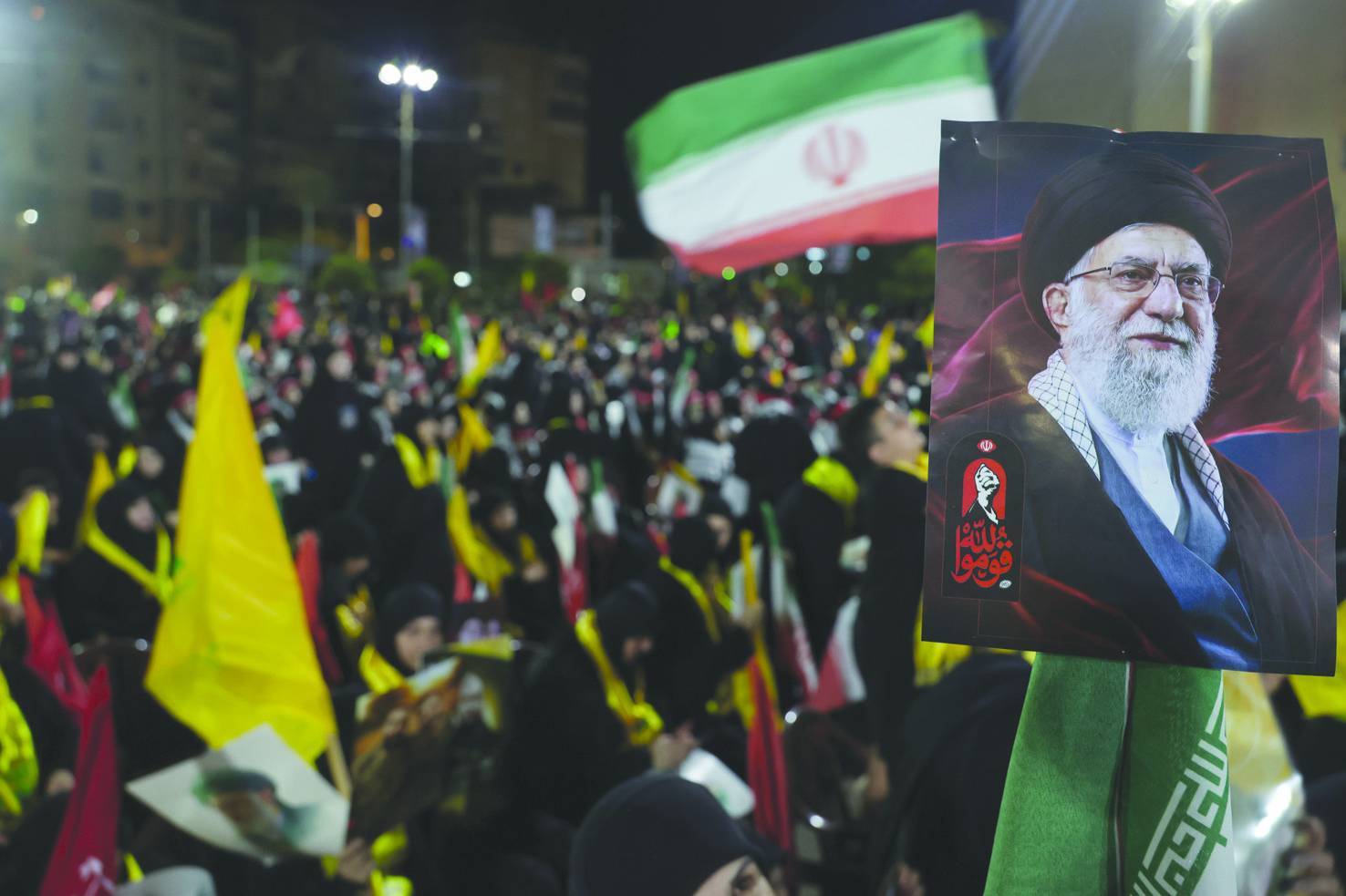
Hezbollah supporters carry posters of slain Iranian supreme leader Ali Khamenei during a rally coinciding with his funeral in Iran in Beirut's southern suburbs. (EPA file)

The nature of management within the group has also changed, as "management in 2024 was local under Iranian guidance, whereas today management and guidance have become directly Iranian," he added.

On the military level, Kahwaji said that "the party's forces have become stationed north of the Litani, after having previously been present directly on the border."

"Nabatieh has practically become the separation line of contact between the group's presence and the Israeli forces," he noted.

Regarding the military arsenal, he said that "missile and drone capabilities still exist, but they have become less than half of what they were before."

He added that Hezbollah's political influence within Lebanon has significantly weakened from its previous levels, noting that one of the most prominent shifts affecting the group is the severe disruption of its supply lines through Syria, which have now been largely cut off.

Since the November 2024 ceasefire up to the current stage, retired Brigadier General Dr. Khalil Helou told Asharq Al-Awsat that the party’s "capabilities have dropped compared to what they were before the war, but it has not lost its military capacity and still possesses capabilities that allow it to continue."

Its limited responses to Israel during the current stage may be a sign that it has entered a new "phase of reorganization and rebuilding of combat readiness," he added.

Helou explained that the period following the November 2024 ceasefire was marked by ongoing Israeli assassinations targeting Hezbollah operatives, while the group largely refrained from retaliating.

This pattern underscores a significant drop in Hezbollah's capabilities compared to its pre-2024 strength, while simultaneously indicating that the group has been undergoing a phase of reorganization, rearmament, and rebuilding of its combat readiness, he noted.

Helou stressed that the strategic landscape shifted following the outbreak of the US war on Iran at the end of February, which Hezbollah joined in early March.

"From that point until the second ceasefire on June 17, the party engaged in the fighting, launching effective retaliatory operations in certain areas and firing missiles into both the Israeli interior and Israeli-occupied territories," Helou said.

He remarked that during that phase, Israel "advanced, made incursions, and established its presence on the ground," while Hezbollah continued to carry out military responses, though the situation following the latest ceasefire has returned to a pattern similar to the period that followed November 2024.

"Today, we have virtually returned to the previous phase, as Hezbollah's responses to Israeli attacks have become almost nonexistent," he stated. "If we review operations over the past two and a half months since the ceasefire, the military operations carried out by the group against Israel are highly limited and can be counted on two hands. This stands in sharp contrast to dozens of daily Israeli operations, including airstrikes, shelling, and assassinations."


Trump, Yemen’s Alimi Discuss Bab al-Mandeb Developments

A Yemeni government soldier during the battles against the Houthis. (Military media)
TT

Trump, Yemen’s Alimi Discuss Bab al-Mandeb Developments

A Yemeni government soldier during the battles against the Houthis. (Military media)

US President Donald Trump discussed the accelerating military developments in Yemen during a telephone call on Sunday with the Chairman of the Yemeni Presidential Leadership Council Dr. Rashad al-Alimi.

The talks focused on the advance of Iran-backed Houthis near the Bab al-Mandeb Strait, according to news agencies citing identical sources.

On the ground, battles are escalating in the highlands between western Taiz and northern Lahj.

Government and southern forces thwarted a Houthi advance towards al-Shamayatayn. They said they repelled repeated attacks, recaptured mountainous positions, and inflicted casualties among the Houthis.

Dozens of Houthis were killed in the past 24 hours, said field sources.

The government's Giants Brigades announced the destruction of five Houthi vehicles in the Kahbub mountains near Bab al-Mandeb, including a vehicle carrying a militant commander and another carrying an anti-aircraft weapon. All others on board were killed.

The government's National Shield Forces also announced the downing of two drones during the fighting.

In western Taiz, the fighting centered around Sharira, Mount Al-Mirzam, and Jardad, with Houthi infiltration attempts and attacks being thwarted.

In Marib, clashes and artillery shelling continue in Harib, Malaa, and Umm Reesh, with no change in the lines of control.

Government forces announced strikes on Houthi gatherings, fortifications, and artillery positions, as well as airstrikes and drone attacks in Marib and Al-Bayda.
