


Iraq's Persecuted Yazidis Fear Going Back to Sinjar

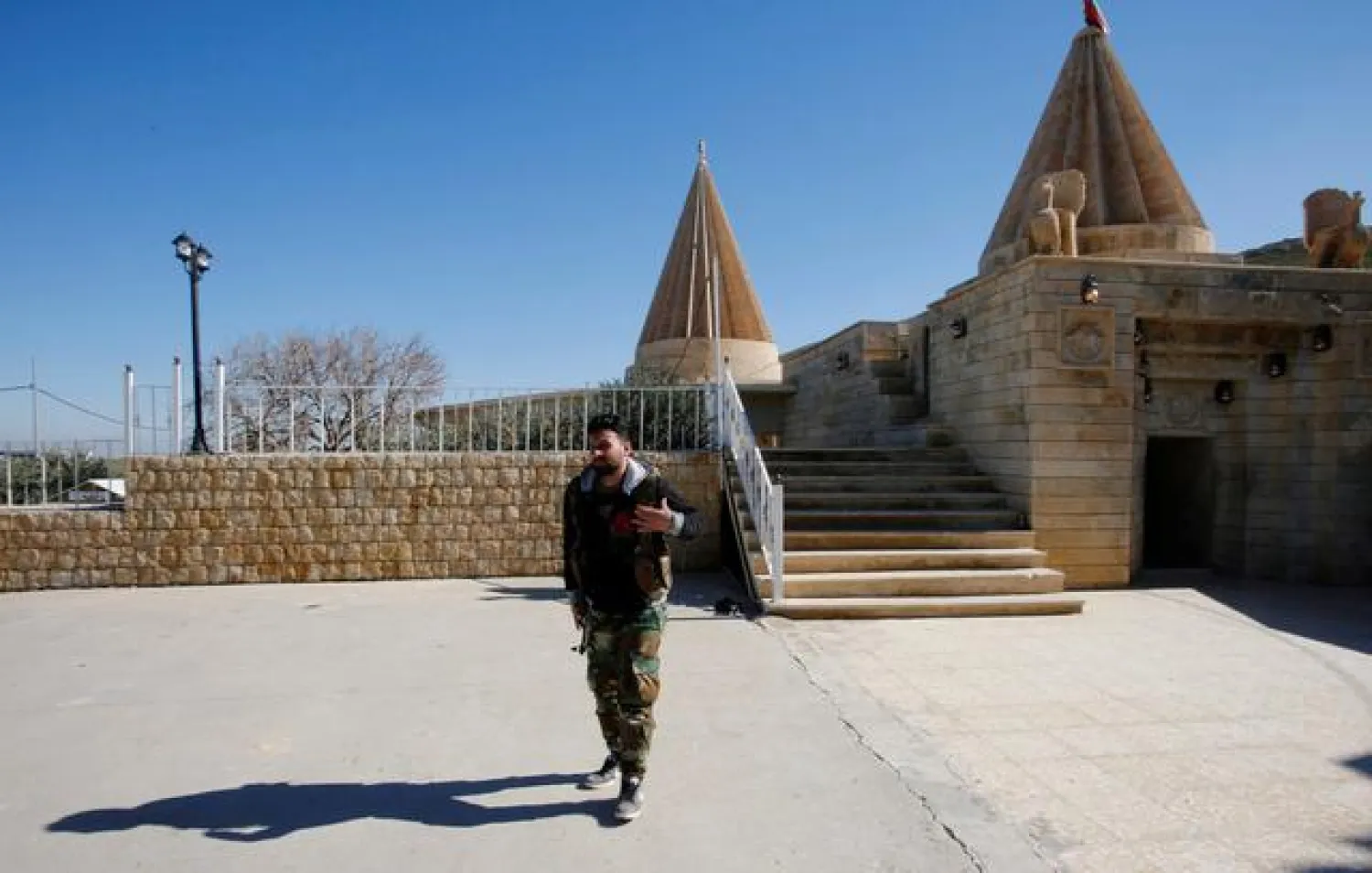
A Yazidi fighter walks near Yazidi temple Sharaf al-Din, in Sinjar, Iraq February 4, 2019. Picture taken February 4, 2019. REUTERS/Khalid al-Mousily/File Photo
TT

Iraq's Persecuted Yazidis Fear Going Back to Sinjar

A Yazidi fighter walks near Yazidi temple Sharaf al-Din, in Sinjar, Iraq February 4, 2019. Picture taken February 4, 2019. REUTERS/Khalid al-Mousily/File Photo

The Yazidis of northern Iraq, an ancient religious minority brutally persecuted by ISIS, want nothing more than peace, security, and a better life in their home town of Sinjar - but they want it on their terms.

Many there distrust a new security and reconstruction plan unveiled this week by the Baghdad government and Kurdish regional authorities which hailed it as a “historic” agreement.

“The deal could pacify Sinjar - but it might also make the situation even worse,” said Talal Saleh, a Yazidi in exile in nearby Kurdistan.

The Yazidis have suffered since ISIS marauded into Sinjar in 2014, one of the Sunni extremist group’s conquests that shocked the West into military action to stop it.

ISIS viewed the Yazidis as devil worshippers for their faith that combines Zoroastrian, Christian, Manichean, Jewish, and Muslim beliefs.

It slaughtered more than 3,000 Yazidis, enslaved 7,000 women and girls, and displaced most of its 550,000-strong community.

Since ISIS was driven out of Sinjar by US-backed Kurdish forces in 2015, the town and its surrounding areas are controlled by a patchwork of armed groups including the Iraqi army, Shi’ite Muslim militia, and Yazidi and Kurdish militants with different loyalties.

The government plan would enforce security and allow the return of tens of thousands of Yazidis afraid to go back because of a lack of security and basic services, according to the office of Iraqi Prime Minister Mustafa al-Kadhimi.

But many Sinjar natives feel the plan is vague, dictated by Baghdad and the Kurdish capital of Erbil. They say it has not included them and entails security reforms that could mean more division and violence.

“The PKK and their Yazidi allies are not just going to leave Sinjar without a fight,” Saleh said.

The security arrangements include booting out the PKK, a Kurdish separatist group that has fought a decades-long insurgency in Turkey and bases itself in northern Iraq.

It would also drive out PKK “affiliates”, an apparent reference to a Yazidi force of hundreds of fighters.

ESCAPE

The PKK with Yazidi volunteers helped thousands of Yazidis escape the IS onslaught to Syria after the Iraqi army fled many areas of Nineveh province and Erbil’s peshmerga forces retreated.

The peshmerga returned to help recapture Sinjar‮‮ ‬‬with US air support.

The PKK is under attack by Turkish forces in Iraq and exists uneasily alongside the peshmerga and the Iraqi army.

The army and the Popular Mobilisation Forces (PMF), Iraq’s state paramilitary body dominated by Shiite militias, would oversee the ejection of the PKK, according to a copy of the plan seen by Reuters.

Some locals fear this could split up families where siblings sometimes belong to different militias, forces, and groups. The Yazidis also have their own force in the PMF, separate to the Yazidi PKK affiliate.

“There are about six political groups in Sinjar now. Brothers belonging to the same family each join different parties,” said Akram Rasho, another displaced Yazidi in Kurdistan.

Baghdad and Erbil defend the plan.

“This is a good step to solve problems,” said Kurdistan government spokesman Jotiar Adil.

Sinjar has also been caught up in a territorial dispute between Baghdad and Erbil since a failed Kurdish bid for full independence in 2017.

Under the plan for Sinjar, the Baghdad and Erbil governments would choose a new mayor and administrators and appoint 2,500 new local security personnel.

Supporters of the PKK suspect those would include returning Yazidis affiliated with the peshmerga.

At a demonstration against the deal in Sinjar on Sunday, Yazidi tribal leader Shamo Khadida shouted, “Sinjar belongs to its people and we are the people.”

Others distance themselves from the politics and simply want to see delivery of services on the ground.

“If actual efforts are made to improve our situation, the people of Sinjar will find agreement,” said Rasho.



Israel Military Says Soldier Killed in Gaza 

A drone view shows the destruction in a residential neighborhood, after the withdrawal of the Israeli forces from the area, amid a ceasefire between Israel and Hamas in Gaza, in Gaza City, October 21, 2025. (Reuters)
TT

Israel Military Says Soldier Killed in Gaza 

A drone view shows the destruction in a residential neighborhood, after the withdrawal of the Israeli forces from the area, amid a ceasefire between Israel and Hamas in Gaza, in Gaza City, October 21, 2025. (Reuters)

The Israeli military announced that one of its soldiers had been killed in combat in southern Gaza on Wednesday, but a security source said the death appeared to have been caused by "friendly fire".

"Staff Sergeant Ofri Yafe, aged 21, from HaYogev, a soldier in the Paratroopers Reconnaissance Unit, fell during combat in the southern Gaza Strip," the military said in a statement.

A security source, however, told AFP that the soldier appeared to have been "killed by friendly fire", without providing further details.

"The incident is still under investigation," the source added.

The death brings to five the number of Israeli soldiers killed in Gaza since a ceasefire took effect on October 10.


Syria: SDF’s Mazloum Abdi Says Implementation of Integration Deal May Take Time

People sit outdoors surrounded by nature, with the Tigris river flowing in the background, following a long atmospheric depression, near the Syrian-Turkish border in Derik, Syria, February 16, 2026 REUTERS/Orhan Qereman
TT

Syria: SDF’s Mazloum Abdi Says Implementation of Integration Deal May Take Time

People sit outdoors surrounded by nature, with the Tigris river flowing in the background, following a long atmospheric depression, near the Syrian-Turkish border in Derik, Syria, February 16, 2026 REUTERS/Orhan Qereman

Mazloum Abdi, commander of the Syrian Democratic Forces, said the process of merging the SDF with Syrian government forces “may take some time,” despite expressing confidence in the eventual success of the agreement.

His remarks came after earlier comments in which he acknowledged differences with Damascus over the concept of “decentralization.”

Speaking at a tribal conference in the northeastern city of Hasakah on Tuesday, Abdi said the issue of integration would not be resolved quickly, but stressed that the agreement remains on track.

He said the deal reached last month stipulates that three Syrian army brigades will be created out of the SDF.

Abdi added that all SDF military units have withdrawn to their barracks in an effort to preserve stability and continue implementing the announced integration agreement with the Syrian state.

He also emphasized the need for armed forces to withdraw from the vicinity of the city of Ayn al-Arab (Kobani), to be replaced by security forces tasked with maintaining order.


Israeli Far-Right Minister to Push for ‘Migration’ of West Bank, Gaza Palestinians 

A Palestinian man checks leather belts as people prepare for Ramadan, in the old city of Hebron in the Israeli-occupied West Bank, February 17,2026. (Reuters)
TT

Israeli Far-Right Minister to Push for ‘Migration’ of West Bank, Gaza Palestinians 

A Palestinian man checks leather belts as people prepare for Ramadan, in the old city of Hebron in the Israeli-occupied West Bank, February 17,2026. (Reuters)

Israel's far-right Finance Minister Bezalel Smotrich said he would pursue a policy of "encouraging the migration" of Palestinians from the occupied West Bank and Gaza Strip, Israeli media reported Wednesday.

"We will eliminate the idea of an Arab terror state," said Smotrich, speaking at an event organized by his Religious Zionism Party late on Tuesday.

"We will finally, formally, and in practical terms nullify the cursed Oslo Accords and embark on a path toward sovereignty, while encouraging emigration from both Gaza and Judea and Samaria.

"There is no other long-term solution," added Smotrich, who himself lives in a settlement in the West Bank.

Since last week, Israel has approved a series of measures backed by far-right ministers to tighten control over the West Bank, including in areas administered by the Palestinian Authority under the Oslo Accords, in place since the 1990s.

The measures include a process to register land in the West Bank as "state property" and facilitate direct purchases of land by Jewish Israelis.

The measures have triggered widespread international outrage.

On Tuesday, the UN missions of 85 countries condemned the measures, which critics say amount to de facto annexation of the Palestinian territory.

"We strongly condemn unilateral Israeli decisions and measures aimed at expanding Israel's unlawful presence in the West Bank," they said in a statement.

"Such decisions are contrary to Israel's obligations under international law and must be immediately reversed.

"We underline in this regard our strong opposition to any form of annexation."

UN Secretary-General Antonio Guterres on Monday called on Israel to reverse its land registration policy, calling it "destabilizing" and "unlawful".

The West Bank would form the largest part of any future Palestinian state. Many on Israel's religious right view it as Israeli land.

Israeli NGOs have also raised the alarm over a settlement plan signed by the government which they say would mark the first expansion of Jerusalem's borders into the occupied West Bank since 1967.

The planned development, announced by Israel's Ministry of Construction and Housing, is formally a westward expansion of the Geva Binyamin, or Adam, settlement situated northeast of Jerusalem in the West Bank.

The current Israeli government has fast-tracked settlement expansion, approving a record 52 settlements in 2025.

Excluding Israeli-annexed east Jerusalem, more than 500,000 Israelis live in West Bank settlements and outposts, which are illegal under international law.