


As Virus Flares Globally, New Strategies Target Hot Spots

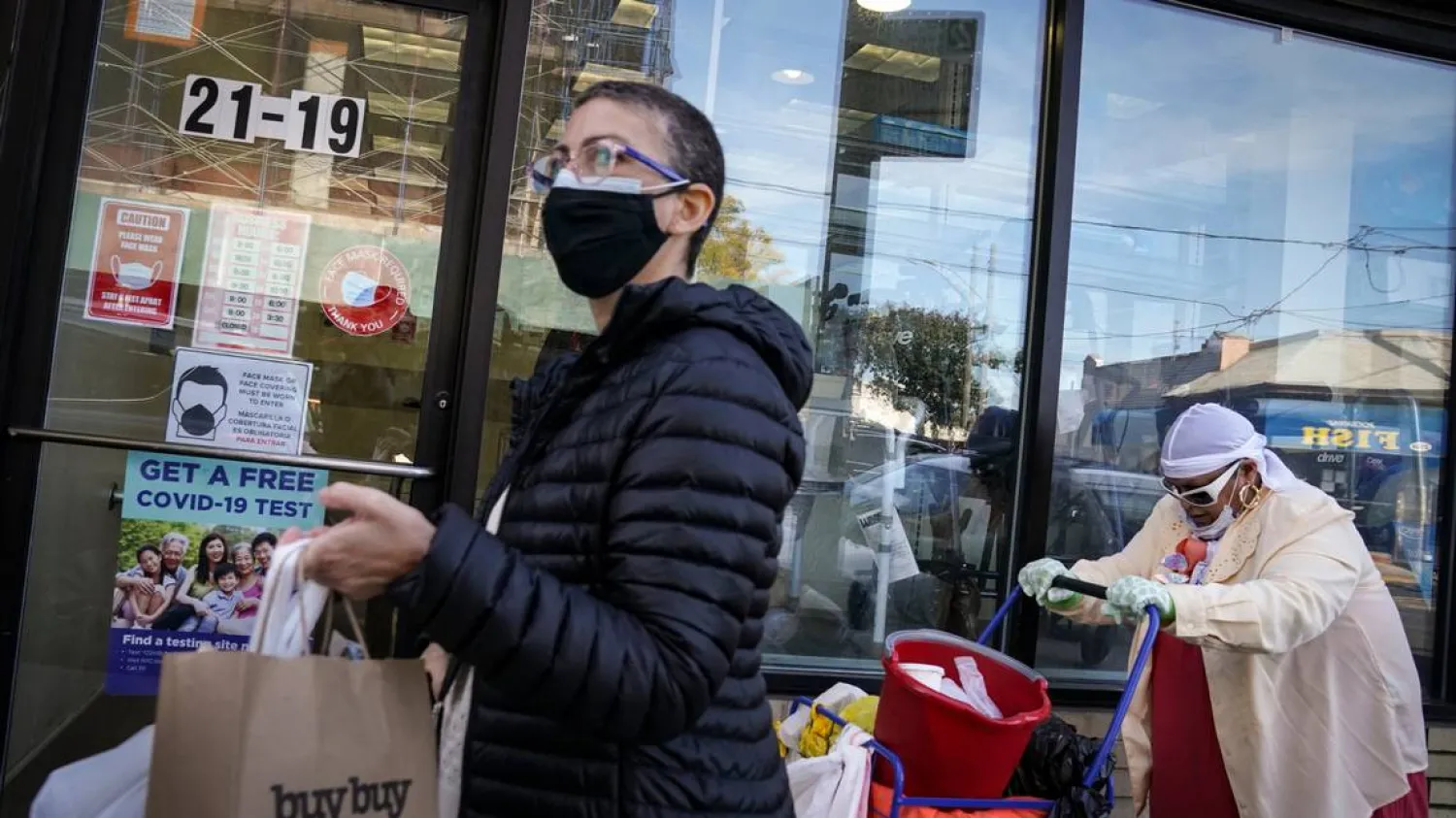
Pedestrians in protective masks pass a storefront on Thursday, Oct. 15, 2020, as restrictions on operations are imposed due to an increase in COVID-19 infections in the Far Rockaway neighborhood of the borough of Queens in New York. (AP Photo/John Minchillo)
TT

As Virus Flares Globally, New Strategies Target Hot Spots

Pedestrians in protective masks pass a storefront on Thursday, Oct. 15, 2020, as restrictions on operations are imposed due to an increase in COVID-19 infections in the Far Rockaway neighborhood of the borough of Queens in New York. (AP Photo/John Minchillo)

After entire nations were shut down during the first surge of the coronavirus earlier this year, some countries and US states are trying more targeted measures as cases rise again around the world, especially in Europe and the Americas.

New York´s new round of virus shutdowns zeroes in on individual neighborhoods, closing schools and businesses in hot spots measuring just a couple of square miles.

Spanish officials limited travel to and from some parts of Madrid before restrictions were widened throughout the capital and some suburbs.

Italian authorities have sometimes quarantined spots as small as a single building.

While countries including Israel and the Czech Republic have reinstated nationwide closures, other governments hope smaller-scale shutdowns can work this time, in conjunction with testing, contact tracing, and other initiatives they've now built up.

The concept of containing hot spots isn't new, but it's being tested under new pressures as authorities try to avoid a dreaded resurgence of illness and deaths, this time with economies weakened from earlier lockdowns, populations chafing at the idea of renewed restrictions, and some communities complaining of unequal treatment.

Some scientists say a localized approach, if well-tailored and explained to the public, can be a nimble response at a complex point in the pandemic.

"It is pragmatic in appreciation of `restriction fatigue´ ... but it is strategic, allowing for mobilization of substantial resources to where they are needed most," says Dr. Wafaa El-Sadr, who is following New York City's efforts closely and is on some city advisory boards.

Other scientists are warier.

"If we´re serious about wiping out COVID in an area, we need coordinated responses across" as wide a swath as possible, says Benjamin Althouse, a research scientist with the Institute for Disease Modeling in Washington state.

In a study that has been posted online but not published in a journal or reviewed by independent experts, Althouse and other scientists found that amid patchwork coronavirus-control measures in the U.S. this spring, some people traveled farther than usual for such activities as worship, suggesting they might have responded to closures by hopscotching to less-restricted areas.

Still, choosing between limited closures and widespread restrictions is "a very, very difficult decision," Althouse notes. "I´m glad I´m not the one making it."

Early in the outbreak, countries tried to quell hot spots from Wuhan, China - where a stringent lockdown was seen as key in squelching transmission in the world's most populous nation - to Italy, where a decision to seal off 10 towns in the northern region of Lombardy evolved within weeks into a nationwide lockdown.

After the virus's first surge, officials fought flare-ups with city-sized closures in recent months in places from Barcelona, Spain, to Melbourne, Australia.

In the English city of Leicester, nonessential shops were shut down and households banned from mixing in late June.

The infection rate fell, dropping from 135 cases per 100,000 to around 25 cases per 100,000 in about two months.

Proponents took that as evidence localized lockdowns work. Skeptics argued that summertime transmission rates were generally low anyway in the United Kingdom, where the official coronavirus death toll of over 43,000 stands as Europe´s highest, according to figures compiled by Johns Hopkins University.

With infection levels and deaths rising anew in Britain, scientists have advised officials to implement a national, two-week lockdown. Instead, the government on Monday carved England into three tiers of coronavirus risk, with restrictions ranging accordingly.

"As a general principle, the targeting of measures to specific groups or geographical areas is preferable to one-size-fits-all measures, because they allow us to minimize the damage that social distancing inevitably imposes on society and the economy," said Flavio Toxvaerd, who specializes in economic epidemiology at the University of Cambridge.

The damage doesn't feel so minimal to Steven Goldstein, who had to close his New York City men's hat shop last week.

The 72-year-old business, Bencraft Hatters, is in one of a handful of small areas around the state with new restrictions. Authorities hope they'll avert a wider crisis in a state that beat back the deadliest spike in the U.S. this spring, losing over 33,000 people to date.

Goldstein takes the virus seriously - he said he and his mother both had it early on - and he sees the economic rationale behind trying local restrictions instead of another citywide or statewide shutdown.

But he questions whether the zones are capturing all the trouble spots, and he's rankled that the restrictions are falling on his shop after, he says, he faithfully enforced mask-wearing and other rules.

"I did my part, and a lot of other people did our part, and yet we´re being forced to close," said Goldstein, 53, who tapped into savings to sustain the third-generation business through the earlier shutdown.

In New York's most restricted "red zones," houses of worship can't admit more than 10 people at a time and schools and nonessential businesses have been closed. Those zones are ensconced in small orange and yellow zones with lighter restrictions.

Some researchers, however, say officials need to consider not just where people live, but where else they go. In New York City, people can escape restrictions entirely by taking the subway one or two stops.

"There´s room for improvement by taking into account some spillovers across neighborhoods," says John Birge, a University of Chicago Booth School of Business operations research professor. He, colleague Ozan Candogan and Northwestern University graduate student Yiding Feng have been modeling how localized restrictions in New York City could best minimize both infections and economic harm; the research hasn't yet been reviewed by other experts.

If hot spot measures can be strategic, they also have been criticized as unfairly selective.

In Brooklyn, Orthodox Jews have complained their communities are being singled out for criticism. In Madrid, residents of working-class areas under mobility restrictions said authorities were stigmatizing the poor. Restaurant and bar owners in Marseille, France, said the city was unfairly targeted last month for the nation's toughest virus rules at the time. As of Saturday, several French cities, including Paris and Marseille, were subject to restrictions including a 9 p.m. curfew.

When an apartment complex housing mostly Bulgarian migrant farm workers was locked down in late June in the Italian city of Mondragone, the workers protested, and about a dozen broke the quarantine.

Other denizens of Mondragone feared infection would spread and, at one point, surrounded the buildings and jeered at the residents, one of whom tossed down a chair. Eventually, authorities called in the army to maintain the quarantine and keep the peace.

For hot spot shutdowns to work, public health experts say, the message behind the measures is key.

"Lead with: `Here´s a community in need. ... We should be empathetic,´" said Rutgers University epidemiology and biostatistics professor Henry F. Raymond. "It´s not a criticism of those people´s behaviors. It´s just saying, ´These communities might need more attention.'"



Pakistan PM Sharif to Seek Clarity on Troops for Gaza in US Visit

US President Donald Trump looks at Pakistan's Prime Minister Shehbaz Sharif speaking following the official signing of the first phase of the Gaza ceasefire agreement between Israel and Hamas, during a world leaders' summit on ending the Gaza war, in Sharm El-Sheikh, Egypt, October 13, 2025. REUTERS/Evelyn Hockstein/File Photo
TT

Pakistan PM Sharif to Seek Clarity on Troops for Gaza in US Visit

US President Donald Trump looks at Pakistan's Prime Minister Shehbaz Sharif speaking following the official signing of the first phase of the Gaza ceasefire agreement between Israel and Hamas, during a world leaders' summit on ending the Gaza war, in Sharm El-Sheikh, Egypt, October 13, 2025. REUTERS/Evelyn Hockstein/File Photo

Before Pakistan commits to sending troops to Gaza as part of the International Stabilization Force it wants assurances from the United States that it will be a peacekeeping mission rather than tasked with disarming Hamas, three sources told Reuters.

Pakistan's Prime Minister Shehbaz Sharif is set to attend the first formal meeting of President Donald Trump's Board of Peace in Washington on Thursday, alongside delegations from at least 20 countries.

Trump, who will chair the meeting, is expected to announce a multi-billion dollar reconstruction plan for Gaza and detail plans for a UN-authorized stabilization force for the Palestinian enclave.

Three government sources said during the Washington visit Sharif wanted to better understand the goal of the ISF, what authority they were operating under and what the chain of command was before making a decision on deploying troops.

"We are ready to send troops. Let me make it clear that our troops could only be part of a peace mission in Gaza," said one of the sources, a close aide of Sharif.

"We will not be part of any other role, such as disarming Hamas. It is out of the question," he said.

Analysts say Pakistan would be an asset to the multinational force, with its experienced military that has gone to war with arch-rival India and tackled insurgencies.

"We can send initially a couple of thousand troops anytime, but we need to know what role they are going to play," the source added.

Two of the sources said it was likely Sharif, who has met Trump earlier this year in Davos and late last year at the White House, would either have an audience with him on the sidelines of the meeting or the following day at the White House.

Initially designed to cement Gaza's ceasefire, Trump sees the Board of Peace, launched in late January, taking a wider role in resolving global conflicts. Some countries have reacted cautiously, fearing it could become a rival to the United Nations.

While Pakistan has supported the establishment of the board, it has voiced concerns against the mission to demilitarize Gaza's militant group Hamas.


Türkiye Pleased with Alignment Steps by Syria, Kurdish Forces, Erdogan Says

Turkish President Tayyip Erdogan delivers a speech during the opening ceremony of male and female dormitories at Bogazici University, in Istanbul, Türkiye, February 13, 2026. REUTERS/Umit Bektas
TT

Türkiye Pleased with Alignment Steps by Syria, Kurdish Forces, Erdogan Says

Turkish President Tayyip Erdogan delivers a speech during the opening ceremony of male and female dormitories at Bogazici University, in Istanbul, Türkiye, February 13, 2026. REUTERS/Umit Bektas

Turkish President Tayyip Erdogan said he is pleased to see steps taken in neighbouring Syria to integrate the Kurdish-led Syrian Democratic Forces (SDF) into state structures, after a US-backed ceasefire deal late last month between the sides.

In a readout on Wednesday of his comments to reporters on a return flight from Ethiopia, Erdogan was cited as saying Ankara is closely monitoring the Syrian integration steps and providing guidance on implementing the agreement.

Meanwhile, a Turkish parliamentary commission voted overwhelmingly on Wednesday to approve a report envisaging legal reforms alongside the militant Kurdistan Workers Party's (PKK) disarmament, advancing a peace process meant to end decades of conflict.

The PKK - designated a terrorist organization by Türkiye, the United States and European Union - halted attacks last year and said it would disarm and disband, calling on Ankara to take steps to let its members participate in politics.

The roughly 60-page report proposes a roadmap for the parliament to enact laws, including a conditional legal framework that urges the judiciary to review legislation and comply with European Court of Human Rights and Constitutional Court rulings.

The pro-Kurdish DEM Party, which has been closely involved in the process and held several meetings with PKK leader Abdullah Ocalan in prison, objected to the report's presentation of the Kurdish issue as a terrorism problem but generally welcomed the report and called for rapid implementation.

“We believe legal regulations must be enacted quickly,” senior DEM lawmaker Gulistan Kilic Kocyigit told Reuters. Parts of the report offered “a very important roadmap for the advancement of this process," she said.

Erdogan signaled that the legislative process would begin straight away. “Now, discussions will begin in our parliament regarding the legal aspects of the process,” he said.


Turkish FM to Attend Trump’s Board of Peace Meeting in Washington, Italy as ‘Observer’ 

28 November 2025, Berlin: Turkish Foreign Minister Hakan Fidan during a joint press conference with German Foreign Minister Wadephul. (dpa)
TT

Turkish FM to Attend Trump’s Board of Peace Meeting in Washington, Italy as ‘Observer’ 

28 November 2025, Berlin: Turkish Foreign Minister Hakan Fidan during a joint press conference with German Foreign Minister Wadephul. (dpa)

‌Turkish Foreign Minister Hakan Fidan will travel to Washington in lieu of President Recep Tayyip Erdogan for the inaugural meeting of US President Donald Trump's "Board of Peace" on Thursday, the foreign ministry said on Wednesday.

A Turkish diplomatic source told Reuters ‌that Fidan, during the ‌talks, would call ‌for ⁠determined steps to ⁠resolve the Palestinian issue and emphasize that Israel must end actions to hinder the flow of aid into Gaza and stop its ceasefire violations.

Fidan ⁠will also reiterate Türkiye's ‌readiness ‌to contribute to Gaza's reconstruction and its ‌desire to help protect Palestinians ‌and ensure their security, the source said.

He will also call for urgent action against Israel's "illegal ‌settlement activities and settler violence in the West Bank", ⁠the ⁠source added.

According to a readout from Erdogan's office, the president separately told reporters on Wednesday that he hoped the Board of Peace would help achieve "the lasting stability, ceasefire, and eventually peace that Gaza has longed for", and would focus on bringing about a two-state solution.

The board, of which Trump is the chairman, was initially designed to oversee the Gaza truce and the territory's reconstruction after the war between Hamas and Israel.

Meanwhile, Italy will be present at the meeting as an "observer", Italian Foreign Minister Antonio Tajani said Wednesday.

"I will go to Washington to represent Italy as an observer to this first meeting of the Board of Peace, to be present when talks occur and decisions are made for the reconstruction of Gaza and the future of Palestine," Tajani said according to ANSA news agency.

Italy cannot be present as anything more than an observer as the country's constitutional rules do not allow it to join an organization led by a single foreign leader.

But Tajani said it was key for Rome to be "at the forefront, listening to what is being done".

Since Trump launched the Board of Peace at the World Economic Forum in Davos in January, at least 19 countries have signed its founding charter.