


Bloated Public Salaries at Heart of Iraq's Economic Woes

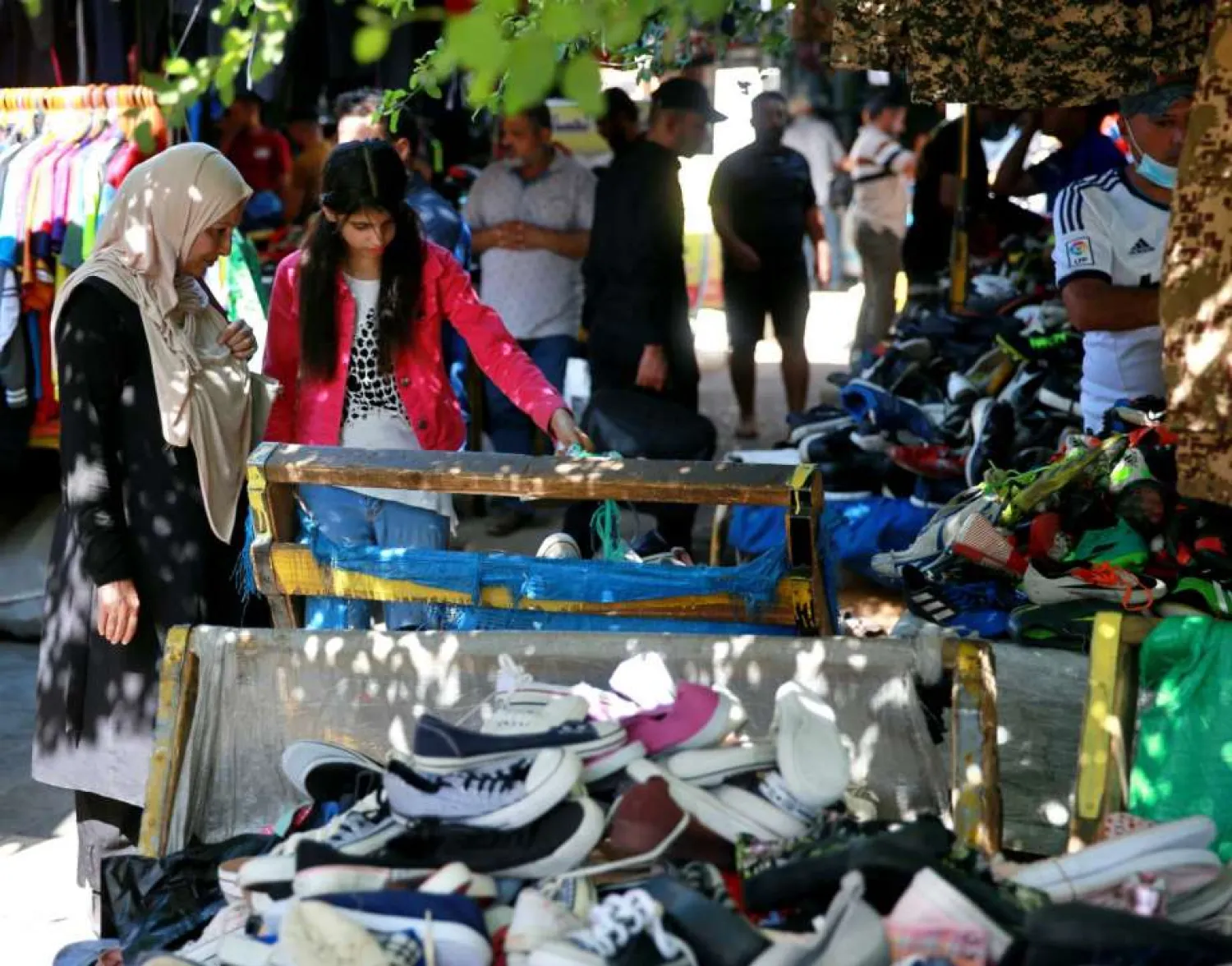
People shop for clothing at the used-clothes market in Baghdad, Iraq, Tuesday, Oct. 20, 2020. Iraq is in the throes of an unprecedented liquidity crisis, as the cash-strapped state wrestles to pay public sector salaries and import essential goods while oil prices remain dangerously low. (AP Photo/Khalid Mohammed)
TT

Bloated Public Salaries at Heart of Iraq's Economic Woes

People shop for clothing at the used-clothes market in Baghdad, Iraq, Tuesday, Oct. 20, 2020. Iraq is in the throes of an unprecedented liquidity crisis, as the cash-strapped state wrestles to pay public sector salaries and import essential goods while oil prices remain dangerously low. (AP Photo/Khalid Mohammed)

Long-time Iraqi civil servant Qusay Abdul-Amma panicked when his monthly salary was delayed. Days of waiting turned to weeks. He defaulted on rent and other bills.

A graphic designer for the Health Ministry, he uses about half his salary to pay his rent of nearly 450,000 Iraqi dinars a month, roughly $400. If he fails to pay twice in a row his landlord will evict him and his family, he fears.

"These delays affect my ability to survive," Abdul-Amma said.

Iraq´s government is struggling to pay the salaries of the ever-swelling ranks of public sector employees amid an unprecedented liquidity crisis caused by low oil prices. September's salaries were delayed for weeks, and October´s still haven´t been paid as the government tries to borrow once again from Iraq´s currency reserves. The crisis has fueled fears of instability ahead of mass demonstrations this week.

The government has outlined a vision for a drastic overhaul of Iraq´s economy in a "white paper" presented last week to lawmakers and political factions. But with early elections on the horizon, the prime minister´s advisers fear there is little political will to execute it fully.

"We are asking the same people we are protesting against and criticizing to reform the system," said Sajad Jiyad, an Iraq researcher.

The white paper´s calls for cutting public sector payrolls and reforming state finances would undermine the patronage systems that the political elite have used to entrench their power.

A major part of that patronage is handing out state jobs in return for support. The result has been a threefold increase in public workers since 2004. The government pays 400% more in salaries than it did 15 years ago. Around three quarters of the state´s expenditures in 2020 go to paying for the public sector - a massive drain on dwindling finances.

"Now the situation is very dangerous," said Mohammed al-Daraji, a lawmaker on parliament´s Finance Committee.

One government official said political factions are in denial that change is needed, believing oil prices will rise and "we will be fine."

"We won´t be fine. The system is unsustainable and sooner or later it will implode," the official said, speaking on condition of anonymity to discuss internal politics.

Iraq´s activists have called for a march on Oct. 25, expected to draw large crowds, a year since massive anti-government protests first brought tens of thousands to the streets demanded reforms and an end to the corrupt political class.

"As far as meeting our demands, there have been no changes," said Kamal Jabar, member of the Tishreen Democratic Movement, founded during the protests last year. "To us, the white paper is a joke."

Abu Ali, a merchant in Baghdad´s commercial district of Shorjah, fears what the following months have in store. The state is the primary source of employment for Iraqis, and civil servants are the lifeblood of his business.

"The delays in salary payments have affected the market directly," he said. "If these delays continue our business and the economy will collapse."

Abdul-Amma´s September pay was 45 days late, and he still hasn´t received the October pay that was supposed to come on the first of the month. He worries about the coming months as well.

"I have a history of chronic heart disease, and one of my daughters is also sick," said the father of four. He pays $100 in medical fees per month.

But to the architects of the reform paper, he is part of the problem: Public sector bloat is first in line for reform.

"We hope the civil service and bureaucracy will recognize a need for change," Finance Minister Ali Allawi told The Associated Press in a recent interview.

Iraq relies on oil exports to fund 90% of state revenues. Those revenues have plunged to an average $3.5 billion a month since oil prices crashed earlier this year.

That´s half the $7 billion a month needed to pay urgent expenses. Of that, $5 billion is for public sector salaries and pensions, according to Finance Ministry figures. Iraq also imports nearly all of its food and medicine; with foreign currency reserves at $53 billion, the World Bank estimates the country can sustain these imports for another nine months. Foreign debts account for another $316 million.

Poor productivity of public workers is the heart of the issue, Allawi said.

"We´ve ended up with a low productivity, high-cost public sector that doesn´t really earn its keep," he said. "In one way or another this issue has to be tackled by either reducing numbers, which is politically difficult, reducing salaries ... or increasing productivity."

The white paper calls for public sector payments to be reduced from 25% of GDP to 12% but doesn´t detail how. Officials said one step may be to restore taxes on civil servants' benefits that previous administrations had lifted.

To meet month-to-month commitments now, the government has had to borrow internally from its foreign currency reserves. A request of a second loan of $35 billion was sent to parliament, drawing criticism from lawmakers.

Haitham al-Jibouri, head of parliament´s Finance Committee, said in televised remarks that if borrowing was the government´s only plan he would fetch a shopkeeper from Bab al-Sharqi, a commercial area in the capital, to do the finance minister´s job.

Parliament´s endorsement of the loan and the reform paper is crucial for the government to avoid a full-scale economic crisis.

But this will prove difficult with elections slated for next June, since factions want to hand out jobs to maintain their constituencies.

"Whoever decides to push ahead and support reforms first will lose out, they will also need to convince other political players who will also lose out," said Jiyad. "That is a tough sell."

Kadhimi´s advisers privately acknowledge the challenges of having the system that produced such mismanagement and corruption be its own savior.

One official recalled a remark made by the finance minister at a meeting of a high-level committee tasked with managing the crisis.

He looked at the room of officials charged with halting the country´s fast spiral toward insolvency and said, "I can´t believe this was done for 10 years and none of you did anything to stop it." There was silence.



Israel Warns of Imminent Strikes on 10 Lebanese Villages

This picture taken on May 21, 2026 shows smoke rising from the site of an Israeli strike that targeted the southern Lebanese village of Mayfadoun. (Photo by AFP)
TT

Israel Warns of Imminent Strikes on 10 Lebanese Villages

This picture taken on May 21, 2026 shows smoke rising from the site of an Israeli strike that targeted the southern Lebanese village of Mayfadoun. (Photo by AFP)

Israel warned the residents of 10 villages in southern Lebanon to evacuate their homes immediately to avoid planned air strikes against alleged Hezbollah targets.

"In light of the terrorist Hezbollah's violation of the ceasefire agreement, the army is compelled to act forcefully against it. The army does not intend to harm you," Israeli military spokesman Avichay Adraee said.

"For your safety, you must evacuate your homes immediately and move away from the villages and towns by a distance of no less than 1,000 meters into open areas."


Ten ISIS Suspects from Türkiye Arrested in Syria

Turkish soldiers are seen in the center of Afrin, Syria. REUTERS/Khalil Ashawi
TT

Ten ISIS Suspects from Türkiye Arrested in Syria

Turkish soldiers are seen in the center of Afrin, Syria. REUTERS/Khalil Ashawi

Ten Turkish citizens accused of being ISIS members have been arrested in Syria, Turkish state media said on Saturday.

The 10 -- for whom Interpol had issued international alerts, or Red Notices -- were apprehended in a joint operation by the Turkish and Syrian intelligence services, they said.

Nine of the 10 were returned to Türkiye, said the Anadolu news agency and state TV channel TRT.

One is suspected of having ties to the perpetrators of an attack in Ankara's central railway station in late 2015, in which more than 100 people died.

Two others are accused of planning or participating in attacks on Turkish soldiers deployed in northern Syria.

Turkish state media said the 10 were thought to have joined ISIS between 2014 and 2017. They did not say exactly when or where the suspects were arrested.


Iraqi Court Hears First Challenge to Zaidi’s Premiership

This handout picture released by the Iraqi Prime Minister's Media Office shows Iraq's new Prime Minister Ali al-Zaidi giving an address after assuming office in Baghdad on May 16, 2026. (Photo by IRAQI PRIME MINISTER'S PRESS OFFICE / AFP)
TT

Iraqi Court Hears First Challenge to Zaidi’s Premiership

This handout picture released by the Iraqi Prime Minister's Media Office shows Iraq's new Prime Minister Ali al-Zaidi giving an address after assuming office in Baghdad on May 16, 2026. (Photo by IRAQI PRIME MINISTER'S PRESS OFFICE / AFP)

Iraq’s Federal Supreme Court has set July 1 for its first hearing in a lawsuit challenging the validity of Ali al-Zaidi’s designation as prime minister, the first legal move of its kind since the current government was formed.

The court date comes as political forces that failed to push through their ministerial nominees look for legal ways to challenge parliamentary voting procedures, amid a deepening dispute over the constitutional mechanisms for forming the government.

Former lawmaker Raad al-Maliki said in a press statement that he had received the official notice by email, along with a response memorandum submitted by the president’s representative in the case.

The memorandum, according to Maliki, argued that the plaintiff had no legal interest in the case and that the claim had been directed at the wrong party. It said the designation, in the plaintiff’s view, was made by the largest parliamentary bloc, not by the president.

It also raised issues related to the nominee’s competence, political ties and ownership of media outlets, and whether these could create a conflict of interest after he took office.

Al-Zaidi, a businessman who owns companies with his brother and partners, including Al-Oweis, Al-Janoob, and Dijlah TV, remains a little-known figure in Iraqi politics. His designation caught political circles by surprise.

The memorandum said that, after taking office, senior officials must give up private interests to avoid conflicts of interest or risk legal accountability.

Maliki said he would press ahead with the lawsuit and file a detailed response to the arguments presented. He said the challenge concerned “public law” and should not be tied to direct personal interest.

Legal view

Constitutional expert Ali al-Tamimi said the Federal Supreme Court, which operates under Law No. 30 of 2005 and its amended rules of procedure, first reviews legal interest and proper standing before considering the substance of a case.

He said the court would examine whether the designation was constitutional under Article 76, whether the requirements for nominating the prime minister and completing the cabinet had been met, and whether the parliamentary vote was valid.

Tamimi said the court could seek additional evidence, including recordings or the testimony of technical experts. He said predicting its decisions was “extremely difficult,” and that it could either reject or accept the case.

On the political side, Tamimi said al-Zaidi was a “consensus candidate” after former Prime Minister Nouri al-Maliki withdrew from the race. He said al-Zaidi’s nomination had the support of a major parliamentary bloc within complex political balances.

Tamimi said the court could delay its ruling for more than a month, adding that its decisions are final, binding and cannot be appealed.