


New Ceasefire Announced in 4-Week Nagorno-Karabakh Conflict

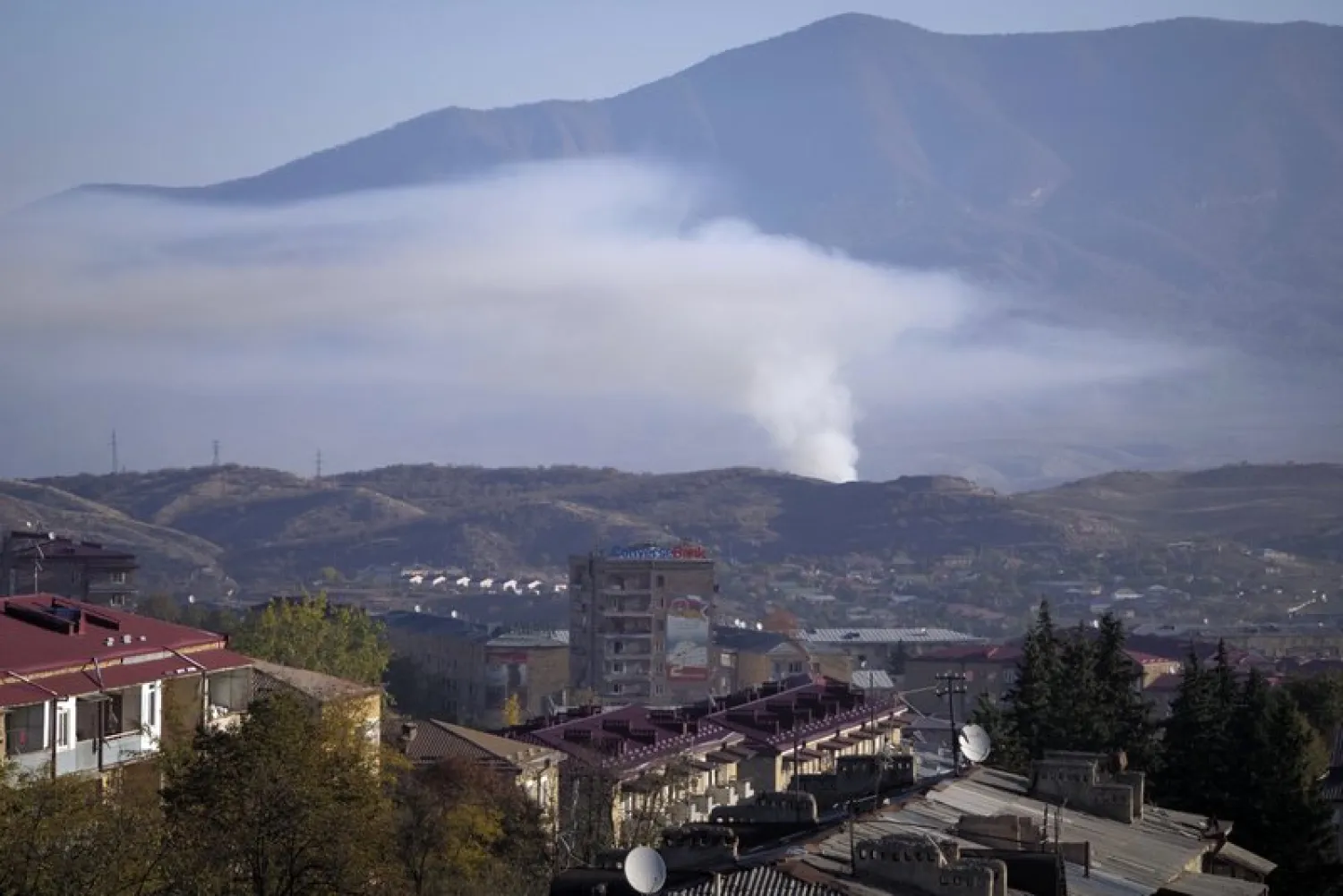
Smoke rises after shelling by Azerbaijan's artillery during a military conflict in Stepanakert, the separatist region of Nagorno-Karabakh, Saturday, Oct. 24, 2020. The heavy shelling forced residents of Stepanakert, the regional capital of Nagorno-Karabakh, into shelters, as emergency teams rushed to extinguish fires. Nagorno-Karabakh authorities said other towns in the region were also targeted by Azerbaijani artillery fire. (AP Photo)
TT

New Ceasefire Announced in 4-Week Nagorno-Karabakh Conflict

Smoke rises after shelling by Azerbaijan's artillery during a military conflict in Stepanakert, the separatist region of Nagorno-Karabakh, Saturday, Oct. 24, 2020. The heavy shelling forced residents of Stepanakert, the regional capital of Nagorno-Karabakh, into shelters, as emergency teams rushed to extinguish fires. Nagorno-Karabakh authorities said other towns in the region were also targeted by Azerbaijani artillery fire. (AP Photo)

Fighting over the Nagorno-Karabakh region continued Sunday, but Armenia and Azerbaijan reiterated their commitment to a peaceful resolution of their decades-old conflict and agreed to a third attempt to establish a ceasefire after four weeks of hostilities.

The agreement on a truce set to begin at 8 a.m. (0400 GMT) Monday was announced in a joint statement by the governments of the United States, Armenia, and Azerbaijan. Two previous Russia-brokered ceasefires, including one last weekend, frayed immediately after taking force, with both sides accusing each other of violations.

US Secretary of State Mike Pompeo said in a tweet Sunday night that the US facilitated "an intensive negotiation" and Armenian Foreign Minister Zohrab Mnatsakanyan and Azerbaijani Foreign Minister Jeyhun Bayramov "have committed to implement and abide by the ceasefire" that comes into force Monday.

Russia, the US, and France, co-chairs of the so-called Minsk Group set up by the Organization for Security and Cooperation in Europe to mediate the conflict, also took part in the talks, Pompeo said.

In a separate statement, co-chairs of the group said they would meet with the Armenian and Azerbaijani foreign ministers in Geneva on Thursday "to discuss, reach agreement on, and begin implementation ... of all steps necessary to achieve a peaceful settlement of the Nagorno-Karabakh conflict."

Nagorno-Karabakh lies within Azerbaijan but has been under the control of ethnic Armenian forces backed by Armenia since a war there ended in 1994. The latest fighting that began Sept. 27 has involved heavy artillery, rockets, and drones, killing hundreds in the largest escalation of hostilities between the South Caucasus neighbors in more than a quarter-century.

The deadly clashes have continued despite numerous calls for the cessation of hostilities and the two attempts at establishing a ceasefire.

UN Secretary-General Antonio Guterres welcomed the ceasefire agreement and reiterated his appeal to Armenia and Azerbaijan to fully implement it without delay and "resume substantive negotiations without preconditions," UN spokesman Stephane Dujarric said.

The UN chief urged the parties to allow unimpeded humanitarian access to Nagorno-Karabakh to deliver aid and "to make concrete steps towards a peaceful resolution of the Nagorno-Karabakh conflict," Dujarric said.

According to Nagorno-Karabakh officials, 974 of their troops and 37 civilians have been killed in the clashes so far. Azerbaijani authorities haven't disclosed their military losses, but say the fighting has killed 65 civilians and wounded 300.

Russian President Vladimir Putin said Thursday that according to Moscow´s information, the death toll from the fighting was nearing 5,000, significantly higher than what both sides report.

On Friday, Pompeo hosted the Armenian and Azerbaijan foreign ministers for separate talks, but the fighting raged on unabated.

On Sunday morning, the Nagorno-Karabakh army said battles continued "on all directions of the frontline," and the Azerbaijani Defense Ministry accused Armenian forces of targeting several Azerbaijani regions. Armenian military officials reported "intense fighting" in the conflict zone throughout the day and "heavy battles" Sunday evening.

The four weeks of fighting have prompted concerns of a wider conflict involving Turkey, which has thrown its weight behind Azerbaijan, and Russia, which has a security pact with Armenia.

It also worried worried Iran, which has borders with both Armenia and Azerbaijan. Iran has occasionally complained about stray mortar rounds and rockets that injured people and damaged buildings in rural areas near the borders.

Iran´s Revolutionary Guard said Sunday it deployed units of its ground forces to the border near the area of the conflict, the country´s state radio reported. Gen. Mohammad Pakpour, chief of the Guard´s ground forces, said that Iran would not accept any action that "violates" the security and peace of Iranian people in the region.

Both Armenia and Azerbaijan maintained they were committed to a peaceful resolution and blamed each other for hindering peace.

Azerbaijani President Ilham Aliyev has said Armenian forces must withdraw from Nagorno-Karabakh to end the fighting. "A ceasefire cannot be without conditions. The truce is possible only after Armenian leadership announces withdrawing its troops from Azerbaijan's occupied territories," Aliyev said Sunday.

Armenian Prime Minister Nikol Pashinian, in turn, accused Azerbaijan of taking a "non-constructive" stance in negotiations. "To solve this issue, we need mutual concessions. Every time Armenia expresses willingness to make any concessions ... Azerbaijan comes up with new demands, new conditions," Pashinian said Sunday in an interview.

The announcement of the new ceasefire came several hours after those remarks.

President Donald Trump´s national security adviser, Robert O´Brien, tweeted Sunday that the president asked him to meet at the White House with the Armenian and Azerbaijani foreign ministers on Friday and that he spoke on the phone Saturday with Pashinian and Aliyev.

"Congratulations to all of them for agreeing to adhere to the ceasefire today," O´Brien said, adding that Pompeo and his deputy Stephen Biegun played key roles. "Lives will be saved in both nations."



Energy Secretary: US to Stop Iran's Nuclear Ambitions 'One Way or the Other'

US Secretary of Energy Chris Wright speaks during a press conference after a meeting with Venezuela's acting president Delcy Rodriguez at the Miraflores Presidential Palace in Caracas on February 11, 2026. (Photo by Juan BARRETO / AFP)
TT

Energy Secretary: US to Stop Iran's Nuclear Ambitions 'One Way or the Other'

US Secretary of Energy Chris Wright speaks during a press conference after a meeting with Venezuela's acting president Delcy Rodriguez at the Miraflores Presidential Palace in Caracas on February 11, 2026. (Photo by Juan BARRETO / AFP)

The United States will deter Iran from acquiring nuclear weapons "one way or the other", US Energy Secretary Chris Wright warned on Wednesday.

"They've been very clear about what they would do with nuclear weapons. It's entirely unacceptable," Wright told reporters in Paris on the sidelines of meetings of the International Energy Agency.

"So one way or the other, we are going to end, deter Iran's march towards a nuclear weapon," Wright said.

US and Iranian officials held talks in Geneva on Tuesday aimed at averting the possibility of US military intervention to curb Tehran's nuclear program.

Iran said following the talks that they had agreed on "guiding principles" for a deal to avoid conflict.

US Vice President JD Vance, however, said Tehran had not yet acknowledged all of Washington's red lines.


Iran, Russia to Conduct Joint Drills in the Sea of Oman 

This handout photo released by Iran's Revolutionary Guards Corps (IRGC)'s official website Sepanews on February 17, 2026, shows boats maneuvering around a tanker vessel during a military exercise by members of the IRGC and navy in the Strait of Hormuz. (Sepahnews / AFP)
TT

Iran, Russia to Conduct Joint Drills in the Sea of Oman 

This handout photo released by Iran's Revolutionary Guards Corps (IRGC)'s official website Sepanews on February 17, 2026, shows boats maneuvering around a tanker vessel during a military exercise by members of the IRGC and navy in the Strait of Hormuz. (Sepahnews / AFP)

Iran and Russia will conduct naval maneuvers in the Sea of Oman on Thursday, following the latest round of talks between Tehran and Washington in Geneva, Iranian media reported.

On Monday, the Revolutionary Guards, the ideological arm of Iran's military, also launched exercises in the strategic Strait of Hormuz, a challenge to US naval forces deployed in the region.

"The joint naval exercise of Iran and Russia will take place tomorrow (Thursday) in the Sea of Oman and in the northern Indian Ocean," the ISNA agency reported, citing drill spokesman, Rear Admiral Hassan Maghsoudloo.

"The aim is to strengthen maritime security and to deepen relations between the navies of the two countries," he said, without specifying the duration of the drill.

The war games come as Iran struck an upbeat tone following the second round of Oman-mediated negotiations in Geneva on Tuesday.

Previous talks between the two foes collapsed following the unprecedented Israeli strike on Iran in June 2025, which sparked a 12-day war that the United States briefly joined.

US President Donald Trump has deployed a significant naval force in the region, which he has described as an "armada."

Iranian officials have repeatedly threatened to block the Strait of Hormuz, particularly during periods of tension with the United States, but it has never been closed.

A key passageway for global shipments of oil and liquefied natural gas, the Strait of Hormuz has been the scene of several incidents in the past and has returned to the spotlight as pressure has ratcheted amid the US-Iran talks.

Iran announced on Tuesday that it would partially close it for a few hours for "security" reasons during its own drills in the strait.


First European Flight Lands in Venezuela Since Maduro’s Ouster 

A man holds up a Venezuelan flag while taking part in a march calling for amnesty for political prisoners and to mark Youth Day, in Caracas, Venezuela, February 12, 2026. (Reuters)
TT

First European Flight Lands in Venezuela Since Maduro’s Ouster 

A man holds up a Venezuelan flag while taking part in a march calling for amnesty for political prisoners and to mark Youth Day, in Caracas, Venezuela, February 12, 2026. (Reuters)

A plane from Spain's Air Europa landed in Venezuela Tuesday, according to a flight tracking monitor, the first European commercial flight to arrive in the country since the United States toppled president Nicolas Maduro.

A slew of international carriers stopped flying to Venezuela after the United States warned of possible military activity there in late November -- a prelude to its surprise attack on January 3.

The Boeing 787-9 Dreamliner landed at Simon Bolivar International Airport, which serves the Venezuelan capital Caracas, at 9:00 pm (0100 GMT).

Since US forces raided Venezuela and captured Maduro, US President Donald Trump has struck a cooperative relationship with interim president Delcy Rodriguez.

Late last month he called for flights to resume to the country.

Spanish airline Iberia is evaluating security guarantees before announcing a return, according to the Spanish press.

Portugal's TAP has said it will resume flights. Colombian airline Avianca and Panama's Copa have already restarted operations.

Hoping to prompt US flights, the Trump administration has lifted a 2019 ban on US airlines flying to the country.