


A Longtime Fixture in US Politics, Biden Seeks to Win Elusive Prize

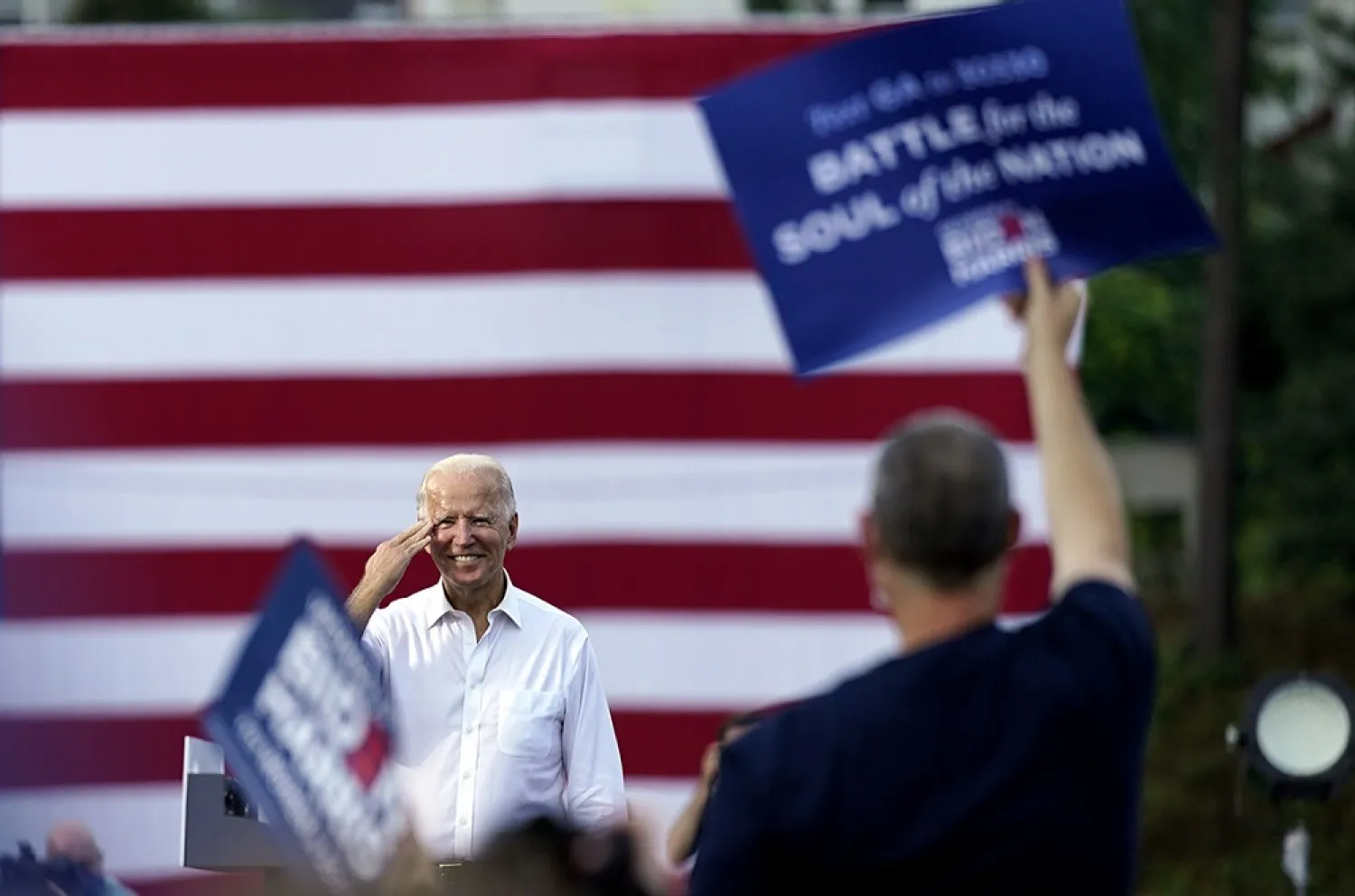
Democratic presidential candidate former Vice President Joe Biden greets supporters at a drive-in rally at Cellairis Amphitheatre in Atlanta, Oct. 27, 2020. (AP)
TT

A Longtime Fixture in US Politics, Biden Seeks to Win Elusive Prize

Democratic presidential candidate former Vice President Joe Biden greets supporters at a drive-in rally at Cellairis Amphitheatre in Atlanta, Oct. 27, 2020. (AP)

Joe Biden, a fixture in US politics for a half century as a senator and vice president, is seeking to complete a long climb to the political mountaintop that includes two previous failed presidential bids by defeating President Donald Trump on Tuesday.

If Biden beats the Republican president, a fellow septuagenarian, the 77-year-old Democrat from Delaware would become the oldest person ever elected to the White House.

Biden has sought to portray his political experience as a benefit, casting himself as a tested leader up to the tasks of healing a nation battered by the coronavirus pandemic and providing steadiness after the turbulence of Trump’s presidency.

Accepting the Democratic presidential nomination in August, Biden stressed compassion and decency, seeking to draw a contrast with the pugnacious Trump.

“I’ll be an ally of the light,” Biden said, “not the darkness.”

Trump has derided him as “Sleepy Joe” and said his mental capacity was “shot” as the president’s allies sought to portray Biden as senile.

If elected, Biden would be 78 years old upon inauguration on Jan. 20. Trump, 74, was the oldest person to assume the presidency when he was sworn in at age 70 in 2017.

Biden unsuccessfully sought the Democratic presidential nomination in 1988 and 2008 before finally securing his party’s blessing this year with strong support among Black voters.

He brings to his political career a mix of blue-collar credentials, foreign policy experience and a compelling life story marked by family tragedy - the loss of his first wife and a daughter in a car crash, and a son to cancer.

Biden arrived in Washington as a young upstart. He was elected in 1972 at age 29 to the US Senate from Delaware and remained there for 36 years before serving from 2009 to 2017 as vice president under Barack Obama, the country’s first Black president.

Trump has sought to turn Biden’s experience into a liability, denouncing him as a career politician. Trump has said Biden would become a puppet of the Democratic Party’s “radical left.”

The coronavirus pandemic has been front and center in the presidential race. Biden accuses Trump of surrendering in the face of the public health crisis, saying the president panicked and tried to wish away the virus rather than do the hard work needed to get it under control, leaving the economy in shambles and millions of people jobless.

Trump, who was hospitalized for three days after contracting COVID-19, has mocked Biden for regularly wearing a face mask to guard against the pathogen’s spread.

‘The soul of this nation’
After serving as vice president, Biden opted not to run for president in 2016, only to watch Trump defeat Democrat Hillary Clinton. When Biden announced his 2020 candidacy in April 2019, he took aim at Trump.

“We are in the battle for the soul of this nation,” Biden said, adding that if re-elected Trump would “forever and fundamentally alter the character of this nation - who we are - and I cannot stand by and watch that happen.”

Biden selected Senator Kamala Harris - whose father is an immigrant from Jamaica and whose mother is an immigrant from India - as his running mate, making her the first Black woman and first person of Asian descent on a major-party US ticket. At 56, Harris is a generation younger than Biden.

An effort by Trump to dig up dirt on Biden resulted in the president’s impeachment in the Democratic-controlled US House of Representatives in December 2019. The two articles of impeachment - abuse of power and obstruction of Congress - stemmed from Trump’s request that Ukraine investigate Biden and his son Hunter on unsubstantiated corruption allegations.

In February, the Senate, controlled by Trump’s fellow Republicans, acquitted him of the charges after refusing to call any witnesses.

US intelligence agencies and the FBI director this year concluded that Russia, after interfering in the 2016 election to harm Trump’s opponent Clinton, was engaging in a campaign to denigrate Biden and boost Trump’s re-election chances while promoting discord in the United States.

Biden’s previous two presidential runs did not go well. He dropped out of the 1988 race after allegations that he had plagiarized some speech lines from British Labor Party leader Neil Kinnock. In 2008, Biden won little support and withdrew, only to be selected later as Obama’s running mate.

The folksy Biden, known for blunt talk and occasional verbal gaffes, has often referenced his working-class roots to connect with ordinary Americans. Biden also was the first Roman Catholic US vice president.

Under Obama, Biden served as a troubleshooter on matters of war and foreign affairs and on domestic issues such as gun control and fiscal policy.

Obama did not always heed Biden’s advice. Obama gave the go-ahead for the 2011 raid in Pakistan that killed al-Qaeda leader Osama bin Laden despite Biden’s warning that it was too risky.

Biden speaks openly about his family’s tragedies including the 1972 car crash that killed his first wife, Neilia, and their 13-month-old daughter, Naomi, weeks after his election to the Senate.

He almost abandoned his political career to care for his two young sons who survived the accident but stayed on, commuting by train from Delaware to Washington to avoid uprooting them.

In 2015, his son Joseph “Beau” Biden III, an Iraq war veteran who had served as Delaware’s attorney general, died from brain cancer at age 46. Biden’s son Hunter struggled with drug issues as an adult.

Biden himself had a health scare in 1988 when he suffered two brain aneurysms.

Blue-collar background
Biden was born in the blue-collar city of Scranton, Pennsylvania, the eldest of four siblings. His family later moved to Delaware. Biden overcame stuttering as a boy by reciting passages of poetry to a mirror.

He was practically a political novice - having served two years on a county board in Delaware - when in 1972 he became the fifth-youngest elected senator in US history.

Despite years of partisan hostilities in Washington, Biden remained a believer in bipartisanship. During his time in the Senate, Biden was known for his close working relationships with some of his Republican colleagues. In addition, a number of disaffected Republicans, including former government officials and former lawmakers, alarmed at Trump’s presidency have endorsed Biden.

Biden also advocated for America’s role as a leader on the world stage at a time when Trump was abandoning international agreements and alienating longtime foreign allies.

One of Biden’s accomplishments as a senator was helping to secure passage in 1994 of a law called the Violence Against Women Act to protect victims of domestic crimes.

While in the Senate, Biden built up a specialty in foreign affairs and at one time headed the Foreign Relations Committee. He voted in favor of authorizing the 2003 Iraq invasion before becoming a critic of Republican President George W. Bush’s handling of the war.

Biden was criticized as chairman of the Senate Judiciary Committee in 1991 for his handling of sexual harassment accusations against Republican President George H.W. Bush’s conservative Supreme Court nominee Clarence Thomas by former aide Anita Hill. Liberals criticized him for doing too little to defend Hill’s allegations, which Thomas had denied.

The committee held explosive televised hearings prior to Thomas’s eventual Senate confirmation. Thomas accused Biden’s committee of conducting “a high-tech lynching for uppity Blacks who in any way deign to think for themselves, to do for themselves, to have different ideas.”

In May of this year, Biden denied a former Senate aide’s accusation that he had sexually assaulted her in 1993, calling the claim “not true” and saying “unequivocally it never, never happened.” The allegation was made by a California woman named Tara Reade who worked as a staff assistant in Biden’s Senate office for about 10 months.

Reade was one of eight women who in 2019 came forward to say Biden had hugged, kissed or touched them in ways that made them uncomfortable, though none accused him of sexual assault. Reade publicly accused him of the assault months later.



European Leaders See Trump’s Troop Drawdown from Germany as New Proof They Must Go it Alone

An AH-64 Apache attack helicopter stands in front of a Galaxy C-5 transport plane at the US Air Base in Ramstein, western Germany, on February 22, 2017. (dpa/AFP)
TT

European Leaders See Trump’s Troop Drawdown from Germany as New Proof They Must Go it Alone

An AH-64 Apache attack helicopter stands in front of a Galaxy C-5 transport plane at the US Air Base in Ramstein, western Germany, on February 22, 2017. (dpa/AFP)

European leaders on Monday said that US President Donald Trump’s snap decision to pull thousands of US troops out of Germany came as a surprise but is a fresh sign that Europe must take care of its own security.

The Pentagon announced last week that it would pull some 5,000 troops out of Germany, but Trump told reporters on Saturday that “we’re going to cut way down. And we’re cutting a lot further than 5,000.”

He offered no reason for the move, which blindsided NATO, but his decision came amid an escalating dispute with German Chancellor Friedrich Merz over the US-Israeli war on Iran, and Trump’s anger that European allies have been reluctant to get involved in the conflict in the Middle East.

Asked about the decision to pull out 5,000 troops from Germany, Norwegian Prime Minister Jonas Gahr Støre said: “I wouldn’t exaggerate that because I think we are expecting that Europe is taking more charge of its own security.

“I do not see those figures as dramatic, but I think they should be handled in a harmonious way inside the framework of NATO,” he told reporters in Yerevan, Armenia, where European leaders are holding a summit.

The European Union’s foreign policy chief, Kaja Kallas, said “there has been a talk about withdrawal of US troops for a long time from Europe. But of course, the timing of this announcement comes as a surprise.”

“I think it shows that we have to really strengthen the European pillar in NATO,” she said.

Asked whether she believes that Trump is trying to punish Merz, who said that the US has been humiliated by Iran in talks to end the war, Kallas said: “I don’t see into the head of President Trump, so he has to explain it himself.”

Over the weekend, NATO spokesperson Allison Hart said that officials at the 32-nation military alliance “are working with the US to understand the details of their decision on force posture in Germany.”

European allies and Canada have known since just after he came to office again last year that Trump would pull troops out of Europe — indeed some left Romania in October — but US officials had pledged to coordinate any moves with their NATO allies to avoid creating a security vacuum.

NATO Secretary-General Mark Rutte played down the move, saying that “there has been at this point disappointment on the US side” about European support for the war on Iran.

Notably France, Spain and the UK have declined to give US forces free rein to use bases on their territory to attack Iran. Spain has denied them the use of its airspace and bases there for the war.

But Rutte, who has championed Trump’s leadership at NATO despite the US president's criticism of the majority of the allies, said: “I would say the Europeans have heard a message. They are now making sure that all the bilateral basing agreements are being implemented.”

Rutte added that European nations “have decided to pre-position assets, key assets, close to the theater for the next phase.”

He provided no details, but the Europeans have insisted they would not help police the Strait of Hormuz, a key energy trade route, until the war is over.

French President Emmanuel Macron said “if the United States is ready to reopen Hormuz, that’s great. That’s what we’ve been asking for since the beginning.” But he underlined that the Europeans are not ready to get involved in any operation “that does not seem clear to us.”

In another sign of friction with Merz, Trump has accused the EU of not complying with its US trade deal and announced plans to increase tariffs next week on cars and trucks produced in the bloc to 25%, a move that would be particularly damaging to Germany, a major automobile manufacturer.

Without mentioning Trump or the United States, European Commission President Ursula von der Leyen listed recent trade deals that the bloc has sealed with Australia and India, and is now working on with Mexico.

“With like-minded friends, you have stable, reliable supply chains and Europe has the biggest network of free trade agreements,” von der Leyen, who is from Germany, told reporters.


What to Know about Hantavirus, the Illness Suspected in a Cruise Ship Outbreak

This aerial picture shows a general view of the cruise ship MV Hondius stationary off the port of Praia, the capital of Cape Verde, on May 3, 2025. (AFP)
TT

What to Know about Hantavirus, the Illness Suspected in a Cruise Ship Outbreak

This aerial picture shows a general view of the cruise ship MV Hondius stationary off the port of Praia, the capital of Cape Verde, on May 3, 2025. (AFP)

A hantavirus is suspected of causing an outbreak aboard a cruise ship that has killed three people and sickened others.

Studies indicate hantaviruses have been around for centuries, with outbreaks documented in Asia and Europe. In the Eastern Hemisphere, it has been linked with hemorrhagic fever and kidney failure. It wasn’t until the early 1990s that a previously unknown group of hantaviruses emerged in the southwestern United States as the cause of an acute respiratory disease now known hantavirus pulmonary syndrome.

The disease gained attention last year after late actor Gene Hackman ’s wife, Betsy Arakawa, died from a hantavirus infection in New Mexico.

The World Health Organization said in a statement Sunday that detailed investigations of the cruise ship outbreak are ongoing, including further laboratory testing and epidemiological investigations. Sequencing of the virus also is ongoing.

The virus is spread by rodents and more rarely, people

Hantavirus is mainly spread by contact with rodents or their urine, saliva or droppings, particularly when the material is disturbed and becomes airborne, posing risk of inhalation. People are typically exposed to hantavirus around their homes, cabins or sheds, especially when cleaning out enclosed spaces with little ventilation or exploring areas where there are mouse droppings.

The WHO says that while rare, hantaviruses may spread between people.

The US Centers for Disease Control and Prevention began tracking the virus after a 1993 outbreak in the Four Corners region — the area where Arizona, Colorado, New Mexico and Utah meet.

It was an astute physician with the Indian Health Service who first noticed a pattern of deaths among young patients, said Michelle Harkins, a pulmonologist with the University of New Mexico Health Sciences Center who for years has been studying the disease and helping patients.

Most US cases are in Western states. New Mexico and Arizona are hotspots, Harkins said, likely because the odds are greater for mouse-human encounters in rural areas.

The illness starts with flu-like symptoms

An infection can rapidly progress and become life-threatening. Experts say it can start with symptoms that include a fever, chills, muscle aches and maybe a headache.

“Early in the illness, you really may not be able to tell the difference between hantavirus and having the flu,” said Dr. Sonja Bartolome of UT Southwestern Medical Center in Dallas.

Symptoms of hantavirus pulmonary syndrome usually show between one to eight weeks after contact with an infected rodent. As the infection progresses, patients might experience tightness in the chest, as the lungs fill with fluid.

The other syndrome caused by hantavirus — hemorrhagic fever with renal syndrome — usually develops within a week or two after exposure.

Death rates vary by which hantavirus causes the illness. Hantavirus pulmonary syndrome is fatal in about 35% of people infected, while the death rate for hemorrhagic fever with renal syndrome varies from 1% to 15% of patients, according to the CDC.

A lot of unknowns

There is no specific treatment or cure, but early medical attention can increase the chance of survival.

Despite years of research, Harkins said many questions have yet to be answered, including why it can be mild for some people and very severe for others and how antibodies are developed.

She and other researchers have been following patients over long periods of time in hopes of finding a treatment.

“A lot of mysteries,” she said, noting that what researchers do know is that rodent exposure is a key.

The best way to avoid the germ is to minimize contact with rodents and their droppings. Use protective gloves and a bleach solution for cleaning up rodent droppings. Public health experts caution against sweeping or vacuuming, which can cause the virus to get into the air.


Why Israel Fears Military Rapprochement Between Egypt and Türkiye

Egyptian Abdel Fattah al-Sisi meets Turkish Recep Tayyip Erdogan on the sidelines of the D-8 Organization for Economic Cooperation summit in Egypt’s New Administrative Capital in December 2024. (Egyptian Presidency)
TT

Why Israel Fears Military Rapprochement Between Egypt and Türkiye

Egyptian Abdel Fattah al-Sisi meets Turkish Recep Tayyip Erdogan on the sidelines of the D-8 Organization for Economic Cooperation summit in Egypt’s New Administrative Capital in December 2024. (Egyptian Presidency)

The growing rapprochement between Egypt and Türkiye is raising concern in Israel, particularly as military cooperation expands through joint training and exercises between two of the region’s largest and most strategically significant armed forces.

Those concerns resurfaced after international military drills involving Egyptian and Turkish forces concluded in the Libyan city of Sirte.

Experts who spoke to Asharq Al-Awsat said the unease stems from several factors, including the two countries’ military weight and their growing alignment on regional issues and defense manufacturing.

They expect the rapprochement could evolve into a regional alliance with expanding influence, while ruling out any imminent military confrontation.

Israeli concerns

The Israeli newspaper Maariv published an article by retired general Yitzhak Brik warning that Tel Aviv could face a “difficult war” against a potential Egyptian-Turkish alliance as both countries strengthen their military capabilities.

Brik warned that strategic cooperation between Cairo and Ankara could extend to joint military production and defense integration.

Any military rapprochement between Egypt and Türkiye, he said, could reshape deterrence dynamics in the region and pose new security challenges for Israel, requiring a comprehensive reassessment of its military doctrine and defense strategies.

Israeli channel i24NEWS reported on April 18 that talks between Egypt and Türkiye were accelerating, noting that in-depth discussions had been referred to Turkish parliamentary committees on security, defense, and intelligence.

Turkish President Recep Tayyip Erdogan visited Cairo in February, where several agreements were signed, including in the defense sector. During a joint press conference, Egyptian President Abdel Fattah al-Sisi said the two countries share converging views on regional and international issues, particularly Gaza, Sudan, Libya and the Horn of Africa.

Israel has also expressed reservations about the possibility of Ankara participating in international stabilization forces in Gaza, after Türkiye became involved in mediation and guarantees for implementing a ceasefire agreement in October. Media reports have also pointed to the possibility of a future military confrontation between Israel and Türkiye following tensions linked to Iran.

‘Cold peace’

Egyptian military and strategic expert Samir Ragheb said Türkiye’s direct presence in the region, combined with its rapprochement with Egypt, reinforces what he described as a “cold peace” with Israel.

He told Asharq Al-Awsat that Cairo and Ankara command the region’s two largest armies and maintain strong ties with key regional powers, something Israel views with concern.

One of the most sensitive issues for Israel, he said, is cooperation in drone manufacturing.

Both Egypt and Türkiye have significant capabilities in this field, and joint production could meet their domestic needs while positioning them as strong competitors to Israeli drones in regional markets, particularly as negative perceptions of Israeli products grow due to ongoing conflicts, making Egyptian-Turkish alternatives more appealing.

Coordination between Egypt and Türkiye spans a broad geographic arc from Somalia to Syria, including Libya. This, Ragheb said, adds to Israeli concerns, particularly as Türkiye seeks to expand its footprint in Africa through Egypt, the continent’s main gateway.

Turkish affairs researcher Taha Ouda Oglu told Asharq Al-Awsat that cooperation between Egypt and Türkiye on Gaza, Libya and Africa is further raising Israeli concerns.

Rising military cooperation

Military cooperation between Egypt and Türkiye has accelerated in recent months. In late 2025, for the first time in 13 years, Egyptian forces took part in joint naval exercises on Turkish soil, involving Turkish frigates, attack boats, a submarine and F-16 fighter jets, alongside Egyptian naval units.

Türkiye’s Defense Ministry said on Thursday that the “Flintlock 2026” exercises, which were in Sirte from April 13 to 30, had concluded. The drills, which included Egyptian forces, aimed to enhance military cooperation and combat readiness through integrated land, air and naval scenarios.

In September, Turkish Foreign Minister Hakan Fidan said in a televised interview that Ankara is seeking to strengthen cooperation with Egypt in defense industries and joint security, noting that regional threats are driving deeper discussions on security as ties develop.

Egypt and Türkiye also signed an agreement in late August to locally produce the “Turkha” drone in Egypt, a step aimed at localizing drone technology and boosting domestic defense industries. The aircraft features advanced surveillance and reconnaissance systems and vertical takeoff and landing capabilities.

Ragheb ruled out the possibility of Israel waging a military confrontation against either Egypt or Türkiye, saying Israeli military doctrine does not allow for fighting on multiple fronts simultaneously against major powers.

He added that the United States would be unlikely to support Israel in a war against countries the size of Egypt or Türkiye, noting both nations rely on deterrence through strength rather than rhetoric.

He said the rapprochement, while not directed against Israel, could evolve into a broader regional alliance that may include major countries, such as Pakistan.

Oglu said military cooperation between Egypt and Türkiye is likely to deepen further and expand across multiple arenas, increasing their influence in the region, without leading to a direct confrontation with Israel.