


Saudi Concern Over Covid-19 Lower Than Global Average

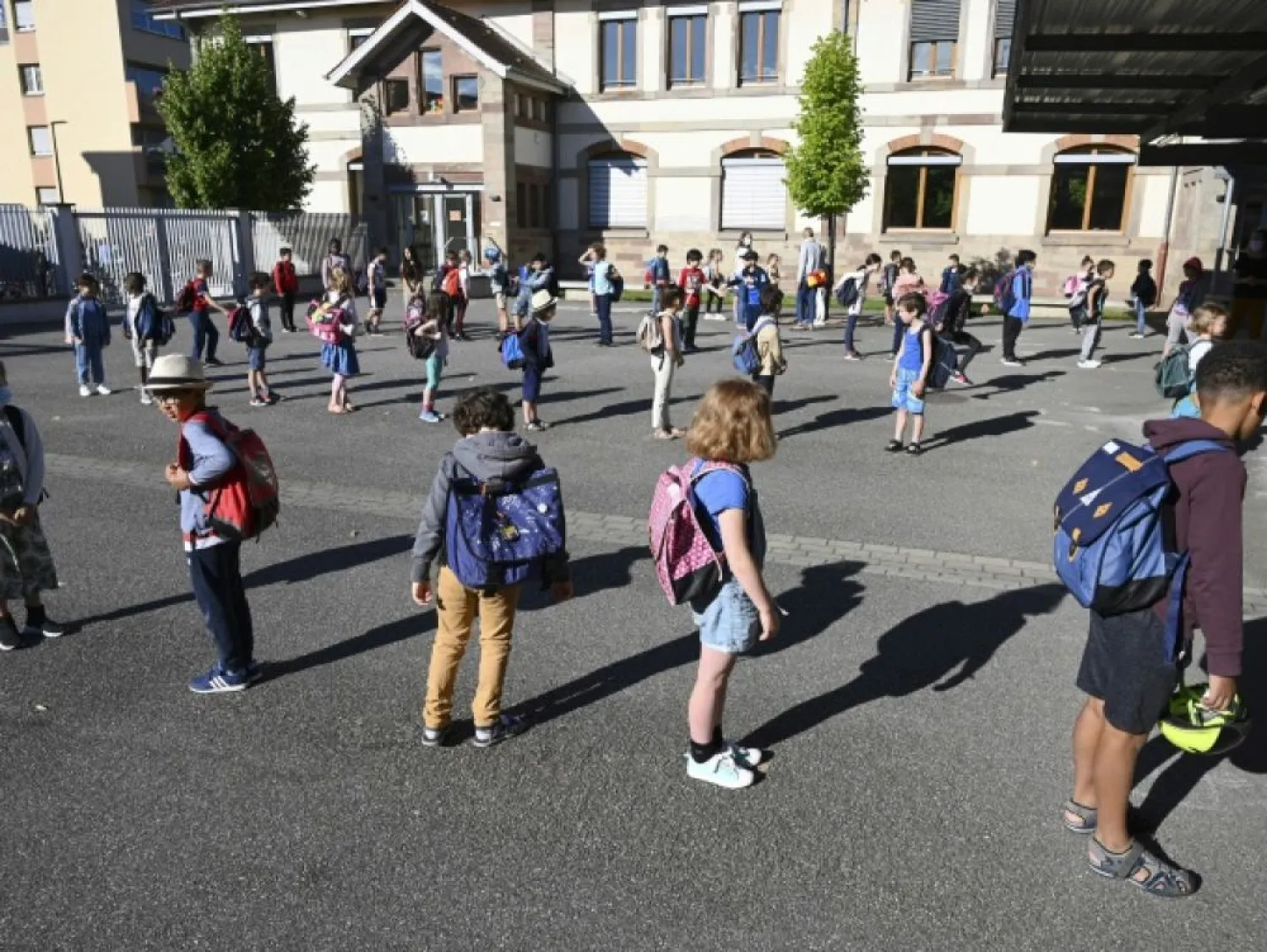
Children queue to enter their classrooms at the Ziegelau elementary school in Strasbourg, eastern France, as primary and middle schools reopen on June 22, 2020. AFP - FREDERICK FLORIN
TT

Saudi Concern Over Covid-19 Lower Than Global Average

Children queue to enter their classrooms at the Ziegelau elementary school in Strasbourg, eastern France, as primary and middle schools reopen on June 22, 2020. AFP - FREDERICK FLORIN

The level of psychological anxiety caused by the coronavirus pandemic in Saudi Arabia is lower than the global average that exceeded 21 percent.

The level was estimated at 17% in the Kingdom, according to recent data presented by the Knowledge Integration virtual Forum to Confront the Pandemic, which was held on Monday.

Organized by the Ministry of Education, with the participation of international speakers and researchers from Saudi universities, the forum featured more than 50 speakers, who talked about the psychological impact of Covid-19.

Dr. Meshaal Al-Aqeel, a consultant psychiatrist, presented a comparison with some countries, stating that anxiety in China was estimated at 29%, while it exceeded 21.5% in Spain and around 19% in Italy.

He emphasized that the pandemic has caused an increase in domestic violence rates globally, and violence against children in particular, calling for the creation of a joint national response plan for psychological interventions in crises and inter-sectoral cooperation.

For his part, Dr. Saleh Al-Nassar, the secretary-general of Education Departments, called for “humanizing the electronic school as much as possible.”

He also underlined the importance of establishing new departments in schools that would focus on remote social activities and social solidarity under the name of “Social Solidarity Unit.”

In order to help students deal with the psychological and social impacts of home confinement, Nassar stressed the need to resort to arts, develop special individual and performing skills, and encourage reading, narrative writing, fine arts, mathematical skills, and other.

Dr. Arwa Arab, associate professor of clinical psychology at King Abdulaziz University in Jeddah, discussed the impact of social distancing imposed by the coronavirus pandemic on the elderly, noting that they were among the most affected groups in terms of mental health. She noted that the psychological effect of Covid-19 included depression, anxiety, and panic.



Saudi FM, Qatari PM Co-Chair Coordination Council Executive Committee Meeting

Prince Faisal bin Farhan and Sheikh Mohammed Al Thani co-chair the Executive Committee meeting of the Saudi-Qatari Coordination Council. SPA
TT

Saudi FM, Qatari PM Co-Chair Coordination Council Executive Committee Meeting

Prince Faisal bin Farhan and Sheikh Mohammed Al Thani co-chair the Executive Committee meeting of the Saudi-Qatari Coordination Council. SPA

Saudi Minister of Foreign Affairs Prince Faisal bin Farhan bin Abdullah met on Thursday with Qatari Prime Minister and Minister of Foreign Affairs Sheikh Mohammed bin Abdulrahman bin Jassim Al Thani in Riyadh.

The meeting reviewed bilateral relations, aspects of cooperation, and ways to develop them in a manner that meets the aspirations of the leaderships and peoples of the two countries.

Following the meeting, Prince Faisal and Sheikh Mohammed co-chaired the Executive Committee meeting of the Saudi-Qatari Coordination Council.

They reviewed the strong fraternal relations and ways to enhance them at bilateral and multilateral levels. They also discussed strengthening cooperation through several initiatives that would elevate relations to broader prospects.

Both sides praised the cooperation and coordination among the committees and working groups formed under the coordination council, stressing the importance of maintaining this level of progress to serve the mutual interests of both nations and their peoples.

The Executive Committee Secretariat presented an overview of the council’s activities and its committees over the past period, along with the latest updates and preparatory work for the eighth meeting of the Saudi-Qatari Coordination Council.

At the end of the meeting, the two ministers signed the minutes of the Executive Committee of the Saudi-Qatari Coordination Council.


Albudaiwi: GCC is a Global Investment Magnet, Driven by Stability and Economic Strength

Secretary General of the Gulf Cooperation Council Jasem Mohamed Albudaiwi. GCC
TT

Albudaiwi: GCC is a Global Investment Magnet, Driven by Stability and Economic Strength

Secretary General of the Gulf Cooperation Council Jasem Mohamed Albudaiwi. GCC

Secretary-General of the Gulf Cooperation Council (GCC) Jasem Albudaiwi stated that the strategic geographical location, political stability, and strong economic foundations of the Gulf states, coupled with the acceleration of Gulf integration projects, make the GCC a global destination attractive for investment and a key platform for international partnerships.

These factors, he added, enhance the status of the council states as a major player in shaping the future of the global economy, reported the Saudi Press Agency on Thursday.

The secretary-general's remarks were made during his participation in the opening session of the seventh Milken Institute Middle East and Africa Summit, held in Abu Dhabi, United Arab Emirates.

Reviewing global economic transformations, Albudaiwi emphasized that the Gulf economy is undergoing a strong and sustainable phase, reflecting the success of economic reforms and strategic investments in future sectors.

He said that the Gross Domestic Product (GDP) of the GCC states reached approximately $2.3 trillion in 2024, positioning the council states in ninth place globally and accounting for 63% of the total Arab economy. He added that the contribution of non-oil sectors exceeded 76% of the GDP, an indicator reflecting the success of economic diversification policies.

Albudaiwi also pointed to the strength and stability of the GCC financial sector, which boasts a market value exceeding $4.2 trillion, banking assets amounting to $3.5 trillion, and reserves approaching $800 billion. This is in addition to sovereign wealth funds exceeding $4.8 trillion, a fact that solidifies the council states' position as a key player in enhancing global economic stability, he stressed.

The secretary-general revealed that the GCC states are negotiating free trade agreements (FTAs) with numerous international partners, including the United Kingdom, China, Türkiye, Japan, Indonesia, New Zealand, Pakistan, and Korea. These negotiations aim to enhance trade and investment flows, diversify income sources, and open new markets for Gulf products, thereby elevating competitiveness and reducing consumer prices within the GCC states.

Regarding artificial intelligence, he confirmed that the GCC states treat AI as a fundamental pillar for economic and social transformation.

The General Secretariat has adopted several regulatory frameworks and guiding principles, including the Guiding Framework for AI Ethics (2024), the General Framework for AI Applications in Public Services (October 2025), and the General Framework for Climate Forecasting and Disaster Management using AI (October 2025). Furthermore, the comprehensive Gulf Strategy for Artificial Intelligence is set to be adopted in December 2025.


Gulf–Italian Drive to Build Platform for Deeper Partnerships

Italian Prime Minister Giorgia Meloni during her speech (Saudi Al-Ekhbariyah). 
TT

Gulf–Italian Drive to Build Platform for Deeper Partnerships

Italian Prime Minister Giorgia Meloni during her speech (Saudi Al-Ekhbariyah). 

Bahrain’s King Hamad bin Isa Al Khalifa reaffirmed the Gulf Cooperation Council’s determination to strengthen its partnership with Italy, underscoring the importance of advancing economic, social, and cultural ties.

Speaking at a Gulf–Italian business session in Manama, the king praised Italy’s significant progress in recent years and its prominent role in supporting international peace, security, and the protection of global maritime routes.

Italian Prime Minister Giorgia Meloni, for her part, described her country as “a nation with an ancient heart and a forward-looking vision.” She invoked what she called the “Arab frontier” between the Roman Empire and the Arabian Peninsula - “not a rigid barrier,” she said, but a corridor of contact and commerce, animated for centuries by the Spice Routes that connected ancient Rome with India through the Mediterranean.

Meloni announced Italy’s readiness to host a Gulf–Mediterranean summit aimed at launching a new, ambitious framework for dialogue between the two regions. She noted that the shared geopolitical space between the Gulf and the Mediterranean is “set to grow in importance,” making more structured engagement essential. Effective cooperation, she said, depends on harnessing the complementary strengths and strategic positioning of both sides.

Meloni stressed that Italy’s approach goes beyond exporting finished goods. The country also offers financing tools, industrial know-how, and advanced technological expertise.

She outlined Italy’s proposal to establish a joint operational platform focused on priority challenges where both sides can have meaningful impact. At the top of that list is strengthening economic connectivity, now a crucial factor in a rapidly innovating global economy.

Meloni highlighted the India–Middle East–Europe Economic Corridor (IMEC), which links major ports from India to the Middle East and Europe, with integration opportunities for the United States, as a project that could unlock “tremendous potential for our economies and companies.”

Turning to regional security, Meloni reiterated that lasting stability in the Middle East requires a two-state solution: Israel’s recognition of the Palestinians’ right to statehood, coupled with a final recognition of Israel’s right to exist and live in security.

On Iran, Meloni noted Tehran’s repeated assertions that it does not seek nuclear weapons. She said: “If this is true - and I want to believe it - then a strict, credible agreement with full participation from the International Atomic Energy Agency is essential to assure the world of the peaceful nature of Iran’s program.”

GCC Secretary-General Jasem Mohamed Albudaiwi affirmed the depth of Gulf–Italian ties, describing them as long-standing, trust-based, and anchored in shared interests. He noted clear progress in recent years across multiple fields, including security, stability, and counterterrorism, all aimed at supporting collective security and advancing peaceful conflict resolution.