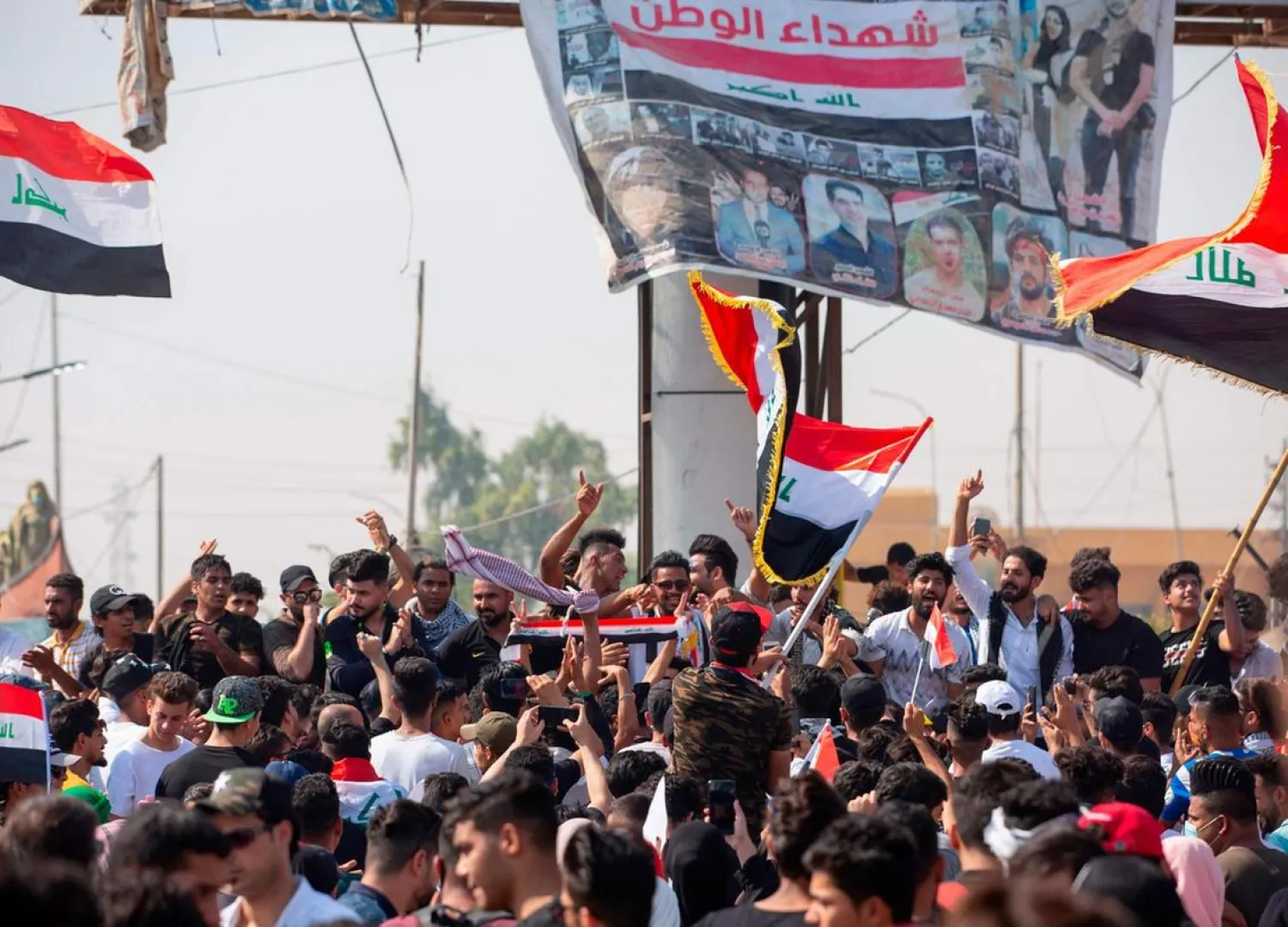
Reactions continued to mount in Iraq over controversial remarks by Badr Organization leader Hadi al-Amiri about the involvement of armed factions in suppressing the 2019 Tishreen protest movement, amid reports of moves to take legal action against him.
Defending the factions and what he described as their role in protecting the current political system, both by fighting ISIS and by confronting attempts to undermine its foundations, al-Amiri said the factions were responsible for quelling what he called the “Tishreen sedition,” referring to the popular protests that erupted in October 2019.
His remarks appeared to be a slip of the tongue, particularly as they came nearly seven years after the mass uprising, which claimed thousands of victims at the hands of what was then referred to as the “third party,” whose identity has never been revealed. The protesters’ sole slogan was: “We want a homeland.”
Al-Amiri is one of the leading figures in the Shiite Coordination Framework and a member of a three-man committee that also includes former Prime Minister Nouri al-Maliki and Prime Minister Mohammed Shia al-Sudani. The committee was formed to mediate between the Iraqi government, on one side, and armed factions refusing to surrender their weapons, on the other.
Al-Amiri made the controversial remarks at a public gathering several days ago, saying: “It was the resistance that courageously stood against the Tishreen sedition and preserved the state and the political system.”
His comments angered the families of protesters killed in the demonstrations, as well as those who were wounded.
Slip of the tongue
Al-Amiri’s remarks appeared intended to justify caution over demands that the factions surrender their weapons, particularly those that have said their arms are rooted in ideological commitments and tied to the ongoing confrontation between the United States and Iran.
His comments also followed a visit to Iraq last week by Iranian parliament Speaker Mohammad Bagher Ghalibaf.
But the remarks, widely described as a “slip of the tongue,” triggered a wave of criticism from victims of the Tishreen movement. Some drew a direct connection between al-Amiri’s statement that armed factions had confronted the “sedition” in 2019 and the unidentified “third party” accused of killing protesters.
The armed factions had not previously stated a position on accusations that they were the mysterious “third party.”
Al-Amiri’s comments, however, appeared to suggest that the party’s identity was now known, prompting victims’ families to begin pursuing legal action.
Al-Amiri has not personally responded to interpretations of his remarks. However, a Shi’ite politician close to the Coordination Framework told Asharq Al-Awsat that al-Amiri’s comments, as he intended them, were a defense of the factions’ position at a pivotal moment.
“The Tishreen movement was supported by regional and international parties and was indeed the most serious movement against the political class at the time, even though its slogans were patriotic,” the politician said.
“Attempts at the time to demonize the so-called third party as hostile to both sides — the government and the protesters — led to accusations against Baathists and others, including Israelis,” he added. “Those attempts were aimed at achieving one objective: protecting the political process from threats, as the ruling political class perceived them.”
The source said al-Amiri “could not have found stronger evidence of efforts to protect the political system than what the factions had done, perhaps without realizing the repercussions.”
“The factions protected the political system through one method: confronting the protesters and attempting to suppress them, which led to further casualties,” he said.
Asked why al-Amiri had not clarified his remarks to ease the fierce backlash, which is expected to move into the courts, the Shi’ite politician said: “Any justification or retraction would weaken his position and increase the accusations against the factions at a time when they are facing intense pressure to disarm.”
“He therefore appears to prefer confronting the protesters’ families, even if that produces legal consequences that may not be in his favor,” he added.
Impunity
Dozens of families of victims of the Tishreen movement have begun completing documents proving that their relatives were killed or wounded in clashes with security forces while taking part in the 2019 protests.
They plan to submit the documents as part of formal lawsuits before Iraqi courts following the Badr leader’s remarks.
The families, who have appointed lawyers to represent them in cases against al-Amiri, are undoubtedly aware that the courts may not convict him directly because his remarks were political.
Their likely objective, however, is to restore the reputations of their relatives who were killed or wounded after the authorities branded protesters at the time with harsh labels such as “agents” and “children of the embassies.”
Legal expert Ali al-Tamimi told Asharq Al-Awsat that “the killing of protesters constitutes genocide under Iraqi law and is not subject to a statute of limitations.”
“The attacks against protesters in Baghdad, Nasiriyah, Karbala and Najaf constituted acts of terrorism under Iraqi law and its definition of terrorism,” he said.
“These crimes are not subject to a statute of limitations or the passage of time under the convention barring statutory limitations for genocide crimes and can therefore be pursued at any point in the future,” Tamimi added.