


Virus Threat 'a New Terror' in Syria's Scarred Idlib Region

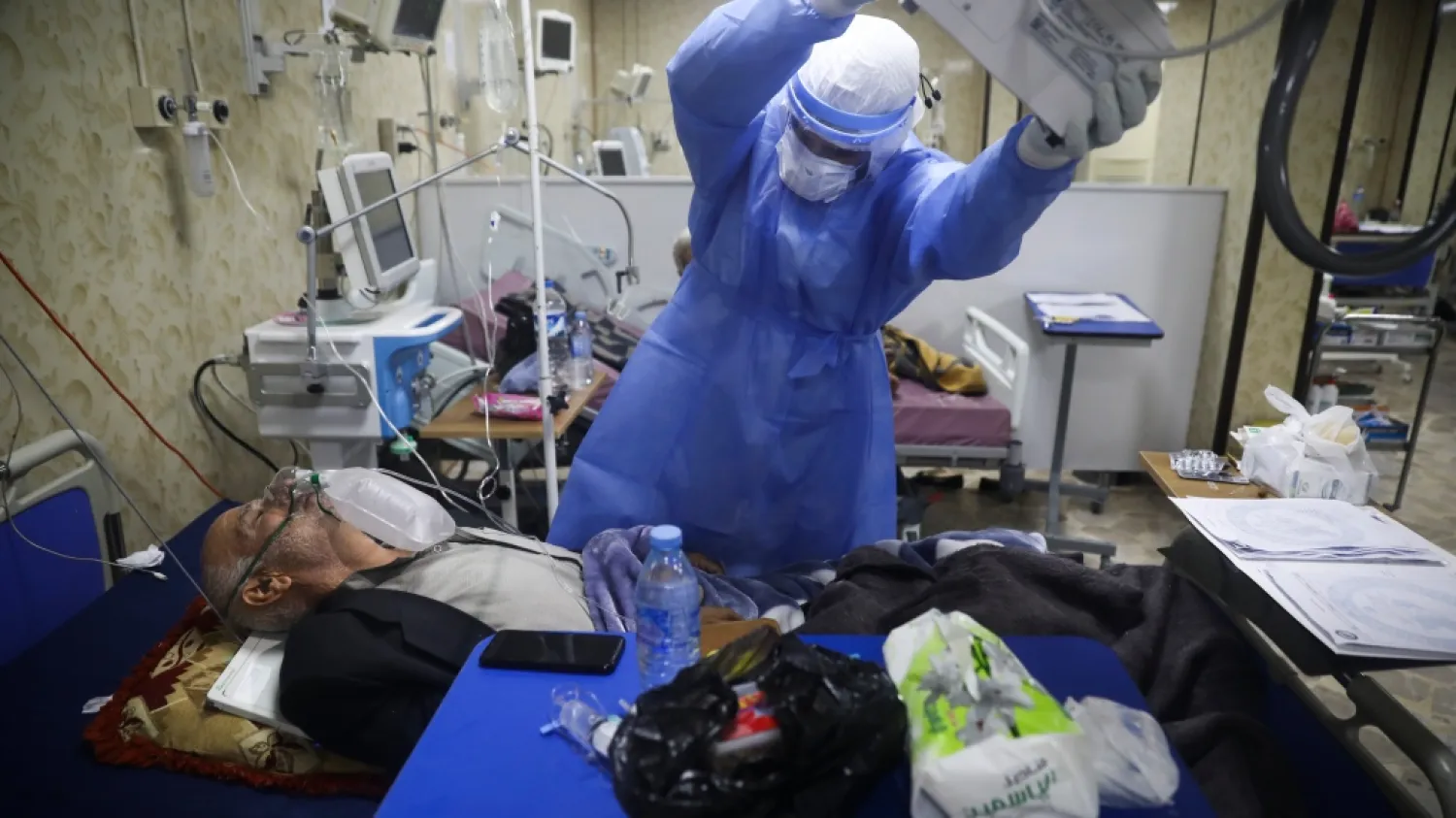
A medic works with corona patients in a hospital in Idlib, Syria, Saturday, Nov. 14, 2020. At one of two coronavirus hospitals in Syria's rebel-held Idlib province, overwhelmed medical staff tend to patients drifting in and out of consciousness. As confirmed case numbers rise to as many as 500 a day, so does the demand for beds in the intensive care ward (AP Photo/Ghaith Alsayed)
TT

Virus Threat 'a New Terror' in Syria's Scarred Idlib Region

A medic works with corona patients in a hospital in Idlib, Syria, Saturday, Nov. 14, 2020. At one of two coronavirus hospitals in Syria's rebel-held Idlib province, overwhelmed medical staff tend to patients drifting in and out of consciousness. As confirmed case numbers rise to as many as 500 a day, so does the demand for beds in the intensive care ward (AP Photo/Ghaith Alsayed)

Nurses hover over a patient to insert a breathing tube as his condition suddenly deteriorates. ICU beds fill up almost overnight. As one patient dies of the coronavirus and is wheeled out, another is whisked in to take his place. An exhausted doctor leans against a wheelchair for a breather.

The pace is dizzying at the largest isolation hospital in Syria's northwestern city of Idlib. There are no bombs falling outside and the wounded don’t crowd bloodstained corridors amid a shaky cease-fire in the country’s decade-old civil war. Still, the intensive care unit staff is overwhelmed with beds full of elderly patients gasping for air.

COVID-19 infections in the last opposition-controlled territory in Syria have been increasing rapidly. Spared until July, the region is now recording 300-500 infections a day, and the number is rising fast.

The area, battered by repeated military offensives from the government of President Bashar Assad, is home to nearly 4 million people, most of them displaced and living in tent camps or unfinished buildings.

Infection rates jumped nearly twentyfold between September and October, the UN said. Since then, it has climbed 300%, with nearly 11,900 cases recorded by Nov. 16, up from 8,100 a week earlier.

The number of infections is probably much higher. Cities have been hit hardest, but workers fear the virus will take hold in overcrowded camps.

“There are many patients, most in very bad condition. We have no time to give them all they need,” said Aref Shabib, one of over 95 nurses and technicians in the 70-bed isolation hospital, one of two in the city of Idlib, now a virus hot spot.

The pandemic, which has severely tested even developed countries, is the biggest challenge yet for Syria's health sector, already depleted by years of conflict. Authorities are pacing themselves, deploying equipment and supplies where needed in war-scarred areas.

Ambulance driver Rami Khalaf ferried a patient and a nurse for three hours from the city of Idlib to a southern town for a breathing machine. By the time they arrived, they found there was no oxygen available, so they headed to a third location, another three-hour drive.

With the nurse tending to the unconscious patient with one hand and operating a walkie-talkie in a search for life-saving equipment with the other, they drove more than 200 kilometers (125 miles).

Khalaf sat sweating behind the wheel for seven hours in his hazmat suit and mask, driving on unpaved and bombed-out roads. “We are living a new difficult experience,” he said.

At least Khalaf didn’t have to dodge bombs. Medical teams and hospitals often were targeted by government forces that accuse them of treating “terrorists” — its label for opposition fighters.

But carrying virus patients is a new challenge. Khalaf transported nearly 50 patients in 10 days, up from practically none in October. He keeps away from his children for two to three days to avoid infecting them.

“It is a new terror that is going around among us,” he said.

Announcements of virus deaths on social media or mosque loudspeakers compete with posters honoring those killed in battle, with 95 fatalities linked to COVID-19.

As winter rains began, bringing with it renewed rumblings of war, fear is growing that exhausted medical teams may not be able to cope.

Nearly 17% of infections were among health workers, who were first to get the virus. At least three doctors and an administrator died. Medical workers who survived the battlefield find themselves fighting an invisible enemy that pushes their resilience to new limits.

Unlike the war wounded, an entire 24-hour shift can be devoted to just one COVID-19 patient, said Shabib, the ICU specialist.

“We could work for six or eight hours nonstop without even sitting down. It is very hard work,” he said.

At the Ziraah or Agriculture Hospital, most of the 42 patients were elderly. At least 16 were getting some form of breathing assistance, said Dr. Salah Eddin al-Saleh, in charge of the ICU at the hospital operated by the Syrian American Medical Society.

Al-Saleh said he had to turn some patients away.

“We are working at full capacity and all our (ICU) beds are taken. The minute one bed is empty, a patient is admitted,” he said.

In northwestern Syria, which has been outside government control for most of the last decade, dispersing aid is as complicated as the politics of the conflict.

According to the UN task force coordinating efforts, there are at least 142 ICU beds and 155 breathing machines in use in the area. The plan is to eventually have 219 ICU beds and 162 machines. Nearly 500 doctors and nurses are working in COVID-19 centers.

Seven of eight hospitals in northwestern Syria that are equipped to treat the virus are already overwhelmed.

“The increase in COVID infections, cases of hospitalization and nearing full occupancy of ICUs, brings us closer to a state of emergency,” said Salem Abdan, head of Idlib's health directorate.

Infections also are rising at the overcrowded camps housing many of the nearly 1 million people who have been displaced since the last government offensive in March.

Dr. Nasser AlMuhawish, who compiles virus data from his base in Turkey, said only about 8% of infections in the camps have been recorded, and teams are increasing their screenings.

For Syrians who have survived so much adversity, the virus seems to be the least of their worries. Social distancing is nearly impossible, with a single tent or temporary shelter housing between nine to two dozen people, some who have been repeatedly displaced.

“People in Idlib have suffered the worst impacts of the conflict over 10 years,” said Misty Buswell, Middle East advocacy director for the International Rescue Committee. “A lot of people are saying ... being displaced is much harder than anything coming from COVID. At this point, I think we have to qualify that and say, ‘Up until now.’”

With an economic crisis gripping Syria, the local currency tumbling and resources in war zones shrinking, even the price of soap and water is soaring.

Residents who have supported each other during cycles of violence describe a new sense of fear.

“I don’t leave my house except to buy bread and food,” said Yasser Aboud, a father of three who has had seven relatives test positive. “I’m diabetic and worry I may get infected.”

A neighbor died of COVID-19, but Aboud was afraid to pay his respects.

With fighting threatening to resume and bring a new wave of displacement, Buswell fears a “perfect storm” could be gathering, especially if infections rise like in Europe and the US.

Virus misinformation also is spreading, such as eating garlic and onions as a preventative. Some see masks as a sign of infection, adding to the stigma of covering up.

Children play a game in which one picks up a mask found on the street and chases others screaming: “COVID! COVID!”



Netanyahu Orders Evacuation of Some West Bank Settler Outposts

FILE PHOTO: Israeli Prime Minister Benjamin Netanyahu, votes in Likud party primary elections ahead of Israel’s general election in October, in Jerusalem, Monday, August. 17, 2026.   Ohad Zwigenberg/Pool via REUTERS/File Photo
FILE PHOTO: Israeli Prime Minister Benjamin Netanyahu, votes in Likud party primary elections ahead of Israel’s general election in October, in Jerusalem, Monday, August. 17, 2026. Ohad Zwigenberg/Pool via REUTERS/File Photo
TT

Netanyahu Orders Evacuation of Some West Bank Settler Outposts

FILE PHOTO: Israeli Prime Minister Benjamin Netanyahu, votes in Likud party primary elections ahead of Israel’s general election in October, in Jerusalem, Monday, August. 17, 2026.   Ohad Zwigenberg/Pool via REUTERS/File Photo
FILE PHOTO: Israeli Prime Minister Benjamin Netanyahu, votes in Likud party primary elections ahead of Israel’s general election in October, in Jerusalem, Monday, August. 17, 2026. Ohad Zwigenberg/Pool via REUTERS/File Photo

Prime Minister Benjamin Netanyahu has ordered the evacuation of some West Bank settlements deemed illegal under Israeli law, Finance Minister Bezalel Smotrich said Sunday.

"To my knowledge, Netanyahu has given the instruction to evacuate" certain settlements, AFP quoted Smotrich as saying.

He added that he did not approve of the measure.

While all Israeli settlements in the West Bank are considered illegal under international law, some established without government approval -- often consisting of just a few prefabricated homes -- are also considered illegal by Israel.

It was not immediately clear when the operation would begin.

UN bodies and most governments deem all Israeli settlements illegal under international law ⁠and consider the West ⁠Bank to be occupied territory under military control. Israel argues the territory is disputed, not occupied.

US Ambassador to Israel Mike Huckabee on Saturday denounced violent settlers as terrorists and called for them to face severe consequences following a meeting with several Palestinian Americans in a West ⁠Bank Palestinian town.

Israeli website Ynet earlier reported the orders targeted around 100 outposts across the occupied territory.


Israeli Strike Kills Two People in Gaza

Palestinians inspect the site of an Israeli air strike on a vehicle, in Gaza City, September 6, 2026. REUTERS/Dawoud Abu Alkas
TT

Israeli Strike Kills Two People in Gaza

Palestinians inspect the site of an Israeli air strike on a vehicle, in Gaza City, September 6, 2026. REUTERS/Dawoud Abu Alkas

An Israeli strike killed at least two Palestinians, including a child, in the Gaza Strip on Sunday, health officials said.

Mohamed Abu Selmia, head of the enclave's largest Al Shifa Hospital, said the Israeli airstrike struck a vehicle in western Gaza City killing two people, including a girl, ⁠and wounding six others, Reuters reported.

An October 2025 US-backed ceasefire halted major fighting in the territory, but it failed to end ⁠strikes by the Israeli military, which it said aimed to thwart attacks by Hamas and other Gaza militants.

Hamas accuses Israel of violating the ceasefire and undermining efforts to implement US President Donald Trump's broader plan to end the Gaza conflict, which also includes Israeli withdrawals ⁠and ⁠Hamas disarmament.

More than 1,300 Palestinians, mostly civilians, have been killed in Gaza since the ceasefire took effect last October, according to the territory's health officials, while the Israeli military says four Israeli soldiers have been killed.


Iraq: Fuel Crisis Exacerbates the Country’s Problems, Citizens’ Burdens

A scene of congestion at a gas station in Baghdad (Iraqi News Agency)
TT

Iraq: Fuel Crisis Exacerbates the Country’s Problems, Citizens’ Burdens

A scene of congestion at a gas station in Baghdad (Iraqi News Agency)

Many Iraqi provinces, including the capital Baghdad, are facing a severe fuel shortage, forcing motorists in some cases to wait for hours to get gasoline. This is placing additional burdens on citizens who are already dealing with deteriorating public services, fewer hours of available electricity, and delays in the payment of pensions and salaries for public-sector employees.

Despite repeated government promises to overcome the fuel crisis, long lines of vehicles can frequently be seen at gas stations across Baghdad, Kirkuk, Babil, Basra, and most provinces of the Kurdistan Region. This is further deepening public distrust in government statements.

According to observers, the current fuel crisis "is one of the consequences of the war and the ongoing state of tension between Washington and Tehran, and its negative repercussions for Iraq since the war began on February 28."

At the same time, successive Iraqi governments face intense public criticism for failing to build enough oil refineries to meet domestic demand in a country that sits on vast oil reserves.

"Deliberate Manipulation"?

While many experts link the fuel crisis to the negative effects of the US-Iran war, particularly following the closure of the Strait of Hormuz and the disruption of most of Iraq's oil exports and foreign imports, sources close to Prime Minister Ali al-Zaidi's government do not rule out "deliberate manipulation" within the Oil Ministry that is worsening the crisis.

They link this alleged manipulation to groups that were recently affected by arrests targeting senior ministry officials on charges of stealing billions of dinars and dollars. Those arrested include former Deputy Oil Minister for Refining Affairs Adnan al-Jumaili, Deputy Oil Minister for Distribution Affairs Ali Maaraj al-Bahadli, Director General of the Oil Products Distribution Company Hussein Talib Abboud, and other figures.

In contrast, the Oil Ministry attributes the current fuel crisis to several factors, including increased demand and higher daily domestic gasoline consumption, technical failures that forced some production units at local refineries to shut down, and delays in the arrival of imported fuel shipments because of security tensions at ports and along regional transportation routes.

Despite the lines of cars at filling stations in more than one province, Oil Minister Basim Mohammed al-Abadi insists that petroleum products are available. During a meeting attended by senior ministry officials, he said that "the temporary shortage of gasoline is being addressed" and that additional gasoline shipments would arrive soon, helping to stabilize supplies and meet citizens' needs.

He added that "gasoline consumption averages around 33 million liters per day and rises to around 38 million liters when citizens become concerned."

He said his ministry "continues to closely monitor supply and distribution flows and is taking the necessary measures to secure petroleum products and strengthen stability in the domestic market."

Regarding the country's current oil exports following the near-total disruption caused by the US-Israeli-Iranian war, Minister al-Abadi said that "crude oil exports were around 250,000 barrels per day when the government took office, while current crude oil production has exceeded 3 million barrels per day."

In a subsequent statement, the Oil Ministry explained that "the congestion at fuel stations is caused by a negative gap between production and consumption." It said the ministry had relied on imported shipments delivered through maritime entry points to make up the shortfall, but regional events and the ongoing conflict have created logistical difficulties for tanker movements, delaying their arrival or docking at Iraqi ports.

No Plans to Export

The Iraqi Oil Ministry on Saturday denied reports circulated by some media outlets and news agencies that it planned to export gasoline, stressing that its immediate priority is to achieve self-sufficiency.

The ministry said in a statement that "the future shift toward exporting certain petroleum products depends on completing expansion work at other refineries," which it is pursuing as part of its strategic plans to transform Iraq from an importer into an exporter.

The statement noted that Iraq currently exports fuel oil and naphtha, in addition to previous shipments of jet fuel and sulfur.