Saudi Arabia Leading G20 during Unprecedented Circumstances, Says Russia

Russia's G20 Sherpa Svetlana Lukash.
TT

Saudi Arabia Leading G20 during Unprecedented Circumstances, Says Russia

Russia's G20 Sherpa Svetlana Lukash.

Russia stated on Friday that the novel coronavirus provided the world with many lessons, starting with how to confront poverty and inequality in the world.

Russia's G20 Sherpa Svetlana Lukash added that one of the most important decisions taken by the G20 under Saudi Arabia’s presidency was the agreement to suspend debt service payments for the world’s poorest countries.

She remarked that the world was caught off-guard during the beginning of the pandemic, but Saudi Arabia’s presidency of the G20 helped professionally shift the focus on confronting the virus, while also still keeping the summit’s regular agenda, including issues related to climate change and poverty, within its sights.

Speaking at a virtual press conference ahead of Saturday’s G20 Summit, which is hosted by Saudi Arabia, Lukash said that the pandemic crisis is unprecedented and cannot be compared with any other.

The G20 has never had to confront such a global challenge, she stated.

The crisis prompted global cooperation from world leaders and the collaboration of the G20 has provided support to the global health and economic sectors, she continued.

Every crisis is an opportunity, not just a challenge, she remarked, explaining that the pandemic presented the world with a greater understanding of the way to choose how to confront poverty and inequality in the world.

The Saudi leadership has been excellent, she added, praising it for focusing on the future and technological advancement.


Rafah Crossing Traffic Lags Two Weeks after Reopening

Humanitarian and relief aid crosses Rafah Crossing (Egyptian Red Crescent)
TT

Rafah Crossing Traffic Lags Two Weeks after Reopening

Humanitarian and relief aid crosses Rafah Crossing (Egyptian Red Crescent)

Despite nearly two weeks since the reopening of the Rafah crossing in both directions, the number of people and humanitarian aid entering the Gaza Strip falls short of what was agreed under the “Gaza ceasefire agreement,” according to an official from the Egyptian Red Crescent in North Sinai.

The daily movement of individuals to and from Gaza does not exceed 50 people, Khaled Zayed, head of the Egyptian Red Crescent in North Sinai, told Asharq Al-Awsat. He said this figure represents only one-third of what was agreed upon in the ceasefire deal.

He added that truck traffic stands at about 100 per day, despite Gaza’s population requiring the entry of around 600 trucks daily.

On Feb. 2, Israel reopened the Rafah crossing on the Palestinian side for individual travel, allowing Palestinians to leave and return to the enclave. Indicators show that most of those departing Gaza are patients and wounded individuals, who are being received at Egyptian hospitals.

This comes as Egyptian Foreign Minister Badr Abdelatty stressed the need to “ensure the unhindered delivery of humanitarian aid and not obstruct movement through the Rafah crossing.”

In his remarks during a ministerial Security Council session on developments in the Middle East on Wednesday, he underscored the importance of “halting all measures aimed at displacing residents or altering the demographic character of the occupied Palestinian territories.”

Israel took control of the Rafah border crossing in May 2024, about nine months after the outbreak of the war in Gaza. The reopening of the crossing was part of the first phase of the ceasefire agreement that entered into force last October, though the deal remains fragile.

The Egyptian Red Crescent announced the departure of the 14th group of wounded, sick, and injured Palestinians arriving and leaving through the crossing.

In a statement on Thursday, it said humanitarian efforts to receive and see off Palestinians include a comprehensive package of relief services, psychological support for children, distribution of suhoor and iftar meals, and heavy clothing, in addition to providing “return bags” for those heading back to Gaza.

At the same time, the Red Crescent dispatched the 142nd “Zad Al-Ezza” convoy, which includes 197,000 food parcels and more than 235 tons of flour as part of the “Iftar for One Million Fasters” campaign in Gaza.

The convoy also carries more than 390 tons of medicines, relief, and personal care supplies, as well as about 760 tons of fuel, according to the organization’s statement.

Zayed said the daily number of individuals crossing through Rafah over the past two weeks does not compare with what was stipulated in the ceasefire agreement.

With the reopening of the Rafah crossing on the Palestinian side, Israel’s Arabic-language public broadcaster Makan reported that 150 people were expected to leave Gaza, including 50 patients, while 50 people would be allowed to enter the enclave.

Despite what he described as Israeli obstacles, Zayed said allowing the movement of individuals and the wounded represents “an unsatisfactory breakthrough in the humanitarian situation in Gaza,” stressing the need to fulfill the ceasefire’s obligations and advance early recovery efforts inside the territory.

The total number of Palestinians who have left through the Rafah crossing since it reopened on both sides does not exceed 1,000, according to Salah Abdel Ati, head of the International Commission to Support Palestinian Rights.

He said around 20,000 wounded and sick Palestinians require urgent evacuation, and that Israeli restrictions are hindering access to medical care, adding that the humanitarian situation requires continued pressure by mediators on Israel.

Abdelatty told Asharq Al-Awsat he was counting on the outcome of the first meeting of the Board of Peace to adopt easing measures, including lifting Israeli restrictions and establishing guarantees for the ceasefire in the Palestinian territories, as well as securing the funding needed for Gaza’s early recovery, in line with US President Donald Trump’s peace plan for the enclave.

According to a statement by the Egyptian Red Crescent, Egypt continues relief efforts at all logistical hubs to facilitate the entry of humanitarian aid, which has exceeded 800,000 tons, with the participation of more than 65,000 volunteers from the Egyptian Red Crescent.


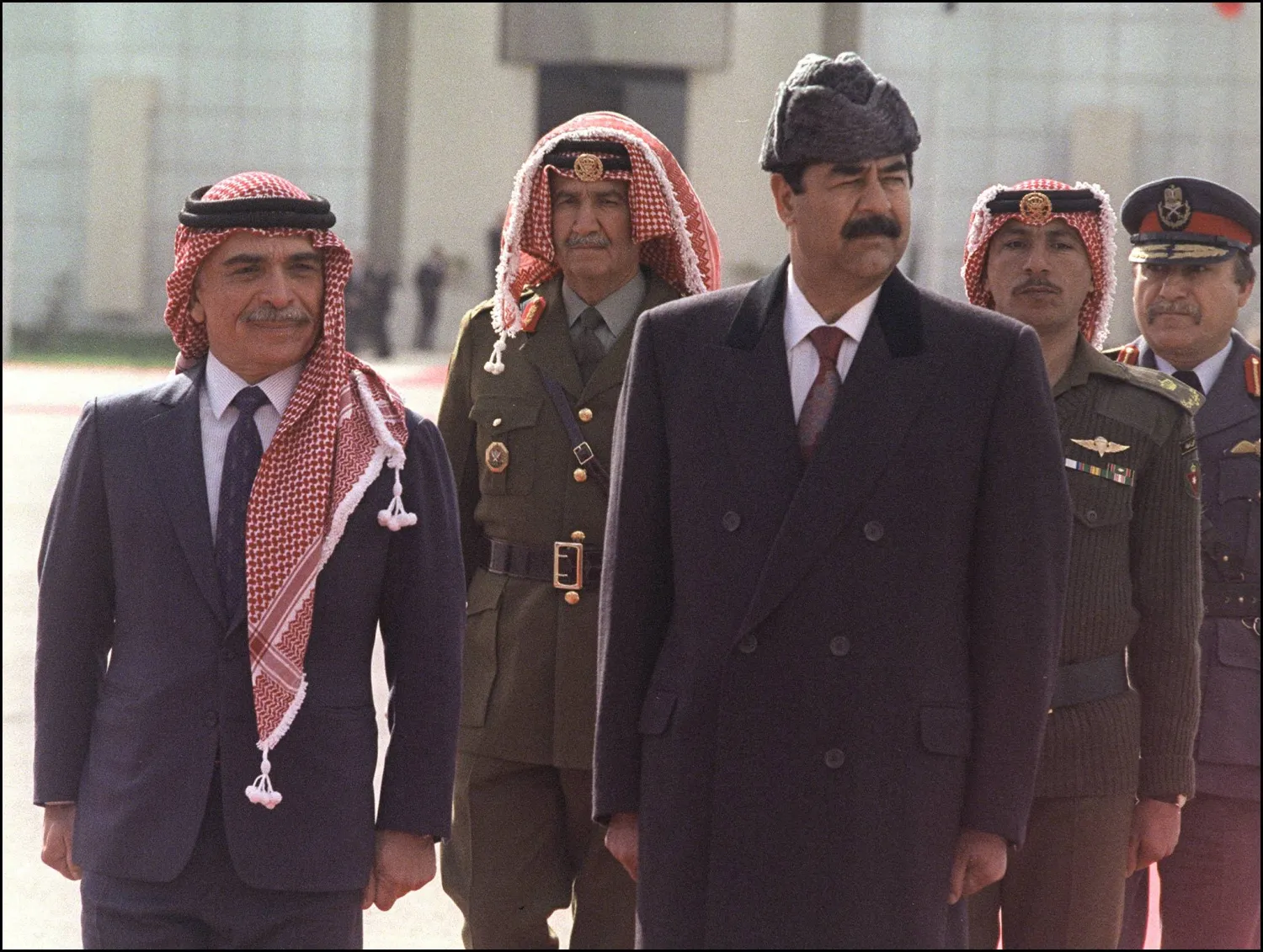
Obeidat to Asharq Al-Awsat: I Left Saddam Meeting Sensing he Misread Threat

There were exceptional communication channels between Saddam Hussein and King Hussein (AFP)
TT

Obeidat to Asharq Al-Awsat: I Left Saddam Meeting Sensing he Misread Threat

There were exceptional communication channels between Saddam Hussein and King Hussein (AFP)

In the final part of his interview with Asharq Al-Awsat, former Jordanian prime minister Ahmad Obeidat, who died earlier this month, recounted in detail his meetings with Iraqi President Saddam Hussein and Syrian President Hafez al-Assad, and disclosed an alleged attempt by Rifaat al-Assad to assassinate former Jordanian prime minister Mudar Badran.

Obeidat began with his impression of Saddam following a 2001 meeting in Baghdad. He said he left convinced that the Iraqi leader “did not accurately understand the reality of the international situation, the trap that had been set for Iraq, nor the magnitude of the danger surrounding the country and what was coming.”

He also described how strong ties between the late King Hussein of Jordan and Assad deteriorated as the Iran-Iraq war intensified. “Exceptional channels of communication” opened between King Hussein and Saddam Hussein, he said, and those channels “thwarted Assad’s efforts to build an axis against Iraq.”

Obeidat further revealed that Rifaat al-Assad “sent a group to assassinate Mudar Badran” on the pretext that Jordan was harboring the Muslim Brotherhood and hosting training camps. “All of that was false,” he said, adding that the attempt was foiled and those involved were arrested.

Turning to the file of the Palestinian militant Abu Nidal, who split from Fatah, Obeidat recalled how Abu Iyad once “protected him from arrest,” before “the tables were turned,” in a reference to Abu Iyad later becoming one of Abu Nidal’s victims.

Asked about his history with Abu Nidal, Obeidat described him as “not an easy adversary.” Abu Nidal attacked Jordanian embassies and diplomats, he said, and was responsible for killing two or three ambassadors. He was also behind the assassination of the son of former prime minister Saeed al-Mufti, a diplomat at the Jordanian embassy in Bucharest, and wounded two ambassadors in separate operations.

When Obeidat served as prime minister in 1983-1984, Abu Nidal assassinated Fahd al-Qawasmi, the mayor of Hebron, during a visit to Amman.

Abu Nidal, Obeidat said, worked at different times for Syrian, Iraqi and Libyan intelligence services. “He was ready to work for the benefit of any intelligence service in any country and allowed them to control him,” he said. Syrian, Iraqi and Libyan intelligence used him more than once, and the Iraqis deployed him against Fatah in an effort to create splits and internal problems.

Abu Iyad had shielded Abu Nidal from detention when Fatah sought to arrest him, Obeidat said. “But in the end the tables were turned,” and Abu Iyad became one of his victims. It was said, he added, that Abu Iyad came to believe that Abu Nidal had begun working for “Zionist intelligence.”

As for Jordan’s response when its diplomats were targeted, Obeidat said that at the time he was prime minister and did not follow the security file closely due to the pressures of government. He was aware, however, that contacts were made to reach a deal to halt Abu Nidal’s operations in Jordan. “Their operations did indeed stop,” he said.

On coordination with major powers, Obeidat said Jordan cooperated with “any party that possessed information of interest to us,” except the Zionists. Relations with Syrian intelligence fluctuated between competition and brief periods of cooperation, after earlier periods of no contact.

He then recounted his 1979 meeting with Hafez al-Assad over accusations that Jordan was training members of the Syrian Muslim Brotherhood. Acting on instructions from King Hussein, Obeidat, then intelligence chief, and Prime Minister Mudar Badran met Assad to address the issue.

“We made clear to Hafez al-Assad that it was impossible for us to have camps training the Syrian Muslim Brotherhood,” he said. Jordan informed Assad that such camps were in Iraq and that Syrians were traveling via Jordan to Iraq using forged passports. Without lists of those names from Damascus, Jordan could not act.

“This is a Syrian problem, not a Jordanian one,” Obeidat said he told Assad. Jordan would not allow armed activity on its soil but needed Syrian intelligence cooperation and names to intervene effectively.

He acknowledged that tensions were aggravated when Jordan’s Muslim Brotherhood leader, Mohammed Abdul Rahman Khalifeh, brought Syrian cleric Saeed Hawwa to meet King Hussein without informing the royal court or intelligence services. The move surprised the palace and embarrassed the intelligence service.

After investigating, Jordan discovered that a group of Syrians had entered the country, most intending to travel onward to Iraq. To prevent escalation with Damascus, Jordan asked them to leave, allowing limited humanitarian cases time to arrange residence elsewhere.

Obeidat described Assad as “a good listener” who did not comment during their meeting but later instructed Syrian intelligence to cooperate with Jordan. His dealings with Syrian intelligence chief Ali Duba were limited but manageable.

He dismissed suggestions that Ahmed Jibril was behind operations against Jordan, saying the more serious problem involved Rifaat al-Assad. Rifaat’s alleged plot to assassinate Badran was uncovered, with suspects arrested at the border and in an apartment in Amman’s Sweileh district. They possessed weapons and explosives and were tried before Jordan’s State Security Court.

In an earlier incident, Obeidat said, members of Rifaat’s force assassinated a Syrian political refugee in Amman.

Asked about challenges upon assuming the premiership, Obeidat cited financial strain. Arab and Gulf aid declined to near zero, while Jordanian workers returned from the Gulf after losing their jobs, placing heavy pressure on living conditions.

Security challenges included Abu Nidal’s activities. At the same time, relations with the Palestine Liberation Organization improved. King Hussein allowed the Palestinian National Council to convene in Amman in 1984, triggering a political crisis with Syria.

Several attempted attacks targeting Jordan and council members were foiled, Obeidat said. Syria exerted pressure to prevent attendance, but Jordan ensured the session’s success. Supporting the PLO after its recognition as the legitimate representative of the Palestinians became, in his words, a Jordanian necessity to prevent a political vacuum.

Obeidat described a later meeting with Yasser Arafat as cordial after earlier strained ties, and said he also met Abu Iyad at the royal court during the council’s session. He met George Habash later in Beirut, outside office.

He then revisited the 1968 Battle of Karameh. Fighters from Fatah “stood firm and fought bravely,” he said, though many were killed. Some trainees were left without weapons or guidance despite warnings that battle was imminent, leading to heavy casualties.

King Hussein, he said, “was very resolute” during the battle.

On his relationship with the monarch, Obeidat said King Hussein “respected those who respected themselves.” Their relationship cooled after the 1994 Wadi Araba peace treaty, which Obeidat opposed.

Jordanian intelligence, he stressed, did not conduct operations in Beirut in response to the assassination of Prime Minister Wasfi al-Tal, though he noted military intelligence operated separately.

Obeidat listed foreign leaders he met as prime minister, including Assad, Egyptian President Hosni Mubarak and Saddam Hussein. Meetings with Britain’s queen, Austria’s president and Spain’s king were protocol visits.

He described relations between King Hussein and Assad as once “good, frank and continuous,” with almost weekly contact, before shifting during the Iran-Iraq war as close ties formed between King Hussein and Saddam.

Recalling his 2001 Baghdad visit, Obeidat said Saddam spoke at length about sanctions and support for Palestinians. He reproached Jordan over its peace treaty and alluded to Hussein Kamel’s defection. Obeidat insisted Jordan had no role in that defection or in his return.

When Iraqi officials called for cutting oil supplies to Jordan, Obeidat told Saddam that such a move would effectively besiege the Jordanian people. Saddam responded, “I will never abandon the Jordanian people under any circumstances.”

In Obeidat’s final reflection, the meeting left a lasting impression. From Saddam’s remarks that day, he said, he concluded that the Iraqi leader did not fully comprehend the scale of the international threat facing his country, a judgment he carried with him long after the encounter.



IMF Board to Review Staff-level $8.1 Bln Agreement for Ukraine

The city's downtown on a frosty winter day, amid Russia's attack on Ukraine, in Kyiv, Ukraine February 19, 2026. REUTERS/Alina Smutko
TT

IMF Board to Review Staff-level $8.1 Bln Agreement for Ukraine

The city's downtown on a frosty winter day, amid Russia's attack on Ukraine, in Kyiv, Ukraine February 19, 2026. REUTERS/Alina Smutko

The International Monetary Fund on Thursday said its board ​would review a staff-level agreement for a new $8.1 billion lending program for Ukraine in coming days.

IMF spokeswoman Jule Kozack told reporters that Ukrainian authorities had completed the prior actions needed to move forward with the request ⁠of a new ⁠IMF program, including submission of a draft law on the labor code and adoption of a budget.

She said Ukraine's economic growth in 2025 ⁠was likely under 2%. After four years of war, the country's economy had settled into a slower growth path with larger fiscal and current account balances, she said, noting that the IMF continues to monitor the situation closely.

"Russia's invasion continues to take a ⁠heavy ⁠toll on Ukraine's people and its economy," Kozack said. Intensified aerial attacks by Russia had damaged critical energy and logistics infrastructure, causing disruptions to economic activity, Reuters quoted her as saying.

As of January, she said, 5 million Ukrainian refugees remained in Europe and 3.7 million Ukrainians were displaced inside the country.