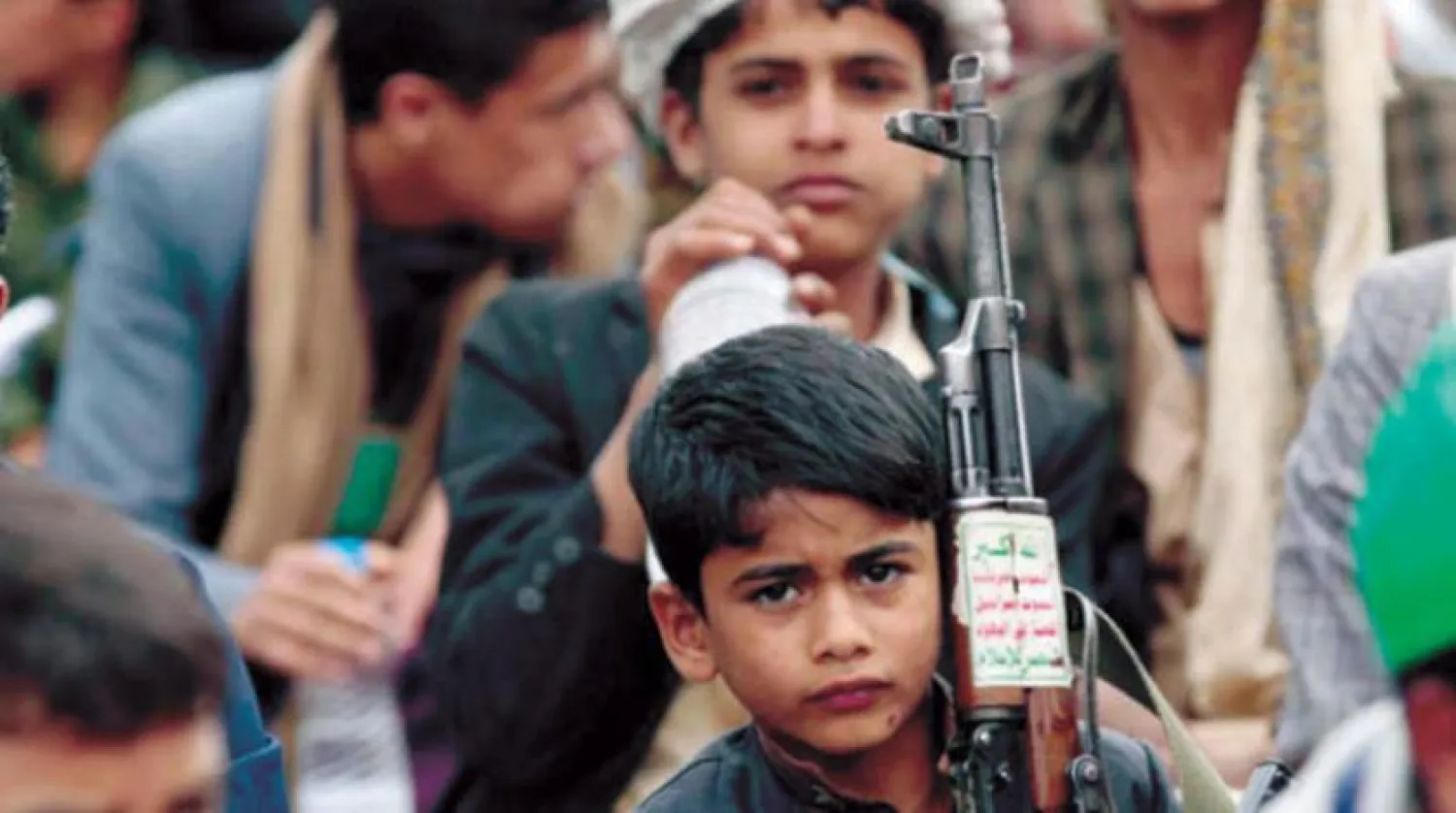
Houthis Accused of Committing Thousands of Children’s Rights Violations

A Yemeni child carrying a weapon during a gathering in Sanaa (Getty Images)
TT

Houthis Accused of Committing Thousands of Children’s Rights Violations

A Yemeni child carrying a weapon during a gathering in Sanaa (Getty Images)

At a time when dangers threatening Yemeni children are escalating, in terms of pandemics, malnutrition, and deprivation of education, government reports have accused Iran-backed Houthi militias of committing thousands of children's rights violations that included torture and forced recruitment.

The Yemeni government’s Sanaa-based human rights office documented 24,488 children’s rights violations in the Houthi-run city between November 2019 and November 2020.

“Militia violations against children included murder, kidnapping, physical assault, forced recruitment, looting and storming of health and educational institutions, and the establishment of sectarian activities and events,” said the director of the Sanaa human rights office, Fahmi al-Zubairi.

Zubairi urged the international community and organizations to take a serious stance on protecting Yemeni children from gross violations carried out by Houthi militias.

Last Friday, the National Committee to Investigate Human Rights Violations (NCHRV) concluded closed hearing sessions with victim children on major violations of the six human rights during armed disputes.

NCHRV member Ishraq al-Maqtari, in official statements, said that the committee commenced its sessions early this November and listened to 12 children who are victims of torture, disfigurement, rape, kidnapping and recruitment.

The committee also listened to the children’s parents, said al-Maqtari, pointing out that the sessions included testimonies from children and their relatives on details of violation incidents and perpetrators and the testimonies unearthed the violations and names and bodies standing behind them.

Maqtari said that since last November, the committee has investigated 661 cases of children who were victims of bombings, mutilation, mine explosions, forced recruitment, torture, and sexual violence.

She also verified that investigative mechanisms pursued by NCHRV are designed to reach the truth and to analyze patterns of human rights violations that encroached on the basic rights of children.

Maqtari expressed deep concern about the scale of violations and abuses that children suffer in Yemen and called on all warring parties in Yemen to immediately cease all violations of international laws.


ISIS, in First Comment, Calls Palmyra Attack a Blow to US and Syrian Forces

A police vehicle of the interim Syrian government moves through a street by the Saha Mosque in Palmyra in central Syria on February 7, 2025. (Photo by Omar HAJ KADOUR / AFP)
TT

ISIS, in First Comment, Calls Palmyra Attack a Blow to US and Syrian Forces

A police vehicle of the interim Syrian government moves through a street by the Saha Mosque in Palmyra in central Syria on February 7, 2025. (Photo by Omar HAJ KADOUR / AFP)

The ISIS group said the killing of US Pentagon personnel in Syria's ancient city of Palmyra was a "blow" to US forces and Syrian armed factions opposed to it, in its first public comment on the incident.

Two US Army soldiers and a civilian interpreter were killed on Saturday when an attacker targeted a convoy of American and ‌Syrian forces ‌in Palmyra before ‌being ⁠shot dead, the ‌US military said. Three US soldiers were wounded.

In an article published on its Telegram channel on Thursday, ISIS accused the United States and its Syrian-based allies of forming a single front against it. ⁠It used religious language to frame the assault as ‌a decisive moment intended ‍to dispel doubt among ‍its supporters, but did not explicitly ‍claim responsibility.

US President Donald Trump called the incident "terrible" and vowed retaliation.

Syria's Interior Ministry said on Sunday it had arrested five people suspected of links to the shooting, describing the attacker as a member of the Syrian ⁠security forces suspected of sympathizing with ISIS.

The ministry said security units in Palmyra carried out the arrests in coordination with international coalition forces.

Syria has been cooperating with a US-led coalition against ISIS. The United States has troops stationed in northeastern Syria as part of a decade-long campaign against the group, which controlled large ‌parts of Syria and Iraq from 2014 to 2019.


Syria, Kurdish Forces Race to Save Integration Deal ahead of Deadline

Kurds wave the flags of the SDF and the new Syrian regime during a celebration in the city of Qamishli in northeastern Syria (AFP).
TT

Syria, Kurdish Forces Race to Save Integration Deal ahead of Deadline

Kurds wave the flags of the SDF and the new Syrian regime during a celebration in the city of Qamishli in northeastern Syria (AFP).

Syrian, Kurdish and US officials are scrambling ahead of a year-end deadline to show some progress in a stalled deal to merge Kurdish forces with the Syrian state, according to several people involved in or familiar with the talks.

Discussions have accelerated in recent days despite growing frustrations over delays, according to the Syrian, Kurdish and Western sources who spoke to Reuters, some of whom cautioned that a major breakthrough was unlikely, Reuters said.

The interim Syrian government has sent a proposal to the Kurdish-led Syrian Democratic Forces (SDF) that controls the country's northeast, according to five of the sources.

In it, Damascus expressed openness to the SDF reorganizing its roughly 50,000 fighters into three main divisions and smaller brigades as long as it cedes some chains of command and opens its territory to other Syrian army units, according to one Syrian, one ‌Western and three Kurdish ‌officials.

'SAVE FACE' AND EXTEND TALKS ON INTEGRATION

It was unclear whether the idea would ‌move ⁠forward, and several sources downplayed ‌prospects of a comprehensive eleventh-hour deal, saying more talks are needed. Still, one SDF official said: "We are closer to a deal than ever before".

A second Western official said that any announcement in coming days would be meant in part to "save face", extend the deadline and maintain stability in a nation that remains fragile a year after the fall of former President Bashar al-Assad.

Whatever emerges was expected to fall short of the SDF's full integration into the military and other state institutions by year-end, as was called for in a landmark March 10 agreement between the sides, most of the sources said.

Failure to mend Syria's deepest remaining fracture risks an armed clash that could derail its emergence from 14 years of war, and ⁠potentially draw in neighboring Türkiye that has threatened an incursion against Kurdish fighters it views as terrorists.

Both sides have accused the other of stalling and acting in bad faith. The SDF ‌is reluctant to give up autonomy it won as the main US ally during ‍the war, after which it controlled ISIS prisons and rich ‍oil resources.

The US, which backs Syrian President Ahmed al-Sharaa and has urged global support for his interim government, has relayed messages between ‍the SDF and Damascus, facilitated talks and urged a deal, several sources said.

A US State Department spokesperson said Tom Barrack, the US ambassador to Türkiye and special envoy to Syria, continued to support and facilitate dialogue between the Syrian government and the SDF, saying the aim was to maintain momentum towards integration of the forces.

SDF DOWNPLAYS DEADLINE; TURKIYE SAYS PATIENCE THIN

Since a major round of talks in the summer between the sides failed to produce results, frictions have mounted including frequent skirmishes along several front lines across the north.

The SDF took control of much of northeast Syria, where most of the nation's oil and wheat production is, after defeating ISIS militants in 2019.

It said ⁠it was ending decades of repression against the Kurdish minority but resentment against its rule has grown among the predominantly Arab population, including against compulsory conscription of young men.

A Syrian official said the year-end deadline for integration is firm and only "irreversible steps" by the SDF could bring an extension.

Türkiye’s foreign minister, Hakan Fidan, said on Thursday it does not want to resort to military means but warned that patience with the SDF is "running out".

Kurdish officials have downplayed the deadline and said they are committed to talks toward a just integration.

"The most reliable guarantee for the agreement's continued validity lies in its content, not timeframe," said Sihanouk Dibo, a Syrian autonomous administration official, suggesting it could take until mid-2026 to address all points in the deal.

The SDF had in October floated the idea of reorganizing into three geographical divisions as well as the brigades. It is unclear whether that concession, in the proposal from Damascus in recent days, would be enough to convince it to give up territorial control.

Abdel Karim Omar, representative of the Kurdish-led northeastern administration in Damascus, said the proposal, which has not been made public, included "logistical and administrative details that could cause disagreement and ‌lead to delays".

A senior Syrian official told Reuters the response "has flexibility to facilitate reaching an agreement that implements the March accord".


Paris Meeting: Conference to be Held in February to Support Lebanese Army

FILE PHOTO: Lebanese army members stand on a military vehicle during a Lebanese army media tour, to review the army's operations in the southern Litani sector, in Alma Al-Shaab, near the border with Israel, southern Lebanon, November 28, 2025. REUTERS/Aziz Taher/File Photo
TT

Paris Meeting: Conference to be Held in February to Support Lebanese Army

FILE PHOTO: Lebanese army members stand on a military vehicle during a Lebanese army media tour, to review the army's operations in the southern Litani sector, in Alma Al-Shaab, near the border with Israel, southern Lebanon, November 28, 2025. REUTERS/Aziz Taher/File Photo

A meeting held between France, the United States and Saudi Arabia in Paris on Thursday resulted in an agreement to hold a conference in February aimed at supporting the Lebanese army.

Lebanese army commander Gen. Rodolphe Haykal held meetings with French, US and Saudi officials to discuss ways of assisting the army in its mission to boost its presence in southern Lebanon along the border with Israel. Haikal started his meetings first by holding talks with French military officials.

The French Foreign Ministry said political parties meeting in Paris agreed to hold a conference in February to support the Lebanese army.

The ministry added that the talks focused on how to demonstrate progress toward Hezbollah's disarmament, as the officials from the three countries met with the head of the Lebanese army to work on a road map for a disarmament mechanism.

A well-informed source told Asharq Al-Awsat that among the demands being made of the Lebanese military units is to “close the gaps” that Israel uses to accuse the army of negligence.

This includes the pressure Israel exerts to inspect homes it claims are being used to stockpile Hezbollah weapons.

There is also another demand that Lebanese military units be accompanied by UN peacekeepers when carrying out their missions. However, this issue has not yet been settled, especially in light of questions about what the situation will be after UNIFIL begins withdrawing from southern Lebanon at the start of 2026, the nature of the force that will replace it, and the role assigned to it.

The final decision on this matter will be left to the UN Security Council in terms of the speed and pace of UNIFIL’s pullout.

However, the issue of searching homes, as Israel is demanding, could provoke problems and disputes with residents in what is known as “Hezbollah’s environment.”

In August, the Security Council voted to extend the peacekeeping mission in southern Lebanon until the end of 2026 but to then terminate the mission in an “orderly and safe drawdown and withdrawal” over the following year.

Thursday’s talks in Paris came a day before a meeting of the committee monitoring the enforcement of the US-brokered ceasefire that halted the war between Israel and Hezbollah a year ago.

The gathering on Friday will be the second meeting of the mechanism after Israel and Lebanon appointed civilian members to a previously military-only committee.

The group also includes the United States, France and UNIFIL.

The Lebanese government has said that the army should have cleared the whole border area south of the Litani River from Hezbollah’s armed presence by the end of 2025.