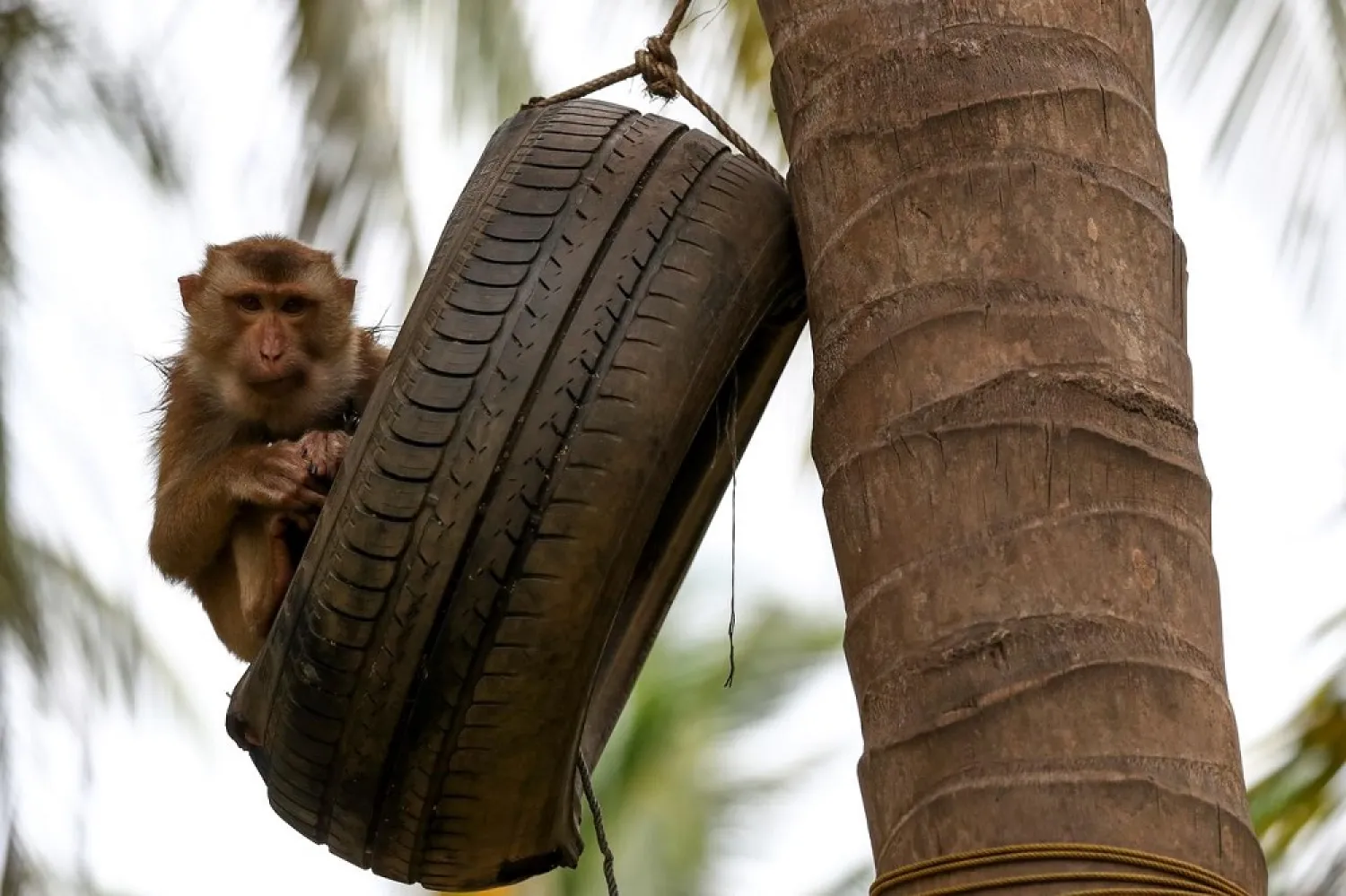

British Pianist's Velvety Tones Soothe Thailand's Hungry Monkeys

Thailand's coronavirus-induced tourism hiatus means fewer visitors to feed its monkeys. (Reuters)
TT

British Pianist's Velvety Tones Soothe Thailand's Hungry Monkeys

Thailand's coronavirus-induced tourism hiatus means fewer visitors to feed its monkeys. (Reuters)

While on tour in central Thailand, British musician Paul Barton has been mobbed by unruly audiences that tug his hair, steal his music and climb over his piano.

Barton is a rock star to hundreds of hungry wild monkeys that he hopes his music can calm, at a time when Thailand's coronavirus-induced tourism hiatus means fewer visitors to feed them, and less funds for their welfare.

"We need to make an effort to make sure that they eat properly. And when they eat properly they will be calmer and will not be aggressive," said Barton, 59, a long-time Thailand resident.

Barton has played at four venues in Lopburi, a province famous for its marauding monkeys, including at an ancient Hindu temple, a hardware store and a derelict cinema.

The macaques are instantly drawn as he plays Greensleeves, Beethoven's Fur Elise and Michael Nyman's Diary of Love, some sharing his stool, others climbing onto his shoulders and touching his head.

Barton maintains focus as a small monkey runs up and down the piano keys as others chew at his sheet music before one tries to wrest it away.

"A wonderful opportunity to see the wild animals just being themselves," said Barton, from Yorkshire in northern England.

"I was surprised to play the piano and find that they were actually eating the music as I was playing it.

"I wasn't going to let those things distract from the project which is to play the music for these wonderful macaques."

Monkeys are his latest audience, having played Bach, Schubert, Chopin and Beethoven for more than a decade to elephants at retirement sanctuaries.

Barton hopes to raise awareness of the monkeys' hunger while also studying their behavioral responses to classical music.

"It's possible that the music can play a part of the rehabilitation process," he said.


2025 Was the World’s Third-Warmest Year on Record, EU Scientists Say

This photograph taken in Lanester, western France on May 31, 2025, shows smoke rising from a factory. (AFP)
TT

2025 Was the World’s Third-Warmest Year on Record, EU Scientists Say

This photograph taken in Lanester, western France on May 31, 2025, shows smoke rising from a factory. (AFP)

The planet experienced its third-warmest year on record in 2025, and average temperatures have ​exceeded 1.5 degrees Celsius of global warming over three years, the longest period since records began, EU scientists said on Wednesday.

The data from the European Union's European Centre for Medium-Range Weather Forecasts (ECMWF) found that the last three years were the planet's three hottest since records began - with 2025 marginally cooler than 2023, by just 0.01 C.

Britain's national weather service, the UK Met Office, confirmed its own data ranked 2025 as the third-warmest in records going back to 1850. The World Meteorological Organization will publish its temperature ‌figures later ‌on Wednesday.

The hottest year on record was 2024.

EXTREME WEATHER EVENTS

ECMWF ‌said ⁠the ​planet ‌also just had its first three-year period in which the average global temperature was 1.5 C above the pre-industrial era - the limit beyond which scientists expect global warming will unleash severe impacts, some of them irreversible.

"1.5 C is not a cliff edge. However, we know that every fraction of a degree matters, particularly for worsening extreme weather events," said Samantha Burgess, strategic lead for climate at ECMWF.

Governments pledged under the 2015 Paris Agreement to try to avoid exceeding ⁠1.5 C of global warming, measured as a decades-long average temperature compared with the pre-industrial era.

But their failure to reduce ‌greenhouse gas emissions means that level could now be ‍breached before 2030 - a decade earlier than ‍had been predicted when the Paris accord was signed in 2015, ECMWF said.

"We are ‍bound to pass it," said Carlo Buontempo, director of the EU's Copernicus Climate Change Service. "The choice we now have is how to best manage the inevitable overshoot and its consequences on societies and natural systems."

POLITICAL PUSHBACK

Currently, the world's long-term warming level is about 1.4 C above the pre-industrial ​era, ECMWF said. Measured on a short-term basis, the world already breached 1.5 C in 2024.

Exceeding the long-term 1.5 C limit - even if ⁠only temporarily - would lead to more extreme and widespread impacts, including hotter and longer heatwaves, and more powerful storms and floods.

In 2025, wildfires in Europe produced the highest total emissions on record, while scientific studies confirmed specific weather events were made worse by climate change, including Hurricane Melissa in the Caribbean and monsoon rains in Pakistan which killed more than 1,000 people in floods.

Despite these worsening impacts, climate science is facing increased political pushback. US President Donald Trump, who has called climate change "the greatest con job", last week withdrew from dozens of UN entities including the scientific Intergovernmental Panel on Climate Change.

The long-established consensus among the world's scientists is that climate change is real, mostly caused by humans, and getting worse. Its main cause ‌is greenhouse gas emissions from burning fossil fuels such as coal, oil and gas, which trap heat in the atmosphere.


Freezing Rain Paralyses Transport in Central Europe

Smoke from chimneys billows over snow-covered rooftops during sunrise as freezing temperatures have hit the country, in Prague, Czech Republic, January 11, 2026. (Reuters)
TT

Freezing Rain Paralyses Transport in Central Europe

Smoke from chimneys billows over snow-covered rooftops during sunrise as freezing temperatures have hit the country, in Prague, Czech Republic, January 11, 2026. (Reuters)

Freezing rain led to flights being suspended at Vienna airport on Tuesday, while neighboring Slovakia, Czech Republic and Hungary also experienced travel disruptions.

Snow and freezing temperatures buffeted Europe last week, with gale-force winds and storms claiming some 15 lives, causing travel mayhem, shutting schools, and cutting power to hundreds of thousands.

A thick layer of ice on the Vienna airport runways led to arriving flights being diverted to other airports, while all departing flights were put on hold early Tuesday.

Austria's state railway company OeBB also asked travelers to postpone non-urgent journeys, with numerous train connections facing interruptions and cancellations.

In neighboring Slovakia, the Bratislava airport was also closed early Tuesday due to bad weather.

Slovak police on Facebook urged people to avoid travel because of "extreme" ice and snow in the west of the country.

In the Czech Republic, ice was also hampering road and rail traffic.

Prague airport came to a virtual standstill, with firefighters having to de-ice the runways.

Around 50 people were treated for injuries because of the icy conditions, according to Prague's emergency services, cited by the CTK agency.

In Hungary, meteorological services also issued alerts for freezing rain and snowfall as severe winter conditions affect a large part of the country.

Trains and flights were experiencing delays, while authorities reported drift ice on the Danube and the Tisza rivers, where icebreakers have been put on alert.

Lake Balaton in the west of the country is currently frozen -- a relatively rare phenomenon seen about once every ten to fifteen years.

However, authorities warned that the ice is still too thin for skating, urging the public to be cautious.


AI Helps Fuel New Era of Medical Self-testing

Neurable research scientist Alicia Howell-Munson demonstrates the company's headset, which it says can detect early signs of Alzheimer's disease. Patrick T. Fallon / AFP
TT

AI Helps Fuel New Era of Medical Self-testing

Neurable research scientist Alicia Howell-Munson demonstrates the company's headset, which it says can detect early signs of Alzheimer's disease. Patrick T. Fallon / AFP

Beyond smart watches and rings, artificial intelligence is being used to make self-testing for major diseases more readily available -- from headsets that detect early signs of Alzheimer's to an iris-scanning app that helps spot cancer.

"The reason preventive medicine doesn't work right now is because you don't want to go to the doctor all the time to get things tested," says Ramses Alcaide, co-founder and CEO of startup Neurable.

"But what about if you knew when you needed to go to the doctor?"

Connected rings, bracelets and watches -- which were everywhere at last week's Consumer Electronics Show in Las Vegas -- can already monitor heart rate, blood pressure and glucose levels, with varying degrees of accuracy.

These gadgets are in high demand from consumers. A recent study published by OpenAI showed that more than 200 million internet users check ChatGPT every week for information on health topics.

On Wednesday, OpenAI even launched a chatbot that can draw on a user's medical records and other data collected by wearable devices, with their consent, to inform its responses.

Using electroencephalogram (EEG) technology, Neurable has developed a headset that records and deciphers brain activity.

The linked app compares data with the user's medical history to check for any deviation, a possible sign of a problem, said Alcaide.

"Apple Watch can pick up Parkinson's, but it can only pick it up once you have a tremor," Alcaide said. "Your brain has been fighting that Parkinson's for over 10 years."

With EEG technology, "you can pick these things up before you actually see physical symptoms of them. And this is just one example."

Detection before symptoms

Some people have reservations about the capabilities of such devices.

"I don't think that wearable EEG devices are reliable enough," said Anna Wexler, a University of Pennsylvania professor who studies consumer detection products, although she acknowledges that "AI has expanded the possibilities of these devices."

While Neurable's product cannot provide an actual diagnosis, it does offer a warning. It can also detect signs of depression and early development of Alzheimer's disease.

Neurable is working with the Ukrainian military to evaluate the mental health of soldiers on the front lines of the war with Russia, as well as former prisoners of war, in order to detect post-traumatic stress disorder (PTSD).

French startup NAOX meanwhile has developed EEG earbuds linked to a small box that can help patients with epilepsy.

Rather than detect seizures, which are "very rare," the device recognizes "spikes" -- quick, abnormal electrical shocks in the brain that are "much more difficult to see," said NAOX's chief of innovation Marc Vaillaud, a doctor by training.

NAOX's device -- which has been cleared by the US Food and Drug Administration -- is designed to be worn at night, to track several hours of data at a time.

The company is working with the Rothschild and Lariboisiere hospitals in Paris to try to better understand the links between these brain "spikes" and Alzheimer's disease, which have been raised in scientific papers.

Advances in AI and technology in general have paved the way for the miniaturization of cheaper detection devices -- a far cry from the heavy machinery once seen in medical offices and hospitals.

IriHealth is preparing to launch, for only about $50, a small smartphone extension that would scan a user's iris.

The gadget relies on iridology, a technique by which iris colors and markings are believed to reveal information about a person's health, but which is generally considered scientifically unreliable.

But the founders of IriHealth -- a spin-off of biometrics specialist IriTech -- are convinced that their device can be effective in detecting anomalies in the colon, and potentially the lungs or the liver.

Company spokesman Tommy Phan said IriHealth had found its device to be 81 percent accurate among patients who already have been diagnosed with colon cancer.