


Sudan Transitional Government Divided Over Israeli Delegation’s Visit

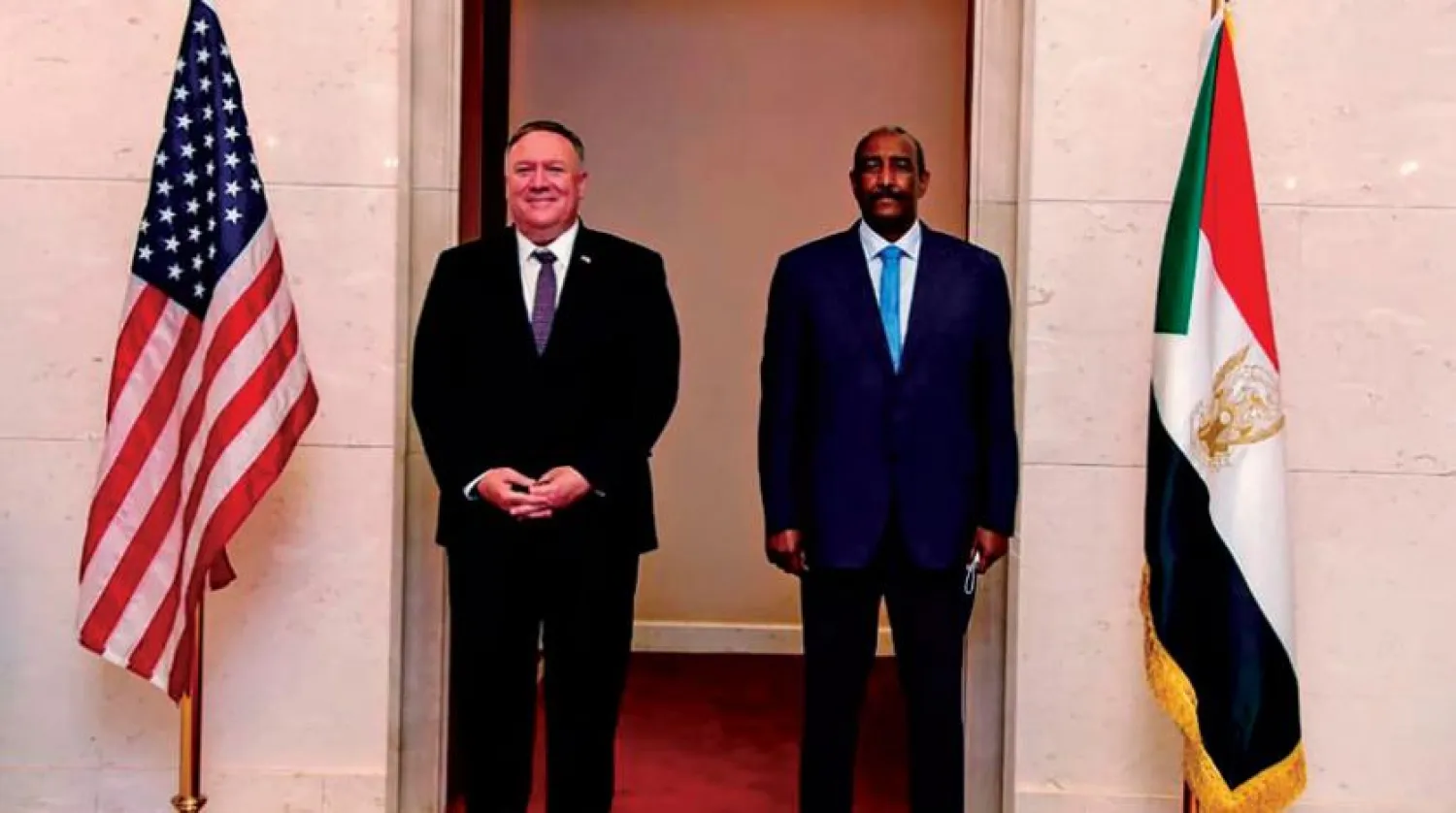
US Secretary of State Mike Pompeo with the head of the Sudanese Sovereign Council, Abdel Fattah al-Burhan, in Khartoum in October 2020 (AFP)
TT

Sudan Transitional Government Divided Over Israeli Delegation’s Visit

US Secretary of State Mike Pompeo with the head of the Sudanese Sovereign Council, Abdel Fattah al-Burhan, in Khartoum in October 2020 (AFP)

A visit by an Israeli delegation to Khartoum on Monday has revealed a clear division between the civilian and military components of the transitional government.

While Abdalla Hamdok’s government has denied knowing anything about the delegation’s visit, its mission, and the parties it would meet with, the military component was reported to have arranged the visit without referring to the premier.

Minister of Culture and Information and the official spokesperson for the Transitional Government Faisal Mohamed Salih told Asharq al-Awsat newspaper that no party has contacted the government about the visit.

“We do not have any information about its members, its mission, or who it will meet with.”

Asharq Al-Awsat has learned that a business jet landed at Khartoum Airport at 10:30 am on Monday, carrying a small Israeli technical delegation, and was scheduled to leave at 5 pm the same day.

Meanwhile, sources from Khartoum’s airport denied knowing the party that granted the permission for the plane’s landing, and no Sudanese party has revealed the goal of neither this visit nor its nature.

The visit was arranged by the military component in the country’s Sovereign Council, sources told Asharq Al-Awsat, affirming that the transitional government was not informed about the visit.

The delegation, which included a specific group of Israeli officials, was scheduled to meet with Sudanese military officials, in preparation for a visit by a large Israeli delegation in the near future to discuss bilateral cooperation in the fields of economy, agriculture, and water.

Several sources in Israel have affirmed that a delegation was sent to Sudan on Monday, in the first visit since October’s announcement of normalization of relations between the two countries.

Israeli Army Radio (Galei Tzahal) said that Head of the Israeli National Security Council Middle East, Africa, and Special Liaison Desk Maoz had left Israel on Monday morning heading to Khartoum after both countries pledged to normalize relations.

Asharq Al-Awsat learned that the delegation was scheduled to visit Khartoum last week. But, even back then, the government denied being informed of the visit.

In October 2020, the Jewish state reached and Sudan reached an initial US-brokered deal to gradual steps on normalizing relations.

The deal followed US pressure and pledge to remove Sudan from the list of state sponsors of terrorism, allow Khartoum access to international aid, release Sudan’s frozen funds in the US and establish full relations with Israel.



OIC-IPHRC Denounces Israeli Violations of Religious Freedom in Occupied Jerusalem

OIC-IPHRC Denounces Israeli Violations of Religious Freedom in Occupied Jerusalem
TT

OIC-IPHRC Denounces Israeli Violations of Religious Freedom in Occupied Jerusalem

OIC-IPHRC Denounces Israeli Violations of Religious Freedom in Occupied Jerusalem

The Independent Permanent Human Rights Commission (IPHRC) of the Organization of Islamic Cooperation (OIC) has unequivocally condemned the continued restrictions imposed by Israel, the occupying power, on the exercise of freedom of religion in occupied Jerusalem.

These measures include the prolonged obstruction imposed on Muslims to pray in the Al-Aqsa Mosque and also denying Christian worshippers access to their holy sites to perform obligatory religious rites.

The commission underscored that freedom of religion, including the right to manifest one’s religion in worship, observance, practice, and teaching, is a non-derogable fundamental human right under international human rights law, SPA reported.

The imposition of arbitrary and discriminatory restrictions on access to places of worship constitutes a serious violation of this right, as well as of the principles of equality and non-discrimination.

Such unjustified restrictions by Israel, the occupying power, violate international human rights law and international humanitarian law and undermine the dignity of individuals and communities by denying them the ability to freely practice their religion.

Any attempt to alter the legal and historical status quo of holy sites or to restrict access constitutes a violation of international legal obligations.

The commission calls upon the international community, including relevant United Nations mechanisms and international human rights bodies, to take appropriate measures to ensure accountability, safeguard the right to freedom of religion, and guarantee unhindered and non-discriminatory access to holy sites for all worshippers.


Indonesia Calls for Investigation into Peacekeeper Deaths in Lebanon

 Wreaths as people visit to offer condolences for Praka Farizal Rhomadhon, a United Nations Interim Force in Lebanon (UNIFIL) peacekeeper killed following an Israeli strike on Sunday in southern Lebanon, in Kulon Progo regency, Yogyakarta, Indonesia, April 1, 2026. (Reuters)
Wreaths as people visit to offer condolences for Praka Farizal Rhomadhon, a United Nations Interim Force in Lebanon (UNIFIL) peacekeeper killed following an Israeli strike on Sunday in southern Lebanon, in Kulon Progo regency, Yogyakarta, Indonesia, April 1, 2026. (Reuters)
TT

Indonesia Calls for Investigation into Peacekeeper Deaths in Lebanon

 Wreaths as people visit to offer condolences for Praka Farizal Rhomadhon, a United Nations Interim Force in Lebanon (UNIFIL) peacekeeper killed following an Israeli strike on Sunday in southern Lebanon, in Kulon Progo regency, Yogyakarta, Indonesia, April 1, 2026. (Reuters)
Wreaths as people visit to offer condolences for Praka Farizal Rhomadhon, a United Nations Interim Force in Lebanon (UNIFIL) peacekeeper killed following an Israeli strike on Sunday in southern Lebanon, in Kulon Progo regency, Yogyakarta, Indonesia, April 1, 2026. (Reuters)

Indonesia has called on the United Nations to investigate the deaths of three of its UNIFIL peacekeepers following Israeli strikes in southern Lebanon, a foreign ministry official said on Wednesday as relatives at home mourned their deaths.

The ministry's UN representative, Umar Hadi, called for the inquiry in a statement during an emergency meeting of the Security Council on Tuesday.

"We demand a direct investigation from the UN, not just Israel's excuses," he said.

Indonesia said earlier this week that ongoing Israeli military operations have ‌placed UN peacekeepers ‌in Lebanon at grave risk.

The Indonesian peacekeepers were ‌killed ⁠in two separate incidents ⁠in southern Lebanon after a bloody weekend in which Lebanese journalists and medics were also killed in Israeli strikes.

PEACEKEEPER'S RELATIVES MOURN

One of the peacekeeping troops, Farizal Rhomadhon, 28, was killed in an attack on Sunday. He is survived by a wife and one child, local media reported.

In his village in the city of ⁠Yogyakarta, his uncle Sumijan, 82, attended a family ‌gathering on Wednesday to pay his respects, ‌though he said his nephew's body had not yet been returned ‌to Indonesia.

"The kid was obedient, hard-working," he told Reuters. "Before he ‌was a soldier, he was in the business of selling songbirds. He was very disciplined."

Indonesian foreign ministry's initial reaction to Farizal's death on Monday drew criticism on social media, with many users complaining that it ‌did not identify the cause of the attack, describing it as "indirect artillery fire".

UN INVESTIGATION BLAMES ROADSIDE ⁠EXPLOSION

A roadside ⁠explosion appeared to strike the convoy of two Indonesian peacekeepers killed in southern Lebanon on Monday, UN peacekeeping chief Jean-Pierre Lacroix said on Tuesday, citing the initial findings of an investigation.

The Israeli military said on Tuesday that its review of an incident involving UNIFIL troops on Monday concluded that Israeli troops had not placed any explosive device in the area and had deployed no troops there.

Indonesia contributes over 2,700 uniformed personnel to UN peacekeeping, among the largest contributors globally, the UN said in 2024.

Indonesia has pledged to contribute troops for potential deployment in Gaza as part of the UN-mandated multinational International Stabilization Force.


Official: Yemen’s Arabian Sea Ports Poised to Become Global Logistics Hubs

Arabian Sea ports poised to become global logistics hubs (Arabian Sea Ports Authority)
TT

Official: Yemen’s Arabian Sea Ports Poised to Become Global Logistics Hubs

Arabian Sea ports poised to become global logistics hubs (Arabian Sea Ports Authority)

A Yemeni maritime official said ports along the Arabian Sea are capable of becoming global logistics hubs, citing their competitive advantages and capacity to handle various types of commercial vessels, particularly container ships and general cargo vessels, as well as dry and liquid bulk carriers.

Dr. Nabil bin Aifan, acting director of maritime affairs in Mukalla in eastern Yemen, told Asharq Al-Awsat that the Port of Mukalla is distinguished by its ability to receive all types of vessels.

He also described Saudi Arabia’s experience in developing the maritime transport and ports sector as “successful” at both regional and global levels, expressing hope that Yemeni ports — particularly Mukalla — would benefit from this experience, as well as from Saudi support for infrastructure projects in the country.

Roadmap

Mohsen al-Amri, Yemen’s transport minister, recently announced a roadmap focused on turning technical and economic studies into tangible projects, particularly regarding the ports in Hadramout, Shabwa and the Socotra archipelago, in addition to the expansion project of the Port of Mukalla, which is considered a key pillar of Yemen’s maritime activity.

Al-Amri pledged to work towards transforming Arabian Sea ports into global logistics hubs, in a move aimed at strengthening Yemen’s position on the international trade map.

Strong potential

Bin Aifan said the Port of Qana in Shabwa governorate has significant potential to become a successful commercial port, particularly in terms of its geographic location, depth, hinterland and the capacity of its berths and yards.

He also referred to a previous study he conducted on the Port of Aden and its strategic importance, noting that the port possesses global competitive advantages and, if properly invested in, could become one of the most prominent ports in the region and among the busiest in cargo handling.

“For example, the port’s geographical location links East and West, and ships need no more than four nautical miles to change direction and reach the pilot station,” he said. “It is also naturally protected from waves and from the northeast and southwest monsoon winds, enabling it to operate year-round without interruption. It lies just 105 nautical miles from the Bab el-Mandeb Strait, through which around 21,000 ships pass annually.”

Sustaining operational capacity

According to a United Nations report cited by bin Aifan, the Port of Aden requires an investment package to maintain its current operational capacity, which has declined due to insufficient maintenance, weak infrastructure and limited institutional capacity.

The report also pointed to the absence of long-term investment plans, the lack of systematic integration of risk management into decision-making processes, as well as weak awareness of health, safety and environmental issues.

Six pillars

Bin Aifan outlined six main pillars for developing Yemeni ports, foremost among them the Port of Aden: infrastructure development, digital transformation, strengthening administrative and logistics systems, developing human capital, meeting safety requirements and protecting the environment, alongside the need for a comprehensive legal framework.

“The role of the private sector in the development process cannot be overlooked, as it is one of the key pillars of successful port operations,” he said, adding that experience has shown that assigning port operations to the private sector helps improve efficiency and enhance competitiveness.

Speaking about Saudi Arabia’s role, bin Aifan said there is a strong direction within the Kingdom to support infrastructure and economic projects in Hadramout in particular and Yemen in general.

“We hope the ports will receive a substantial share of this support, based on the Kingdom’s priorities and its successful experience in this field,” he stated.