Saudi Arabia Wins Six Arab Governmental Excellence Prizes

The Arab Government Excellence Award, UAE. WAM
TT

Saudi Arabia Wins Six Arab Governmental Excellence Prizes

The Arab Government Excellence Award, UAE. WAM

The Kingdom of Saudi Arabia won six prizes during the first edition of the Arab Government Excellence Award, which is organized by the UAE, and aims to contribute to developing the governmental work system in Arab countries, establish an advanced platform for exchanging ideas and experience and celebrate the distinguished Arab examples and experience in the field of governmental work.

The event was held under the patronage of Sheikh Mohammed bin Rashid Al Maktoum, Vice President and Prime Minister of the UAE and Ruler of Dubai.

The Saudi Ministry of Commerce won the Best Arab Ministry Award, while the Food and Drug Authority in Saudi Arabia won the award for Best Arab Government Entity.

Also, Furijat KSA won the best Arab government initiative, while "Sakani", a government app to facilitate real estate finance and Saudi "Start up Your Company" app won the award for best Arab govt applications.

Remarkably, the Best General Manager of an Arab entity went to Eng. Mohammed bin Ahmed Al-Mowkley, CEO of the National Water Company in Saudi Arabia.

Sheikh Mohammed congratulated the Saudi leadership, noting that Vision 2030, led by Saudi Crown Prince Mohammed bin Salman, has made unprecedented governmental accomplishments.

"I congratulate King Salman Bin Abdul Aziz of Saudi Arabia and Crown Prince Mohammed Bin Salman for the Ministry of Commerce being chosen as the best Ministry in the Arab world. The Saudi Ministry of Commerce was selected as the best Ministry from among more than 5,000 Arab government entities," he noted.

For his part, Saudi Minister of Commerce Dr. Majid bin Abdullah Al-Qasabi affirmed that granting his ministry the Arab Government Excellence Award is a new achievement for the country, describing it as one of the fruits of the Kingdom’s Vision 2030 and praising the efforts and hard work of the Ministry of Commerce team.

Over the past years, the Saudi Ministry of Commerce has worked on restructuring and adopting a new organization chart to go in line with the Kingdom’s Vision 2030.

It also attracted qualified competencies in various fields, and worked to strengthen the job link, as it reached (80%) in 2019 AD, as it is higher than the global average, and the highest among government agencies during three consecutive years, also the percentage of employees who were trained increased to more than 90%.

The legislation system has also been enhanced and strengthened by preparing and developing nearly 60 legislations, rules and regulations including: E-Commerce System, the Commercial Franchise System, the Professional Companies System, the Commercial Mortgage System, the Anti-Commercial Concealment System and others.

Notably, the Saudi Ministry of Commerce had been recently granted a certificate of recognition of institutional excellence with a rating of (4 stars) from the European Organization for Quality Management, as the first government agency granted such award in the Kingdom of Saudi Arabia, thus the Ministry of Commerce is among the only 4 government agencies awarded this certificate around the world.


This Beirut Family Has Sold Falafel for 100 Years, Through War and Crisis. It Has No Plan to Stop

 Ziad Tabarra, right, holds falafel sandwiches made with finely ground fava beans at his family's shop in Beirut's Hamra district, Lebanon, Wednesday, Nov. 11, 2026. (AP)
Ziad Tabarra, right, holds falafel sandwiches made with finely ground fava beans at his family's shop in Beirut's Hamra district, Lebanon, Wednesday, Nov. 11, 2026. (AP)
TT

This Beirut Family Has Sold Falafel for 100 Years, Through War and Crisis. It Has No Plan to Stop

 Ziad Tabarra, right, holds falafel sandwiches made with finely ground fava beans at his family's shop in Beirut's Hamra district, Lebanon, Wednesday, Nov. 11, 2026. (AP)
Ziad Tabarra, right, holds falafel sandwiches made with finely ground fava beans at his family's shop in Beirut's Hamra district, Lebanon, Wednesday, Nov. 11, 2026. (AP)

For more than a century, the Tabbara family has been serving up falafel to Beirut’s residents.

Their business, which predates Lebanon’s founding, has survived two world wars and a series of local conflicts in the small Mediterranean nation.

Now, a fourth generation is getting ready to take over the modest shop, where customers can get $3 sandwiches of small, doughnut-shaped patties of deep-fried ground fava beans wrapped in flat Lebanese bread with pickled cucumber, tomatoes, parsley, thick tahini sauce and homemade dark red-hot pepper paste for the spice lovers.

“I have clients spread all over the world,” 82-year-old Mohammed Tabbara said as a European customer waited for a sandwich in Beirut’s busy Hamra district that's packed with cafes, clothing shops and two major universities.

“They all come to eat falafel because they know the flavor and the taste,” Tabbara added.

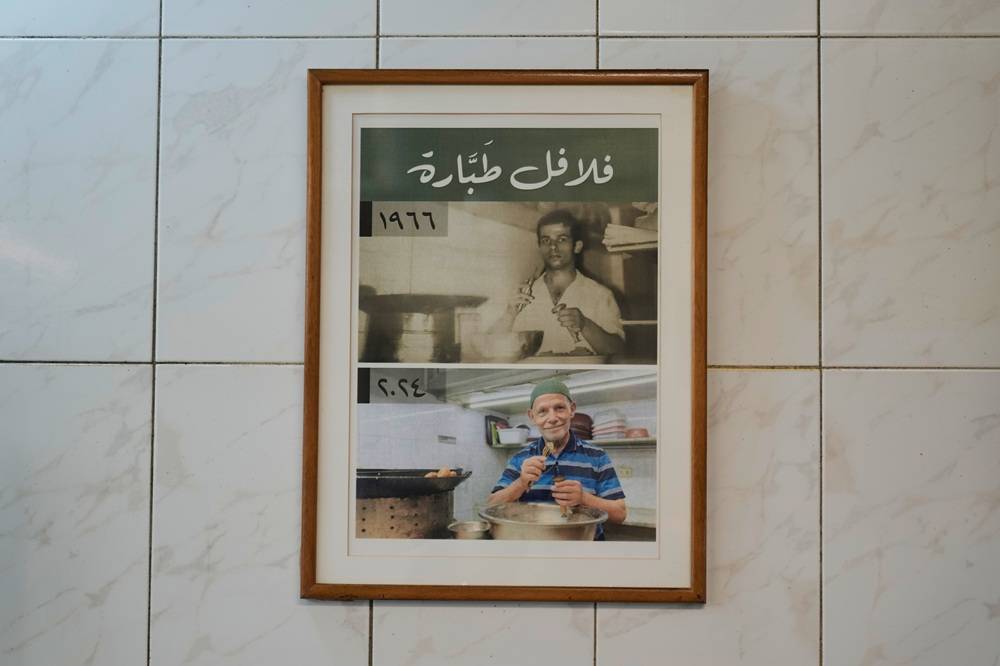
Photographs of Mohammed Tabarra taken in 1966, top, and 2024 hang at his family's shop in Beirut's Hamra district, Lebanon, Wednesday, Nov. 11, 2026. (AP)

He is passing down the culinary craft to his 40-year-old son, Ziad Tabbara, a former accountant who has spent the last six years working full time with his dad.

“This is a flavor that made history and heritage passed down through generations,” said Ziad Tabbara, who as a child helped his father in the shop during summer vacations.

Ziad has no children of his own to pass on the tradition to — a sore point with his father who wants to see him married with children.

Beirut was still part of the Ottoman Empire when Ziad's great-grandfather Kamel Tabbara opened the family’s first falafel shop in the city’s central Bab Idriss district in 1914. It would be six years before the state of Greater Lebanon was established after World War I.

Kamel passed the business to his son Ahmad. Since 1950, the business has been mostly run by Kamel’s grandson Mohammed. It was around that time that the family moved its business from central Beirut. The current shop in a narrow street has been in place since 1979.

“I have been through 40 wars,” Mohammed Tabbara said, referring to two civil wars, Israel's 1982 invasion of Lebanon, multiple Israel-Hezbollah wars, and several conflicts involving Palestinian groups and the Syrian army.

Mohammed Tabbara, who began working with his dad at the shop when he was just 6 years old, still mans the counter, taking orders from clients and assembling sandwiches. Always smiling, Mohammed knows many customers by name. Some have been getting falafel there for decades.

A falafel sandwich made with finely ground fava beans is prepared at the Tabarra family's shop in Beirut's Hamra district, Lebanon, Wednesday, Nov. 11, 2026. (AP)

Beirut is known throughout the Middle East for its cuisine, from fine restaurants to street food.

Small falafel spots can be found throughout Lebanon. A sandwich is a filling, affordable meal for people in a nation that's been experiencing a historic economic meltdown since 2019, rooted in decades of corruption and mismanagement.

Mohammed Tabbara's shop is decorated with two photos of him: A black-and-white one taken in 1966 and another taken two years ago in which he wears his trademark skull cap.

He takes pride in the shop's cleanliness. They change the cooking oil every day and wash the vegetables with vinegar and salt.

Jean Matta, 60, works in the neighborhood and has been eating falafel at Tabbara since 1992. “It’s crunchy, tasty and clean,” Matta said.

Ziad has learned his father's special secret recipe for falafel, which is made of Australian fava beans, soaked in water the night before, then ground before being mixed with salt and an array of spices, including coriander.

Mohammed said chickpeas, used in many falafel recipes, are heavier and take more time to digest than fava beans alone. He also said he was the first in Lebanon to introduce a falafel patty covered with sesame seeds and with a hole in the middle, making it well-cooked inside and crunchy on the outside.

“The sandwich you take from here is light and 100% healthy,” Mohammed said as he wrapped a sandwich while his son dropped falafel patties into a giant frying pot.

“God willing, I will continue to offer the same flavor,” Ziad said.


Missing Teen Found Alive After 6 Days in Australian Woodlands

In this image made from video and provided by the Victoria State Police 17-year-old William, center right, is embraced by his mother Elizabeth, only first names were provided by police, while in a helicopter in Cowwarr, Australia, Thursday, Nov. 12, 2026, after William spent six days lost in eastern Australian woodlands. (Victoria Police via AP)
TT

Missing Teen Found Alive After 6 Days in Australian Woodlands

In this image made from video and provided by the Victoria State Police 17-year-old William, center right, is embraced by his mother Elizabeth, only first names were provided by police, while in a helicopter in Cowwarr, Australia, Thursday, Nov. 12, 2026, after William spent six days lost in eastern Australian woodlands. (Victoria Police via AP)

A 17-year-old boy with autism was found alive Thursday after six days lost in eastern Australian woodlands.

The boy, whom police identified only as William, had begun camping with a teenage friend when he disappeared last Friday near Walhalla, a former gold-mining town 185 kilometers (115 miles) east of Melbourne, police said.

A police helicopter crew found him surrounded by wilderness lying asleep on a flat rock beside a creek, and he was later reunited with his mother. William was in good spirits and mostly in good health, the police statement said.

Video shot from the rescue helicopter showed he was shirtless and sunburned. He was wearing shorts and boots and was using towels as blankets.

“I’m just over the moon that he’s alive,” his mother, Elizabeth, told reporters.

The AP has decided not to provide her family name to avoid identifying her son.

“And he’s never leaving the house again. He’s grounded for life. He’s not going anywhere ever again,” she joked.

William was later taken to a hospital for his health to be monitored, police said.

William's family have said he has Level 2 autism. That requires “substantial support,” according to the Australian advocacy group Autism360.

Such a person may have marked deficits in verbal and non-verbal social communication and rely heavily on routines and predictable activities.

Disruption can cause significant distress.

The Southern Hemisphere spring weather had been mild for the past week in the alpine region where William was lost and there had been little rain.

Elizabeth had dropped off her son and his friend last Friday for a weekend of camping. William walked a short distance from the campsite to the drop-off location to collect more camping equipment but never returned to his friend, police said.

After becoming lost, William trekked for days up and down “some very steep terrain,” Acting Police Inspector Jason Benbow said.

He spent the last two days where he was found at the creek, trapped by the steepness of his surrounds 2 kilometers (1.2 miles) from his camp site, Benbow said.

“He woke up to the sound of the helicopter, gave them a thumbs up and they winched him to safety,” Benbow told reporters.

The extensive police search for him involved more than 100 emergency services personnel and volunteers.


Europe’s Hera Spacecraft Begins Close Inspections of an Asteroid Rammed by NASA in a 2022 Test

This undated image provided by the European Space Agency on Nov. 5, 2026 and taken by the Hera spacecraft, shows asteroid Didymos. (European Space Agency via AP)
TT

Europe’s Hera Spacecraft Begins Close Inspections of an Asteroid Rammed by NASA in a 2022 Test

This undated image provided by the European Space Agency on Nov. 5, 2026 and taken by the Hera spacecraft, shows asteroid Didymos. (European Space Agency via AP)

A European spacecraft has begun close inspections of an asteroid rammed by NASA four years ago in a planetary defense test.

The European Space Agency announced Wednesday that the Hera spacecraft is now studying Didymos and its moonlet Dimorphos from just 15 miles to 18 miles (25 kilometers to 30 kilometers) away, The AP news reported.

NASA’s Dart spacecraft deliberately slammed into little Dimorphos in 2022 to see whether such a defensive move might help save Earth from a killer space rock one day.

The impact shortened the moonlet’s orbit around Didymos. More importantly, it nudged the moonlet into a slightly different path around the sun.

Next month, the small car-sized Hera, launched in 2024, will venture even closer — just 12 miles (20 kilometers) away.

ESA officials consider this a “crash site investigation” worthy of its finest robotic detective. Hera is carrying 25 science instruments as well as a pair of shoebox-sized Cubesats to survey Dimorphos even more closely and attempt to land on it.

The Dart spacecraft — short for Double Asteroid Redirection Test — sent rubble and even boulders flying off Dimorphos, providing an extra kick to the impact’s momentum. The debris trail extended thousands of miles (more than 10,000 kilometers) into space for months.

Some of that debris could still be in the vicinity, according to scientists.

Dimorphos is an estimated 500 feet (151 meters) in diameter. Didymos is roughly 2,560 feet (780 meters) in diameter.