

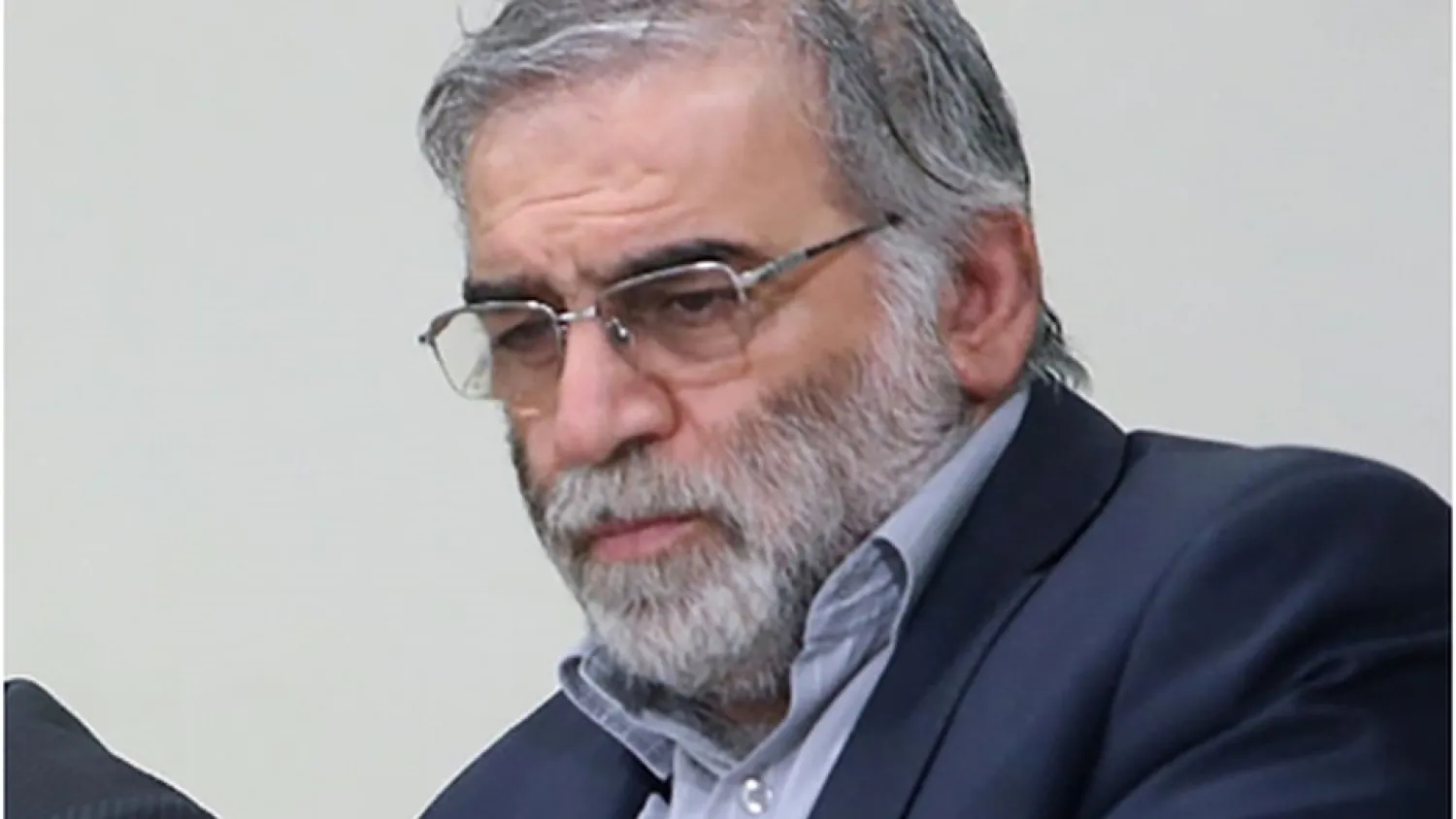

Baghdad Fears Rise of US, Iranian Tensions in Iraq

Iran's nuclear mastermind Mohsen Fakhrizadeh pictured in an undated photo, Reuters
TT

Baghdad Fears Rise of US, Iranian Tensions in Iraq

Iran's nuclear mastermind Mohsen Fakhrizadeh pictured in an undated photo, Reuters

Even though Baghdad refrained from taking an official stance on the assassination of Iranian nuclear scientist Mohsen Fakhrizadeh, Shiite political parties and blocs in Iraq like the Islamic Dawa Party issued loud condemnations against the killing.

A single Sunni organization, the Iraq Scholars Association, headed by cleric Khaled Al-Mulla, issued an obituary and condemnation statement.

The assassination preoccupied the Iraqi public opinion on various media platforms.

Controversy was sparked between those who believe that an Iranian retaliation would not involve Iraq, given its current political instability, and those who say that Tehran will not avenge Fakhrizadeh’s death for the time being.

Many are convinced that Tehran will remain silent in order to avert chances of outgoing US President Donald Trump using their retaliation to warrant a striking hit on Iran.

Others say that Iran may decide to respond to Fakhrizadeh’s killing in other parts of the region, like in the Arab Gulf or against Israel.

While it may prove to be too risky for Iran to respond now that the US administration is undergoing a delicate power transition, Iranian proxies in Iraq may stage retaliatory missile attacks against Baghdad’s Green Zone, where the US embassy is found, or against American assets in the country.

National Iraqi Alliance leader Ayad Allawi warned against the rise of extremism in light of the absence of political stability in Iraq.

“I am afraid of an expected escalation of extremist groups, on top of which is ISIS, which may take advantage of political instability,” Allawi tweeted on Saturday.

“These groups may exploit the aggravated economic and health crisis, the absence of a national contract that binds components of the people and political parties, and failure to eradicate terrorism from its roots,” he added.

Allawi emphasized the need for the Iraqi government to focus efforts on resolving the above mentioned challenges.

Hussein Allawi, national security professor at Al-Nahrain University, explained that if Iraq doesn’t overcome its vulnerabilities and political instability it would be rendered an easy target for Iranian agenda.

“Political parties have left the Iraqi government to face internal and external challenges on its own,” Allawi told Asharq Al-Awsat.

“Iran can place Iraq in the basket of targeted goals, especially since there are diplomatic and training advisory missions working with the joint Iraqi forces,” Allawi cautioned.



Energy Secretary: US to Stop Iran's Nuclear Ambitions 'One Way or the Other'

US Secretary of Energy Chris Wright speaks during a press conference after a meeting with Venezuela's acting president Delcy Rodriguez at the Miraflores Presidential Palace in Caracas on February 11, 2026. (Photo by Juan BARRETO / AFP)
TT

Energy Secretary: US to Stop Iran's Nuclear Ambitions 'One Way or the Other'

US Secretary of Energy Chris Wright speaks during a press conference after a meeting with Venezuela's acting president Delcy Rodriguez at the Miraflores Presidential Palace in Caracas on February 11, 2026. (Photo by Juan BARRETO / AFP)

The United States will deter Iran from acquiring nuclear weapons "one way or the other", US Energy Secretary Chris Wright warned on Wednesday.

"They've been very clear about what they would do with nuclear weapons. It's entirely unacceptable," Wright told reporters in Paris on the sidelines of meetings of the International Energy Agency.

"So one way or the other, we are going to end, deter Iran's march towards a nuclear weapon," Wright said.

US and Iranian officials held talks in Geneva on Tuesday aimed at averting the possibility of US military intervention to curb Tehran's nuclear program.

Iran said following the talks that they had agreed on "guiding principles" for a deal to avoid conflict.

US Vice President JD Vance, however, said Tehran had not yet acknowledged all of Washington's red lines.


Iran, Russia to Conduct Joint Drills in the Sea of Oman 

This handout photo released by Iran's Revolutionary Guards Corps (IRGC)'s official website Sepanews on February 17, 2026, shows boats maneuvering around a tanker vessel during a military exercise by members of the IRGC and navy in the Strait of Hormuz. (Sepahnews / AFP)
TT

Iran, Russia to Conduct Joint Drills in the Sea of Oman 

This handout photo released by Iran's Revolutionary Guards Corps (IRGC)'s official website Sepanews on February 17, 2026, shows boats maneuvering around a tanker vessel during a military exercise by members of the IRGC and navy in the Strait of Hormuz. (Sepahnews / AFP)

Iran and Russia will conduct naval maneuvers in the Sea of Oman on Thursday, following the latest round of talks between Tehran and Washington in Geneva, Iranian media reported.

On Monday, the Revolutionary Guards, the ideological arm of Iran's military, also launched exercises in the strategic Strait of Hormuz, a challenge to US naval forces deployed in the region.

"The joint naval exercise of Iran and Russia will take place tomorrow (Thursday) in the Sea of Oman and in the northern Indian Ocean," the ISNA agency reported, citing drill spokesman, Rear Admiral Hassan Maghsoudloo.

"The aim is to strengthen maritime security and to deepen relations between the navies of the two countries," he said, without specifying the duration of the drill.

The war games come as Iran struck an upbeat tone following the second round of Oman-mediated negotiations in Geneva on Tuesday.

Previous talks between the two foes collapsed following the unprecedented Israeli strike on Iran in June 2025, which sparked a 12-day war that the United States briefly joined.

US President Donald Trump has deployed a significant naval force in the region, which he has described as an "armada."

Iranian officials have repeatedly threatened to block the Strait of Hormuz, particularly during periods of tension with the United States, but it has never been closed.

A key passageway for global shipments of oil and liquefied natural gas, the Strait of Hormuz has been the scene of several incidents in the past and has returned to the spotlight as pressure has ratcheted amid the US-Iran talks.

Iran announced on Tuesday that it would partially close it for a few hours for "security" reasons during its own drills in the strait.


First European Flight Lands in Venezuela Since Maduro’s Ouster 

A man holds up a Venezuelan flag while taking part in a march calling for amnesty for political prisoners and to mark Youth Day, in Caracas, Venezuela, February 12, 2026. (Reuters)
TT

First European Flight Lands in Venezuela Since Maduro’s Ouster 

A man holds up a Venezuelan flag while taking part in a march calling for amnesty for political prisoners and to mark Youth Day, in Caracas, Venezuela, February 12, 2026. (Reuters)

A plane from Spain's Air Europa landed in Venezuela Tuesday, according to a flight tracking monitor, the first European commercial flight to arrive in the country since the United States toppled president Nicolas Maduro.

A slew of international carriers stopped flying to Venezuela after the United States warned of possible military activity there in late November -- a prelude to its surprise attack on January 3.

The Boeing 787-9 Dreamliner landed at Simon Bolivar International Airport, which serves the Venezuelan capital Caracas, at 9:00 pm (0100 GMT).

Since US forces raided Venezuela and captured Maduro, US President Donald Trump has struck a cooperative relationship with interim president Delcy Rodriguez.

Late last month he called for flights to resume to the country.

Spanish airline Iberia is evaluating security guarantees before announcing a return, according to the Spanish press.

Portugal's TAP has said it will resume flights. Colombian airline Avianca and Panama's Copa have already restarted operations.

Hoping to prompt US flights, the Trump administration has lifted a 2019 ban on US airlines flying to the country.