ISIS Still Strongly Present in Syria 20 Months after its ‘Defeat’https://english.aawsat.com/home/article/2655351/isis-still-strongly-present-syria-20-months-after-its-%E2%80%98defeat%E2%80%99
ISIS Still Strongly Present in Syria 20 Months after its ‘Defeat’
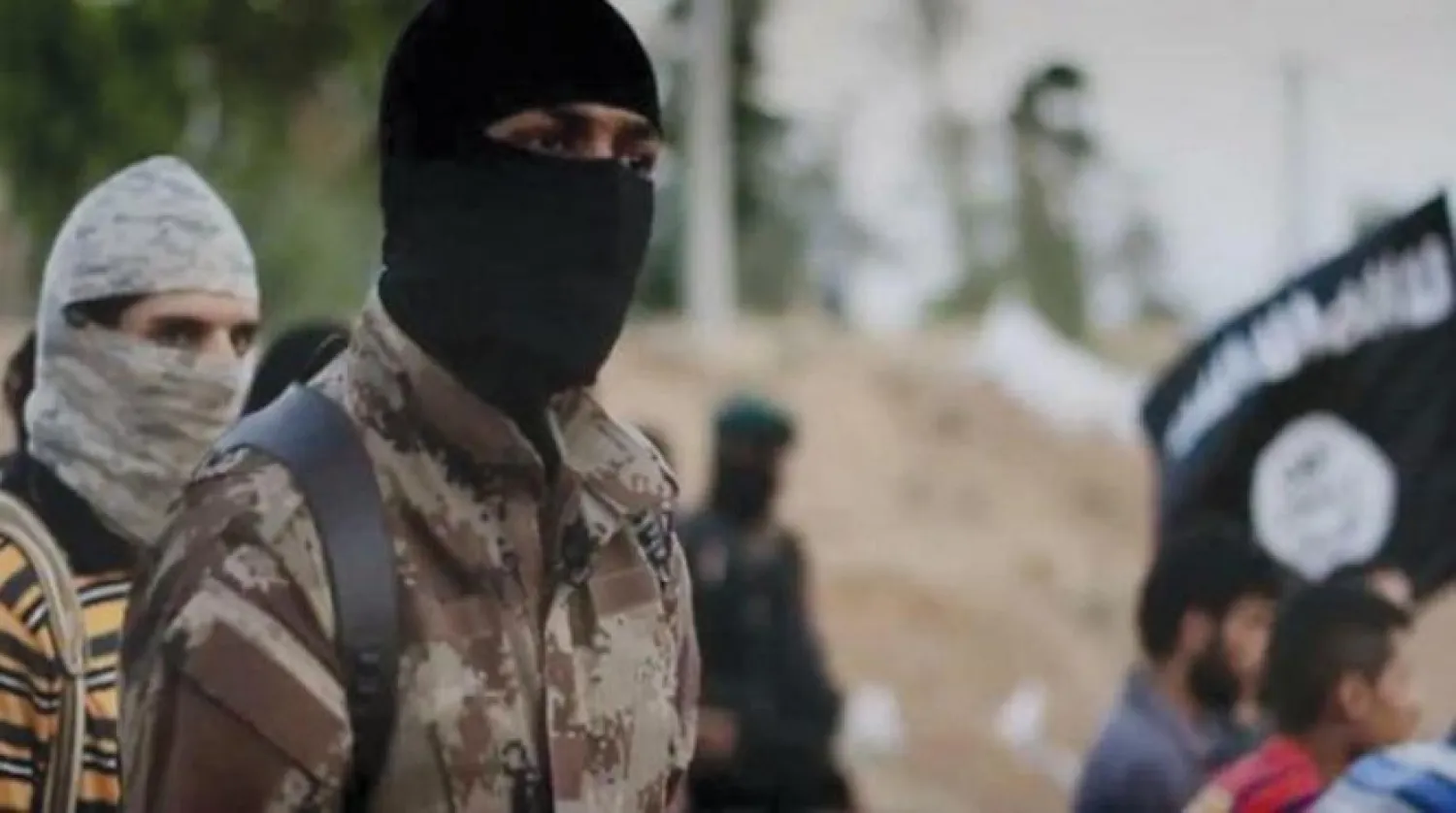
Archive photo of an ISIS member in Syria.
The presence of the ISIS terrorist group is still felt strongly on the ground in Syria, months after the international coalition declared its defeat in March 2019.
The terrorist group is making its presence felt through its escalation of attacks against the regime and Syrian Democratic Forces (SDF), said the Syrian Observatory for Human Rights.
In return, military operations waged by the SDF with the support of the international coalition have been on the rise against ISIS remnants, as have security operations by the regime, with Russia’s cooperation.
The Observatory said ISIS was escalating its attacks in various regions of the Syrian Desert (Badia), targeting the regime and its allied militias. It has carried out ambushes against them, as well as bombings and targeted attacks, incurring human and material losses every time.
The attacks are taking place despite Russia and the regime’s intense aerial bombardment of areas where ISIS is deployed. Clashes and strikes intensified in October in the Aleppo, Hama and al-Raqqa regions, as well as the desert areas of Homs and Deir Ezzor.
According to the Observatory, ISIS has managed to kill 92 regime and allied militia fighters in October through ambushes and attacks in the Badia. March 24, 2019, the Observatory has documented the killing of at least 1,020 regime soldiers and loyalists of Syrian and non-Syrian nationalities, including at least two Russians, and 140 Iranian-backed militiamen of non-Syrian nationalities.
In the same period, four civilians working in gas fields, 11 shepherds and four other people were killed in attacks by ISIS cells, while 562 members of the terrorist organization were killed in attacks and bombardment.
The Observatory said the situation in SDF-controlled areas has not been much better than that of the regime-controlled areas, as ISIS cells are numerous and have been widely active, moving in the region “comfortably” in the wake of the “timid” security campaigns by the SDF and the international coalition.
Fighting in Yemen Intensifies as Govt Attacks Houthis Along Read Seahttps://english.aawsat.com/arab-world/5317868-fighting-yemen-intensifies-govt-attacks-houthis-along-read-sea
A member of the Yemeni government forces, including National Army and Taiz Axis forces, mans a turret mounted on the back of a pickup truck at a checkpoint along the al-Kadha frontline west of Taiz in western Yemen on September 13, 2026. (AFP)
TT
TT
Fighting in Yemen Intensifies as Govt Attacks Houthis Along Read Sea
A member of the Yemeni government forces, including National Army and Taiz Axis forces, mans a turret mounted on the back of a pickup truck at a checkpoint along the al-Kadha frontline west of Taiz in western Yemen on September 13, 2026. (AFP)
The conflict in Yemen intensified on Sunday, as government forces launched attacks against Iran-backed Houthi group along the Red Sea.
The Yemeni government vowed to send more forces to the Red Sea coast after conceding a “painful” defeat last week when Houthis captured the port city of Mokha and an island on the Bab al-Mandeb Strait, a crucial shipping alternative to the Strait of Hormuz.
The United Nations estimated that more than 80,000 people have been displaced by the fighting since the start of September.
One woman said a mortar shell fell nearby as she fled in the middle of the night from the town of Khawkha in the Houthi-held Hodeidah province along the Red Sea, shortly before it was captured by the militants.
“I saw with my own eyes cars and buses burning, and bodies of children and women were lying on the road in a horrific scene,” said the woman, who spoke on condition of anonymity out of concern for her and her family’s safety.
The Saudi civil defense overnight said a Houthi projectile fell in a different area near the border with Yemen along the Red Sea, injuring two people and damaging a mosque and several other buildings.
The National Resistance, a government-allied force that had controlled coastal areas, said more than 500 government fighters were killed on the west coast over the past four weeks — its first comprehensive toll. It said about 1,500 others had been wounded in the fighting since August 9.
It said more than 1,000 Houthis had been killed in the Hodeidah and Taiz provinces.
Sultan al-Aradah, a member of the ruling Presidential Leadership Council, described the collapse of government forces in the port city of Mokha and elsewhere on Yemen’s west coast as “painful and regrettable.”
Al-Aradah said in the televised interview aired late Saturday that forces “are currently regrouping and will return to the battle in one form or another.”
On Sunday, the Yemeni military said it launched airstrikes on Houthi positions in Mokha and the coastal town of Dhubab, and elsewhere in Taiz province.
The Houthis also reported strikes by the government forces in the province, as well as artillery shelling in the province of Saada, the Houthi stronghold on Yemen's northern borders.
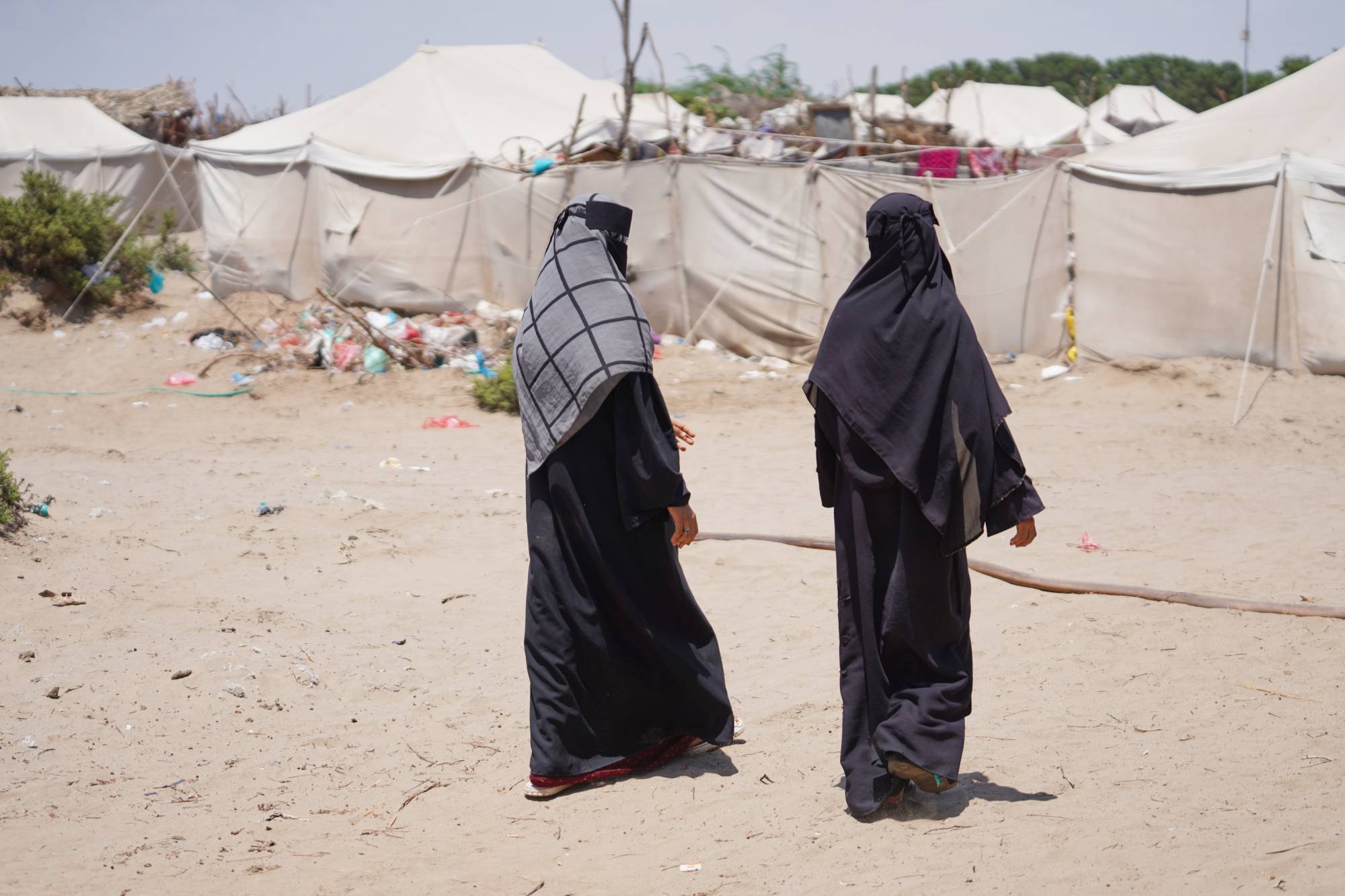
Displaced Yemenis, from al-Khawkha city, 400 kilometers (249 miles) southwest of Sanaa, walk past their temporary shelter in Aden, Yemen, Sunday, Sept. 13, 2026. (AP)
The Houthis' advance puts them just 20 miles (32 kilometers) from the US military base in Djibouti, on the other side of the Bab al-Mandeb Strait. It's the main US base in Africa and one of several foreign military bases in Djibouti, including those of China, France and Japan.
The small Horn of Africa nation is already seeing the arrival of displaced Yemenis making the perilous water crossing. More than 2,000 Yemenis have reached Djibouti, the International Organization for Migration said Sunday.
Djibouti's Economy and Finance Minister Ilyas M. Dawaleh, said on X that the country's navy, coast guard and other specialized agencies were conducting rescue operations and providing emergency assistance.
Yemenis displaced by fighting worry about their survival
The UN migration agency said Sunday that more than 82,000 people in Yemen have been displaced since the beginning of September.
“The displaced people are in a very bad condition,” said Ahmad al-Masawi, the director of the Al Salam camp in the southern port city of Aden, who appealed to international organizations for assistance. “They left their homes quickly without any clothing or anything. They are crammed in camps, houses and even on roads."
Hussein Haydara sat outside a shelter at the camp in a white undershirt, as his children waited to be assigned to a tent. He worried about how far the shelter is from schools, hospitals and markets, and wondered how they will survive the next weeks or months.
Haydara had fled his home in Hodeidah once before, when the Houthis took it over in 2015. But this time feels more precarious.
“With the first displacement, we had time to plan things but this time we were forced to escape all of a sudden. One could hardly take their children and the lightest stuff possible,” he said.
Yemeni Leadership Moves to Overcome Shock of Losing West Coasthttps://english.aawsat.com/arab-world/5317841-yemeni-leadership-moves-overcome-shock-losing-west-coast
An internally displaced (IDP) Yemen, one of many who fled their homes due to renewed clashes between Yemen's government forces and the Houthi group, sits in his shelter in the al-Kadha area of the Taiz governorate, southwestern Yemen on September 6, 2026. (AFP)
Yemeni Leadership Moves to Overcome Shock of Losing West Coast
An internally displaced (IDP) Yemen, one of many who fled their homes due to renewed clashes between Yemen's government forces and the Houthi group, sits in his shelter in the al-Kadha area of the Taiz governorate, southwestern Yemen on September 6, 2026. (AFP)
The Yemeni leadership is moving to deal with the loss suffered by government forces on the west coast as a painful field setback, but one that should not become a turning point in the conflict with the Houthi group.
The government and Presidential Leadership Council are, meanwhile, seeking to rearrange forces and regain the initiative, while containing the humanitarian consequences of displacement and maintaining the operation of state institutions.
PLC member and Governor of Marib Sultan Al-Aradah said the developments on the west coast are "painful and regrettable," but are part of wars that witness advances and retreats.
The developments will not deflect from the main goal, he added.
In remarks carried by state media, he said the forces that withdrew from the coast are rearranging their ranks and will return to the battle "in one way or another."
Field developments on the west coast had forced government troops to redeploy after losing positions and areas, amid a broad Houthi escalation. The developments led to new waves of displacement, while a number of military personnel relocated to Marib, where Al-Aradah said authorities had prepared a camp for them and made arrangements to secure their needs.
Al-Aradah's remarks reveal that the Yemeni leadership is attempting to shift the handling of the west coast loss from a state of field shock to restoring combat capability.
This approach aligns with what Prime Minister Shaya Al-Zandani put forward during a cabinet meeting in the interim capital Aden, when he stressed that the difficult developments over the past days should not be understood as an end to the confrontation.
He stressed that battles are not measured by the outcome of a single day or a change in a position, but rather by the state's ability to reorganize its efforts, mobilize its resources, support its forces, maintain the cohesion of its institutions, and regain the initiative.
It appears that the Yemeni leadership's priority in the coming phase centers on rearranging the forces that withdrew from the coast and reintegrating them into operations, alongside elevating government support for the armed and security forces.
The cabinet confirmed that it reviewed a report from the minister of defense regarding the military situation across various fronts, operational readiness levels, and requirements, while underlining the need to boost the forces' capacity to confront the escalation and regain the initiative.
In Marib, Al-Aradah said that the governorate's forces are focused on victory and supporting various fronts, noting that the ultimate goal in the fighting, in Marib and elsewhere, remains the liberation of the capital, Sanaa, from the Houthis.
The forces and commanders on the ground bear a historic responsibility to defend the state and national dignity, he said.
Tareq Saleh’s Forces Accuses Iran’s Revolutionary Guards of Guiding Assault on Yemen’s West Coasthttps://english.aawsat.com/arab-world/5317818-tareq-saleh%E2%80%99s-forces-accuses-iran%E2%80%99s-revolutionary-guards-guiding-assault-yemen%E2%80%99s
Tareq Saleh’s Forces Accuses Iran’s Revolutionary Guards of Guiding Assault on Yemen’s West Coast
Smoke rises during clashes between Yemeni government forces and Houthis (Reuters)
In its first statement since losing extensive positions on Yemen's west coast, the government’s National Resistance revealed the cost of a month-long battle against the Houthis. It accused Iran’s Revolutionary Guard Corps (IRGC) and its regional allies of providing direct support and managing the offensive, which culminated in the group seizing control of vast positions and areas along the coast.
The "National Resistance" forces, led by member of the Yemen’s Presidential Leadership Council Tareq Saleh, announced that more than 500 of their personnel were killed and nearly 1,500 others wounded. This was compared to more than 1,000 dead and thousands wounded among the Houthis, according to the statement about the battles that spanned from August 9 to September 10.
The statement, broadcast by the military forces' media, comes following a major field shift on the west coast fronts, with the Houthis advancing and seizing control of Hays, al-Khawkha, Mokha and its port, and extending their control to Bab al-Mandeb, Mayyun Island, and the rest of the Yemeni islands in the southern Red Sea.
The National Resistance described the battles as some of the "fiercest clashes" they have fought against the Houthis, stating that the offensive began with intensive missile bombardment and attacks using drones and booby-trapped boats, before expanding across the Hays, al-Kadha, Maqbanah, and al-Barah areas.
It added that the Houthis deployed large numbers of fighters and reinforcements from various axes in an attempt to shift the balance of power on the ground and besiege the defending forces.
The National Resistance linked the nature of the offensive and the Houthis' ability to mobilize forces and execute simultaneous operations to what they described as direct support from personnel and expertise of the IRGC and its regional allies.
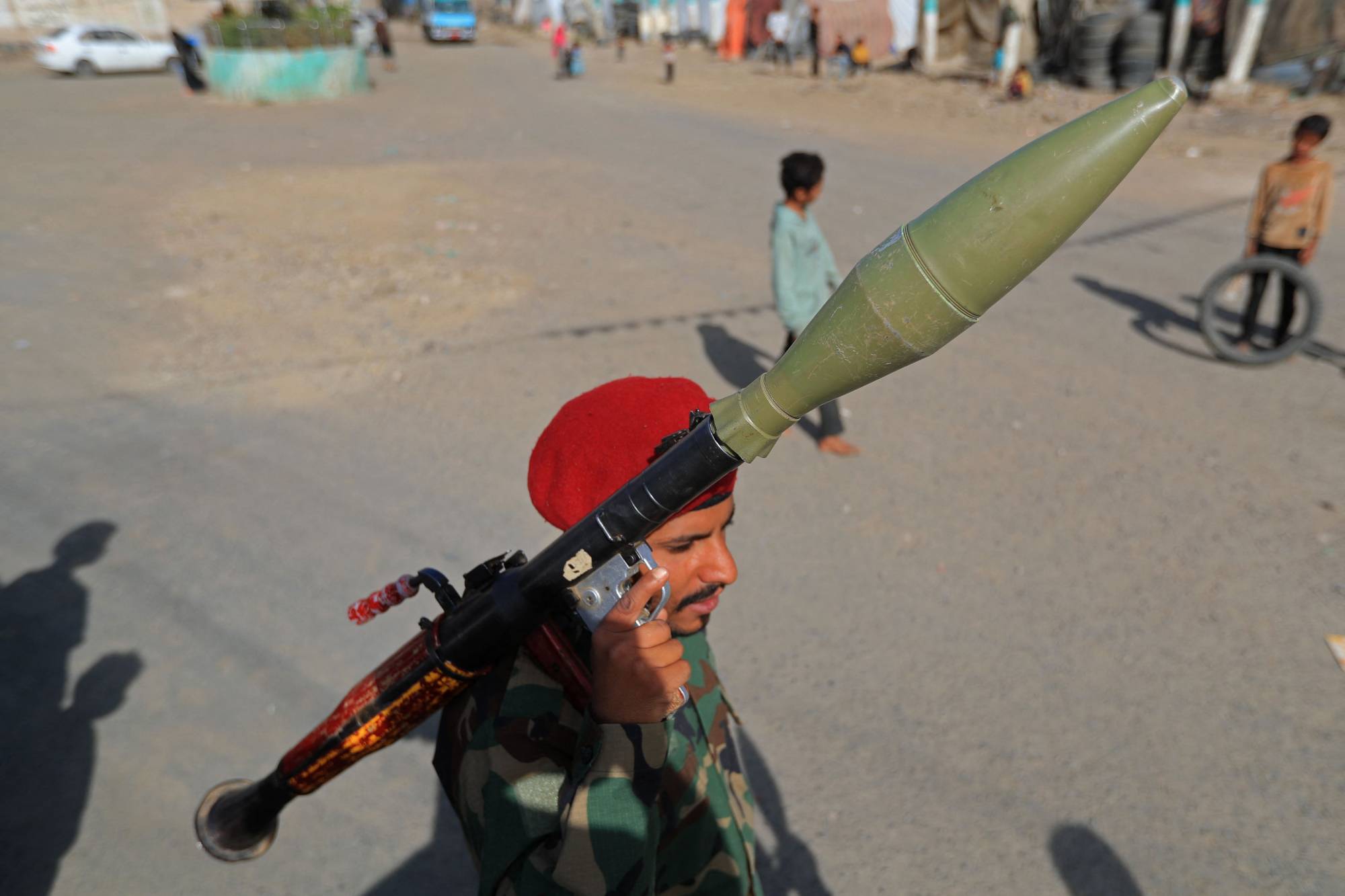
A Yemeni gunman brandishes his weapon during a rally to recruit more fighters in Sanaa on September 10, 2026. (AFP)
It said the offensive was prepared in advance to exploit the terrain and establish fire control over several commanding heights, in an attempt to tighten the siege on the forces and destroy their combat capability.
It added that the course of the battles revealed, according to its assessment, the nature of the Iranian role in supporting the Houthis, accusing the group of executing a project that targets Arab national security and international waterways.
Faced with the intensity of the offensive and the succession of reinforcements, the National Resistance revealed that its leadership decided to reposition forces into new defensive lines, aiming to preserve its "strike force" and foil the plan to encircle and destroy it.
The repositioning is not the end of the fight, but rather a measure to preserve its forces and rearrange their deployment after losing extensive positions.
The statement praised Saudi support, which it said continued until the "last moment," alongside the backing of the Giants Brigades, National Shield, and tribal volunteers, saying this is an embodiment of the unity among anti-Houthi forces.
The National Resistance said the developments underscore the need for integrating anti-Houthi fronts and mobilizing them simultaneously, rather than relying on a single military sector, aiming to regain the initiative and impose a new military reality.
In an attempt to avoid holding other Yemeni factions responsible for the loss, the statement stressed that the resistance has no intention of "accusing anyone of treason" or engaging in "settling scores or political posturing." It called for viewing developments objectively, drawing lessons, and rearranging priorities for the upcoming phase.
لم تشترك بعد
انشئ حساباً خاصاً بك لتحصل على أخبار مخصصة لك ولتتمتع بخاصية حفظ المقالات وتتلقى نشراتنا البريدية المتنوعة