

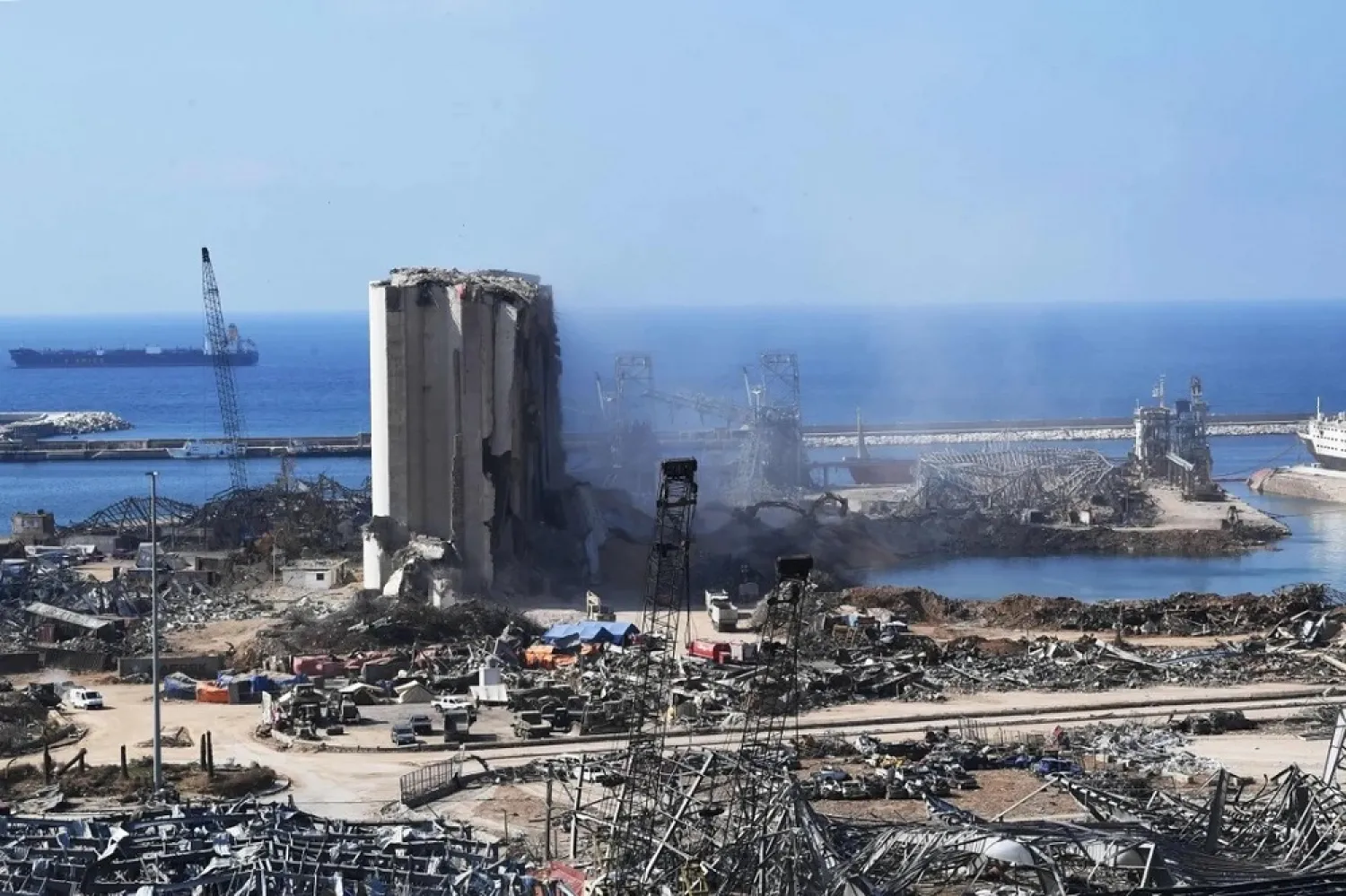

Lebanon Investigates Death of Former Customs Official

Beirut's port in the aftermath of the huge explosion. (AFP)
TT

Lebanon Investigates Death of Former Customs Official

Beirut's port in the aftermath of the huge explosion. (AFP)

Lebanese authorities are investigating the killing of a retired customs officer in what a leading politician described as a “terrible incident”.

Colonel Munir Abu Rjeili was found dead in his home on Wednesday in Qartaba, some 40 km (25 miles) northeast of Beirut, with a blow to the head, a security source said.

Head of the Progressive Socialist Party Walid Jumblatt asked on Twitter on Thursday what was behind the killing. He questioned whether there was a link with the Aug. 4 explosion at Beirut port that killed about 200 people and devastated swathes of the capital.

“Is this terrible incident to obstruct any serious investigation into the case of the explosion at Beirut port?” Jumblatt wrote.

But a senior interior ministry source said: “So far, no link has been found between the port and the murder”.

Abu Rjeili’s career in Lebanese customs included leading a Beirut division that counters overland smuggling, serving at the airport and heading a division of the Higher Customs Council, according to CV sent by a relative and lawyer, Joseph Khalil.

Abu Rjeili had not been summoned for questioning in the investigation in to the Beirut blast probe and had not served at the port, the source said, according to Reuters.

Khalil, the lawyer, said the family was waiting for the results of the investigation.

Four months since the explosion, Lebanese are still awaiting the final results of the investigation, after authorities promised a full and swift probe.

President Michel Aoun last month called for the acceleration of the investigation.

The first warning about the cargo that blew up in Beirut port came in 2014 from another late Lebanese customs officer, Colonel Joseph Skaf. Skaf’s family believe his death in 2017 was murder, possibly connected to his long career as a customs officer fighting criminality and drug smuggling.



Trump Tells First Meeting of Board of Peace that $7 billion Raised for Gaza

US President Donald Trump speaking in Washington - AFP
TT

Trump Tells First Meeting of Board of Peace that $7 billion Raised for Gaza

US President Donald Trump speaking in Washington - AFP

US President Donald Trump told the first meeting of his Board of Peace on Thursday that $7 billion has been contributed to a Gaza reconstruction fund that aims to rebuild the enclave once Hamas disarms, an objective that is far from becoming a reality.

The disarmament of Hamas militants and accompanying withdrawal of Israeli troops, the size of the reconstruction fund and the flow of humanitarian aid to the war-battered populace of Gaza are among the major questions likely to test the effectiveness of the board in the weeks and months ahead.

In a flurry of announcements at the end of a long, winding speech, Trump said the United States will make a contribution of $10 billion to the Board of Peace. He said contributing nations had raised $7 billion as an initial down payment for Gaza reconstruction.

Trump first proposed the board last September when he announced his plan to end Israel's war in Gaza. He later made clear the board's remit would be expanded beyond Gaza to tackle other conflicts worldwide.

Trump also said FIFA will raise $75 million for soccer-related projects in Gaza and that the United Nations will chip in $2 billion for humanitarian assistance.

TRUMP SAYS ANY IRAN DEAL MUST BE MEANINGFUL, PROSPECTS SHOULD BE CLEAR IN 10 DAYS

The Board of Peace includes Israel but not Palestinian representatives and Trump's suggestion that the Board could eventually address challenges beyond Gaza has stirred anxiety that it could undermine the U.N.'s role as the main platform for global diplomacy and conflict resolution.

"We're going to strengthen the United Nations," Trump said, trying to assuage his critics. "It's really very important."

The meeting came as Trump threatens war against Iran and has embarked on a massive military buildup in the region in case Tehran refuses to give up its nuclear program.

Trump said he should know in 10 days whether a deal is possible. "We have to have a meaningful deal," he said.

The event had the feel of a Trump campaign rally, with music blaring from his eclectic playlist from Elvis Presley to the Beach Boys. Red Trump hats were given to participants.

Senior US officials said Trump will also announce that several nations are planning to send thousands of troops to participate in an International Stabilization Force that will help keep the peace in Gaza when it eventually deploys.

Hamas, fearful of Israeli reprisals, has been reluctant to hand over weaponry as part of Trump's 20-point Gaza plan that brought about a fragile ceasefire last October in the two-year Gaza war.

Trump said he hoped use of force to disarm Hamas would not be necessary. He said Hamas had promised to disarm and it "looks like they're going to be doing that, but we'll have to find out."


Few People Left at Syria Camp that Held ISIS Families, Former Director Says

Children, part of a group of detainees, look through a fence at al-Hol camp after the Syrian government took control of it following the withdrawal of Syrian Democratic Forces (SDF), in Hasaka, Syria, January 21, 2026. REUTERS/Khalil Ashawi
TT

Few People Left at Syria Camp that Held ISIS Families, Former Director Says

Children, part of a group of detainees, look through a fence at al-Hol camp after the Syrian government took control of it following the withdrawal of Syrian Democratic Forces (SDF), in Hasaka, Syria, January 21, 2026. REUTERS/Khalil Ashawi

Fewer than 1,000 families remain at a camp where relatives of suspected ISIS militants had been held in Syria's northeast, the camp's former director said on Wednesday, with thousands having fled last month as government forces seized control of the area from Kurdish-led fighters.

Al-Hol, near the Iraqi border, was one of the main detention camps for relatives of suspected ISIS militants who were detained during the US-backed campaign against the terrorist group in Syria.

Control of the camp changed hands last month when government forces under President Ahmed al-Sharaa seized swathes of the northeast from the Kurdish-led Syrian Democratic Forces, including several jails holding ISIS militants. The US military said last week it had completed a mission to transfer 5,700 adult male ISIS detainees to Iraq.

Jihan Hanna, the former director who still coordinates with international agencies and the Syrian government, told Reuters the remaining families were Syrian nationals and were being transferred to a camp in Aleppo. Most of the camp’s foreign nationals had fled, she said.

The Syrian government did not immediately respond to requests for comment.

According to the latest camp data obtained by Reuters, dated January 19 - a day before the government took control of the camp - its population was 6,639 families comprising 23,407 people, mostly Syrians and Iraqis, as well as 6,280 foreigners from more than 40 nationalities.

UNHCR, the UN refugee agency, said it had observed "a significant decrease in the number of residents in al-Hol camp in recent weeks," adding in a statement to Reuters that there were no confirmed figures on the remaining population.

"Over the weekend the camp administration advised UNHCR not to enter the camp due to the unrest and anxiety in the camp," UNHCR added.

The Syrian government accused the SDF of withdrawing from al-Hol on January 20 without any coordination.

The SDF, in a statement that day, said its forces had been "compelled to withdraw from al-Hol camp and redeploy to areas surrounding cities in northern Syria that are facing increasing risks and threats."

A Syrian government security source said most people in the camp fled that day during a five-hour period when it was unguarded, and that some had left with men who came to take their relatives to unknown destinations.

The security source and a source from a non-governmental organization working there said a section of the camp that housed its most dangerous residents, known as the annex, was empty.

The security source said the escapees had spread throughout Syria and that security authorities, working in cooperation with international partners, had established a unit to "follow up on the matter and pursue those who are wanted."

Some have left Syria.

In Lebanon, the army has questioned more than a dozen Lebanese who crossed illegally from Syria after leaving al-Hol, a Lebanese security source said.

The Syrian government’s Directorate of International Cooperation said on Tuesday that hundreds of people, mostly women and children, had been transferred from al-Hol to a newly prepared camp near the town of Akhtarin in northern Aleppo.


Germany Moves Troops Out of Iraq, Citing Mideast 'Tensions'

FILE PHOTO: German Defense Minister Ursula von der Leyen visits the Transport Helicopter Regiment 30 (Transporthubschrauberregiment 30) at the Hermann-Koehl-Kaserne in Niederstetten, Germany, August 20, 2018. REUTERS/Ralph Orlowski
TT

Germany Moves Troops Out of Iraq, Citing Mideast 'Tensions'

FILE PHOTO: German Defense Minister Ursula von der Leyen visits the Transport Helicopter Regiment 30 (Transporthubschrauberregiment 30) at the Hermann-Koehl-Kaserne in Niederstetten, Germany, August 20, 2018. REUTERS/Ralph Orlowski

Germany's military has "temporarily" moved some troops out of Erbil in northern Iraq because of "escalating tensions in the Middle East," a German defense ministry spokesman told AFP on Thursday.

Dozens of German soldiers had been relocated away from the base in Erbil, capital of Iraq's autonomous Kurdistan region.

"Only the personnel necessary to maintain the operational capability of the camp in Erbil remain on site," the spokesman said.

The spokesman did not specify the source of the tensions, but US President Donald Trump has ordered a major build-up of US warships, aircraft and other weaponry in the region and threatened action against Iran.

German troops are deployed to Erbil as part of an international mission to train local Iraqi forces.

The spokesman said the German redeployment away from Erbil was "closely coordinated with our multinational partners".