


US Envoy Accuses Syrian Regime, Iran of Coordinating With ISIS East of Euphrates

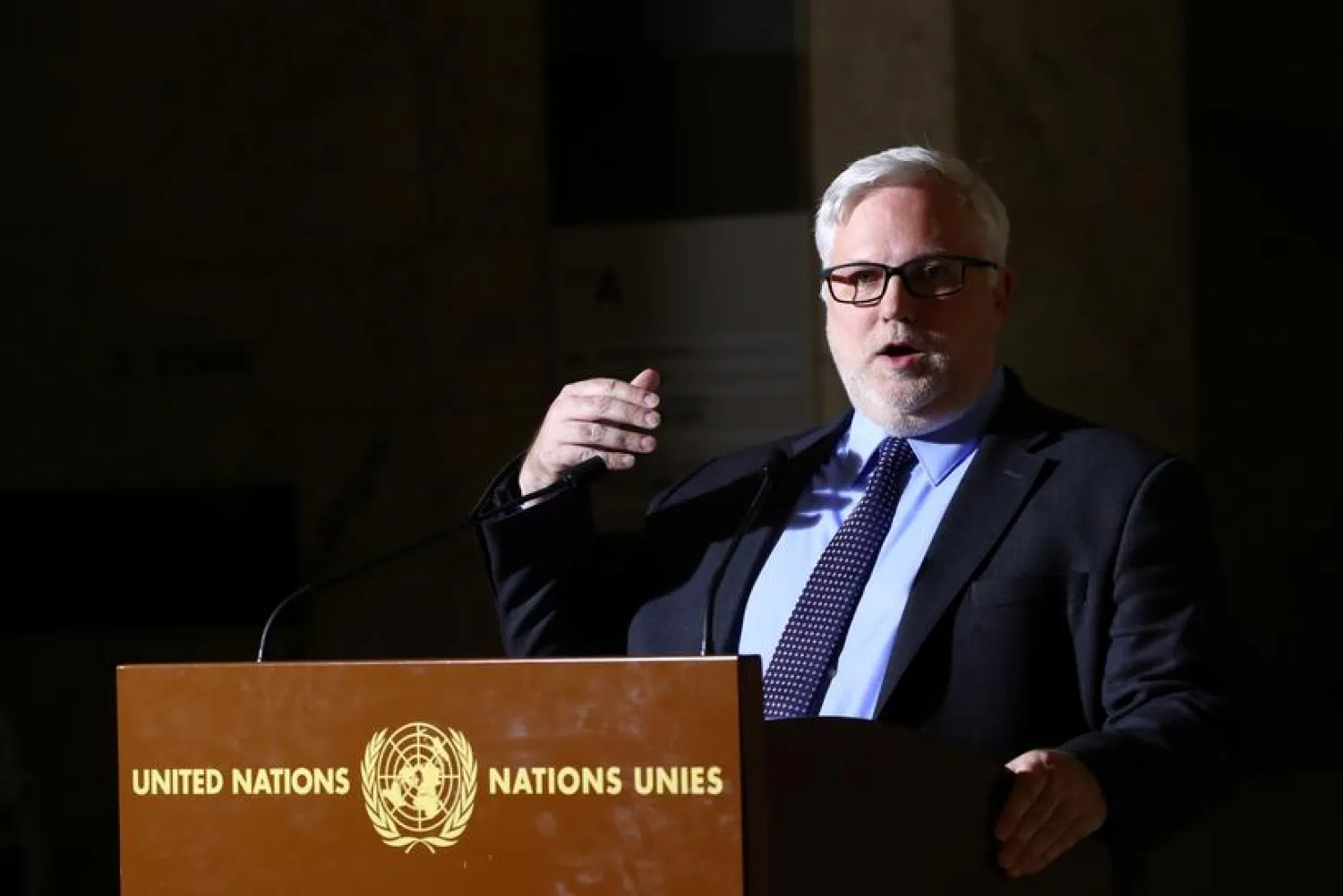
US deputy assistant secretary of state for Levant affairs and the special envoy for Syria, Joel Rayburn (Reuters)
TT

US Envoy Accuses Syrian Regime, Iran of Coordinating With ISIS East of Euphrates

US deputy assistant secretary of state for Levant affairs and the special envoy for Syria, Joel Rayburn (Reuters)

The United States has monitored efforts of Syrian President Bashar al-Assad and Iran to coordinate with ISIS to attack areas controlled by the Syrian Democratic Forces (SDF) and destabilize the region, leading to the withdrawal of US forces from the region, according to deputy assistant secretary of state for Levant affairs and the special envoy for Syria, Joel Rayburn.

Speaking during the hearing of the House Foreign Affairs Committee to evaluate US policy toward Syria, Rayburn said that he returned from an expanded tour that included several countries in the region, as well as northeastern Syria.

During his tour, the envoy discussed the efforts of President Donald Trump's administration to continue to implement its objectives to prevent ISIS resurgence, whether in Syria or Iraq.

Rayburn described the Syrian conflict as “one of the most dangerous crises in the world”, indicating that the Syrian civil society highly values the Caesar Act which was passed by Congress.

He emphasized that he held fruitful talks with SDF leaders and US allies.

The talks focused on the “withdrawal of all Iranian-commanded forces from Syria,” said Rayburn, stressing that all efforts of the enemies of the United States have so far failed to prevent the implementation of the strategy in this country.

He indicated that each of the US major goals in Syria is within reach, adding that adversaries have failed to achieve their goals.

“The strategic situation today is encouraging, and it attests to what can be done when diplomatic efforts are strongly backed by both this Congress and responsible members of the international community.”

The envoy stressed that political and economic pressures on the Assad regime and its enablers will continue until they are forced to stop their inhuman policies against the Syrian people and commit to a political solution in coordination with the Western allies.

Chairperson of the committee congressman Eliot Engel wondered why the Caesar Act had not included non-Syrians, in particular Russian entities.

Rayburn believes that the US will extend the Caesar Act designation to non-Syrians in the future because the Act had a “remarkable chilling effect” even outside Syria and the regime.

He explained that the designation is done in collaboration between the State Department and the Treasury Department to determine the most efficient sanction authorities.

“We need to continue to put accumulating pressure on the Assad regime and its backers in the future.”

Engel called on the administration of President-elect Joe Biden to remember the suffering of the Syrian people, saying that the Assad regime, supported by Russia and Iran, managed to recapture areas previously held by opposition factions, and carried out large-scale cleansing operations.

The congressman wondered what can be done to prevent them from continuing these policies, especially targeting civilians in Idlib.

“After many months of the Assad regime, with Russian and Iranian and Lebanese Hezbollah backing, being able to retake territories, we saw that come to halt when they ran up against Turkish military supporting Syrian armed opposition groups, in February and March of this year," explained Rayburn.

He noted no indications of the Syrian regime overcoming the military opposition from Turkey and Turkish-backed groups.

Rayburn stated that the US must continue to support the Syrian opposition in the areas it still controls, and provide assistance to the Free Syrian Army that cooperates with Turkey and supports Kurdish-Kurdish reconciliation efforts in those areas.



Lebanon, Britain to Hold Joint Military Exercise Starting Tuesday

A Lebanese flag flies as buildings lie in ruins in Mansouri, as seen from Henniye, Lebanon, September 29, 2026. (Reuters)
TT

Lebanon, Britain to Hold Joint Military Exercise Starting Tuesday

A Lebanese flag flies as buildings lie in ruins in Mansouri, as seen from Henniye, Lebanon, September 29, 2026. (Reuters)

Lebanon's army will hold exercises with the British military this month, both sides said on Monday, with the drills also to involve personnel and representatives from countries including the United States and France.

Britain has been a key supporter of the cash-strapped Lebanese army and has provided millions of dollars in assistance over the years, including helping train Lebanese soldiers to secure the country's land borders.

The Lebanese army said that the joint "Pegasus Cedar 2026" exercise would begin on Tuesday and aimed to "bolster the capabilities of military units and raise the level of coordination between the Lebanese army and friendly armies".

It said the exercise would include "training on reconnaissance, raids and combat in built-up areas", among other activities.

A British embassy statement said British soldiers based in Cyprus would "join their Lebanese counterparts in the Air Assault Regiment in a landmark military exercise aimed at strengthening bilateral defense ties and enhancing operational readiness".

"Personnel from the armies of the United States and Italy will also take part, with representatives from the armies of France, Cyprus, Qatar, and Jordan joining as observers," it added.

The exercise, to be held over three weeks, builds on a previous UK-Lebanon military training exercise held in September 2023, the embassy statement added.

Lebanese authorities have called for increased support for the country's under-resourced army, which counts some 80,000 personnel and depends heavily on foreign aid.

The military faces enormous challenges in completing its deployment to south Lebanon under a framework agreement reached in June between Israel and Lebanon that involves the disarmament of the Hezbollah group and the gradual withdrawal of Israeli forces.

Hezbollah drew the country into the Middle East war in March by attacking Israel, which responded with massive airstrikes and a ground invasion.

While violence has dropped since June, Israel still carries out attacks and demolitions, and its troops are occupying a self-declared "security zone" running around 10 kilometers (six miles) inside Lebanon along the border.

The fighting followed another conflict that erupted in 2023 that led to an all-out war the following year.

Last month in Paris, Lebanese President Joseph Aoun met his French counterpart Emmanuel Macron and Jordan's King Abdullah II, and discussed international support for the country's military.


UN Chief Calls for Gaza Ceasefire Ahead of Oct 7 Anniversary

A photograph shows destruction at the Jabalia refugee camp in the northern Gaza Strip, with an Israeli flag fluttering in the background, on October 5, 2026. (AFP)
TT

UN Chief Calls for Gaza Ceasefire Ahead of Oct 7 Anniversary

A photograph shows destruction at the Jabalia refugee camp in the northern Gaza Strip, with an Israeli flag fluttering in the background, on October 5, 2026. (AFP)

United Nations Secretary General Antonio Guterres on Monday called for a permanent ceasefire in Gaza ahead of the third anniversary of the October 7, 2023 Hamas attack on Israel.

"It is time for the ceasefire to become permanent. It is time to allow humanitarian assistance at scale. And it is time to respect international law," Guterres said in a statement, calling for a "political path to lasting peace across the whole region."

"Let this anniversary mark not only another year of mourning, but also a renewed determination to build a different future: one in which Israelis and Palestinians can live side by side in peace and security, with their rights, dignity, and aspirations fulfilled," Guterres said.

The UN chief acknowledged Israel's casualties in the statement, calling the Hamas attack "abhorrent" for "killing more than 1,200 Israelis and foreign nationals" and the hostage-taking of another 251 people.

Guterres also said Palestinians in Gaza have faced a "massive loss of life, displacement and destruction," without specifying their death toll.

"Their suffering, too, demands an end, now," Guterres said.

Israel's years-long military campaign in Gaza has killed more than 74,200 people according to the Palestinian Health Ministry, which is under Hamas' authority and whose figures are deemed reliable by the UN.

Guterres acknowledged that a brief ceasefire, announced by US President Donald Trump in October 2025, "brought some relief. But it has yet to deliver security, adequate humanitarian assistance or a credible path to recovery and peace."

Israel, which still controls most of Gaza, refuses to withdraw its soldiers until Hamas' disarmament has been verified.

Hamas, for its part, has advocated for gradual disarmament rather than immediate and unilateral surrender of its arsenal.

Since the 2023 attacks, Israel has waged military attacks on several fronts, notably invading southern Lebanon to confront Hezbollah, the movement backed by Tehran, and launching war against Iran in late February alongside the United States.


ISIS Attack Kills Iraqi Policeman Near Kirkuk

Iraqi police patrol vehicles are stationed outside the Karkh Court house during the trial of six French citizens accused of terrorism in Baghdad, on October 5, 2026. (AFP)
TT

ISIS Attack Kills Iraqi Policeman Near Kirkuk

Iraqi police patrol vehicles are stationed outside the Karkh Court house during the trial of six French citizens accused of terrorism in Baghdad, on October 5, 2026. (AFP)

At least ‌one Iraqi federal policeman was killed and four others wounded on Monday when ISIS militants attacked a federal police site southwest of the oil-rich city of Kirkuk, two security sources told Reuters.

The attackers used semi-automatic machine guns and sniper fire against the federal police regiment stationed near Hawija, about 70 km (43 miles) southwest of Kirkuk, the sources said.

There ‌was no ‌immediate claim of responsibility. But ‌security and ⁠army sources said ⁠ ISIS militants, who are still active in the area, were involved in the attack.

The attack is the first reported assault by ISIS on Iraqi security forces since US forces completed their withdrawal ⁠from Iraq on September 30, ending ‌the military mission in ‌the country.

The United States had led a ‌coalition that supported Iraqi forces in the fight ‌against ISIS, including efforts to prevent the militant group from regrouping.

Washington said it would continue to provide targeted training and intelligence support after ‌the withdrawal, while Iraqi forces would take full responsibility for the country’s security ⁠and ⁠for suppressing ISIS remnants.

Despite the defeat of ISIS nearly a decade ago, the group retains sleeper cells in Iraq, Iraqi security officials told Reuters ahead of the US withdrawal.

The withdrawal had raised concerns that a security vacuum could provide an opening for ISIS to regain strength, with some officials warning that Iraqi forces would now have to contain the group without the coalition’s military presence.