


Scientists Focus on Bats for Clues to Prevent Next Pandemic

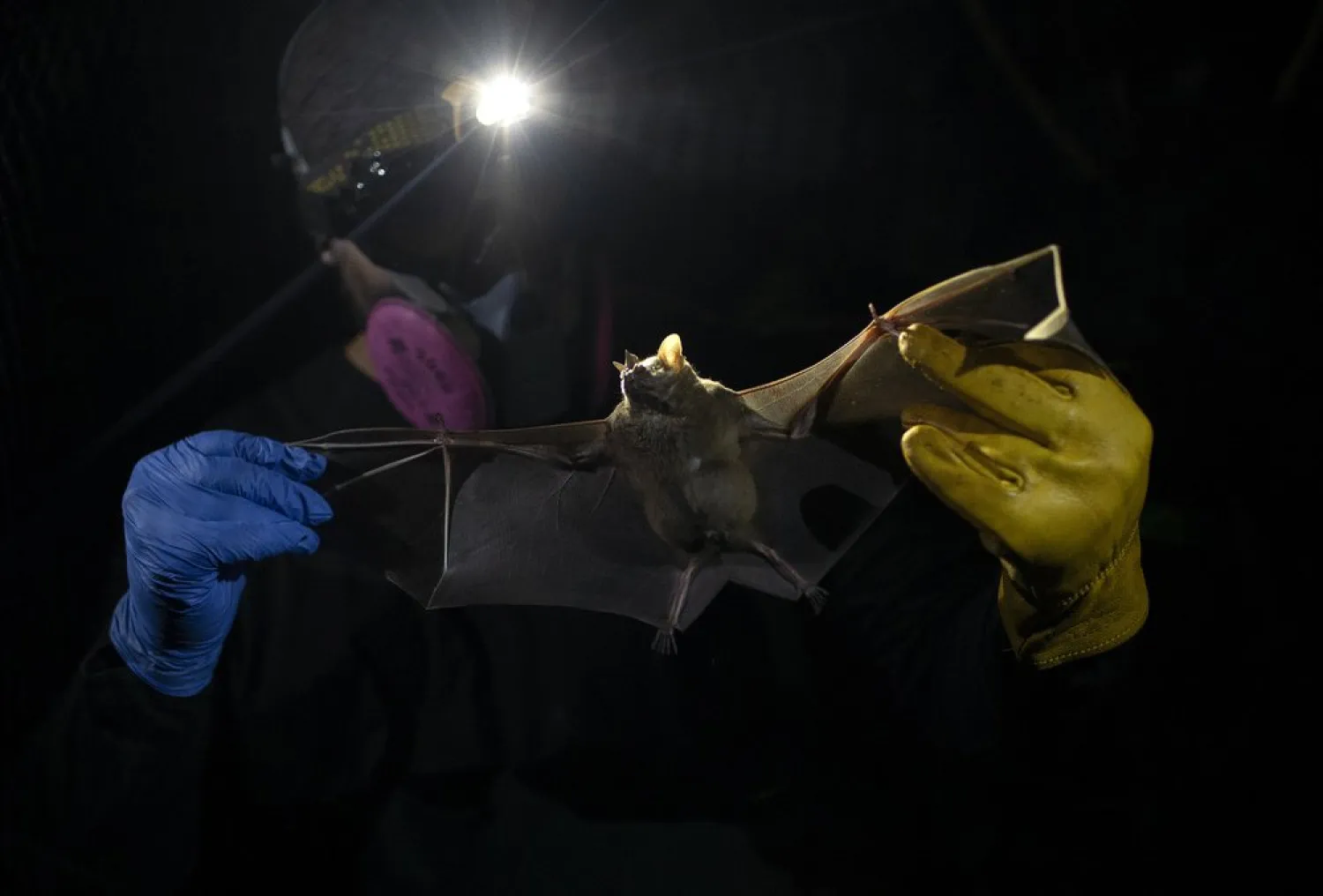
A researcher for Brazil's state-run Fiocruz Institute holds a bat captured in the Atlantic Forest, at Pedra Branca state park, near Rio de Janeiro, Nov. 17, 2020. (AP)
TT

Scientists Focus on Bats for Clues to Prevent Next Pandemic

A researcher for Brazil's state-run Fiocruz Institute holds a bat captured in the Atlantic Forest, at Pedra Branca state park, near Rio de Janeiro, Nov. 17, 2020. (AP)

Night began to fall in Rio de Janeiro’s Pedra Branca state park as four Brazilian scientists switched on their flashlights to traipse along a narrow trail of mud through dense rainforest. The researchers were on a mission: capture bats and help prevent the next global pandemic.

A few meters ahead, nearly invisible in the darkness, a bat made high-pitched squeaks as it strained its wings against the thin nylon net that had ensnared it. One of the researchers removed the bat, which used its pointed teeth to bite her gloved fingers.

The November nighttime outing was part of a project at Brazil’s state-run Fiocruz Institute to collect and study viruses present in wild animals — including bats, which many scientists believe were linked to the outbreak of COVID-19.

The goal now is to identify other viruses that may be highly contagious and lethal in humans, and to use that information to devise plans to stop them from ever infecting people — to forestall the next potential global disease outbreak before it gets started.

In a highly connected world, an outbreak in one place endangers the entire globe, just as the coronavirus did. And the Brazilian team is just one among many worldwide racing to minimize the risk of a second pandemic this century.

It’s no coincidence that many disease scientists are focusing attention on bats, the world’s only flying mammals. Bats are thought to be the original or intermediary hosts for multiple viruses that have spawned recent epidemics, including SARS, MERS, Ebola, Nipah virus, Hendra virus and Marburg virus.

A 2019 study found that of viruses originating from the five most common mammalian sources — primates, rodents, carnivores, ungulates and bats — those from bats are the most virulent in humans.

Bats are a diverse group, with more than 1,400 species flitting across every continent except Antarctica. But what many have in common are adaptations that allow them to carry viruses that are deadly in humans and livestock while exhibiting minimal symptoms themselves — meaning they are able travel and shed those viruses, instead of being quickly hobbled.

“The secret is that bats have unusual immune systems, and that’s related to their ability to fly,” said Raina Plowright, an epidemiologist who studies bats at Montana State University.

Plowright and other bat scientists believe evolutionary tweaks that help bats recover from the stress of flying, when their metabolic rate rises sixteen-fold, also give them extra protection against pathogens.

Probing the secrets of bat immune systems may help scientists understand more about when bats do shed viruses, as well as providing hints for possible future medical treatment strategies, said Arinjay Banerjee, a virologist at McMaster University in Canada.

Increasing destruction and fragmentation of habitats worldwide — especially biodiverse areas like tropical forests — means “we are seeing higher rates of contact between wildlife and humans, creating more opportunities for spillover,” said Cara Brook, a disease ecologist at the University of California, Berkeley.

In India, a National Mission on Biodiversity and Human Well-Being has been pending since 2018 and will likely be launched next year. A core part of the plan is to set up 25 virus surveillance sites across the country.

A varied patchwork of virus surveillance programs exists in several other countries, but funding tends to wax and wane with the political climate and sense of urgency.

One approach that won’t help, scientists say, is treating bats as the enemy — vilifying them, throwing stones or trying to burn them out of caves. An attack along those lines took place this spring, when villagers in the Indian state of Rajasthan identified bat colonies in abandoned forts and palaces and killed hundreds with bats and sticks.

Scientists say such tactics are likely to backfire.

“Stress is a huge factor in upsetting the natural balance that bats have with their viruses — the more you stress bats, the more they shed viruses,” said Vikram Misra, a virologist at the University of Saskatchewan in Canada.

“People have a lot of misconceptions about bats. They’re nocturnal and look a little weird flying,” said Hannah Kim Frank, a biologist at Tulane University. “But bats aren’t aggressive — and attacking bats doesn’t help control diseases.”

Bats also play vital roles in ecosystems: They consume insects like mosquitos, pollinate plants like agave, and disperse seeds.

“We actually need bats in the wild to consume insects that otherwise destroy cotton, corn and pecan harvests,” said Kristen Lear, an ecologist at Bat Conservational International.

A better approach to minimize disease risk, Frank said, is simply to minimize contact between wild bats and people and livestock.

In Australia, widespread destruction of winter flowering eucalyptus trees that provide nectar for fruit bats — known locally as “flying foxes” — prompted the bats to move into areas closer to human settlements looking for alternate meals, including to a suburb of Brisbane called Hendra.

There, the bats transmitted a virus to horses, which in turn infected people. First identified in 1994 and named Hendra virus, it is highly lethal, killing 60% of people and 75% of horses infected.

To potentially reverse the movement of bats, Montana State University’s Plowright and colleagues based in Australia are studying restoring the bats’ original habitat.

“The idea is to plant new forests and make sure they are away from places with domestic animals and people,” she said.

Bats aren’t the problem, said Ricardo Moratelli, coordinator of the Fiocruz project in Brazil. “The problem is when human beings enter into contact with them,” he said.



17th Century Wreck Reappears from Stockholm Deep

The remains of a 17th century shipwreck is pictured after resurfacing in Stockholm, Sweden, on February 17, 2026. (Photo by Jonathan NACKSTRAND / AFP)
TT

17th Century Wreck Reappears from Stockholm Deep

The remains of a 17th century shipwreck is pictured after resurfacing in Stockholm, Sweden, on February 17, 2026. (Photo by Jonathan NACKSTRAND / AFP)

A 17th century Swedish Navy shipwreck buried underwater in central Stockholm for 400 years has suddenly become visible due to unusually low Baltic Sea levels.

The wooden planks of the ship's well-preserved hull have since early February been peeking out above the surface of the water off the island of Kastellholmen, providing a clear picture of its skeleton.

"We have a shipwreck here, which was sunk on purpose by the Swedish Navy," Jim Hansson, a marine archeologist at Stockholm's Vrak - Museum of Wrecks, told AFP.

Hansson said experts believe that after serving in the navy, the ship was sunk around 1640 to use as a foundation for a new bridge to the island of Kastellholmen.

Archeologists have yet to identify the exact ship, as it is one of five similar wrecks lined up in the same area to form the bridge, all dating from the late 16th and early 17th centuries.

"This is a solution, instead of using new wood you can use the hull itself, which is oak" to build the bridge, Hansson said.

"We don't have shipworm here in the Baltic that eats the wood, so it lasts, as you see, for 400 years," he said, standing in front of the wreck.

Parts of the ship had already broken the surface in 2013, but never before has it been as visible as it is now, as the waters of the Baltic Sea reach their lowest level in about 100 years, according to the archaeologist.

"There has been a really long period of high pressure here around our area in the Nordics. So the water from the Baltic has been pushed out to the North Sea and the Atlantic," Hansson explained.

A research program dubbed "the Lost Navy" is underway to identify and precisely date the large number of Swedish naval shipwrecks lying on the bottom of the Baltic.


China Has Slashed Air Pollution, but the ‘War’ Isn’t Over 

This picture taken on February 11, 2026 shows pedestrians walking along an overpass as traffic snarls in Beijing. (AFP)
TT

China Has Slashed Air Pollution, but the ‘War’ Isn’t Over 

This picture taken on February 11, 2026 shows pedestrians walking along an overpass as traffic snarls in Beijing. (AFP)

Fifteen years ago, Beijing's Liangma riverbanks would have been smog-choked and deserted in winter, but these days they are dotted with families and exercising pensioners most mornings.

The turnaround is the result of a years-long campaign that threw China's state power behind policies like moving factories and electrifying vehicles, to improve some of the world's worst air quality.

Pollution levels in many Chinese cities still top the World Health Organization's (WHO) limits, but they have fallen dramatically since the "airpocalypse" days of the past.

"It used to be really bad," said Zhao, 83, soaking up the sun by the river with friends.

"Back then when there was smog, I wouldn't come out," she told AFP, declining to give her full name.

These days though, the air is "very fresh".

Since 2013, levels of PM2.5 -- small particulate that can enter the lungs and bloodstream -- have fallen 69.8 percent, Beijing municipality said in January.

Particulate pollution fell 41 percent nationwide in the decade from 2014, and average life expectancy has increased 1.8 years, according to the University of Chicago's Air Quality Life Index (AQLI).

China's rapid development and heavy coal use saw air quality decline dramatically by the 2000s, especially when cold winter weather trapped pollutants close to the ground.

There were early attempts to tackle the issue, including installing desulphurization technology at coal power plants, while factory shutdowns and traffic control improved the air quality for events like the 2008 Olympics.

But the impact was short-lived, and the problem worsened.

- Action plan -

Public awareness grew, heightened by factors like the US embassy in Beijing making monitoring data public.

By 2013, several international schools had installed giant inflatable domes around sport facilities to protect students.

That year, multiple episodes of prolonged haze shrouded Chinese cities, with one in October bringing northeastern Harbin to a standstill for days as PM2.5 levels hit 40 times the WHO's then-recommended standard.

The phrase "I'm holding your hand, but I can't see your face" took off online.

Later that year, an eight-year-old became the country's youngest lung cancer patient, with doctors directly blaming pollution.

As concerns mounted, China's ruling Communist Party released a ten-point action plan, declaring "a war against pollution".

It led to expanded monitoring, improved factory technology and the closure or relocation of coal plants and mines.

In big cities, vehicles were restricted and the groundwork was laid for widespread electrification.

For the first time, "quantitative air quality improvement goals for key regions within a clear time limit" were set, a 2016 study noted.

These targets were "the most important measure", said Bluetech Clean Air Alliance director Tonny Xie, whose non-profit worked with the government on the plan.

"At that time, there were a lot of debates about whether we can achieve it, because (they were) very ambitious," he told AFP.

The policy targeted several key regions, where PM2.5 levels fell rapidly between 2013 and 2017, and the approach was expanded nationwide afterwards.

"Everybody, I think, would agree that this is a miracle that was achieved in China," Xie said.

China's success is "entirely" responsible for a decline in global pollution since 2014, AQLI said last summer.

- 'Low-hanging fruits' gone -

Still, in much of China the air remains dangerous to breathe by WHO standards.

This winter, Chinese cities, including financial hub Shanghai, were regularly among the world's twenty most polluted on monitoring site IQAir.

Linda Li, a running coach who has lived in both Beijing and Shanghai, said air quality has improved, but she still loses up to seven running days to pollution in a good month.

A top environment official last year said China aimed to "basically eliminate severe air pollution by 2025", but the government did not respond when AFP asked if that goal had been met.

Official 2025 data found nationwide average PM2.5 concentrations decreased 4.4 percent on-year.

Eighty-eight percent of days featured "good" air quality.

However, China's current definition of "good" is PM2.5 levels of under 35 micrograms per cubic meter, significantly higher than the WHO's recommended five micrograms.

China wants to tighten the standard to 25 by 2035.

The last five years have also seen pollution reduction slow.

The "low-hanging fruits" are gone, said Chengcheng Qiu from the Center for Research on Energy and Clean Air (CREA).

Qiu's research suggests pollution is shifting west as heavy industry relocates to regions like Xinjiang, and that some cities in China have seen double-digit percentage increases in PM2.5 in the last five years.

"They can't just stop all industrial production. They need to find cleaner ways to produce the output," Qiu said.

There is hope for that, given China's status as a renewable energy powerhouse, with coal generation falling in 2025.

"Cleaner air ultimately rests on one clear direction," said Qiu.

"Move beyond fossil fuels and let clean energy power the next stage of development."


Sydney Man Jailed for Mailing Reptiles in Popcorn Bags 

Investigators recovered 101 Australian reptiles from parcels destined for Hong Kong, South Korea, Sri Lanka and Romania. (AFP file)
TT

Sydney Man Jailed for Mailing Reptiles in Popcorn Bags 

Investigators recovered 101 Australian reptiles from parcels destined for Hong Kong, South Korea, Sri Lanka and Romania. (AFP file)

A Sydney man who tried to post native lizards, dragons and other reptiles out of Australia in bags of popcorn and biscuit tins has been sentenced to eight years in jail, authorities said Tuesday.

The eight-year term handed down on Friday was a record for wildlife smuggling, federal environment officials said.

A district court in Sydney gave the man, 61-year-old Neil Simpson, a non-parole period of five years and four months.

Investigators recovered 101 Australian reptiles from seized parcels destined for Hong Kong, South Korea, Sri Lanka and Romania, the officials said in a statement.

The animals -- including shingleback lizards, western blue-tongue lizards, bearded dragons and southern pygmy spiny-tailed skinks -- were posted in 15 packages between 2018 and 2023.

"Lizards, skinks and dragons were secured in calico bags. These bags were concealed in bags of popcorn, biscuit tins and a women's handbag and placed inside cardboard boxes," the statement said.

The smuggler had attempted to get others to post the animals on his behalf but was identified by government investigators and the New South Wales police, it added.

Three other people were convicted for taking part in the crime.

The New South Wales government's environment department said that "the illegal wildlife trade is not a victimless crime", harming conservation and stripping the state "and Australia of its unique biodiversity".