
Months after Beirut Blast, Victims Await Answers

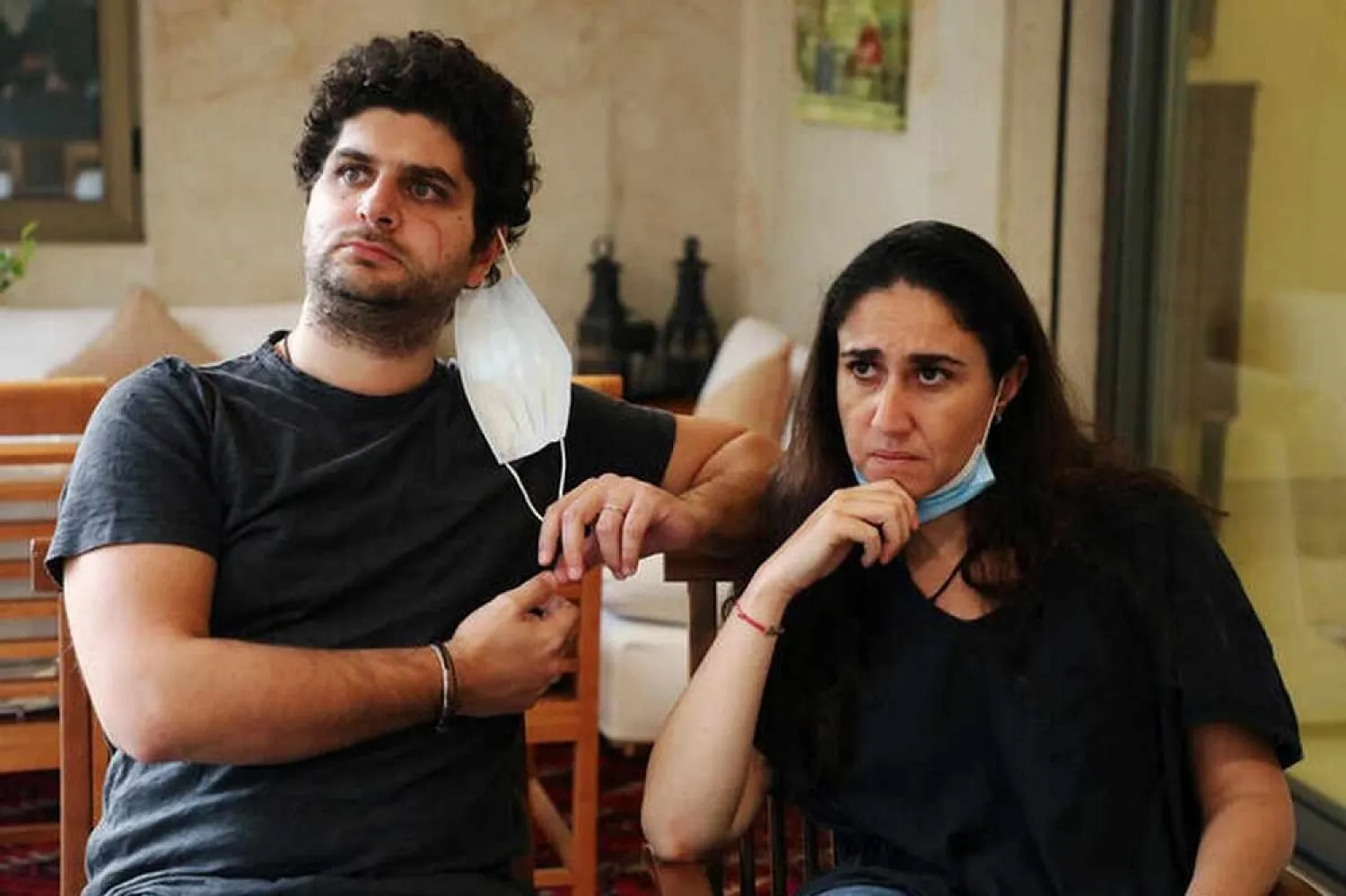
Tracy and Paul Najjar, whose daughter Alexandra was killed in the Aug. 4 explosion at Beirut port, attend an interview with Reuters in Beirut, Lebanon December 8, 2020. (Reuters)
TT

Months after Beirut Blast, Victims Await Answers

Tracy and Paul Najjar, whose daughter Alexandra was killed in the Aug. 4 explosion at Beirut port, attend an interview with Reuters in Beirut, Lebanon December 8, 2020. (Reuters)

Tracy and Paul Najjar believe their daughter Alexandra could have survived the Aug. 4 explosion at Beirut port if the authorities had raised the alarm on that fateful day.

As they mourn the loss of their three-year-old, one question continues to haunt them: why did no one warn residents or evacuate them as fire raged for more than half an hour close to a huge store of ammonium nitrate?

“They had 40 minutes to tell us ‘Leave Beirut! Go hide! Get away from the windows!’. They didn’t do it,” said Tracy Najjar, 34, who was at home with her family in the Gemmayzeh district when the blast at the nearby port tore through Beirut.

“They had 40 minutes to prepare for the post-blast. To prepare hospitals, to open the roads, to send doctors, to send the army, and they didn’t do it.”

Security officials reached by Reuters declined to comment on the families’ grievances and questions over why they were not prepared and did not raise the alarm.

The Aug. 4 tragedy was one of the biggest non-nuclear explosions ever recorded. It killed some 200 people, wounded thousands and devastated swathes of the Lebanese capital.

More than four months later, victims are still awaiting the result of the investigation into why 2,750 tons of potentially explosive material were stored unsafely at the port, which is surrounded by residential areas, for more than six years.

Lebanese leaders had promised it would come within days.

“Instead of grieving and trying to continue with life, we are fighting today for something that is actually our right. To find the truth. To get justice,” Najjar said.

“We didn’t give up and we will not give up.”

Their only child, Alexandra, died from her wounds five days after the blast.

It took an hour to get her to hospital because of traffic.

“If they had opened the roads, then many people would have survived, maybe Alexandra would have survived,” Najjar said.

She recalled how she could not find members of the security services to assist in the immediate aftermath and how ordinary people helped each other. Her husband, Paul, eventually made it to hospital with Alexandra on the back of a stranger’s scooter.

Weeks passed before the Najjars heard from a state official.

The first to get in touch was an army officer who asked them to take part in a commemoration to be attended by the army commander. They declined.

“For us, the president, the government, the army are all part of it and it’s a way of washing their hands,” said Paul Najjar, 36, his face scarred from the blast. Many casualties could have been avoided if the alarm had been raised, he said.

‘Betrayed, sold out’
For some, the explosion and the state’s handling of its aftermath are an indictment of politicians who have led Lebanon as it lurches from crisis to crisis.

Several senior officials have been detained, including the port’s general manager and head of customs. The judge investigating has also charged Lebanon’s caretaker Prime Minister Hassan Diab and three former ministers with negligence.

Diab, whose cabinet resigned over the August blast after taking office in early 2020, said his conscience was clear and accused the judge of breaching the constitution.

Security officials warned the prime minister and president in July that the ammonium nitrate stored at the port posed a security risk and could destroy the capital if it exploded, according to documents seen by Reuters and senior security sources.

A high-ranking security official told Reuters in August that the fire spread due to sparks from welding.

The US Federal Bureau of Investigation, which sent investigators to Beirut to help, said in October it had reached no firm conclusion about what caused the explosion.

Other US and European government agencies closely following the investigations strongly believe that the blast was accidental.

Families of some of the victims marked the four-month anniversary with a protest at the entrance to the port. “We want the results of the investigation and transparency before our patience runs out,” declared a banner.

Since the blast, and the resignation of the government shortly afterwards, powerful politicians have failed to form a new one as they haggle over who gets what position.

The familiar bickering has hampered Lebanon’s efforts to rebuild after the blast, and with longer term problems like the deepening economic crisis that has plunged millions of people into poverty.

“We have no leaders, there are a mafia,” said Rita Hitti, whose firefighter son Najib was killed along with two other family members as they battled the flames that ignited the explosives at the port.

“Those at the top should have resigned and gone home. They are still dividing up the pie, they still haven’t had enough.”

The firefighting trio - Najib Hitti, 27, his brother-in-law Charbel Karam, 37, and cousin Charbel Hitti, 21 - always did their shifts together. In his last call home, Karam told his wife Karlin they were going to the port to put out a fire.

After the explosion, the families went from hospital to hospital searching for the men, said Karlin, who must now raise their two daughters, Angelina and Catherina, alone.

Karlin said: “When asked what gift does she want Santa to bring her for Christmas, Angelina replied: ‘I want Santa to bring me my dad.’”

Russia, China Unlikely to Back Iran Against US Military Threats

A man stands by the wreckage of a burnt bus bearing a banner (unseen) that reads "This was one of Tehran’s new buses that was paid for with the money of the people’s taxes,” in Tehran's Sadeghieh Square on January 15, 2026. (AFP)
TT

Russia, China Unlikely to Back Iran Against US Military Threats

A man stands by the wreckage of a burnt bus bearing a banner (unseen) that reads "This was one of Tehran’s new buses that was paid for with the money of the people’s taxes,” in Tehran's Sadeghieh Square on January 15, 2026. (AFP)

While Russia and China are ready to back protest-rocked Iran under threat by US President Donald Trump, that support would diminish in the face of US military action, experts told AFP.

Iran is a significant ally to the two nuclear powers, providing drones to Russia and oil to China. But analysts told AFP the two superpowers would only offer diplomatic and economic aid to Tehran, to avoid a showdown with Washington.

"China and Russia don't want to go head-to-head with the US over Iran," said Ellie Geranmayeh, a senior policy expert for the European Council on Foreign Relations think tank.

Tehran, despite its best efforts over decades, has failed to establish a formal alliance with Moscow and Beijing, she noted.

If the United States carried out strikes on Iran, "both the Chinese and the Russians will prioritize their bilateral relationship with Washington", Geranmayeh said.

China has to maintain a "delicate" rapprochement with the Trump administration, she argued, while Russia wants to keep the United States involved in talks on ending the war in Ukraine.

"They both have much higher priorities than Iran."

- Ukraine before Iran -

Despite their close ties, "Russia-Iranian treaties don't include military support" -- only political, diplomatic and economic aid, Russian analyst Sergei Markov told AFP.

Alexander Gabuev, director of Carnegie Russia Eurasia Center, said Moscow would do whatever it could "to keep the regime afloat".

But "Russia's options are very limited," he added.

Faced with its own economic crisis, "Russia cannot become a giant market for Iranian products" nor can it provide "a lavish loan", Gabuev said.

Nikita Smagin, a specialist in Russia-Iran relations, said that in the event of US strikes, Russia could do "almost nothing".

"They don't want to risk military confrontation with other great powers like the US -- but at the same time, they're ready to send weaponry to Iran," he said.

"Using Iran as a bargaining asset is a normal thing for Russia," Smagin said of the longer-term strategy, at a time when Moscow is also negotiating with Washington on Ukraine.

Markov agreed. "The Ukrainian crisis is much more important for Russia than the Iranian crisis," he argued.

- Chinese restraint -

China is also ready to help Tehran "economically, technologically, militarily and politically" as it confronts non-military US actions such as trade pressure and cyberattacks, Hua Po, a Beijing-based independent political observer, told AFP.

If the United States launched strikes, China "would strengthen its economic ties with Iran and help it militarize in order to contribute to bogging the United States down in a war in the Middle East," he added.

Until now, China has been cautious and expressed itself "with restraint", weighing the stakes of oil and regional stability, said Iran-China relations researcher Theo Nencini of Sciences Po Grenoble.

"China is benefiting from a weakened Iran, which allows it to secure low-cost oil... and to acquire a sizeable geopolitical partner," he said.

However, he added: "I find it hard to see them engaging in a showdown with the Americans over Iran."

Beijing would likely issue condemnations, but not retaliate, he said.

Hua said the Iran crisis was unlikely to have an impact on China-US relations overall.

"The Iranian question isn't at the heart of relations between the two countries," he argued.

"Neither will sever ties with the other over Iran."


Beirut’s Commodore Hotel, a Haven for Journalists During Lebanon’s Civil War, Shuts Down

People stand outside the closed Commodore hotel, in Beirut, Lebanon, Sunday, Jan. 11, 2026. (AP)
TT

Beirut’s Commodore Hotel, a Haven for Journalists During Lebanon’s Civil War, Shuts Down

People stand outside the closed Commodore hotel, in Beirut, Lebanon, Sunday, Jan. 11, 2026. (AP)

During Lebanon’s civil war, the Commodore Hotel in western Beirut's Hamra district became iconic among the foreign press corps.

For many, it served as an unofficial newsroom where they could file dispatches even when communications systems were down elsewhere. Armed guards at the door provided some sense of protection as sniper fights and shelling were turning the cosmopolitan city to rubble.

The hotel even had its own much-loved mascot: a cheeky parrot.

The Commodore endured for decades after the 15-year civil war ended in 1990 — until this week, when it closed for good.

The main gate of the nine-story hotel with more than 200 rooms was shuttered Monday. Officials at the Commodore refused to speak to the media about the decision to close.

Although the country’s economy is beginning to recover from a protracted financial crisis that began in 2019, tensions in the region and the aftermath of the Israel-Hezbollah war that was halted by a tenuous ceasefire in November 2024 are keeping many tourists away. Lengthy daily electricity cuts force businesses to rely on expensive private generators.

The Commodore is not the first of the crisis-battered country’s once-bustling hotels to shut down in recent years.

But for journalists who lived, worked and filed their dispatches there, its demise hits particularly hard.

“The Commodore was a hub of information — various guerrilla leaders, diplomats, spies and of course scores of journalists circled the cafes and lounges,” said Tim Llewellyn, a former BBC Middle East correspondent who covered the civil war. “On one occasion (late Palestinian leader) Yasser Arafat himself dropped in to sip coffee with” with the hotel manager's father, he recalled.

A line to the outside world

At the height of the civil war, when telecommunications were dysfunctional and much of Beirut was cut off from the outside world, it was at the Commodore where journalists found land lines and Telex machines that always worked to send reports to their media organizations around the globe.

Across the front office desk in the wide lobby of the Commodore, there were two teleprinters that carried reports of The Associated Press and Reuters news agencies.

“The Commodore had a certain seedy charm. The rooms were basic, the mattresses lumpy and the meal fare wasn’t spectacular,” said Robert H. Reid, the AP’s former Middle East regional editor, who was among the AP journalists who covered the war. The hotel was across the street from the international agency’s Middle East head office at the time.

“The friendly staff and the camaraderie among the journalist-guests made the Commodore seem more like a social club where you could unwind after a day in one of the world’s most dangerous cities,” Reid said.

Llewellyn remembers that the hotel manager at the time, Yusuf Nazzal, told him in the late 1970s “that it was I who had given him the idea” to open such a hotel in a war zone.

Llewellyn said that during a long chat with Nazzal on a near-empty Middle East Airlines Jumbo flight from London to Beirut in the fall of 1975, he told him that there should be a hotel that would make sure journalists had good communications, “a street-wise and well-connected staff running the desks, the phones, the teletypes.”

During Israel's 1982 invasion of Lebanon and a nearly three-month siege of West Beirut by Israeli troops, journalists used the roof of the hotel to film fighter jets striking the city.

The parrot

One of the best-known characters at the Commodore was Coco the parrot, who was always in a cage near the bar. Patrons were often startled by what they thought was the whiz of an incoming shell, only to discover that it was Coco who made the sound.

AP’s chief Middle East correspondent Terry Anderson was a regular at the hotel before he was kidnapped in Beirut in 1985 and held for seven years, becoming one of the longest-held American hostages in history.

Videos of Anderson released by his kidnappers later showed him wearing a white T-shirt with the words “Hotel Commodore Lebanon.”

With the kidnapping of Anderson and other Western journalists, many foreign media workers left the predominantly-Muslim western part of Beirut, and after that the hotel lost its status as a safe haven for foreign journalists.

Ahmad Shbaro, who worked at different departments of the hotel until 1988, said the main reason behind the Commodore’s success was the presence of armed guards that made journalists feel secure in the middle of Beirut’s chaos as well as functioning telecommunications.

He added that the hotel also offered financial facilities for journalists who ran out of money. They would borrow money from Nazzal and their companies could pay him back by depositing money in his bank account in London.

Shbaro remembers a terrifying day in the late 1970s when the area of the hotel was heavily shelled and two rooms at the Commodore were hit.

“The hotel was full and all of us, staffers and journalists, spent the night at Le Casbah,” a famous nightclub in the basement of the building, he said.

In quieter times, journalists used to spend the night partying by the pool.

“It was a lifeline for the international media in West Beirut, where journalists filed, ate, slept, and hid from air raids, shelling, and other violence,” said former AP correspondent Scheherezade Faramarzi.

“It gained both fame and notoriety,” she said, speaking from the Mediterranean island of Cyprus.

The hotel was built in 1943 and kept functioning until 1987 when it was heavily damaged in fighting between Shiite and Druze militiamen at the time. The old Commodore building was later demolished and a new structure was build with an annex and officially opened again for the public in 1996.

But Coco the parrot was no longer at the bar. The bird went missing during the 1987 fighting. Shbaro said it is believed he was taken by one of the gunmen who stormed the hotel.


Key Details of Greenland’s Rich but Largely Untapped Mineral Resources

Houses covered by snow are seen on the coast of a sea inlet of Nuuk, Greenland, on Monday, Jan. 12, 2026. (AP)
TT

Key Details of Greenland’s Rich but Largely Untapped Mineral Resources

Houses covered by snow are seen on the coast of a sea inlet of Nuuk, Greenland, on Monday, Jan. 12, 2026. (AP)

The Danish and Greenlandic foreign ministers will meet US Vice President JD Vance and Secretary of State Marco Rubio on Wednesday after President Donald Trump recently
stepped up threats to take over Greenland.

The autonomous territory of Denmark could be useful for the ​United States because of its strategic location and rich mineral resources. A 2023 survey showed that 25 of 34 minerals deemed "critical raw materials" by the European Commission were found in Greenland.

The extraction of oil and natural gas is banned in Greenland for environmental reasons, while development of its mining sector has been snarled in red tape and opposition from indigenous people.

Below are details of Greenland's main mineral deposits, based on data from its Mineral Resources Authority:

RARE EARTHS
Three of Greenland's biggest deposits are located in the southern province of Gardar.

Companies ‌seeking to ‌develop rare-earth mines are Critical Metals Corp, which bought the ‌Tanbreez ⁠deposit, ​Energy Transition Minerals, ‌whose Kuannersuit project is stalled amid legal disputes, and Neo Performance Materials.

Rare-earth elements are key to permanent magnets used in electric vehicles (EV) and wind turbines.

GRAPHITE
Occurrences of graphite and graphite schist are reported from many localities on the island.
GreenRoc has applied for an exploitation license to develop the Amitsoq graphite project.
Natural graphite is mostly used in EV batteries and steelmaking.

COPPER
According to the Mineral Resources Authority, most copper deposits have drawn only limited exploration campaigns.

Especially interesting are the underexplored areas ⁠in the northeast and center-east of Greenland, it said.

London-listed 80 Mile is seeking to develop the Disko-Nuussuaq deposit, which has ‌copper, nickel, platinum and cobalt.

NICKEL
Traces of nickel accumulations are numerous, ‍according to the Mineral Resources Authority.

Major miner ‍Anglo American was granted an exploration license in western Greenland in 2019 and has ‍been looking for nickel deposits, among others.

ZINC
Zinc is mostly found in the north in a geologic formation that stretches more than 2,500 km (1,550 miles).

Companies have sought to develop the Citronen Fjord zinc and lead project, which had been billed as one of the world's largest undeveloped zinc resources.

GOLD
The most prospective ​areas for gold potential are situated around the Sermiligaarsuk fjord in the country's south.

Amaroq Minerals launched a gold mine last year in Mt Nalunaq in ⁠the Kujalleq Municipality.

DIAMONDS
While most small diamonds and the largest stones are found in the island's west, their presence in other regions may also be significant.

IRON ORE
Deposits are located at Isua in southern West Greenland, at Itilliarsuk in central West Greenland, and in North West Greenland along the Lauge Koch Kyst.

TITANIUM-VANADIUM
Known deposits of titanium and vanadium are in the southwest, the east and south.

Titanium is used for commercial, medical and industrial purposes, while vanadium is mainly used to produce specialty steel alloys. The most important industrial vanadium compound, vanadium pentoxide, is used as a catalyst for the production of sulfuric acid.

TUNGSTEN
Used for several industrial applications, tungsten is mostly found in the central-east and northeast of the country, with assessed deposits in the south and west.

URANIUM
In 2021, ‌the then-ruling left-wing Inuit Ataqatigiit party banned uranium mining, effectively halting development of the Kuannersuit rare-earths project, which has uranium as a byproduct.