


FBI Found Beirut Port Blast Caused by 500 Tons of Fertilizer, Says PM

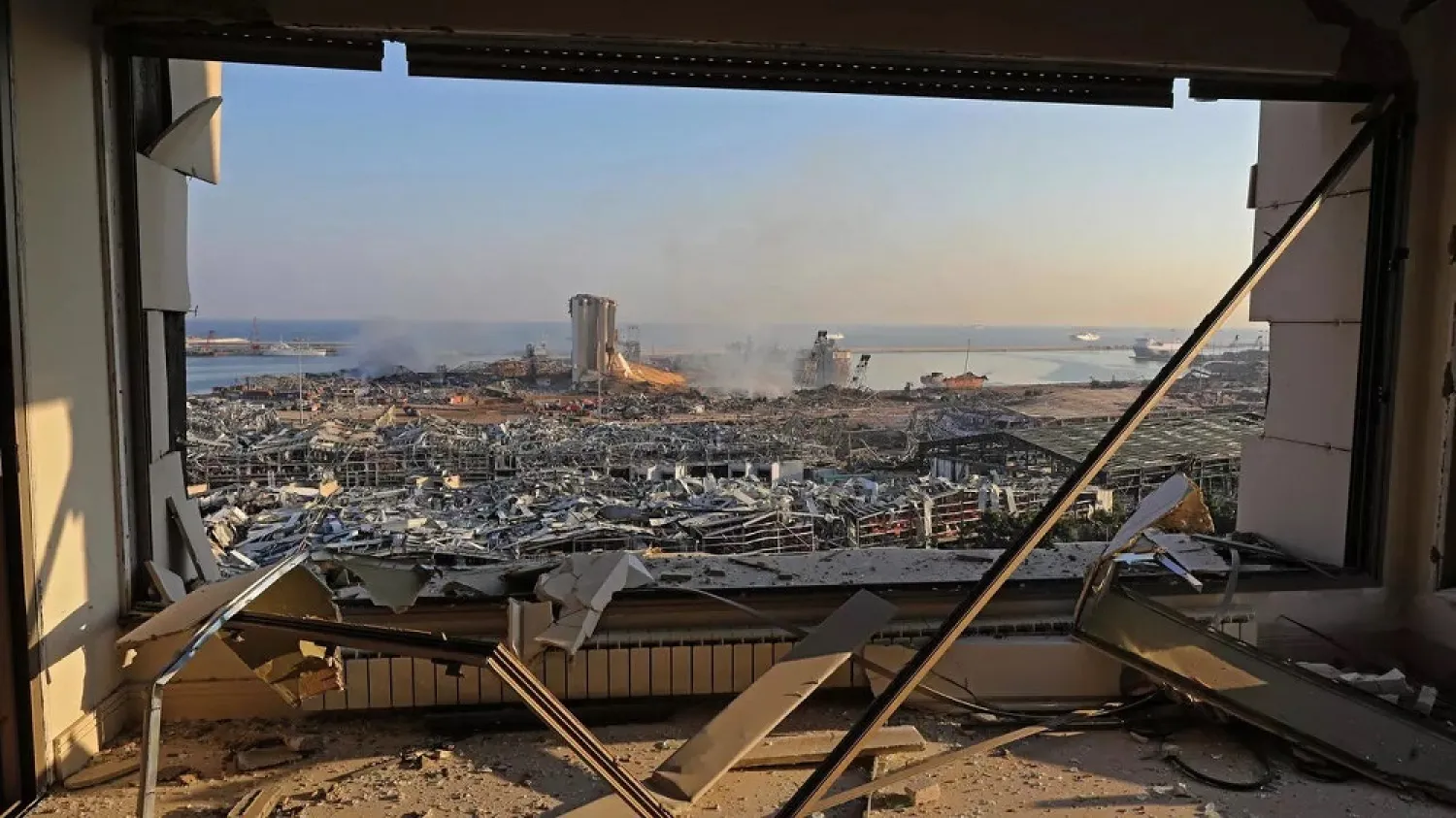
A massive explosion at the Beirut port on August 4 killed more than 200 people and laid waste to large swathes of the Lebanese capital. (AFP)
TT

FBI Found Beirut Port Blast Caused by 500 Tons of Fertilizer, Says PM

A massive explosion at the Beirut port on August 4 killed more than 200 people and laid waste to large swathes of the Lebanese capital. (AFP)

Lebanon's outgoing premier Hassan Diab said Tuesday that an FBI investigation into an August 4 explosion at the Beirut port found it was caused by 500 tons of ammonium nitrate.

The prime minister, who resigned in the wake of the blast that killed more than 200 people, had previously said that more than 2,700 tons of ammonium nitrate fertilizer had been stored haphazardly at a port warehouse for years.

But a report by the US domestic intelligence agency, which aided Lebanon in the probe, said that less than a quarter of that amount had exploded, Diab told reporters during a briefing.

"The FBI report revealed that the amount that exploded is only 500 tons," he said. "Where did the (other) 2,200 tons go?" he asked.

The FBI has not made its findings public. AFP could not independently verify the contents of the FBI report.

Nearly five months after the blast, little light has been shed on the circumstances that led to Lebanon's worst peacetime disaster, which is widely blamed on decades of negligence and corruption by the country's ruling elite.

The slow pace of the investigation has sparked outrage at home and fueled distrust among international donors, whose support is much needed if Lebanon is to stand a chance of surviving its deepest economic crisis in decades.

Lead investigative judge Fadi Sawwan this month charged Diab and three former ministers over the explosion in the first set of indictments against politicians.

He charged them with "negligence and causing death to hundreds and injuries to thousands more" in the first such official indictment against a prime minister in office in Lebanese history.

The blast probe has since been suspended after two of the charged ministers called on Sawwan to be replaced. Lebanon's top Court of Cassation must rule on their request before investigations proceed.

The investigation had led to the arrest of at least 25 suspects, including the chief of the port and its customs director, but not a single politician.

‘Diabolical’ move

Diab said he was shocked to learn he was being charged with negligence over the explosion, saying he did his utmost duty during his brief tenure, during which he learned about dangerous chemicals stored at the port.

In an interview with The Associated Press, Diab described being singled out and charged while others knew more, calling it “diabolical.” He insisted the investigating judge must go through parliament to question him further, now that he has been charged.

The charges caused a political storm in Lebanon and Diab and other ministers refused to appear before the judge for questioning as defendants, calling the charges politically motivated and selective.

“Questioning me is not an issue, he (the judge) is welcome to do it. But being charged is a whole different ball game,” Diab said.

The challenge to Sawwan’s summoning is rooted in disparate interpretations over who has the authority to question ministers and heads of governments. According to Lebanon’s constitution, a separate council made up of judges and politicians and set up by parliament is entrusted with trying ministers and premiers for crimes of high treason, dereliction of duty and breach of the constitution — a body that has never been activated by parliament.

The move by Sawwan to exercise his discretion in accusing government officials came after he sent a letter and documents to parliament last month, informing lawmakers of serious suspicions relating to government officials and asking them to investigate. The lawmakers responded by saying that the material they received did not point to any professional wrongdoing.

On Tuesday, Diab — who voluntarily gave an affidavit to Sawwan in September — challenged him to present any evidence that incriminates him to parliament.

Diab said he first found out about the potentially dangerous material at the port from an adviser who had heard about it at an informal dinner on June 3. He said that two hours later received a different set of information, after which he requested a detailed file be presented to him within two days.

Diab said it took more than a month and a half to complete the file. The first letter he officially received was on July 22 and he immediately acted on it with the concerned authorities and scheduled a visit to the port. But he said he canceled after being told the stored chemicals were fertilizers. Ammonium nitrate is highly explosive when it decomposes but is predominantly used in agriculture as a high-nitrogen fertilizer.

“I respect the judicial system but I also respect the constitution, which is above all. And as such, if you want to charge me, send your files to the parliament and I can be charged there,” Diab said. He said he did not know why he was singled out among former prime ministers who spent more years in office, calling it “mind boggling” and “diabolical.”

“Somebody that has come and fought corruption from Day 1 ... somebody that is independent like me, with clean hands like me, I don’t know why they’re targeting me this way,” he said.

A former professor at the American University of Beirut, Diab was named prime minister a year ago after receiving the support of the Hezbollah group and its allies. He resigned in the wake of the Aug. 4 blast but remains in his post in a caretaker capacity, as Lebanese officials have failed to agree on a new cabinet.

Diab urged the judge to focus on why the ship carrying the ammonium nitrate was allowed entry into Lebanon in the first place and who allowed it to stay there for six years.

Diab, in the interview, called on Lebanese politicians to urgently form a new government to put the brakes on the country's economic and financial meltdown, which has been made worse by the explosion.

“They (politicians) are still behaving as if there’s no problem in the country. ... We’re in a disaster. It doesn’t matter who takes which ministry, we have to all work together and forget political disputes," he said.

Diab said he hopes that a new US administration headed by President-elect Joe Biden will help “stir things up” and help move the country positively toward forming a government.



Israeli Reservist Rams Vehicle into Palestinian Man Praying in West Bank

Israeli security forces secure a street as they leave the Palestinian village of Bizariya, in the occupied West Bank, where Israeli authorities demolished the house of a Palestinian man killed in July after he and another man reportedly killed an Israeli settler on the same day, on December 24, 2025. (AFP)
TT

Israeli Reservist Rams Vehicle into Palestinian Man Praying in West Bank

Israeli security forces secure a street as they leave the Palestinian village of Bizariya, in the occupied West Bank, where Israeli authorities demolished the house of a Palestinian man killed in July after he and another man reportedly killed an Israeli settler on the same day, on December 24, 2025. (AFP)

An Israeli reservist soldier rammed his vehicle into a Palestinian man as he prayed on a roadside in ​the occupied West Bank on Thursday, after earlier firing shots in the area, the Israeli military said.

"Footage was received of an armed individual running over a Palestinian individual," it said in a statement, adding the individual was a reservist ‌and his ‌military service had ‌been terminated.

The ⁠reservist ​acted "in severe ‌violation of his authority" and his weapon had been confiscated, the military said.

Israeli media reported that he was being held under house arrest.

The Israeli police did not immediately respond to a Reuters request for comment.

The ⁠Palestinian man went to hospital for checks after ‌the attack, but was unhurt ‍and is now ‍at home.

Video which aired on Palestinian ‍TV shows a man in civilian clothing with a gun slung over his shoulder driving an off-road vehicle into a man praying on ​the side of the road.

This year ​was one of the most violent on ⁠record for Israeli civilian attacks against Palestinians in the West Bank, according to United Nations data that shows more than 750 injuries.

More than a thousand Palestinians were killed in the West Bank between October 7, 2023 and October 17, 2025, mostly in operations by security forces and some by settler violence, according to the UN In ‌the same period, 57 Israelis were killed in Palestinian attacks.


Deadly Blast Hits Mosque in Syria’s Homs, Saraya Ansar al-Sunna Claims Responsibility

Syrian security forces stand inside a damaged mosque after several people were killed in an explosion at a mosque as the Syrian Arab News Agency (SANA) said, in Homs, Syria December 26, 2025. REUTERS/Ali Ahmed al-Najjar
TT

Deadly Blast Hits Mosque in Syria’s Homs, Saraya Ansar al-Sunna Claims Responsibility

Syrian security forces stand inside a damaged mosque after several people were killed in an explosion at a mosque as the Syrian Arab News Agency (SANA) said, in Homs, Syria December 26, 2025. REUTERS/Ali Ahmed al-Najjar

A bombing at a mosque in Syria during Friday prayers killed at least eight people and wounded 18 others, authorities said.

Images released by Syria’s state-run Arab News Agency showed blood on the mosque’s carpets, holes in the walls, shattered windows and fire damage. The Imam Ali bin Abi Talib Mosque is located in Homs, Syria's third-largest city.

SANA, citing a security source, said that preliminary investigations indicate that explosive devices were planted inside the mosque. Authorities were searching for the perpetrators, who have not yet been identified, and a security cordon was placed around the building, Syria’s Interior Ministry said in a statement.

In a statement on Telegram, the Saraya Ansar al-Sunna said its fighters "detonated a number of explosive devices" in the mosque.

The same group had previously claimed a suicide attack in June in which a gunman opened fire and then detonated an explosive vest inside a Greek Orthodox church in Dweil’a, on the outskirts of Damascus, killing 25 people as worshippers prayed on a Sunday.

Several countries, including Saudi Arabia, Jordan and Lebanon, condemned the attack. 


Fuel Shortage Forces Gaza Hospital to Suspend Most Services

The sun sets behind a makeshift tent camp for displaced Palestinians set up in an area of al-Bureij camp, in the central Gaza Strip, Wednesday, Dec. 24, 2025. (AP)
TT

Fuel Shortage Forces Gaza Hospital to Suspend Most Services

The sun sets behind a makeshift tent camp for displaced Palestinians set up in an area of al-Bureij camp, in the central Gaza Strip, Wednesday, Dec. 24, 2025. (AP)

A major Gaza hospital has suspended several services because of a critical fuel shortage in the devastated Palestinian territory, which continues to face a severe humanitarian crisis, it said.

Devastated by more than two years of war, the Al-Awda Hospital in the central Gaza district of Nuseirat cares for around 60 in-patients and receives nearly 1,000 people seeking medical treatment each day.

"Most services have been temporarily stopped due to a shortage of the fuel needed for the generators," said Ahmed Mehanna, a senior official involved in managing the hospital.

"Only essential departments remain operational: the emergency unit, maternity ward and pediatrics."

To keep these services running, the hospital has been forced to rent a small generator, he added.

Under normal conditions, Al-Awda Hospital consumes between 1,000 and 1,200 liters of diesel per day. At present, however, it has only 800 liters available.

"We stress that this shutdown is temporary and linked to the availability of fuel," Mehanna said, warning that a prolonged fuel shortage "would pose a direct threat to the hospital's ability to deliver basic services".

He urged local and international organizations to intervene swiftly to ensure a steady supply of fuel.

Despite a fragile truce observed since October 10, the Gaza Strip remains engulfed in a severe humanitarian crisis.

While the ceasefire agreement stipulated the entry of 600 aid trucks per day into Gaza, only 100 to 300 carrying humanitarian assistance can currently enter, according to the United Nations and non-governmental organizations.

The remaining convoys largely transport commercial goods that remain inaccessible to most of Gaza's 2.2 million people.

- Health hard hit -

On a daily basis, the vast majority of Gaza's residents rely on aid from UN agencies and international NGOs for survival.

Gaza's health sector has been among the hardest hit by the war.

During the fighting, the Israeli miliary repeatedly struck hospitals and medical centers across Gaza, accusing Hamas of operating command centers there, an allegation the group denied.

International medical charity Doctors Without Borders now manages roughly one-third of Gaza's 2,300 hospital beds, while all five stabilization centers for children suffering from severe malnutrition are supported by international NGOs.

The war in Gaza was sparked on October 7, 2023, following an unprecedented Hamas attack on Israel that resulted in the deaths of 1,221 people, most of them civilians, according to an AFP tally based on official Israeli figures.

In Israel's ensuing military campaign in Gaza, at least 70,942 people - also mostly civilians - have been killed, according to the health ministry in the Hamas-run territory.