


In Somalia, COVID-19 Vaccines Are Distant as Virus Spreads

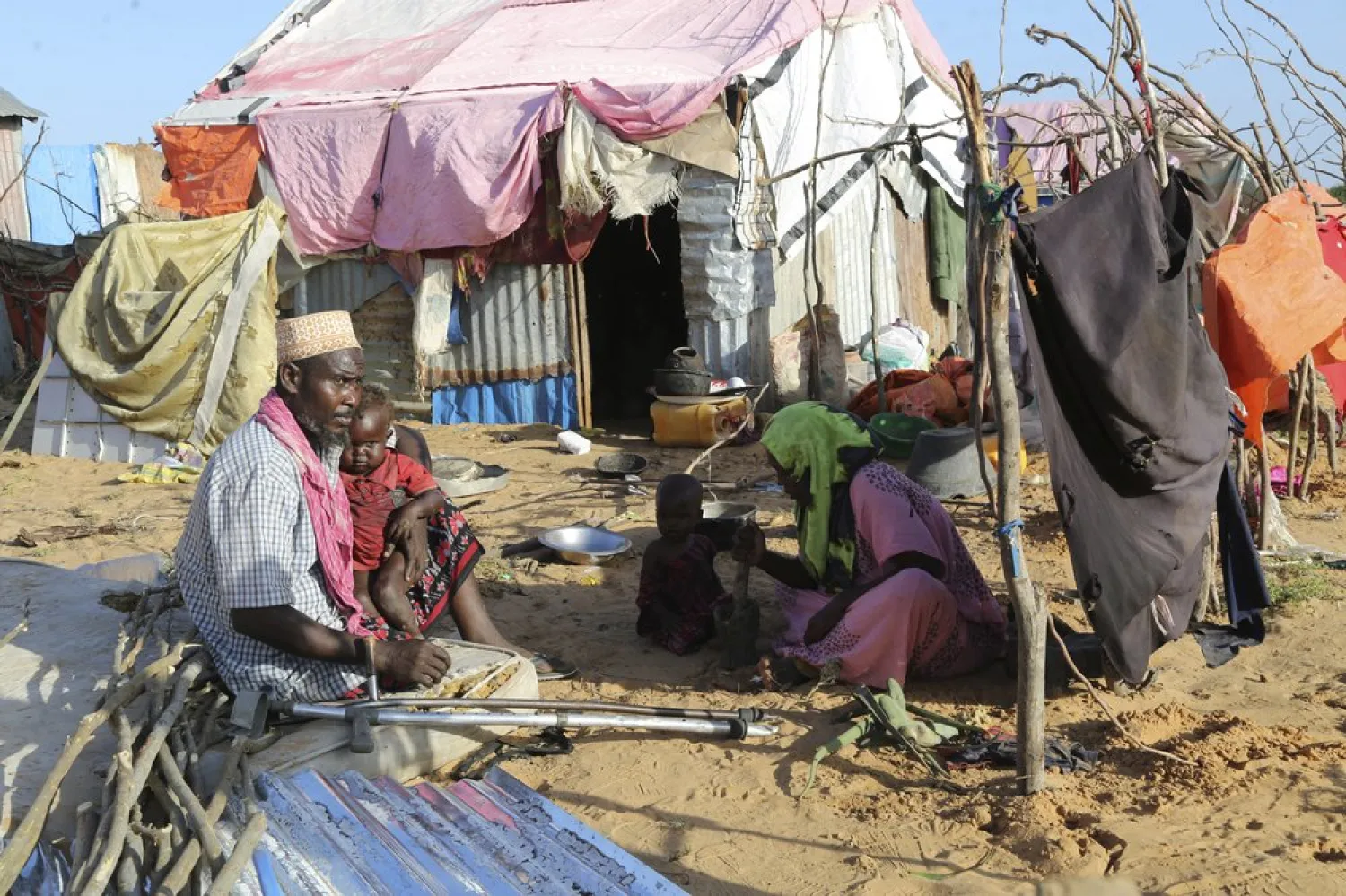
Hassan Mohamed Yusuf, 45 year old father, sits with his family at their make shift shelter at the Dayniile camp, in Mogadishu, Somalia on Thursday Dec. 17, 2020. . (AP Photo/Farah Abdi Warsameh)
TT

In Somalia, COVID-19 Vaccines Are Distant as Virus Spreads

Hassan Mohamed Yusuf, 45 year old father, sits with his family at their make shift shelter at the Dayniile camp, in Mogadishu, Somalia on Thursday Dec. 17, 2020. . (AP Photo/Farah Abdi Warsameh)

As richer countries race to distribute COVID-19 vaccines, Somalia remains the rare place where much of the population hasn't taken the coronavirus seriously. Some fear that’s proven to be deadlier than anyone knows.

“Certainly our people don’t use any form of protective measures, neither masks nor social distancing,” Abdirizak Yusuf Hirabeh, the government’s COVID-19 incident manager, said in an interview.

“If you move around the city (of Mogadishu) or countrywide, nobody even talks about it.” And yet infections are rising, he said.

It is places like Somalia, the Horn of Africa nation torn apart by three decades of conflict, that will be last to see COVID-19 vaccines in any significant quantity. With part of the country still held by the al-Qaeda-linked al-Shabab extremist group, the risk of the virus becoming endemic in some hard-to-reach areas is strong — a fear for parts of Africa amid the slow arrival of vaccines.

“There is no real or practical investigation into the matter,” said Hirabeh, who is also the director of the Martini hospital in Mogadishu, the largest treating COVID-19 patients, which saw seven new patients the day he spoke. He acknowledged that neither facilities nor equipment are adequate in Somalia to tackle the virus, The Associated Press reported.

Fewer than 27,000 tests for the virus have been conducted in Somalia, a country of more than 15 million people, one of the lowest rates in the world. Fewer than 4,800 cases have been confirmed, including at least 130 deaths.

Some worry the virus will sink into the population as yet another poorly diagnosed but deadly fever.

For 45-year-old street beggar Hassan Mohamed Yusuf, that fear has turned into near-certainty. “In the beginning we saw this virus as just another form of the flu,” he said.

Then three of his young children died after having a cough and high fever. As residents of a makeshift camp for people displaced by conflict or drought, they had no access to coronavirus testing or proper care.

At the same time, Yusuf said, the virus hurt his efforts to find money to treat his family as “we can’t get close enough” to people to beg.

Early in the pandemic, Somalia’s government did attempt some measures to limit the spread of the virus, closing all schools and shutting down all domestic and international flights. Mobile phones rang with messages about the virus.

But social distancing has long disappeared in the country’s streets, markets or restaurants. On Thursday, some 30,000 people crammed into a stadium in Mogadishu for a regional football match with no face masks or other anti-virus measures in sight.

The next challenge in Somalia is not simply obtaining COVID-19 vaccines but also persuading the population to accept them.

That will take time, “just the same as what it took for our people to believe in the polio or measles vaccines,” a concerned Bilaal said.

Hirabeh, in charge of Somalia’s virus response, agreed that “our people have little confidence in the vaccines,” saying that many Somalis hate the needles. He called for serious awareness campaigns to change minds.

The logistics of any COVID-19 vaccine rollout are another major concern. Hirabeh said Somalia is expecting the first vaccines in the first quarter of 2021, but he worries that the country has no way to handle a vaccine like the Pfizer one that requires being kept at a temperature of minus 70 degrees Celsius.

“One that could be kept between minus 10 and minus 20 might suit the Third World like our country,” he said.



Trump Seeks $152 Mn to Revive Alcatraz as Federal Prison

FILE PHOTO: A view of Alcatraz prison complex located on Alcatraz Island in San Francisco Bay near San Francisco, California, US July 17, 2025. REUTERS/Carlos Barria/File Photo
TT

Trump Seeks $152 Mn to Revive Alcatraz as Federal Prison

FILE PHOTO: A view of Alcatraz prison complex located on Alcatraz Island in San Francisco Bay near San Francisco, California, US July 17, 2025. REUTERS/Carlos Barria/File Photo

US President Donald Trump asked Congress on Friday for $152 million to begin rebuilding the notorious Alcatraz prison, pressing ahead with his vision to return the former island lockup to active use.

The funding request, included in the White House's proposed 2027 budget, would cover the first year of converting the San Francisco Bay site into what officials describe as a "state-of-the-art secure prison facility."

Trump has pushed for reopening Alcatraz since last year, portraying it as a symbol of a tougher approach to crime, said AFP.

In a social media post at the time, he called for a "substantially enlarged and rebuilt" facility to house the country's most dangerous offenders.

The proposal comes as part of a broader Justice Department budget that emphasizes prison investment and law enforcement, though such requests are ultimately subject to approval by Congress.

Political news outlet Axios, citing administration officials, reported that any "supermax" prison complex at the site would have to be built from scratch -- putting the total cost at somewhere around $2 billion.

Alcatraz, which opened as a federal penitentiary in 1934, was once considered among the most secure prisons in the United States due to its isolated island location and the strong currents surrounding it.

It held a relatively small number of prisoners, including high-profile inmates such as Al Capone.

The island fortress entered American cultural lore after a 1962 escape by three inmates, which became an inspiration for the film "Escape from Alcatraz" starring Clint Eastwood.

It was closed in 1963 after officials determined it was too costly to maintain.

According to the Federal Bureau of Prisons, operating expenses were nearly three times higher than at other federal facilities, largely because all supplies -- including fresh water -- had to be transported to the island.

Since the early 1970s, Alcatraz has been managed by the National Park Service as part of the Golden Gate National Recreation Area and has become one of San Francisco's most popular tourist attractions, drawing more than a million visitors annually.

The White House argues that rebuilding the site would help modernize the federal prison system and expand capacity for high-risk inmates.

But critics have questioned both the practicality and cost of the plan, noting that the island's infrastructure would likely require extensive reconstruction.

Feasibility studies have already been conducted by federal agencies to assess whether a modern correctional facility could be established on the site, though no final decision has been made.

Any move to proceed could face political resistance given competing budget priorities and the site's current status as a major tourism and historical landmark.


French, Japanese Ships Cross Strait of Hormuz in First Since War

A cargo ship in the Gulf, near the Strait of Hormuz, as seen from northern Ras al-Khaimah, near the border with Oman’s Musandam governance, amid the US-Israeli conflict with Iran, in United Arab Emirates, March 11, 2026. (Reuters)
TT

French, Japanese Ships Cross Strait of Hormuz in First Since War

A cargo ship in the Gulf, near the Strait of Hormuz, as seen from northern Ras al-Khaimah, near the border with Oman’s Musandam governance, amid the US-Israeli conflict with Iran, in United Arab Emirates, March 11, 2026. (Reuters)

One French- and another Japanese-owned vessel are among a handful of vessels to have crossed the war-torn Strait of Hormuz, maritime tracking data showed Friday.

The passage, a vital maritime route for oil and liquified natural gas, has been virtually blocked by Iran since the start of the war, said AFP.

But both ships made the crossing on Thursday, according to ship tracking company Marine Traffic's website.

The Maltese-flagged Kribi belonging to the French maritime transport group CMA CGM crossed the waterway to leave the Gulf on Thursday afternoon, Marine Traffic's data showed.

By early Friday, it was off Muscat, Oman, still broadcasting the message "owner France" on its transponder system in the field usually used to give the destination.

The vessel's navigation data showed it had crossed via an Iranian-approved route through its waters, dubbed the "Tehran Toll Booth" by leading shipping journal Lloyd's List.

- Southern route -

In addition, three tankers -- including one co-owned by a Japanese company -- crossed the Strait of Hormuz on Thursday by taking an alternative, southern route.

They hugged close to the shore of Oman's Musandam Peninsula -- a first in nearly three weeks according to Lloyd's List.

Before the war, which started more than a month ago, about a fifth of global oil and liquefied natural gas (LNG) passed through the Strait.

All three ships signaled they were an "OMANI SHIP" in the message broadcast by their transponder as they crossed the strait.

The Sohar LNG, which was empty when crossing, is co-owned by Japanese shipping company Mitsui O.S.K.

That makes it the first Japanese vessel to exit the Gulf since the start of the war, according to a company statement quoted by Japanese media.

The Hong-Kong flagged New Vision, which crossed the strait on March 1 right after the war started, is expected in the French port of Le Havre on Saturday evening.

Since the conflict started however, that has dwindled to a trickle as Iran selectively attacks ships and energy facilities throughout the Gulf in retaliation for US and Israeli attacks.

A few commercial ships crossing the Strait of Hormuz recently have passed through the Iranian-approved route in the north of the waterway.

- Down to a trickle -

Just 221 commodities vessels have crossed the Strait of Hormuz since March 1, some more than once, according to Kpler data up to Friday morning.

In peacetime, the same waterway handles around 120 daily transits, according to Lloyd's List.

Of the vessels that made the crossing, 60 percent either came from Iran or were heading there.

It was not clear from the data how many had been cleared to make the crossing by Tehran.

But it did show that, among the 118 crossings by ships carrying cargo, 37 had left the Gulf carrying crude oil.

Most of those oil tankers -- 30 of them -- came from Iran or sailed under the Iranian flag. And most ships carrying Iranian oil did not specify their destination on their transponder.

Of those who did, all but one reported they were heading to China.

In the early days of the war, transponder data showed dozens of ships broadcasting messages such as "Chinese crew" or "Chinese owner" in the field usually used for their destination.

This appeared to be an attempt by the ships to avoid being targeted by Iran.


Iran Executes Two Linked to Opposition Group

Executions in Iran have surged in recent years - AFP
TT

Iran Executes Two Linked to Opposition Group

Executions in Iran have surged in recent years - AFP

Iran on Saturday executed two men it said were convicted of links to an opposition group, the People's Mojahedin Organization of ‌Iran, and ‌of carrying out armed ‌attacks, ⁠domestic media reported.

The ⁠executions were the latest in recent days of individuals with PMOI links.

The PMOI confirmed ⁠Saturday's executions, saying ‌in ‌a statement that Iran was "trying ‌to hide its ‌weakness by executing political prisoners, especially PMOI members and supporters." Four PMOI ‌members were executed earlier this week, ⁠it ⁠said.

The group said the two men executed on Saturday were arrested in January 2024 and had their death sentences upheld in December 2025.