Amid Unpaid Wages, Yemenis Are Enraged with Houthis for Exorbitant Spending on Soleimani Rally

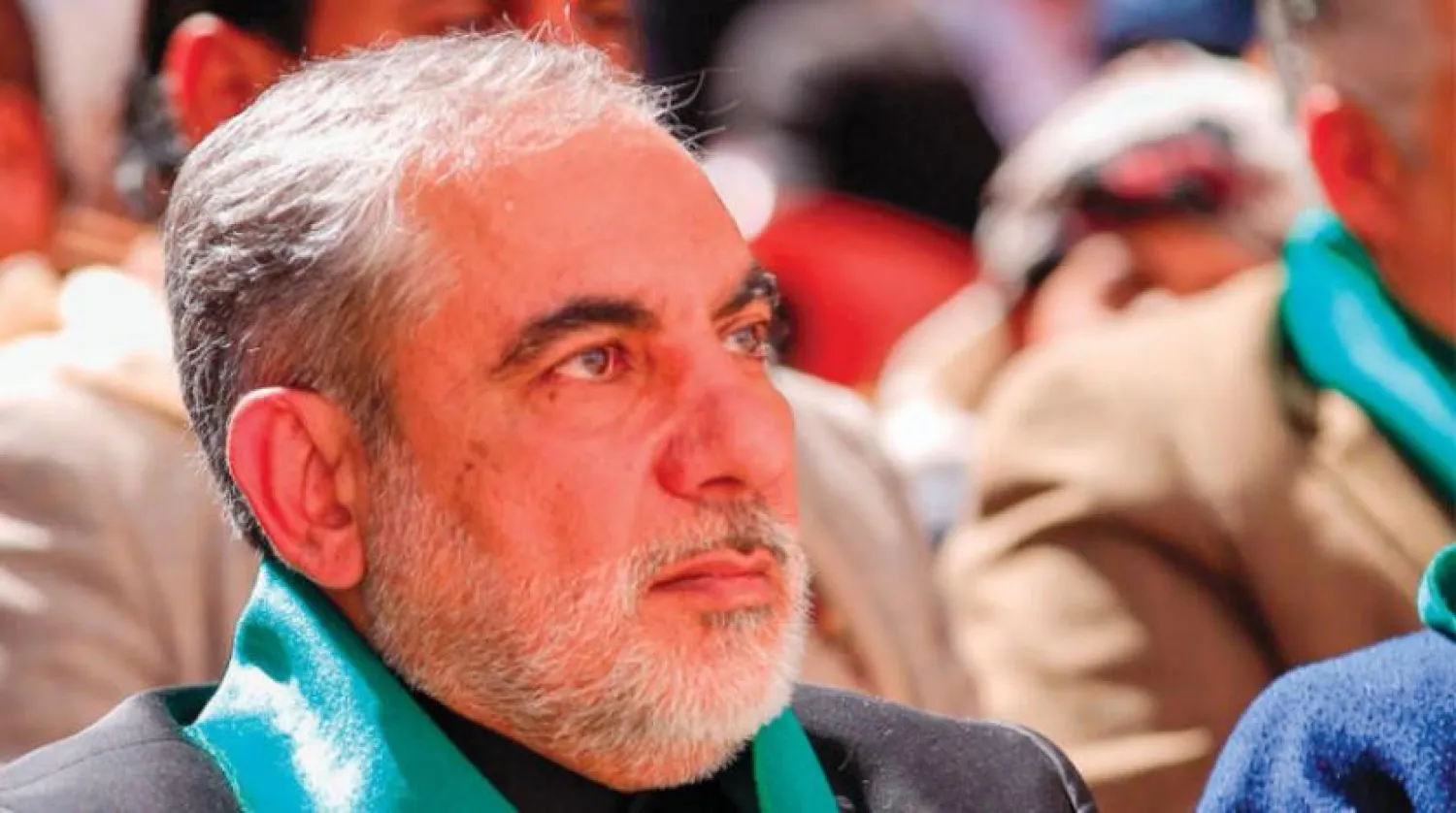
Iran’s so-called ambassador to Sanaa Hassan Eyrlou attending a Houthi rally. (AFP)
TT

Amid Unpaid Wages, Yemenis Are Enraged with Houthis for Exorbitant Spending on Soleimani Rally

Iran’s so-called ambassador to Sanaa Hassan Eyrlou attending a Houthi rally. (AFP)

Yemeni people and officials were incensed with the Houthi militias’ spending of money and resources to hold ceremonies marking the anniversary of the assassination of Iranian General Qassem Soleimani.

The Houthis’ celebrating the memory of Soleimani, who commanded Iran’s Quds Force, with elaborate gatherings and excessive printing of memorial banners comes at a time the salaries of public workers are frozen in areas run by Iran-backed militias.

The streets of the Houthi-run capital, Sanaa, were flooded with posters of Soleimani and Popular Mobilization Forces deputy chief Abu Mahdi al-Muhandis, who was killed in the same US drone strike as Iranian general in January 2020.

Hundreds of Houthi officials and members, joined by the Iranian “ambassador” to Sanaa Hassan Eyrlou, gathered in one of the capital’s largest mosque squares to remember Soleimani.

Yemeni activists blasted the ceremonies, strongly arguing that paying the salaries of civil servants is far more important than Soleimani and Eyrlou.

In an effort to assert Houthi loyalty to the regime in Iran, Eyrlou praised the Yemeni militias’ terror attacks against Yemenis and neighboring countries, and hailed the ties between Tehran and the militants.

“This ceremony today shows the deep ties between the two governments and people of Yemen and Iran,” he said.

Eyrlou encouraged Houthis to commit more terrorist acts, claiming that it would make the militias “more influential at the level of geopolitics in the region,” and transform it into a “major regional power.”

Yemen’s Information Minister Mammar al-Eryani slammed the Houthis for celebrating the memory of a terrorist whose hands are stained with the blood of innocents across the region.

“The terrorist Houthi militia is spending hundreds of millions to celebrate symbols of Iranian terrorism, whose hands are stained with the blood of innocents in Iraq, Syria, Lebanon and Yemen, at a time when millions of citizens in Houthi-run areas are starving,” he said.


Russian Strikes Injure Six in Ukraine as Fuel Crisis Deepens into Siberia

In this photo provided by the Ukrainian Emergency Service, emergency services personnel work to extinguish a fire following a Russian air attack in in Zaporizhzhia region, Ukraine, Monday, June 22, 2026. (Ukrainian Emergency Service via AP)
TT

Russian Strikes Injure Six in Ukraine as Fuel Crisis Deepens into Siberia

In this photo provided by the Ukrainian Emergency Service, emergency services personnel work to extinguish a fire following a Russian air attack in in Zaporizhzhia region, Ukraine, Monday, June 22, 2026. (Ukrainian Emergency Service via AP)

Six people were wounded in Russian air strikes on Ukraine overnight on Tuesday, local authorities said, while Russia's ongoing fuel crisis deepened into parts of Siberia.

The strikes came in the wake of a Ukrainian attack on a plant producing electronics for missiles in Russia's border Voronezh region on Monday that killed five people and injured dozens, according to the local governor.

Russia and Ukraine have continued to exchange strikes as the war has dragged into a fifth year. Meanwhile, Ukrainian President Volodymyr Zelenskiy has sought support from Western allies for a peace deal while also pushing for ‌fast-track admission to ‌the European Union.

Two people sought medical help after Russian forces struck the southeastern ‌region ⁠of Zaporizhzhia, Governor ⁠Ivan Fedorov said on Telegram, and three more people were wounded in Sumy, in the north, late on Monday, emergency services said.

One woman was injured in a drone attack on Ukraine's second-largest city of Kharkiv, Mayor Ihor Terekhov said on Telegram on Monday evening. Early on Tuesday, Kyiv authorities briefly issued an air raid alert before withdrawing it. Zelenskiy warned last week that Russia was preparing a massive attack — something Moscow has said it would conduct regularly. Russia's full-scale invasion of Ukraine started in February 2022.

Reuters could not independently verify details of the latest strikes.

FUEL ⁠CRISIS DEEPENS FURTHER INTO SIBERIA

Ukrainian attacks on maritime logistics and supply ‌roads have sparked a fuel crisis in Russia and areas of ‌Ukraine it controls. Kyiv's intensified air strikes on Russian energy infrastructure hit targets as far away as Siberia, more than ‌2,000 kilometers (1,243 miles) from the front line, undermining the availability of gasoline and diesel in Russia, ‌the world's third-largest oil producer.

The fuel crisis has spread from Russia-annexed Crimea to areas in the center and east and has also covered Siberian regions of Novosibirsk, home to city of the same name, Russia's third largest, and Omsk close to Kazakhstan's border.

The Omsk region, about 2,500 kilometers southeast of Moscow, is limiting fuel sales and the nearby Novosibirsk ‌region is preparing to do the same, local governors said on Telegram.

The move was "to avoid artificially creating panic buying at gas stations and speculation," ⁠Omsk Governor Vitaly Khotsenko said ⁠in a post on the platform on Monday evening, adding that sales of gasoline would be limited to 40 liters per car and diesel to between 80 and 200 liters, depending on location.

Sales of fuel for use in refueling cans would be banned, he said. The Novosibirsk region was also about to introduce restrictions to "prevent speculative demand," Governor Andrei Travnikov said.

From Tuesday, Lukoil, Russia's second biggest oil producer, was limiting gasoline and diesel sales in Voronezh region, the regional government said on Telegram.

Russia's war on Ukraine has prompted Europe to increase defense spending and partner with Kyiv on possible drone production. The conflict has spurred Sweden and Finland, until recently members of the EU but not NATO, to join the alliance.

Foreign fighter jets escorted Russian strategic missile-carrying bombers during their 16-hour flight — which included air-to-air refueling — in the neutral zone over the Barents Sea and the Norwegian Sea, Russia's defense ministry said on Tuesday.

Russia borders NATO members Norway and Finland. The defense ministry did not provide details on the origin of the foreign jets.


North Korea's Kim Vows to Accelerate Military Buildup

A photo released by the official North Korean Central News Agency (KCNA) shows North Korean leader Kim Jong Un (C) speaking during the Second Plenary Meeting of the Ninth Central Committee of the Workers' Party of Korea (WPK) held from 20-22 June 2026 in Pyongyang, North Korea (issued 23 June 2026). EPA/KCNA
TT

North Korea's Kim Vows to Accelerate Military Buildup

A photo released by the official North Korean Central News Agency (KCNA) shows North Korean leader Kim Jong Un (C) speaking during the Second Plenary Meeting of the Ninth Central Committee of the Workers' Party of Korea (WPK) held from 20-22 June 2026 in Pyongyang, North Korea (issued 23 June 2026). EPA/KCNA

Kim Jong Un vowed to beef up North Korea's defense capabilities, citing military modernization efforts by South Korea and the United States pushing the region "to the brink of a nuclear war", state media reported Tuesday.

Pyongyang is under multiple sets of sanctions over its nuclear program, and the two Koreas remain technically at war because their 1950-53 conflict ended in an armistice rather than a peace treaty, AFP said.

"Comrade Kim Jong Un in his concluding speech reaffirmed the steadfast policy stand of our Party and state to beef up the national defense capabilities faster," the official Korean Central News Agency quoted the leader as saying.

The speech was delivered as Kim presided over a three-day meeting of the Workers' Party of Korea that wrapped up on Monday, during which senior officials reviewed policy initiatives, KCNA said.

It quoted Kim as saying "the US and the ROK are pushing forward with the ROK's possession of a nuclear submarine while getting evermore undisguised in their moves towards the reinforcement and modernization of armed forces in the region", referring to South Korea by the acronym of its official name.

According to KCNA, Kim said such moves were "pushing the situation in the Korean peninsula to the brink of a nuclear war".

In the face of such developments, it was the "steadfast stand" of the North to "further expand and strengthen the powerful and absolutely reliable deterrent for self-defense", Kim said.

- 'Line of no retreat' -

KCNA said the meeting "unanimously recognized that to steadily expand and strengthen the nuclear forces... is the most correct and unique way to actively and confidently cope with the unpredictable international military and political situation".

It added the North's development of a war deterrent "with nuclear technology as a basis" would proceed "at increasing speed".

Pyongyang has repeatedly declared itself an "irreversible" nuclear state since a 2019 summit between Kim and Trump in Hanoi collapsed over the scope of denuclearization and sanctions relief.

Kim's powerful sister, Yo Jong, said this month the North's nuclear policy was a "line of no retreat", reiterating the regime's position that it has no intention of giving up its nuclear arsenal.

South Korean President Lee Jae Myung said last week that US counterpart Donald Trump had told him it was time to "pay attention to the North Korea issue".

He told reporters he had told Trump at a meeting of the G7 in France that sanctions on the North were "ineffective."

"I also said that we can no longer deal with the North Korean nuclear issue in the same way we deal with other countries, and President Trump agreed," Lee added.


US Authorizes Iranian Oil Sales Amid Talks on Final Peace Deal

US Treasury Secretary Scott Bessent attends a bilateral meeting during the G7 Summit in Evian-les-Bains, France, June 17, 2026. (Reuters)
TT

US Authorizes Iranian Oil Sales Amid Talks on Final Peace Deal

US Treasury Secretary Scott Bessent attends a bilateral meeting during the G7 Summit in Evian-les-Bains, France, June 17, 2026. (Reuters)

The United States authorized Iranian oil sales on Monday, easing decades-old sanctions as it pushes toward a final peace deal with Tehran in return for commitments on nuclear inspections and free transit through the Strait of Hormuz.

The general license, announced by the Treasury Department, allows the sale of crude oil and petrochemical and petroleum products of Iranian origin through August 21.

The license says Iranian oil can be imported into the US when necessary to complete ‌its sale, delivery ‌or offloading. The US has not meaningfully imported Iranian ‌oil ⁠since Washington imposed measures ⁠after the 1979 revolution.

"In line with the ongoing productive talks in Switzerland, Iran has committed to free and open transit in the Strait of Hormuz and to permit International Atomic Energy Agency (IAEA) inspectors into their country," Treasury Secretary Scott Bessent wrote on X.

"As part of the framework, Treasury has issued a temporary 60-day general license authorizing the production, delivery and sale of Iranian oil."

Under a memorandum of ⁠understanding signed last week between Washington and Tehran, the US ‌agreed to issue waivers for the export ‌of Iranian crude oil, petroleum products and derivatives, and all associated services, including banking transactions, insurances ‌and transportation.

Payment of funds to Iran may be made in US dollar-denominated ‌funds, according to the license.

Cuba, North Korea and Crimea are among those excluded from the license.

Washington first sanctioned Iran in 1979 when revolutionary students seized the US embassy in Tehran, holding diplomats hostage. Numerous additional sanctions have been imposed since then over the ‌nuclear program and Iran's support for groups the US deems terrorist organizations.

Independent Chinese refiners have been the main buyers ⁠of sanctioned Iranian ⁠oil, taking advantage of deep discounts as others avoided such purchases. India, South Korea, Japan, Italy, Greece, Taiwan and Türkiye were also major buyers of Iranian crude before US sanctions were reimposed in 2018.

Mediators said on Monday that Washington and Tehran made "encouraging progress" at the first round of talks aimed at reaching a final peace deal. The talks began under the terms of the memorandum of understanding reached last week to extend a tenuous ceasefire from April for at least another 60 days.

Oil prices had risen sharply when Tehran started blockading the Strait of Hormuz, prompting a US blockade of Iranian ports, but after the interim deal, fell to their lowest since before the war began on February 28 with US-Israeli attacks on Iran.