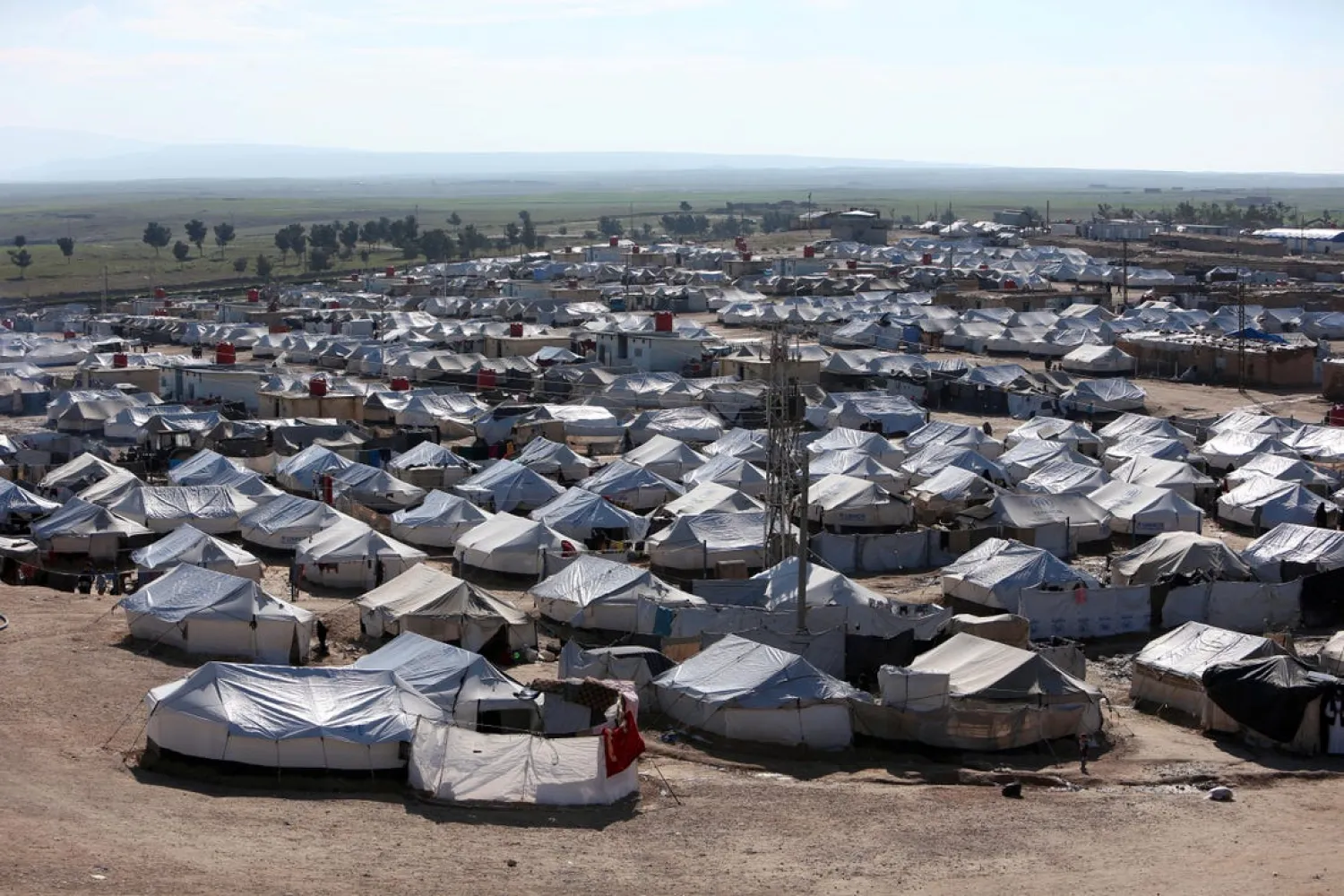
Representatives of Sudan, Somalia and Indonesia have received another group of their nationals from the Roj camp in Syria’s northeastern Hasakah province, the country’s last remaining camp housing families of ISIS fighters.
The handover took place three days ago during a visit by the foreign representatives, accompanied by Syrian government officials and members of the Internal Security Forces, according to a local activist.
The repeated visits by government security delegations suggest that Damascus is preparing to take over administration of the facility from the dissolved Kurdish Syrian Democratic Forces (SDF), the activist said.
Ibrahim al-Halabi, a resident of Hasakah, told Asharq Al-Awsat that the delegation met women living at the site who described their circumstances.
Located in the far northeast of Hasakah province, Roj houses around 2,200 women and children in 750 tents. Its residents hold various foreign and Arab nationalities, including Turkish, Russian, British, French, German, Australian, Indonesian, Sudanese, Somali and Tunisian citizenship. It became Syria’s last remaining camp for families of ISIS fighters following the closure of al-Hol, also in the Hasakah countryside.
Several groups of Sudanese, Somali and Indonesian nationals have already been repatriated since 2022.
According to Halabi, the latest handover included 12 Indonesian women and their children, 30 Somali women and between three and nine Sudanese women.
Dual citizenship complicates repatriation
Halabi explained that Sudanese and Somali nationals repatriated in previous operations held only one nationality. Others, however, have dual citizenship, including Sudanese-British and Somali-British nationals, complicating efforts to arrange their return.
Some women have refused to be handed over to Sudanese authorities, demanding instead that they be transferred to the British government. As a result, Sudanese and Somali women holding dual nationality have yet to be repatriated, Halabi noted.
He added that Syrian government Internal Security Forces had entered Roj several times recently, during which residents from Australia, Sudan, Somalia, Indonesia and Trinidad and Tobago were transferred out.
The latest visit brought considerable relief to residents.
Halabi also viewed the visits as a sign that Damascus would assume responsibility for managing the facility. However, he expected security arrangements to remain under the supervision of former SDF personnel integrated into the government’s Internal Security Forces under the January 2026 agreement between Damascus and the Kurdish-led force.
Roj's future
In February, the Syrian government took control of al-Hol, previously the country’s largest detention camp for families of ISIS fighters, after wresting it from the SDF, which had administered both facilities.
Al-Hol, described as the world’s most dangerous camp, had housed tens of thousands of families of various nationalities.
Following its takeover, Damascus began evacuating foreign residents and transferring them to another camp in the northern Aleppo province.
With al-Hol closed, Roj emerged as the most prominent remaining facility housing women and widows of ISIS members from different countries.
However, activists in northern Syria say it remains unclear when the camp will close or where its residents will be transferred afterward.