


'Extreme Urgent Need': Starvation Haunts Ethiopia's Tigray

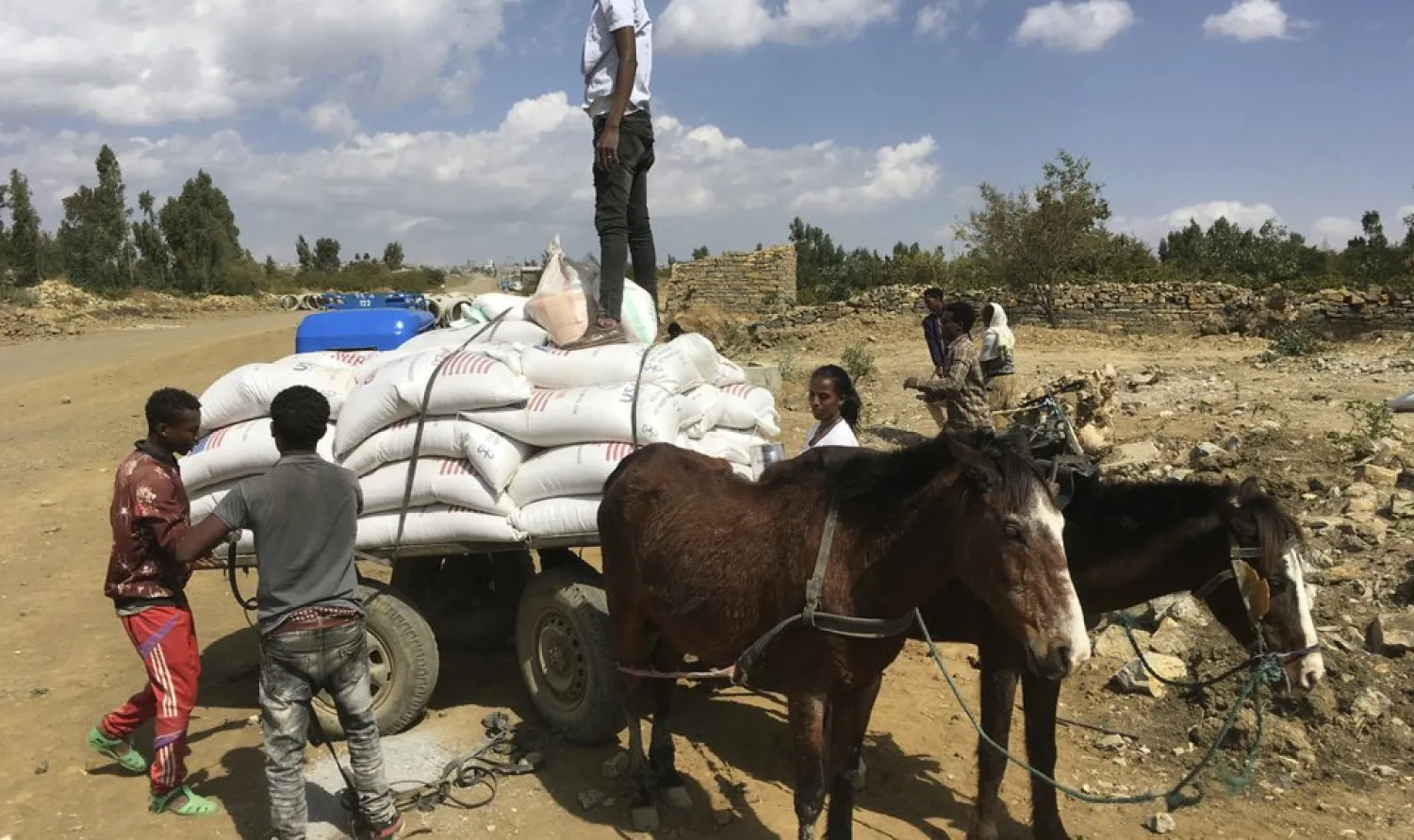
In this Tuesday Jan. 12, 2021 photo provided by the Catholic Relief Services, people affected by the conflict in Tigray load food aid provided by USAID and Catholic Relief Services onto a donkey cart to be transported to their home, outside Mekele, Ethiopia. (Catholic Relief Services via AP)
TT

'Extreme Urgent Need': Starvation Haunts Ethiopia's Tigray

In this Tuesday Jan. 12, 2021 photo provided by the Catholic Relief Services, people affected by the conflict in Tigray load food aid provided by USAID and Catholic Relief Services onto a donkey cart to be transported to their home, outside Mekele, Ethiopia. (Catholic Relief Services via AP)

From "emaciated" refugees to crops burned on the brink of harvest, starvation threatens the survivors of more than two months of fighting in Ethiopia´s Tigray region.

The first humanitarian workers to arrive after pleading with the Ethiopian government for access describe weakened children dying from diarrhea after drinking from rivers. Shops were looted or depleted weeks ago. A local official told a Jan. 1 crisis meeting of government and aid workers that hungry people had asked for "a single biscuit."

More than 4.5 million people, nearly the region's entire population, need emergency food, participants say. At their next meeting on Jan. 8, a Tigray administrator warned that without aid, "hundreds of thousands might starve to death" and some already had, according to minutes obtained by The Associated Press.

"There is an extreme urgent need - I don´t know what more words in English to use - to rapidly scale up the humanitarian response because the population is dying every day as we speak," Mari Carmen Vinoles, head of the emergency unit for Doctors Without Borders, told the AP.

But pockets of fighting, resistance from some officials, and sheer destruction stand in the way of a massive food delivery effort. To send 15-kilogram (33-pound) rations to 4.5 million people would require more than 2,000 trucks, the meeting's minutes said, while some local responders are reduced to getting around on foot.

The specter of hunger is sensitive in Ethiopia, which transformed into one of the world's fastest-growing economies in the decades since images of starvation there in the 1980s led to a global outcry. Drought, conflict, and government denial contributed to the famine, which swept through Tigray and killed an estimated 1 million people.

The largely agricultural Tigray region of about 5 million people already had a food security problem amid a locust outbreak when Prime Minister Abiy Ahmed on Nov. 4 announced fighting between his forces and those of the defiant regional government. Tigray leaders dominated Ethiopia for almost three decades but were sidelined after Abiy introduced reforms that won him the Nobel Peace Prize in 2019.

Thousands of people have been killed in the conflict. More than 50,000 have fled into Sudan, where one doctor has said newer arrivals show signs of starvation. Others shelter in rugged terrain. A woman who recently left Tigray described sleeping in caves with people who brought cattle, goats, and the grain they had managed to harvest.

"It is a daily reality to hear people dying with the fighting consequences, lack of food," a letter by the Catholic bishop of Adigrat said this month.

Hospitals and other health centers, crucial in treating malnutrition, have been destroyed. In markets, food is "not available or extremely limited," the United Nations says.

Though Ethiopia's prime minister declared victory in late November, its military and allied fighters remain active amid the presence of troops from neighboring Eritrea, a bitter enemy of the now-fugitive officials who once led the region.

Fear keeps many people from venturing out. Others flee. Tigray´s new officials say more than 2 million people have been displaced, a number the US government´s Bureau for Humanitarian Assistance calls "staggering." The UN says the number of people reached with aid is "extremely low."

A senior Ethiopian government official, Redwan Hussein, did not respond to a request for comment on Tigray colleagues warning of starvation.

In the northern Shire area near Eritrea, which has seen some of the worst fighting, up to 10% of the children whose arms were measured met the diagnostic criteria for severe acute malnutrition, with scores of children affected, a UN source said. Sharing the concern of many humanitarian workers about jeopardizing access, the source spoke on condition of anonymity.

Near Shire town are camps housing nearly 100,000 refugees who have fled over the years from Eritrea. Some who have walked into town "are emaciated, begging for aid that is not available," UN High Commissioner for Refugees Filippo Grandi said Thursday.

Food has been a target. Analyzing satellite imagery of the Shire area, a UK-based research group found two warehouse-style structures in the UN World Food Program compound at one refugee camp had been "very specifically destroyed." The DX Open Network could not tell by whom. It reported a new attack Saturday.

It's challenging to verify events in Tigray as communications links remain poor and almost no journalists are allowed.

In the towns of Adigrat, Adwa, and Axum, "the level of civilian casualties is extremely high in the places we have been able to access," the Doctors Without Borders emergency official Vinoles said. She cited the fighting and lack of health care.

Hunger is "very concerning," she said, and even water is scarce: Just two of 21 wells still work in Adigrat, a city of more than 140,000, forcing many people to drink from the river. With sanitation suffering, disease follows.

"You go 10 kilometers (6 miles) from the city and it´s a complete disaster," with no food, Vinoles said.

Humanitarian workers struggle to gauge the extent of need.

"Not being able to travel off main highways, it always poses the question of what´s happening with people still off-limits," said Panos Navrozidis, Action Against Hunger´s director in Ethiopia.

Before the conflict, Ethiopia´s national disaster management body classified some Tigray woredas, or administrative areas, as priority one hotspots for food insecurity. If some already had high malnutrition numbers, "two-and-a-half months into the crisis, it´s a safe assumption that thousands of children and mothers are in immediate need," Navrozidis said.

The Famine Early Warning Systems Network, funded and managed by the US, says parts of central and eastern Tigray are likely in Emergency Phase 4, a step below famine.

The next few months are critical, John Shumlansky, the Catholic Relief Services representative in Ethiopia, said. His group so far has given up to 70,000 people in Tigray a three-month food supply, he said.

Asked whether combatants use hunger as a weapon, one concern among aid workers, Shumlansky dismissed it by Ethiopian defense forces and police. With others, he didn´t know.

"I don´t think they have food either, though," he said.


US Judge Blocks Deportation of Columbia University Palestinian Activist

Mohsen Mahdawi at a press conference in Vermont last year - Photo by Alex Driehaus/AP
TT

US Judge Blocks Deportation of Columbia University Palestinian Activist

Mohsen Mahdawi at a press conference in Vermont last year - Photo by Alex Driehaus/AP

A US immigration judge has blocked the deportation of a Palestinian graduate student who helped organize protests at Columbia University against Israel's war in Gaza, according to US media reports.

Mohsen Mahdawi was arrested by immigration agents last year as he was attending an interview to become a US citizen.

Mahdawi had been involved in a wave of demonstrations that gripped several major US university campuses since Israel began a massive military campaign in the Gaza Strip.

A Palestinian born in the occupied West Bank, Mahdawi has been a legal US permanent resident since 2015 and graduated from the prestigious New York university in May. He has been free from federal custody since April.

In an order made public on Tuesday, Judge Nina Froes said that President Donald Trump's administration did not provide sufficient evidence that Mahdawi could be legally removed from the United States, multiple media outlets reported.

Froes reportedly questioned the authenticity of a copy of a document purportedly signed by Secretary of State Marco Rubio that said Mahdawi's activism "could undermine the Middle East peace process by reinforcing antisemitic sentiment," according to the New York Times.

Rubio has argued that federal law grants him the authority to summarily revoke visas and deport migrants who pose threats to US foreign policy.

The Trump administration can still appeal the decision, which marked a setback in the Republican president's efforts to crack down on pro-Palestinian campus activists.

The administration has also attempted to deport Mahmoud Khalil, another student activist who co-founded a Palestinian student group at Columbia, alongside Mahdawi.

"I am grateful to the court for honoring the rule of law and holding the line against the government's attempts to trample on due process," Mahdawi said in a statement released by his attorneys and published Tuesday by several media outlets.

"This decision is an important step towards upholding what fear tried to destroy: the right to speak for peace and justice."


Fire Breaks out Near Iran's Capital Tehran, State Media Says

Smoke rises from a fire caused by an explosion in Tehran (File photo - Reuters)
TT

Fire Breaks out Near Iran's Capital Tehran, State Media Says

Smoke rises from a fire caused by an explosion in Tehran (File photo - Reuters)

A fire broke out in Iran's Parand near the capital city Tehran, state media reported on Wednesday, publishing videos of smoke rising over the area which is close to several military and strategic sites in the country's Tehran province, Reuters reported.

"The black smoke seen near the city of Parand is the result of a fire in the reeds around the Parand river bank... fire fighters are on site and the fire extinguishing operation is underway", state media cited the Parand fire department as saying.


Pakistan PM Sharif to Seek Clarity on Troops for Gaza in US Visit

US President Donald Trump looks at Pakistan's Prime Minister Shehbaz Sharif speaking following the official signing of the first phase of the Gaza ceasefire agreement between Israel and Hamas, during a world leaders' summit on ending the Gaza war, in Sharm El-Sheikh, Egypt, October 13, 2025. REUTERS/Evelyn Hockstein/File Photo
TT

Pakistan PM Sharif to Seek Clarity on Troops for Gaza in US Visit

US President Donald Trump looks at Pakistan's Prime Minister Shehbaz Sharif speaking following the official signing of the first phase of the Gaza ceasefire agreement between Israel and Hamas, during a world leaders' summit on ending the Gaza war, in Sharm El-Sheikh, Egypt, October 13, 2025. REUTERS/Evelyn Hockstein/File Photo

Before Pakistan commits to sending troops to Gaza as part of the International Stabilization Force it wants assurances from the United States that it will be a peacekeeping mission rather than tasked with disarming Hamas, three sources told Reuters.

Pakistan's Prime Minister Shehbaz Sharif is set to attend the first formal meeting of President Donald Trump's Board of Peace in Washington on Thursday, alongside delegations from at least 20 countries.

Trump, who will chair the meeting, is expected to announce a multi-billion dollar reconstruction plan for Gaza and detail plans for a UN-authorized stabilization force for the Palestinian enclave.

Three government sources said during the Washington visit Sharif wanted to better understand the goal of the ISF, what authority they were operating under and what the chain of command was before making a decision on deploying troops.

"We are ready to send troops. Let me make it clear that our troops could only be part of a peace mission in Gaza," said one of the sources, a close aide of Sharif.

"We will not be part of any other role, such as disarming Hamas. It is out of the question," he said.

Analysts say Pakistan would be an asset to the multinational force, with its experienced military that has gone to war with arch-rival India and tackled insurgencies.

"We can send initially a couple of thousand troops anytime, but we need to know what role they are going to play," the source added.

Two of the sources said it was likely Sharif, who has met Trump earlier this year in Davos and late last year at the White House, would either have an audience with him on the sidelines of the meeting or the following day at the White House.

Initially designed to cement Gaza's ceasefire, Trump sees the Board of Peace, launched in late January, taking a wider role in resolving global conflicts. Some countries have reacted cautiously, fearing it could become a rival to the United Nations.

While Pakistan has supported the establishment of the board, it has voiced concerns against the mission to demilitarize Gaza's militant group Hamas.
