


Nepali Climbers Return Home on Top of the World After K2 Triumph

Nepali mountaineer Mingma Gyalje Sherpa said future generations could "be proud" of his country's climbers after this month's historic K2 ascent | AFP
TT

Nepali Climbers Return Home on Top of the World After K2 Triumph

Nepali mountaineer Mingma Gyalje Sherpa said future generations could "be proud" of his country's climbers after this month's historic K2 ascent | AFP

Nepali mountaineers who conquered one of the world's most treacherous peaks returned home to a rapturous welcome Tuesday, with cheering supporters hailing their first-ever winter summit of K2 as a triumph for their Himalayan nation.

Their ascent in mid-January of the world's second-highest mountain -- the notoriously challenging 8,611-metre (28,251-feet) "savage mountain" of Pakistan -- shone a much-deserved spotlight on their own climbing prowess.

A band played patriotic songs as the team arrived in Kathmandu, while well-wishers held out flowers and waved national flags.

"This is not just our success -- it is for all Nepalis, so that our future generations can look back and be proud about achievements of Nepali climbers," one of the 10 summiteers, Mingma Gyalje Sherpa, told AFP.

Kami Rita Sherpa, who has climbed Everest a record 24 times, said the recognition was long overdue.

"The Western climbers did not set the records without the help of Sherpas," he told AFP in Kathmandu.

"All the routes are set by us, the food is cooked by us, their loads are carried by our brothers -- they haven't done it alone."

To reflect their immense pride in making the achievement in their country's name, the team sang the Nepali anthem, with their distinctive national flag fluttering in one of their hands, as they neared K2's savage summit.

- Invisible climbers -

Since the first British teams set their sights on summiting Everest in the 1920s, Nepali climbers -- mostly from the Sherpa ethnic group -- have been by their side.

But they did not aspire to reach for the heavens -- among Nepal's poorest communities, they risked life and limb to help foreign climbers achieve their life-long ambitions because they needed to feed their families.

Ang Tharkay, who was part of the successful 1950 French expedition to Annapurna -- the first recorded ascent of a peak above 8,000 meters -- refused to be part of the summit team.

For him, being part of the record books was less important than running the risk of losing his fingers and toes to frostbite, which would jeopardize his livelihood.

The industry has since grown into a lucrative sector, attracting hundreds of foreign climbers each year and bringing in millions of dollars in revenue for the government.

An experienced guide can make up to US$10,000 -- many times the country's average annual income -- for several months of hazardous work.

The risks remain high despite the commercialization of the sector, with Nepalis hired by foreign climbers making up a quarter of deaths on Himalayan mountains, according to the authoritative Himalayan Database.

In 2014, an avalanche killed 16 Nepalis who were hauling gear up Everest, triggering an unprecedented shutdown of the season and demands for better compensation and benefits.

- Taking control -

The exploits of the K2 team, which included Nirmal Purja, who last year smashed the speed record for summiting the world's 14 highest peaks, reflect the changing approach of modern-day Nepali climbers.

In 1953, Tenzing Norgay Sherpa achieved international recognition when he completed the first summit of Everest with New Zealand mountaineer Edmund Hillary.

But in the following decades, only four other Nepalis have claimed first summits of the 14 peaks above 8,000 meters, compared to nearly 70 mostly European mountaineers.

In recent years, however, climbers like Purja have set record after record, and are hopeful their feats will inspire the next generation of Nepali mountaineers.

Meanwhile, local expedition groups -- instead of playing second fiddle to foreign climbing agencies -- now bring the bulk of paying clients into Nepal.

Italy's legendary Reinhold Messner has seen the transformation first-hand.

"When I heard the K2 news I thought 'finally!'," Messner told AFP, recalling that in his first ascent of Everest without supplemental oxygen in 1978, the Sherpas would follow him as he navigated upwards.

In contrast, today's Sherpas are in front of the climbers, setting routes and guiding them.

"It is an evolution... and this is also important for the future economy of the country."

Alpine journalist Ed Douglas, who has called for better protections for the high-altitude workers, said the climbers deserve credit for "taking control of their own industry".

The K2 winter summit showed that Nepalis "are now mountaineers in their right", added Dawa Steven Sherpa, who runs Asian Trekking, an expedition company.

"There is no question about whether they deserve to have that place on the podium with all the other celebrated mountaineers that have come before us."



Ukraine's Officials to Boycott Paralympics over Russian Flag Decision

Milano Cortina 2026 Winter Olympics - Skeleton - Interview with Ukraine Youth and Sports minister Matvii Bidnyi - N H Hotel, Milan, Italy - February 12, 2026 Ukraine Youth and Sports Minister Matvii Bidnyi speaks after the disqualification of Ukrainian skeleton racer Vladyslav Heraskevych from the Winter Games. REUTERS/Kevin Coombs
TT

Ukraine's Officials to Boycott Paralympics over Russian Flag Decision

Milano Cortina 2026 Winter Olympics - Skeleton - Interview with Ukraine Youth and Sports minister Matvii Bidnyi - N H Hotel, Milan, Italy - February 12, 2026 Ukraine Youth and Sports Minister Matvii Bidnyi speaks after the disqualification of Ukrainian skeleton racer Vladyslav Heraskevych from the Winter Games. REUTERS/Kevin Coombs

Ukrainian officials will boycott the Paralympic Winter Games, Kyiv said Wednesday, after the International Paralympic Committee allowed Russian athletes to compete under their national flag.

Ukraine also urged other countries to shun next month's Opening Ceremony in Verona on March 6, in part of a growing standoff between Kyiv and international sporting federations four years after Russia invaded.

Six Russians and four Belarusians will be allowed to take part under their own flags at the Milan-Cortina Paralympics rather than as neutral athletes, the Games' governing body confirmed to AFP on Tuesday.

Russia has been mostly banned from international sport since Moscow invaded Ukraine. The IPC's decision triggered fury in Ukraine.

Ukraine's sports minister Matviy Bidny called the decision "outrageous", and accused Russia and Belarus of turning "sport into a tool of war, lies, and contempt."

"Ukrainian public officials will not attend the Paralympic Games. We will not be present at the opening ceremony," he said on social media.

"We will not take part in any other official Paralympic events," he added.

Ukrainian Foreign Minister Andriy Sybiga said he had instructed Kyiv's ambassadors to urge other countries to also shun the opening ceremony.

"Allowing the flags of aggressor states to be raised at the Paralympic Games while Russia's war against Ukraine rages on is wrong -- morally and politically," Sybiga said on social media.

The EU's sports commissioner Glenn Micallef said he would also skip the opening ceremony.

- Kyiv demands apology -

The IPC's decision comes amid already heightened tensions between Ukraine and the International Olympic Committee, overseeing the Winter Olympics currently underway.

The IOC banned Ukrainian skeleton racer Vladyslav Heraskevych for refusing to ditch a helmet depicting victims of the war with Russia.

Ukraine was further angered that the woman chosen to carry the "Ukraine" name card and lead its team out during the Opening Ceremony of the Games was revealed to be Russian.

Media reports called the woman an anti-Kremlin Russian woman living in Milan for years.

"Picking a Russian person to carry the nameplate is despicable," Kyiv's foreign ministry spokesman Georgiy Tykhy said at a briefing in response to a question by AFP.

He called it a "severe violation of the Olympic Charter" and demanded an apology.

And Kyiv also riled earlier this month at FIFA boss Gianni Infantino saying he believed it was time to reinstate Russia in international football.

- 'War, lies and contempt' -

Valeriy Sushkevych, president of the Ukrainian Paralympic Committee told AFP on Tuesday that Kyiv's athletes would not boycott the Paralympics.

Ukraine traditionally performs strongly at the Winter Paralympics, coming second in the medals table four years ago in Beijing.

"If we do not go, it would mean allowing Putin to claim a victory over Ukrainian Paralympians and over Ukraine by excluding us from the Games," said the 71-year-old in an interview.

"That will not happen!"

Russia was awarded two slots in alpine skiing, two in cross-country skiing and two in snowboarding. The four Belarusian slots are all in cross-country skiing.

The International Paralympic Committee (IPC) said earlier those athletes would be "treated like (those from) any other country".

The IPC unexpectedly lifted its suspension on Russian and Belarusian athletes at the organisation's general assembly in September.


'Not Here for Medals', Nakai Says after Leading Japanese Charge at Olympics

Ami Nakai of Japan competes during the women's short program figure skating at the 2026 Winter Olympics, in Milan, Italy, Tuesday, Feb. 17, 2026. (AP Photo/Ashley Landis)
TT

'Not Here for Medals', Nakai Says after Leading Japanese Charge at Olympics

Ami Nakai of Japan competes during the women's short program figure skating at the 2026 Winter Olympics, in Milan, Italy, Tuesday, Feb. 17, 2026. (AP Photo/Ashley Landis)

Ami Nakai entered her first Olympics insisting she was not here for medals — but after the short program at the Milano Cortina Games, the 17-year-old figure skater found herself at the top, ahead of national icon Kaori Sakamoto and rising star Mone Chiba.

Japan finished first, second, and fourth on Tuesday, cementing a formidable presence heading into the free skate on Thursday. American Alysa Liu finished third.

Nakai's clean, confident skate was anchored by a soaring triple Axel. She approached the moment with an ease unusual for an Olympic debut.

"I'm not here at this Olympics with the goal of achieving a high result, I'm really looking forward to enjoying this Olympics as much as I can, till the very last moment," she said.

"Since this is my first Olympics, I had nothing to lose, and that mindset definitely translated into my results," she said.

Her carefree confidence has unexpectedly put her in medal contention, though she cannot imagine herself surpassing Sakamoto, the three-time world champion who is skating the final chapter of her competitive career. Nakai scored 78.71 points in the short program, ahead of Sakamoto's 77.23.

"There's no way I stand a chance against Kaori right now," Nakai said. "I'm just enjoying these Olympics and trying my best."

Sakamoto, 25, who has said she will retire after these Games, is chasing the one accolade missing from her resume: Olympic gold.

Having already secured a bronze in Beijing in 2022 and team silvers in both Beijing and Milan, she now aims to cap her career with an individual title.

She delivered a polished short program to "Time to Say Goodbye," earning a standing ovation.

Sakamoto later said she managed her nerves well and felt satisfied, adding that having three Japanese skaters in the top four spots "really proves that Japan is getting stronger". She did not feel unnerved about finishing behind Nakai, who also bested her at the Grand Prix de France in October.

"I expected to be surpassed after she landed a triple Axel ... but the most important thing is how much I can concentrate on my own performance, do my best, stay focused for the free skate," she said.

Chiba placed fourth and said she felt energised heading into the free skate, especially after choosing to perform to music from the soundtrack of "Romeo and Juliet" in Italy.

"The rankings are really decided in the free program, so I'll just try to stay calm and focused in the free program and perform my own style without any mistakes," said the 20-year-old, widely regarded as the rising all-rounder whose steady ascent has made her one of Japan's most promising skaters.

All three skaters mentioned how seeing Japanese pair Riku Miura and Ryuichi Kihara deliver a stunning comeback, storming from fifth place after a shaky short program to capture Japan's first Olympic figure skating pairs gold medal, inspired them.

"I was really moved by Riku and Ryuichi last night," Chiba said. "The three of us girls talked about trying to live up to that standard."


PSG’s Mental Strength Hailed as they Come from Behind to Win at Monaco

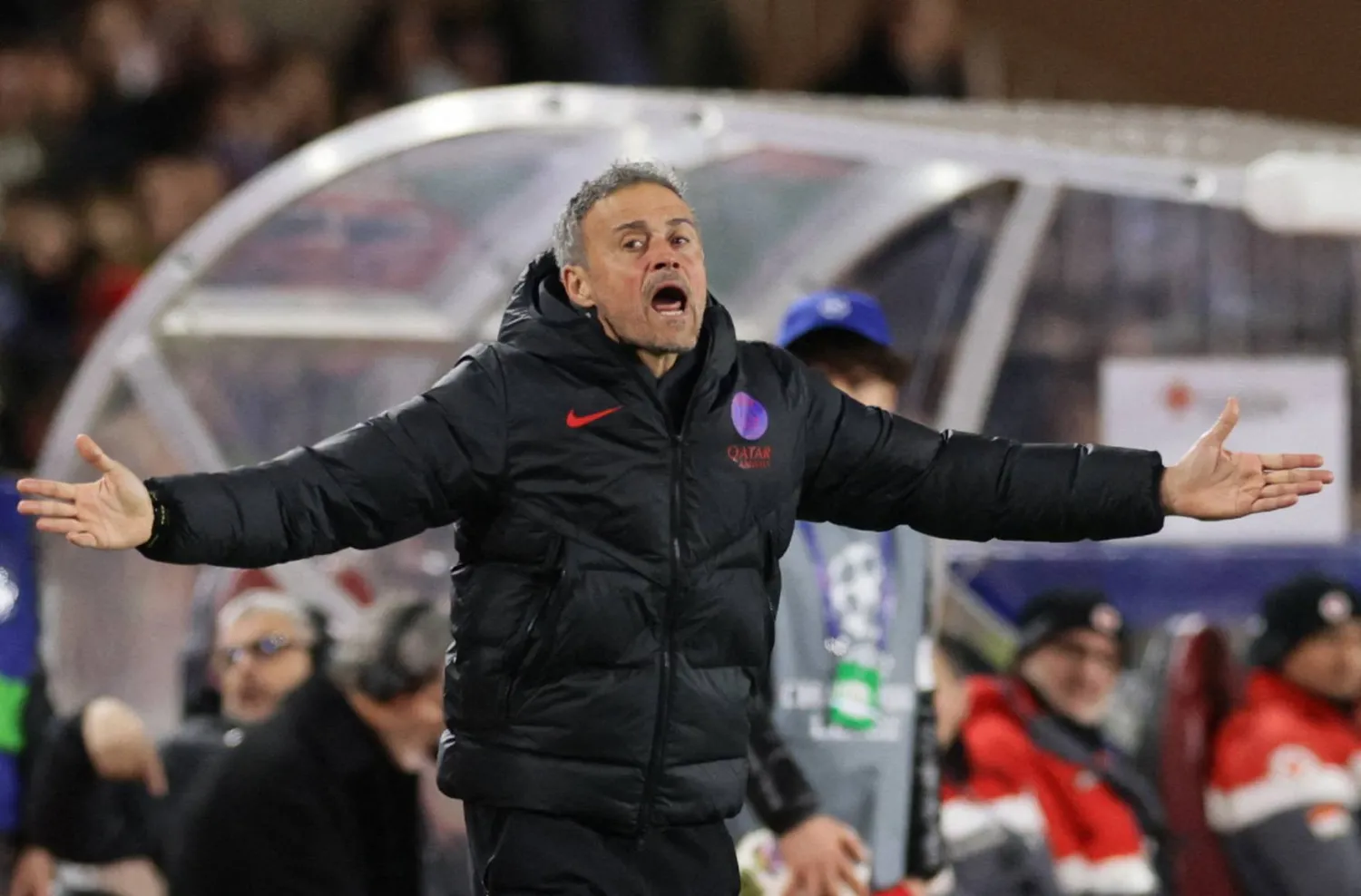
Soccer Football - UEFA Champions League - Play Off - First Leg - AS Monaco v Paris St Germain - Stade Louis II, Monaco - February 17, 2026 Paris St Germain coach Luis Enrique reacts REUTERS/Manon Cruz
TT

PSG’s Mental Strength Hailed as they Come from Behind to Win at Monaco

Soccer Football - UEFA Champions League - Play Off - First Leg - AS Monaco v Paris St Germain - Stade Louis II, Monaco - February 17, 2026 Paris St Germain coach Luis Enrique reacts REUTERS/Manon Cruz

Paris Saint-Germain coach Luis ‌Enrique hailed the mental strength of his side in coming from two goals down to win 3-2 away at Monaco in the Champions League on Tuesday, but warned the knockout round tie was far from finished.

The first leg clash between the two Ligue 1 clubs saw Folarin Balogun score twice for the hosts in the opening 18 minutes before Vitinha had his penalty saved to compound matters.

But after Desire Doue came on for injured Ousmane Dembele, the ‌match turned ‌and defending champions PSG went on to ‌secure ⁠a one-goal advantage ⁠for the return leg.

"Normally, when a team starts a match like that, the most likely outcome is a loss,” Reuters quoted Luis Enrique as saying.

“It was catastrophic. It's impossible to start a match like that. The first two times they overcame our pressure and entered our half, they scored. They ⁠made some very good plays.

“After that, it's difficult ‌to have confidence, but we ‌showed our mental strength. Plus, we missed a penalty, so ‌it was a chance to regain confidence. In the ‌last six times we've played here, this is only the second time we've won, which shows how difficult it is.”

The 20-year-old Doue scored twice and provided a third for Achraf Hakimi, just ‌days after he had turned in a poor performance against Stade Rennais last Friday ⁠and was ⁠dropped for the Monaco clash.

“I'm happy for him because this past week, everyone criticized and tore Doue apart, but he was sensational, he showed his character. He helped the team at the best possible time.”

Dembele’s injury would be assessed, the coach added. “He took a knock in the first 15 minutes, then he couldn't run.”

The return leg at the Parc des Princes will be next Wednesday. “Considering how the match started, I'm happy with the result. But the match in Paris will be difficult, it will be a different story,” Luis Enrique warned.