


Kurds, Regime End Rival Sieges in N. Syria after Russian Mediation

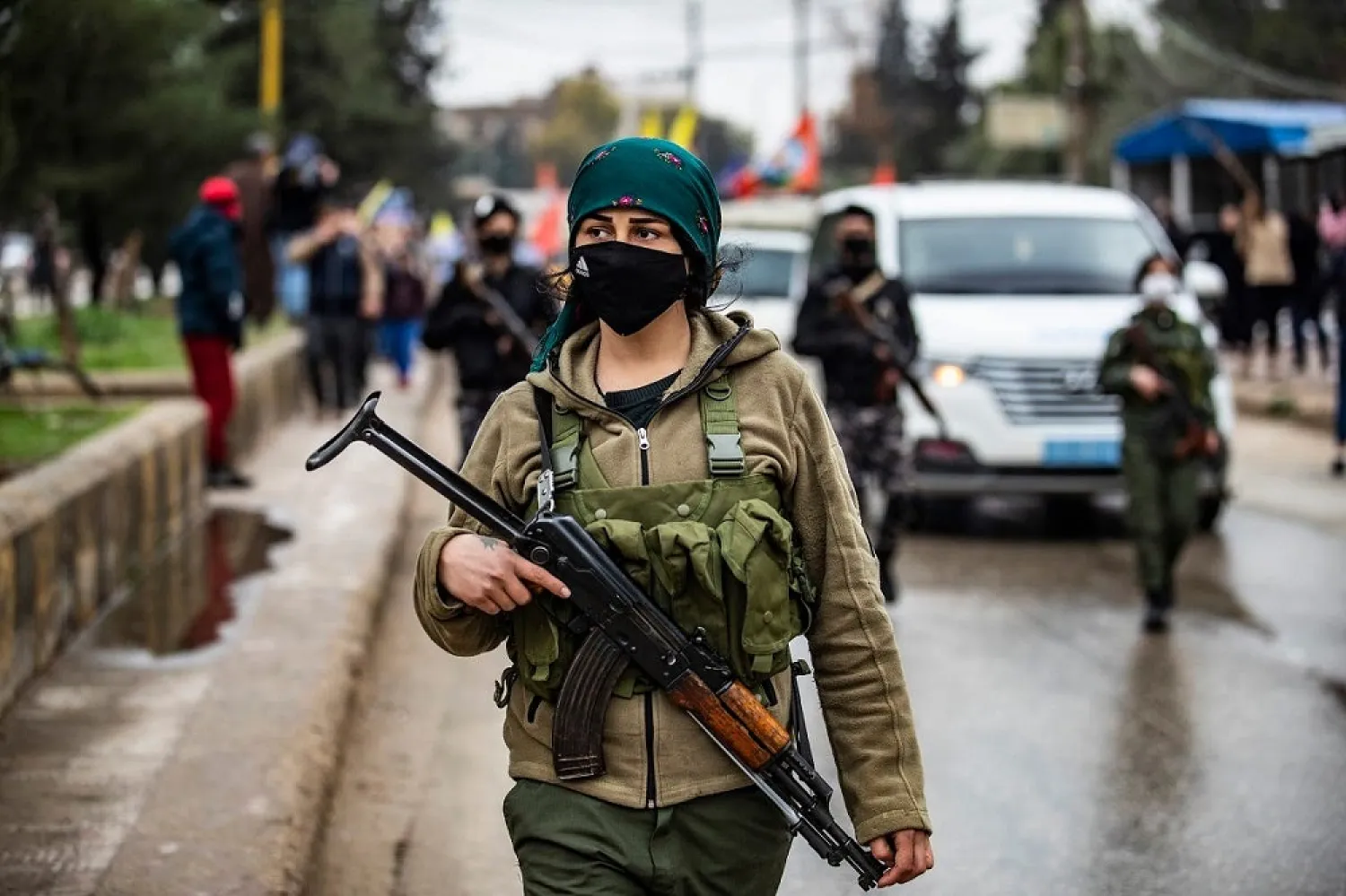
A member of the Kurdish internal security services known as Asayish stands guard as Syrian Kurds demonstrate in the northeastern city of Qamishli on January 20, 2021. (AFP)
TT

Kurds, Regime End Rival Sieges in N. Syria after Russian Mediation

A member of the Kurdish internal security services known as Asayish stands guard as Syrian Kurds demonstrate in the northeastern city of Qamishli on January 20, 2021. (AFP)

Kurdish forces in northern Syria ended a weekslong siege of regime-held neighborhoods in two northeastern cities Tuesday, they said, as part of a deal brokered by Russia.

As part of the agreement with Kurdish forces, Syrian government troops allowed supplies to enter Kurdish-held areas in the northern province of Aleppo, an opposition activist group reported.

The deal to end the sieges by government forces and Kurdish fighters in different parts of the war-torn country's north came two days after Kurdish fighters shot one person dead during a pro-government protest. The deal was brokered by Russia, an opposition war monitor said.

Local Kurdish police said in a statement they would end the siege on government-held parts of the provincial capital of Hasakeh province that carries the same name as well and the city of Qamishli along the border with Turkey.

Areas held by the government in Hasakeh and Qamishli are known as the security square. State institutions still function in the areas despite the fact the US-backed Kurdish-led fighters control much of the region.

The Kurds, Syria’s largest ethnic minority, have carved out a semi-autonomous enclave in Syria’s north after the start of the war in 2011. In the area, the Kurds run their own affairs and control most of the country’s oil resources.

In both Hasakeh and Qamishli cities, they share control with government forces, which have a presence in security zones, near the airport and in some neighborhoods. Both cities have a sizeable Kurdish population.

“We at the Internal Security Forces are committed to the unity of Syrian blood,” the local Kurdish police force said, blaming government forces for tension in the cities. On Sunday, Kurdish forces shot dead a pro-government protester in Hasakeh during a demonstration against the siege.

The police force said life returned to normal on Tuesday with the siege lifted and material will be allowed to flow into government-held areas.

Tensions are not uncommon between the two sides in northern Syria and Kurdish officials have said their moves are in retaliation for a government siege on Kurdish areas in the northern province of Aleppo.

Kurdish fighters, who are backed and armed by the US, played an instrumental role in defeating the ISIS group in Syria.

The US-led coalition still has forces in Kurdish-controlled areas in Syria, citing continued joint efforts to weed out the militants’ remnants. The presence of US troops is another reason for tension between the Kurdish and government forces.



Israel Approves Nearly 800 Housing Units in Three West Bank Settlements 

Israeli Finance Minister Bezalel Smotrich attends a Plenum session of the Knesset, Israel's Parliament, also attended by Argentine President Javier Milei (not pictured), in Jerusalem, June 11, 2025. (Reuters) 
TT

Israel Approves Nearly 800 Housing Units in Three West Bank Settlements 

Israeli Finance Minister Bezalel Smotrich attends a Plenum session of the Knesset, Israel's Parliament, also attended by Argentine President Javier Milei (not pictured), in Jerusalem, June 11, 2025. (Reuters) 

Israel has given final approval for 764 housing units to be built in three settlements in the occupied West Bank, Finance Minister Bezalel Smotrich said on Wednesday.

The ultra-nationalist Smotrich, who opposes the creation of a Palestinian state, said that since the beginning of his term in late 2022, some 51,370 housing units have been approved by the government's Higher Planning Council in the West Bank, territory Palestinians seek for a future state.

"We continue the revolution," Smotrich said in a statement, adding the latest approval of housing units "is part of a clear strategic process of strengthening the settlements and ensuring continuity of life, security, and growth ... and genuine concern for the future of the State of Israel."

The units will be spread out between Hashmonaim, just over the Green Line in central Israel, and Givat Zeev and Beitar Illit near Jerusalem.

Most world powers deem Israel's settlements - on land it captured in a 1967 war - as illegal and numerous UN Security Council resolutions have called on Israel to halt all settlement activity.

"For us, all the settlements are illegal...and they are contrary to all the resolutions of international legitimacy," Wasel Abu Yousef, a member of the Palestine Liberation Organization's Executive Committee, told Reuters.

Israel says settlements are critical to its security and cites biblical, historical and political connections to the territory.

Israeli settler attacks against Palestinians have been on the rise. At least 264 attacks in the West Bank against Palestinians were reported in October, the biggest monthly total since UN officials began tracking such incidents in 2006, according to a UN report.


Lebanon Foreign Minister Declines Tehran Visit, Proposes Talks in Neutral Country 

Lebanon's Foreign Minister Youssef Rajji. (NNA)
TT

Lebanon Foreign Minister Declines Tehran Visit, Proposes Talks in Neutral Country 

Lebanon's Foreign Minister Youssef Rajji. (NNA)

Lebanon's Foreign Minister Youssef Rajji said on Wednesday he had declined an invitation to visit Tehran for now, proposing instead talks with Iran in a mutually agreed neutral third country, Lebanese state news agency NNA reported.

Rajji cited “current conditions” for the decision not to go to Iran, without specifying further, and stressed that the move does not mean rejection of dialogue with Iran.

Last week, Iran's Foreign Minister Abbas Araqchi invited Rajji to visit Iran in the near future to discuss bilateral ties.

Rajji expressed “readiness to establish a new phase in constructive ties between Lebanon and Iran on condition that they are strictly based on mutual and absolute respect of each country’s independence and sovereignty and non-interference in their internal affairs in any way and under any pretext.”

“The establishment of any strong state cannot take place if the state, through its army, does not have sole control over possession of arms and does not have monopoly over decisions of war and peace,” he stressed.

Rajji added that Araqchi was “always welcome to visit Lebanon.”

The Lebanese government earlier this year decided to impose state monopoly over arms, which effectively calls for Hezbollah to disarm. Iran is the party’s main backer.

Hezbollah’s critics have over the years accused it of following an Iranian agenda at the expense of Lebanon’s interests.

They also accuse it of usurping the state’s decision-making power when it comes to war and peace. In 2023, the party started firing rockets at Israel in support of Hamas in Gaza. The clashes escalated to all-out war in 2024 with Hezbollah left severely battered.

In August, Iran's top security official Ali Larijani visited Beirut, warning Lebanon not to “confuse its enemies with its friends”. In June, Foreign Minister Araqchi said Tehran sought a “new page” in ties. 


At Least 22 Killed in Collapse of Two Buildings in Morocco’s Old City of Fez 

Emergency personnel search for victims in the rubble of two collapsed buildings in Fez late on December 9, 2025. (AFP)
TT

At Least 22 Killed in Collapse of Two Buildings in Morocco’s Old City of Fez 

Emergency personnel search for victims in the rubble of two collapsed buildings in Fez late on December 9, 2025. (AFP)

At least 22 people were killed late on Tuesday after two buildings collapsed in Fez, one of Morocco's oldest cities and a key tourist destination, with the state broadcaster saying the blocks had shown signs of cracking. 

Local authorities in Fez prefecture reported two adjacent four-storey buildings had collapsed overnight, state news agency MAP said. The buildings were inhabited by eight families and were in the Al-Mustaqbal neighborhood, a densely populated area in the west of the city, it reported. 

State-owned broadcaster SNRT reported eyewitnesses at the scene as saying the buildings had shown signs of cracking for some time, without any effective preventive measures being taken. 

SNRT showed rescue workers and residents digging through the rubble to look for survivors overnight. 

"My son who lives upstairs told me the building is coming down. When we went out, we saw the building collapsing," an old woman wrapped in a blanket told SNRT, without giving her name. 

Another survivor, who lost his wife and three children in the collapse, told local Medi1 TV early on Wednesday that the rescuers were able to retrieve one body, but he was still waiting for the others.  

Fez, a former capital dating back to the eighth century and the country's third-most-populous city, was caught up in a wave of protests two months ago against the government over deteriorating living conditions and poor public services. 

Adib Ben Ibrahim, housing secretary of state, said in January that approximately 38,800 buildings across the country have been classified as being at risk of collapse. 

Wednesday's collapse is one of the worst in Morocco since the fall of a minaret in the historic northern city of Meknes, which killed 41 people in 2010.