


Shiite Opposition of UN Supervision of Iraqi Elections Grows

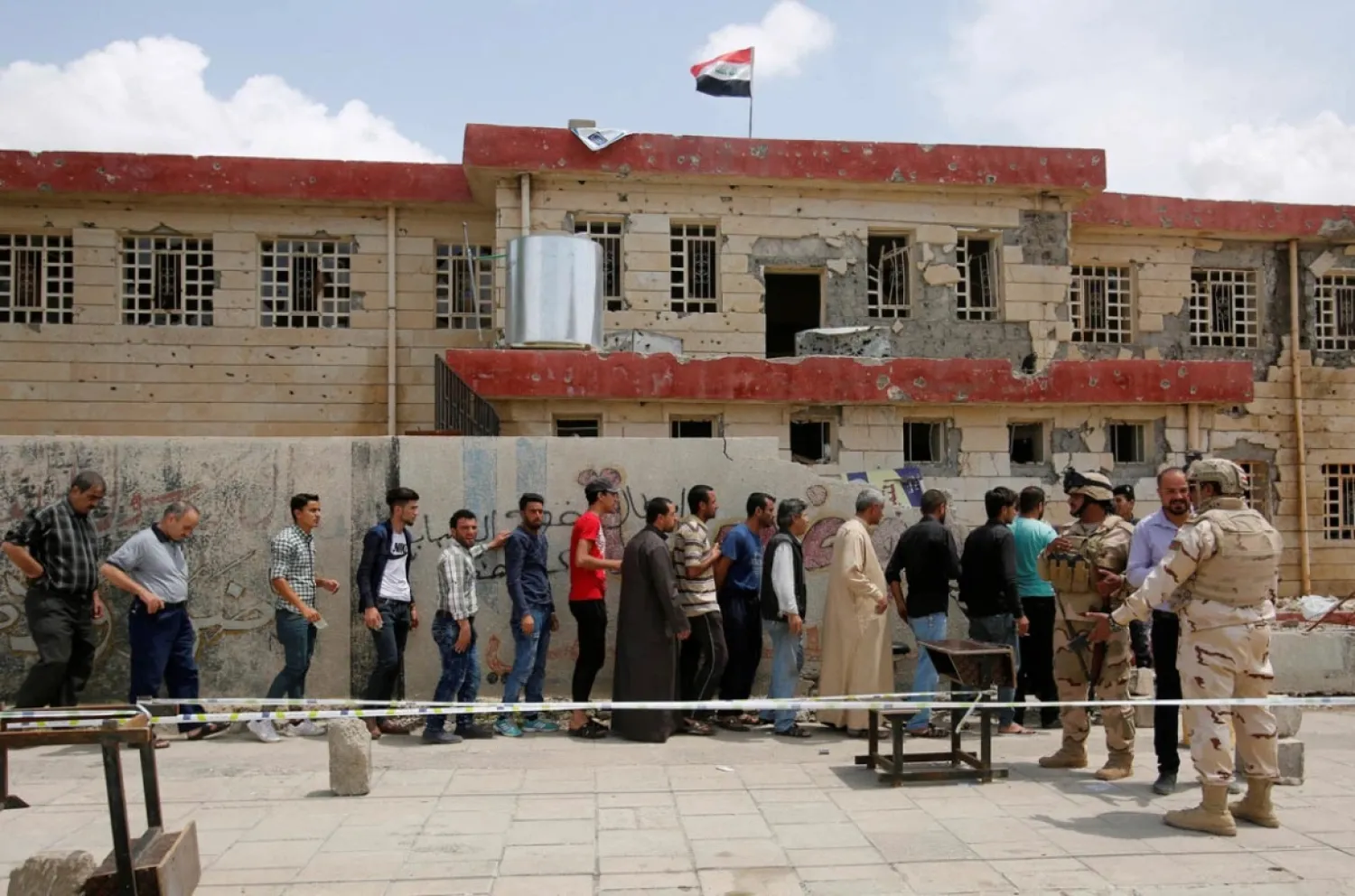
Iraqis stand in a queue to cast their vote at a polling station during the parliamentary election in Mosul, Iraq in 2018. (Reuters)
TT

Shiite Opposition of UN Supervision of Iraqi Elections Grows

Iraqis stand in a queue to cast their vote at a polling station during the parliamentary election in Mosul, Iraq in 2018. (Reuters)

Despite the recent dispute that erupted between the Sadrist movement, led by cleric Moqtada al-Sadr, and head of the State of Law coalition, headed by former Prime Minister Nouri al-Maliki, both Shiite sides are united in their opposition of United Nations supervision of the upcoming Iraqi parliamentary elections.

The Sadrists and Maliki have recently traded accusations over the vehicle that was used during the 2006-2008 sectarian war to carry out assassinations.

Debate over the “Batta”, Arabic for duck, erupted after former Sunni MP Mashaan al-Jabbouri accused the Sadrist movement of seeking to take over the premiership after the upcoming elections.

He stated that the “Sunnis do not aspire to become the PM’s ‘Batta’ driver.”

Maliki, for his part, announced that he was keen on becoming prime minister if he was asked, vowing to crack down on the “Batta”, provoking the Sadrists.

Pro-Sadr minister Mohammed Saleh al-Iraqi slammed the former PM’s statement, saying: “The ‘Batta’ is the only option for corrupt figures who sold out a third of Iraq to ISIS.”

He made his comments in reference to accusations that Maliki was to blame for the fall of Mosul and other Iraqi cities in ISIS’ clutches when it swept across Iraq in 2014.

The proposed issue of UN supervision of the October elections has started to create new divisions in Iraq. The move has not been opposed by Sunnis and Kurds, but Shiite blocs have objected, alleging that the supervisors would violate the country’s sovereignty.

Recent visits to Iran by UN envoy to Iraq Jeanine Hennis-Plasschaert and Foreign Minister Fuad Hussein have been interpreted as attempts to promote the idea of international supervision. The results of the visits were not revealed, but observers interpreted them as efforts to convince Iran that the UN officials would not undermine Iraqi sovereignty or deprive the Shiite political blocs of their control over political decisions.

State of Law coalition MP Gatah al-Rekabi said: “Any sovereign state that respects itself cannot accept international supervision.”

“Iraq does not need to ask the UN or any other international side to oversee the elections. We support the idea of monitors, who can ensure the transparency of the elections,” he added.

Monitors have been brought in to oversee elections since 2003.

Rekabi said there are fears that the supervisors may work for political powers against others through the manipulation of the votes.

Maliki himself has objected to the supervision, declaring in televised remarks that such a move “would be very dangerous.”

“No country in the world accepts supervisors of the elections because that is a violation of sovereignty,” he said, while expressing his support for “monitors alone”.

Member of Sadr’s Sairoon bloc Riad al-Masoudi said all elections in the world are held under international monitors.

“The supervision can take place over the electoral process and not the actual organization of the elections,” he explained, adding: “This means that neither the UN nor any other international side can stage the polls.”



Israel Permits 10,000 West Bank Palestinians for Friday Prayers at Al Aqsa

Palestinians attend Friday prayers in a mosque following an attack that local Palestinians said was carried out by Israeli settlers, in the village of Deir Istiya near Salfit in the Israeli-occupied West Bank November 14, 2025. REUTERS/Sinan Abu Mayzer
TT

Israel Permits 10,000 West Bank Palestinians for Friday Prayers at Al Aqsa

Palestinians attend Friday prayers in a mosque following an attack that local Palestinians said was carried out by Israeli settlers, in the village of Deir Istiya near Salfit in the Israeli-occupied West Bank November 14, 2025. REUTERS/Sinan Abu Mayzer

Israel announced that it will cap the number of Palestinian worshippers from the occupied West Bank attending weekly Friday prayers at the Al-Aqsa Mosque in east Jerusalem at 10,000 during the holy month of Ramadan, which began Wednesday.

Israeli authorities also imposed age restrictions on West Bank Palestinians, permitting entry only to men aged 55 and older, women aged 50 and older, and children up to age 12.

"Ten thousand Palestinian worshippers will be permitted to enter the Temple Mount for Friday prayers throughout the month of Ramadan, subject to obtaining a dedicated daily permit in advance," COGAT, the Israeli defense ministry agency in charge of civilian matters in the Palestinian territories, said in a statement, AFP reported.

"Entry for men will be permitted from age 55, for women from age 50, and for children up to age 12 when accompanied by a first-degree relative."

COGAT told AFP that the restrictions apply only to Palestinians travelling from the West Bank, which Israel has occupied since the 1967 Arab-Israeli war.

"It is emphasised that all permits are conditional upon prior security approval by the relevant security authorities," COGAT said.

"In addition, residents travelling to prayers at the Temple Mount will be required to undergo digital documentation at the crossings upon their return to the areas of Judea and Samaria at the conclusion of the prayer day," it said, using the Biblical term for the West Bank.

During Ramadan, hundreds of thousands of Palestinians traditionally attend prayers at Al-Aqsa, Islam's third holiest site, located in east Jerusalem, which Israel captured in 1967 and later annexed in a move that is not internationally recognized.

Since the war in Gaza broke out in October 2023, the attendance of worshippers has declined due to security concerns and Israeli restrictions.

The Palestinian Jerusalem Governorate said this week that Israeli authorities had prevented the Islamic Waqf -- the Jordanian-run body that administers the site -- from carrying out routine preparations ahead of Ramadan, including installing shade structures and setting up temporary medical clinics.

A senior imam of the Al-Aqsa Mosque, Sheikh Muhammad al-Abbasi, told AFP that he, too, had been barred from entering the compound.

"I have been barred from the mosque for a week, and the order can be renewed," he said.

Abbasi said he was not informed of the reason for the ban, which came into effect on Monday.

Under longstanding arrangements, Jews may visit the Al-Aqsa compound -- which they revere as the site of the first and second Jewish temples -- but they are not permitted to pray there.

Israel says it is committed to upholding this status quo, though Palestinians fear it is being eroded.

In recent years, a growing number of Jewish ultranationalists have challenged the prayer ban, including far-right politician Itamar Ben Gvir, who prayed at the site while serving as national security minister in 2024 and 2025.


EU Exploring Support for New Gaza Administration Committee, Document Says

Palestinians push a cart past the rubble of residential buildings destroyed during the two-year Israeli offensives, in Gaza City, February 17, 2026. REUTERS/Mahmoud Issa
TT

EU Exploring Support for New Gaza Administration Committee, Document Says

Palestinians push a cart past the rubble of residential buildings destroyed during the two-year Israeli offensives, in Gaza City, February 17, 2026. REUTERS/Mahmoud Issa

The European Union is exploring possible support for a new committee established to take over the civil administration of Gaza, according to a document produced by the bloc's diplomatic arm and seen by Reuters.

"The EU is engaging with the newly established transitional governance structures for Gaza," the European External Action Service wrote in a document circulated to member states on Tuesday.

"The EU is also exploring possible support to the National Committee for the Administration of Gaza," it added.

European foreign ministers will discuss the situation in Gaza during a meeting in Brussels on February 23.


Israel Military Says Soldier Killed in Gaza 

A drone view shows the destruction in a residential neighborhood, after the withdrawal of the Israeli forces from the area, amid a ceasefire between Israel and Hamas in Gaza, in Gaza City, October 21, 2025. (Reuters)
TT

Israel Military Says Soldier Killed in Gaza 

A drone view shows the destruction in a residential neighborhood, after the withdrawal of the Israeli forces from the area, amid a ceasefire between Israel and Hamas in Gaza, in Gaza City, October 21, 2025. (Reuters)

The Israeli military announced that one of its soldiers had been killed in combat in southern Gaza on Wednesday, but a security source said the death appeared to have been caused by "friendly fire".

"Staff Sergeant Ofri Yafe, aged 21, from HaYogev, a soldier in the Paratroopers Reconnaissance Unit, fell during combat in the southern Gaza Strip," the military said in a statement.

A security source, however, told AFP that the soldier appeared to have been "killed by friendly fire", without providing further details.

"The incident is still under investigation," the source added.

The death brings to five the number of Israeli soldiers killed in Gaza since a ceasefire took effect on October 10.