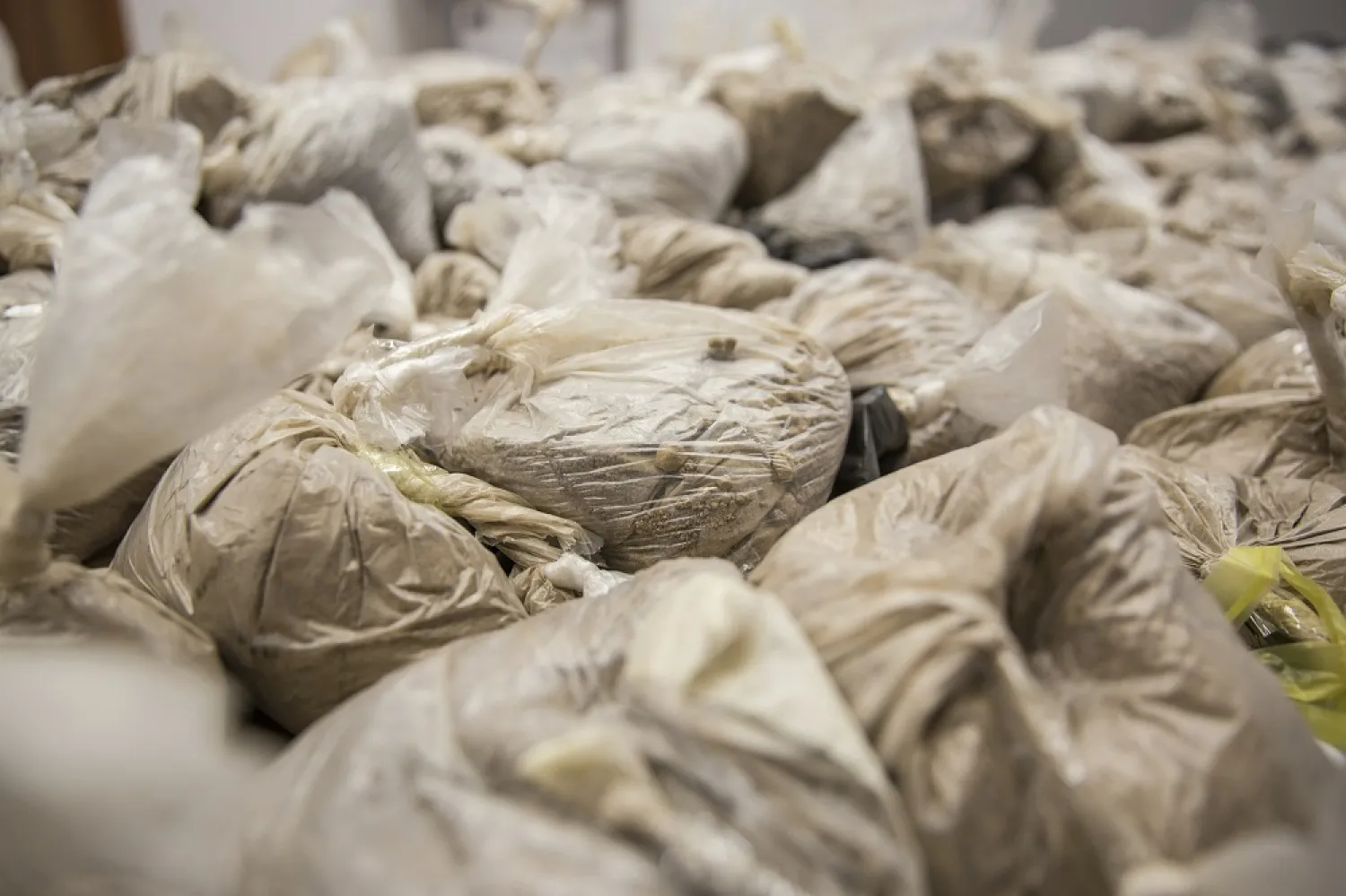
Bulgarian Prosecutors Say Heroin Found in Cargo from Iran

Photo released by Bulgarian Prosecutor's Office on Tuesday, Feb. 16 2021, shows packages of seized heroin from Iranian cargo in the Black Sea port of Varna. (AP)
TT

Bulgarian Prosecutors Say Heroin Found in Cargo from Iran

Photo released by Bulgarian Prosecutor's Office on Tuesday, Feb. 16 2021, shows packages of seized heroin from Iranian cargo in the Black Sea port of Varna. (AP)

Bulgarian customs officials confiscated more than 400 kilograms (880 pounds) of heroin from a ship transporting goods from Iran, prosecutors said Tuesday.

The drugs were divided in 487 packages and hidden among asphalt rollers the ship was carrying, prosecutor Vladimir Chavdarov.

Customs officials in the Black Sea port of Varna valued the seized heroin at 18 million euros ($22 million).

Two Bulgarian men - the owner of the receiving company and a customs officer - were detained and could face up to 20 years in jail, if convicted on drug trafficking charges.

Bulgarian police believe the heroin was not intended for the domestic market but rather destined to be sold in Western Europe.

Drugs from the Middle East sometimes are transported on trucks from Afghanistan through Iran, Turkey and Bulgaria to Western Europe.

Bulgaria has taken steps in recent years to prevent drug trafficking.


South Korea Says Hormuz Talks with France Concern Contribution Options, Not Troop Deployment

South Korean military fighter jets (South Korean Air Force website)
TT

South Korea Says Hormuz Talks with France Concern Contribution Options, Not Troop Deployment

South Korean military fighter jets (South Korean Air Force website)

South Korean President Lee Jae Myung and French President Emmanuel Macron discussed cooperation on security and freedom of navigation in the Strait of Hormuz during a summit in Paris on Tuesday, but the talks did not concern troop deployment, Seoul's presidential office said.

Lee, who is on a state visit to France, said at a joint press conference that he had discussed the Strait of Hormuz with Macron as part of wider talks on international security ‌issues, reported Reuters.

"South Korea and ‌France agreed to continue close coordination so that freedom of ‌navigation ⁠in the Strait ⁠of Hormuz and the stability of global supply chains can be restored swiftly," Lee said.

The Strait of Hormuz is a critical energy transit route for South Korea, which relied on the waterway for 61% of its crude oil imports and 54% of its naphtha imports last year.

In a briefing after the summit, South Korean National Security Adviser Wi Sung-lac said discussions focused on how South Korea could contribute to international maritime security efforts in the strait rather than on troop deployment.

"We ⁠are still in the review stage," Wi said, regarding Seoul's contribution options. "No ‌decision has been made."

Wi said Iran had sought ‌explanations through diplomatic channels following media reports about a possible South Korean role in Hormuz security efforts.

He dismissed ‌suggestions that Seoul's review of Hormuz contribution options was linked to US investment discussions.

The presidential office separately denied reports that the US had set a deadline for Seoul to dispatch assets to Hormuz.

Seoul said last week it was reviewing various options, including military measures, to contribute to freedom of navigation in Hormuz, while denying reports a deployment decision had already been made.

The announcement followed US President Donald Trump's decision in August to scale back US-South Korea joint military exercises, which he said was partly because South Korea had declined to assist Washington in the US-Iran conflict.

Iran's Foreign Ministry spokesperson warned this week that any South Korean military participation in operations in the Gulf or Strait of Hormuz would be regarded as support for US "aggression" and would carry serious consequences.



North Korea Builds New Yongbyon Uranium Enrichment Facility, IAEA Says

A satellite image shows a nuclear material production factory, in Yongbyon, North Korea, September 4, 2025. (2026 Planet Labs PBC/Handout via Reuters)
TT

North Korea Builds New Yongbyon Uranium Enrichment Facility, IAEA Says

A satellite image shows a nuclear material production factory, in Yongbyon, North Korea, September 4, 2025. (2026 Planet Labs PBC/Handout via Reuters)

North Korea has built ‌a new uranium enrichment facility at its main Yongbyon nuclear complex that could house up to 28 centrifuge cascades, and started operating an expanded annex at its Kangson enrichment site, the International Atomic Energy Agency (IAEA) said.

The Vienna-based nuclear watchdog said in a report the findings pointed to a steady expansion of North Korea's nuclear infrastructure at multiple locations.

In the report, dated August 28, the IAEA said it relied on satellite imagery and open-source material, including photographs published by North Korean state media, ‌to track Pyongyang's nuclear ‌activities. The agency has had no ‌inspectors in ⁠North Korea since ⁠2009.

It identified a new two-storey building at Yongbyon as the site's second uranium enrichment facility by comparing state media photographs of a June visit by North Korean leader Kim Jong Un with satellite images taken during the building's construction.

Photographs from the visit indicate gas centrifuge cascades are installed on both the ⁠upper and lower floors of the main building, the ‌report said, adding the ‌building could accommodate up to 28 of the cascades shown in the ‌photographs.

The report also said there were indications that ‌operations began in January at a uranium enrichment facility in Kangson, near the capital Pyongyang, within an annex that had been constructed in 2024.

The IAEA said the developments in North Korea's nuclear program violated UN ‌Security Council resolutions.

"The ongoing operation of enrichment facilities at Kangson and Yongbyon and the reported ⁠further expansion ⁠of the DPRK’s production of weapons-grade nuclear material is a cause for serious concern," IAEA Director General Rafael Grossi said in a statement to the board of governors on Monday, referring to the North's official name, the Democratic People's Republic of Korea.

The report accompanied Grossi's statement.

Pyongyang has repeatedly rejected the agency's authority. North Korea's mission to the United Nations in Vienna said last September that North Korea's status as a nuclear weapons state had become irreversible and the IAEA had "no legal right ... to interfere in the internal affairs of a nuclear weapons state which exists outside the NPT", referring to the Non-Proliferation Treaty.


Nepal Seeks Survivors Two Weeks After Deadly Floods

A flooded home, following the deadly flash floods and mudslides in Nuwakot district, Bagmati province, Nepal, September 8, 2026. (Reuters)
TT

Nepal Seeks Survivors Two Weeks After Deadly Floods

A flooded home, following the deadly flash floods and mudslides in Nuwakot district, Bagmati province, Nepal, September 8, 2026. (Reuters)

Nepali rescuers clung to hopes of finding survivors trapped in hydropower tunnels on Wednesday, two weeks after deadly flooding triggered by a glacial mountain collapse.

The August 26 tsunami-like surge of water, mud and debris, which began on the China-Nepal border, has killed more than 1,401 people and left 5,845 missing.

"The rescue and search work in the tunnels at Trishuli 3A, 3B and Chilime hydropower projects is ongoing," Nepal Army spokesman Raja Ram Basnet told AFP.

In Nepal, 1,358 bodies have been recovered and 5,326 people are missing, according to Kathmandu's disaster authority.

In China, 43 people are dead and 519 missing, according to state media.

Hundreds of foreigners are among the missing, as well as hundreds of hydropower workers.

Three people were rescued from deep inside tunnels -- two Nepalis on Friday and a Chinese man on Saturday.

But there has been no official confirmation of further survivors since then.

While the exact cause of the glacial collapse is unclear, climate change is accelerating glacial melt worldwide and increasing the risk of such disasters.

Nepal, a largely rural nation of 30 million people that has contributed little to the greenhouse gas emissions driving global warming, has said reconstruction could cost billions of dollars.