


Russia Sponsors Swap Deal Between Damascus, Tel Aviv

Members of a Syrian family riding a motorcycle in the rubble in the Yarmouk camp, south of Damascus (EPA)
TT

Russia Sponsors Swap Deal Between Damascus, Tel Aviv

Members of a Syrian family riding a motorcycle in the rubble in the Yarmouk camp, south of Damascus (EPA)

Israeli Prime Minister Benjamin Netanyahu called for an emergency cabinet meeting on Tuesday evening, boosting expectations for another exchange deal sponsored by Russian President Vladimir Putin between Tel Aviv and Damascus.

The new deal will likely include freeing Israelis who were arrested in Syria’s southwestern Quneitra governorate and releasing information about the remains of Israeli soldiers in the war-torn Levantine country.

Tel Aviv, for its part, would release Syrians detained in its prisons.

It is worth noting that Moscow had sponsored a similar agreement between the two countries in 2019.

Russian president’s special envoy for Syria Alexander Lavrentiev, speaking in Sochi on Wednesday at the 15th Astana format talks, confirmed that Moscow and Tel Aviv are holding calls for de-escalating tensions.

Lavrentiev, however, warned that Damascus may retaliate against Israel’s persistent strikes in Syria.

What happened?

Details of the Israeli cabinet’s unscheduled meeting were banned from publication at Defense Minister Benny Gantz’s request.

Cabinet ministers were notified of the meeting shortly before it was held and were asked not to reveal details of it to the media or even reveal the meeting's existence.

The meeting, organized by Gantz and Israeli Prime Minister Benjamin Netanyahu, dealt with a "sensitive security matter", the Israeli daily Haaretz reported.

In recent weeks, Netanyahu has spoken with Putin, and Gantz and Foreign Minister Gabi Ashkenazi have spoken with their Russian counterparts, Sergey Shoygu and Sergei Lavrov.

On February 10, Gantz tweeted that his call with Shoygu was focused on the issue of humanitarian efforts and counterterrorism efforts.

The urgent Israeli cabinet meeting came a day after the UK-based war monitor, the Syrian Observatory for Human Rights, reported that Israeli missile strikes killed at least six pro-regime foreign fighters in areas near Damascus.

An Iranian weapons depot, according to the Observatory, was also hit in the strike.

Israeli military spokesman Lt. Col. Jonathan Conricus, speaking to Russia’s TASS news agency the day after the attack, confirmed that Moscow and Tel Aviv have put in place a tactical coordination mechanism and established a hotline to prevent clashing with Russian forces in Syria.

“The Israeli army takes into consideration the safety and security of Russian troops in Syria,” Conricus said.

Russia and Israel also have a deconfliction mechanism in place, which allows Israeli jets to strike Iranian targets in Syria without threatening Russian forces.

Damascus, responding to the recent Israeli attack, filed a complaint with the UN Security Council and called on the international community to condemn Israel and prevent it from carrying out such attacks in the future.

With the help of Russian mediation, Damascus has negotiated the release of two Syrians held by Israel in exchange for releasing an Israeli woman that entered Syria by mistake, Syria’s official news agency (SANA) reported Wednesday.

Nihal al-Makt and Ziyab Qahmouz are Syrian nationals from the Israeli-annexed Golan Heights, SANA confirmed.

The Palestinian Prisoners' Club (PPC) reported that Israel decided to release Qahmouz from its custody under an exchange deal with Damascus.

“The occupation prisons administration summoned, this morning, the Syrian prisoner Ziyab Qahmouz to inform him of the decision to release him to Syria, according to a deal that was concluded between Syria and the occupation, with Russian mediation,” said the PPC.

This prisoner swap deal is part of Russia’s broader efforts in Syria.

Early in February, eyewitnesses spotted Russian troops launching excavations at the Yarmouk refugee camp cemetery in south Damascus in search of an Israeli soldier’s remains.

Local reports suggested that the Russian military was looking to identify the body of an Israel Defense Forces (IDF) soldier who had fallen in the First Lebanon War in 1982.

Home to one of the largest Palestinian refugee communities in Syria, the Yarmouk refugee camp was once again being searched for remains by the Russian military, the Syrian Capital Voice site reported.

The report said the search would include DNA testing.

The cemetery area was designated a closed military zone as Russian forces conducted the search operations, it added.

Local sources confirmed to the Capital Voice site that Russian forces have excavated many remains from the camp’s two cemeteries.

The battle of Sultan Yacoub, 39 years ago, was a skirmish between the IDF and Syrian army in Lebanon’s Bekaa Valley. It claimed the lives of 21 Israeli servicemen, and more than 30 were injured during it.

Tzvi Feldman and Yehuda Katz went missing in the battle of Sultan Yacoub.

During the battle of Sultan Yacoub, Syrian forces took over eight Israeli tanks, one of which was put on display in a museum outside the Russian capital, Moscow.

In 2016, Putin heeded the request of Israeli Prime Minister Benjamin Netanyahu on returning the lost tank to Israel.

The remains of Zachary Baumel, who went missing with Feldman and Katz, were recovered and returned to Israel in 2019.

In exchange for Baumel’s remains, Tel Aviv released the two Syrian prisoners, Ahmed Khamis and Ziad Al-Tawil.

Early in 2020, Israel also freed two Syrian prisoners, one of them Sidqi al-Makt who was serving a prison sentence after being convicted of “espionage” for Damascus.

Netanyahu's office, at the time, said that the release of al-Makt and his colleague Amal Abu Saleh was a “goodwill gesture” after Baumel's remains were recovered.

Building Trust

To this date, Israel is still demanding the recovery of the remains of the legendary Israeli spy Eli Cohen, who was executed in Damascus in 1965.

Tel Aviv has also requested Russian mediation in solving the mystery behind the fate of missing airman Ron Arad, who was lost after his plane was shot down in Lebanon in 1986. Netanyahu is seeking a breakthrough in the search for the remains of Israeli soldiers in Syria before elections next month.

Recently, there have been reports of efforts to test the possibility of resuming peace negotiations between Damascus and Tel Aviv.

It is believed that the multiple “humanitarian deals” brokered by Russia between the two aim to “build confidence.”



US Slaps Sanctions on Sudan’s RSF Commanders over El-Fasher Killings

FILE - A Sudanese child, who fled el-Fasher city with family after Sudan's RSF attacked the western Darfur region, receives treatment at a camp in Tawila, Sudan, Nov. 2, 2025. (AP Photo/Mohammed Abaker, File)
TT

US Slaps Sanctions on Sudan’s RSF Commanders over El-Fasher Killings

FILE - A Sudanese child, who fled el-Fasher city with family after Sudan's RSF attacked the western Darfur region, receives treatment at a camp in Tawila, Sudan, Nov. 2, 2025. (AP Photo/Mohammed Abaker, File)

The United States announced sanctions on Thursday on three Sudanese Rapid Support Forces (RSF) commanders over their roles in the "horrific campaign" of the siege and capture of El-Fasher.

The US Treasury said the RSF carried out "ethnic killings, torture, starvation, and sexual violence" in the operation.

Earlier Thursday, the UN's independent fact-finding mission on Sudan said the siege and seizure of the city in Darfur bore "the hallmarks of genocide."

Its investigation concluded that the seizure last October had inflicted "three days of absolute horror," and called for those responsible to be brought to justice.

"The United States calls on the Rapid Support Forces to commit to a humanitarian ceasefire immediately," US Treasury Secretary Scott Bessent said in a statement.

"We will not tolerate this ongoing campaign of terror and senseless killing in Sudan."

The Treasury noted that the three sanctioned individuals were part of the RSF's 18-month siege of and eventual capture of El-Fasher.

They are RSF Brigadier General Elfateh Abdullah Idris Adam, Major General Gedo Hamdan Ahmed Mohamed and field commander Tijani Ibrahim Moussa Mohamed.

Bessent warned that Sudan's civil war risks further destabilizing the region, "creating conditions for terrorist groups to grow and threaten the safety and interests of the United States."

The UN probe into the takeover of El-Fasher -- after the 18-month siege -- concluded that thousands of people, particularly from the Zaghawa ethnic group, "were killed, raped or disappeared."


Israel's Netanyahu Says No Reconstruction of Gaza before Demilitarization

Israel’s Prime Minister Benjamin Netanyahu - File Photo/AFP
TT

Israel's Netanyahu Says No Reconstruction of Gaza before Demilitarization

Israel’s Prime Minister Benjamin Netanyahu - File Photo/AFP

Israeli Prime Minister Benjamin Netanyahu said on Thursday there would be no reconstruction of war-shattered Gaza before the disarmament of Hamas, as the "Board of Peace" convened for its inaugural meeting in Washington.

Around two dozen world leaders and senior officials met for the first meeting of the board, which was set up after the United States, Qatar and Egypt negotiated a ceasefire in October to halt two years of war in the Gaza Strip.

"We agreed with our ally the US there will be no reconstruction of Gaza before the demilitarization of Gaza," Netanyahu said during a televised speech at a military ceremony on Thursday, AFP reported.

The meeting in Washington will also look at how to launch the International Stabilization Force (ISF) that will ensure security in Gaza.

One of the most sensitive issues before the board is the future of the Islamist movement Hamas, which fought the war with Israel and still exerts influence in the territory.

Disarmament of the group is a central Israeli demand and a key point in negotiations over the ceasefire's next stage.

US officials including Steve Witkoff, Trump's friend and roving negotiator, have insisted that solid progress is being made and that Hamas is feeling pressure to give up weapons.

Israel has suggested sweeping restrictions including seizing small personal rifles from Hamas.

It remains unclear whether, or how, the Palestinian technocratic committee formed to handle day-to-day governance of Gaza will address the issue of demilitarization.

The 15-member National Committee for the Administration of Gaza (NCAG) will operate under the supervision of the "Board of Peace", and its head, Ali Shaath, is attending the meeting in Washington on Thursday.


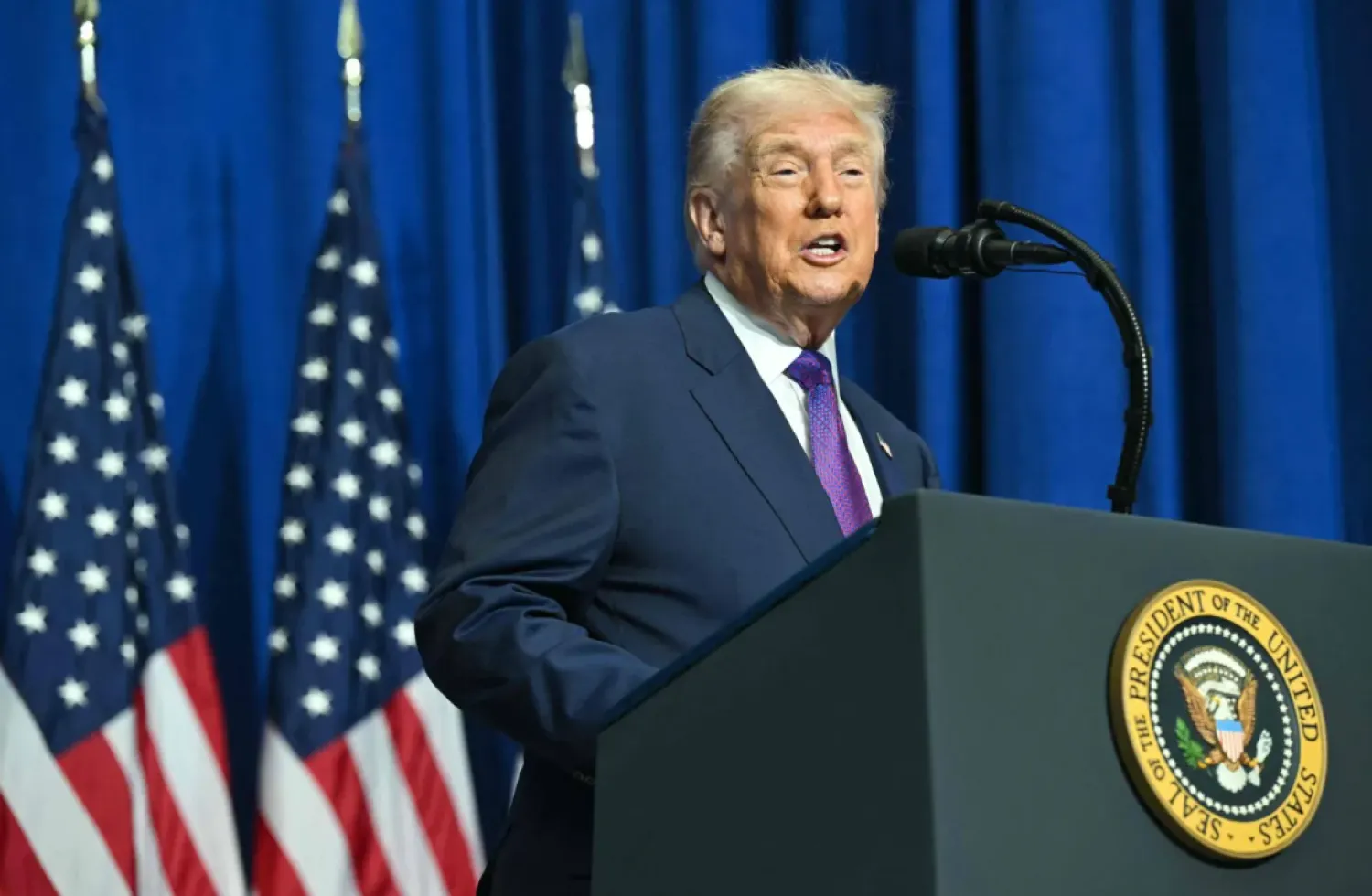
Trump Tells First Meeting of Board of Peace that $7 billion Raised for Gaza

US President Donald Trump speaking in Washington - AFP
TT

Trump Tells First Meeting of Board of Peace that $7 billion Raised for Gaza

US President Donald Trump speaking in Washington - AFP

US President Donald Trump told the first meeting of his Board of Peace on Thursday that $7 billion has been contributed to a Gaza reconstruction fund that aims to rebuild the enclave once Hamas disarms, an objective that is far from becoming a reality.

The disarmament of Hamas militants and accompanying withdrawal of Israeli troops, the size of the reconstruction fund and the flow of humanitarian aid to the war-battered populace of Gaza are among the major questions likely to test the effectiveness of the board in the weeks and months ahead.

In a flurry of announcements at the end of a long, winding speech, Trump said the United States will make a contribution of $10 billion to the Board of Peace. He said contributing nations had raised $7 billion as an initial down payment for Gaza reconstruction.

Trump first proposed the board last September when he announced his plan to end Israel's war in Gaza. He later made clear the board's remit would be expanded beyond Gaza to tackle other conflicts worldwide.

Trump also said FIFA will raise $75 million for soccer-related projects in Gaza and that the United Nations will chip in $2 billion for humanitarian assistance.

TRUMP SAYS ANY IRAN DEAL MUST BE MEANINGFUL, PROSPECTS SHOULD BE CLEAR IN 10 DAYS

The Board of Peace includes Israel but not Palestinian representatives and Trump's suggestion that the Board could eventually address challenges beyond Gaza has stirred anxiety that it could undermine the UN's role as the main platform for global diplomacy and conflict resolution.

"We're going to strengthen the United Nations," Trump said, trying to assuage his critics. "It's really very important."

The meeting came as Trump threatens war against Iran and has embarked on a massive military buildup in the region in case Tehran refuses to give up its nuclear program.

Trump said he should know in 10 days whether a deal is possible. "We have to have a meaningful deal," he said.

The event had the feel of a Trump campaign rally, with music blaring from his eclectic playlist from Elvis Presley to the Beach Boys. Red Trump hats were given to participants.

Senior US officials said Trump will also announce that several nations are planning to send thousands of troops to participate in an International Stabilization Force that will help keep the peace in Gaza when it eventually deploys.

Hamas, fearful of Israeli reprisals, has been reluctant to hand over weaponry as part of Trump's 20-point Gaza plan that brought about a fragile ceasefire last October in the two-year Gaza war.

Trump said he hoped use of force to disarm Hamas would not be necessary. He said Hamas had promised to disarm and it "looks like they're going to be doing that, but we'll have to find out."