


Touchdown: NASA's Perseverance Rover Ready to Search for Life on Mars

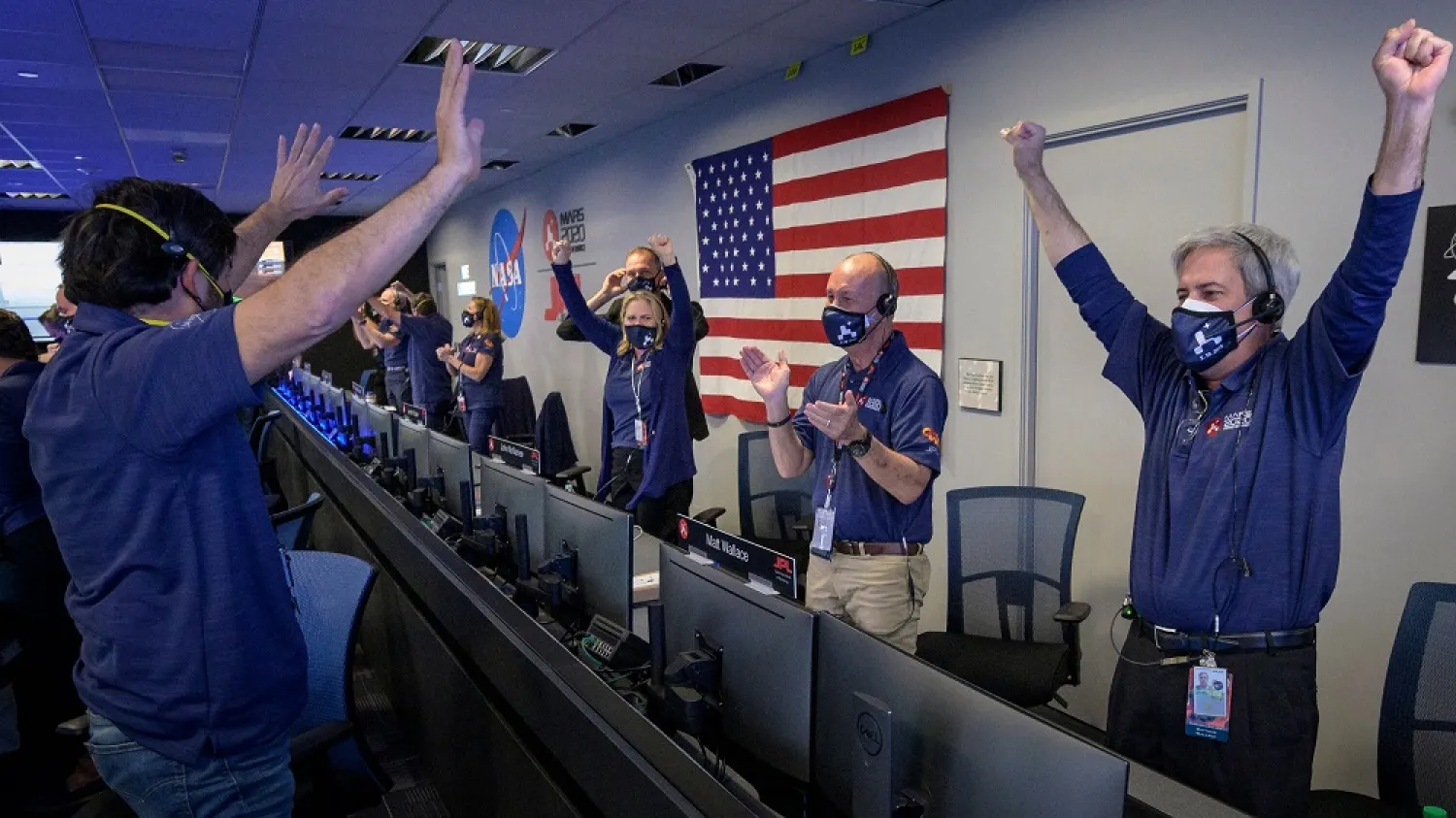
Members of NASA's Perseverance rover team react in mission control after receiving confirmation that the spacecraft successfully touched down on Mars. (AFP)
TT

Touchdown: NASA's Perseverance Rover Ready to Search for Life on Mars

Members of NASA's Perseverance rover team react in mission control after receiving confirmation that the spacecraft successfully touched down on Mars. (AFP)

After seven months in space, NASA's Perseverance rover overcame a tense landing phase with a series of perfectly executed maneuvers to gently float down to the Martian soil Thursday and embark on its mission to search for signs of past life.

"Touchdown confirmed," said operations lead Swati Mohan at 3:55 pm Eastern Time (2055 GMT), as mission control at NASA's Jet Propulsion Laboratory in Pasadena erupted in cheers.

The autonomously guided procedure was in fact completed more than 11 minutes earlier, the length of time it took for radio signals to return to Earth.

Shortly after landing, the rover sent back its first black-and-white images, revealing a rocky field at the landing site in the Jezero Crater, just north of the Red Planet's equator.

More images, video of the descent and perhaps the first sounds of Mars ever recorded by microphones are expected in the coming hours as the rover relays data to overhead satellites.

US President Joe Biden hailed the "historic" event.

"Today proved once again that with the power of science and American ingenuity, nothing is beyond the realm of possibility," he tweeted.

Perseverance's prime mission will last just over two years but it is likely to remain operational well beyond that, with its predecessor Curiosity still functioning eight years after landing on the planet, said NASA acting administrator Steve Jurczyk.

"It'll be on Mars for its entire life," he said, adding "these robots tend to be really reliable."

Over the coming years, Perseverance will attempt to collect 30 rock and soil samples in sealed tubes, to be eventually sent back to Earth sometime in the 2030s for lab analysis.

About the size of an SUV, the craft weighs a ton, is equipped with a seven foot- (two meter-) long robotic arm, has 19 cameras, two microphones and a suite of cutting-edge instruments to assist in its scientific goals.

Before it could set out on its lofty quest, it first had to overcome the dreaded "seven minutes of terror" -- the risky entry, descent and landing phase that has scuppered nearly half of all missions to Mars.

The spacecraft carrying Perseverance careened into the Martian atmosphere at 12,500 miles (20,000 kilometers) per hour, protected by its heat shield, then deployed a supersonic parachute the size of a Little League field, before firing up an eight-engined jetpack.

Finally, it lowered the rover carefully to the ground on a set of cables.

Allen Chen, lead engineer for the landing stage, said a new guidance system called "Terrain Relative Navigation," which uses a special camera to identify surface features and compare them to an onboard map, was key to landing in a rugged region of scientific interest.

"We are in a nice flat spot, the vehicle is only tilted by about 1.2 degrees," he said. "We did successfully find that parking lot, and have a safe rover on the ground."

Ancient lake
Scientists believe that around 3.5 billion years ago the crater was home to a river that flowed into a deep lake, depositing sediment in a fan-shaped delta.

Perseverance ended up landing about two kilometers (a mile) southeast of the delta, NASA scientist Ken Farley said, in a geologically significant area.

Mars was warmer and wetter in its distant past, and while previous exploration has determined the planet was habitable, Perseverance is tasked with determining whether it was actually inhabited.

It will begin drilling its first samples in summer, and along the way it will deploy new instruments to scan for organic matter, map chemical composition and zap rocks with a laser to study the vapor.

Despite the rover's state-of-the-art technology, bringing samples back to Earth remains crucial because of anticipated ambiguities in the specimens it documents.

For example, fossils that arose from ancient microbes may look suspiciously similar to patterns caused by precipitation.

Flying on another world
Before getting to the main mission, NASA wants to run several eye-catching experiments.

Tucked under Perseverance's belly is a small helicopter drone that will attempt the first powered flight on another planet in a few weeks' time.

Dubbed Ingenuity, it will have to achieve lift in an atmosphere that's one percent the density of Earth's, a demonstration of concept that could revolutionize the way humans explore other planets.

Another experiment involves an instrument that can convert oxygen from Mars's primarily carbon dioxide atmosphere, much like a plant.

The idea is that humans eventually won't need to carry their own oxygen on hypothetical future trips, which is crucial for rocket fuel as well as for breathing.

The rover is only the fifth ever to set its wheels down on Mars. The feat was first accomplished in 1997, and all of them have been American.

The US is also preparing for an eventual human mission to the planet, though planning remains very preliminary.

"Maybe by mid-to-end of the 2030s we can start pushing out of the Earth-Moon system and land astronauts on Mars," said Jurczyk.




Encouraging Trial Results for AstraZeneca's New Weight-Loss Pill

The logo for AstraZeneca is seen outside its North America headquarters in Wilmington, Delaware, US, March 22, 2021. (Reuters)
TT

Encouraging Trial Results for AstraZeneca's New Weight-Loss Pill

The logo for AstraZeneca is seen outside its North America headquarters in Wilmington, Delaware, US, March 22, 2021. (Reuters)

A new pill developed by the British pharma firm AstraZeneca appears to help people lose a similar amount of weight to other GLP-1 oral drugs, trial results showed Monday.

If confirmed by further research, the pill could mark AstraZeneca's entrance into the massively lucrative weight-loss drug market currently dominated by Denmark's Novo Nordisk and American giant Eli Lilly.

The astronomical popularity of the appetite suppressing injectable drugs called GLP-1 agonists has kicked off a race to produce tablet versions that easier to take.

AstraZeneca's new pill, called elecoglipron, resulted in weight loss "comparable to that reported for other oral" GLP-1 drugs, according to phase 2 trial results published in the Lancet medical journal.

Side effects recorded during the randomized trial, which had 310 participants, were also similar to those seen for other GLP-1 pills, with nausea being the most common.

For overweight or obese adults without diabetes, the pill resulted in "average weight reductions of up to 10.5 percent at 26 weeks and 11.8 percent at 36 weeks in the highest-dose group," said Marie Spreckley of the University of Cambridge.

But the weight management researcher -- who was not involved in the study -- emphasized the phase 2 trial was not mainly designed to compare the pill to other anti-obesity drugs.

"Larger and longer phase 3 trials will therefore be needed to confirm the durability of these effects, establish longer-term safety and tolerability, and determine its place within the growing range of obesity and diabetes treatments," she explained.

AstraZeneca will face stiff competition -- Novo Nordisk and Eli Lilly have already developed pill versions of their hugely successful drugs.

The oral form of Eli Lilly's popular Mounjaro GLP-1 drug was approved in April in the United States, where it is sold under the brand name Foundayo.

The pill version of Novo Nordisk's blockbuster drug Wegovy is already available in the US and was given the green light by European Union health authorities last month.


Wild Black Bear in Japan Captured After Multi-Day Hunt Captures the Nation’s Attention

 Police officers with shields and sticks search for a bear at a residential area after a black bear was spotted in Utsunomiya, Tochigi Prefecture, Japan, June 9, 2026. (Reuters)
Police officers with shields and sticks search for a bear at a residential area after a black bear was spotted in Utsunomiya, Tochigi Prefecture, Japan, June 9, 2026. (Reuters)
TT

Wild Black Bear in Japan Captured After Multi-Day Hunt Captures the Nation’s Attention

 Police officers with shields and sticks search for a bear at a residential area after a black bear was spotted in Utsunomiya, Tochigi Prefecture, Japan, June 9, 2026. (Reuters)
Police officers with shields and sticks search for a bear at a residential area after a black bear was spotted in Utsunomiya, Tochigi Prefecture, Japan, June 9, 2026. (Reuters)

The Japanese city of Utsunomiya captured a wild black bear on Tuesday after a dramatic multi-day search that gripped the nation, as local schools closed and residents were urged to stay indoors. 

The city closed all 94 municipal primary and middle schools for a second straight day on Tuesday after its first-ever bear sighting on Saturday evening.  

Authorities decided to keep schools closed again on Wednesday due to a report of a possible second bear roaming the city, an official said. 

Bear attacks have spiked in Japan, including ‌in urban areas, prompting ‌the government to set up a task ‌force ⁠this year to reduce ⁠incidents. In fiscal 2025, the country reported a record 238 casualties, including 13 deaths, according to the environment ministry. 

With about 500,000 residents, Utsunomiya, in Tochigi Prefecture, is part of the Greater Tokyo Metropolitan region, about 100 km (60 miles) north of the capital. 

When the bear resurfaced in a residential area early on Tuesday afternoon, police cars and other vehicles involved ⁠in the search promptly blocked off the vicinity. ‌For more than an hour, police officers ‌milled about, with some holding long sticks and others metal shields, as some ‌national broadcasters aired live footage filmed from helicopters. 

The adult bear, which ‌was estimated to weigh about 100 kg (220 lbs), was eventually shot with a tranquilizer gun, loaded onto a cage on a truck and driven away. The city has yet to decide what to do with it, an ‌official said. 

Around 100 km to the northeast, Iwaki, in Fukushima Prefecture, also suspended classes at three ⁠schools on Tuesday in ⁠a neighborhood where a black bear was spotted a day earlier. 

Last week, a bear attack in Fukushima city left at least four people injured, with security footage in one incident showing the animal chasing a man and throwing him to the ground. 

Asiatic black bears are listed as a vulnerable species globally, but their numbers are estimated to have tripled in Japan since 2012, aided by a decline in hunting. 

Experts say climate change has reduced harvests of natural bear food like acorns and beechnuts, while the depopulation of rural areas and the proliferation of abandoned farmland have emboldened them to seek nourishment near human settlements. 


Italian Commuters Find a Moment of Peace on a Cable-Guided Ferry Sketched by Leonardo Da Vinci

 Commuters board the “Da Vinci Ferry,” a hand-operated ferry of a type sketched by Leonardo da Vinci in the 15th century, on the Adda River between the provinces of Lecco and Bergamo, in Imbersago, Italy, Thursday, June 4, 2026. (AP)
Commuters board the “Da Vinci Ferry,” a hand-operated ferry of a type sketched by Leonardo da Vinci in the 15th century, on the Adda River between the provinces of Lecco and Bergamo, in Imbersago, Italy, Thursday, June 4, 2026. (AP)
TT

Italian Commuters Find a Moment of Peace on a Cable-Guided Ferry Sketched by Leonardo Da Vinci

 Commuters board the “Da Vinci Ferry,” a hand-operated ferry of a type sketched by Leonardo da Vinci in the 15th century, on the Adda River between the provinces of Lecco and Bergamo, in Imbersago, Italy, Thursday, June 4, 2026. (AP)
Commuters board the “Da Vinci Ferry,” a hand-operated ferry of a type sketched by Leonardo da Vinci in the 15th century, on the Adda River between the provinces of Lecco and Bergamo, in Imbersago, Italy, Thursday, June 4, 2026. (AP)

The ferry glides from one bank of northern Italy's Adda River to the other, guided by a cable and pulled by currents, offering harried commuters five minutes of serenity and an alternate route now that a bridge closure has backed up traffic.

Called “Leonardo’s Ferry,” the mechanism of the so-called reaction ferry was designed five centuries ago and immortalized by the Renaissance genius himself in a drawing preserved in Windsor Castle's Royal Collection outside of London.

It is the last remaining of its kind along the Adda River, which extends from the Alps to the Po River in the Lombardy region.

“This is a mean of transport that has been here for 500 years and has always connected the two banks of the Adda,” said Massimo Zoia, one of the volunteer ferrymen who operates the vessel. “And now it has returned to its original purpose: connecting two populations living on different banks of a river."

Despite its name, it remains unclear whether Leonardo himself actually designed the ferry. What is certain, however, is that he sketched it in 1513, as part of his famed studies of waterways, including Milan's canal system.

Leonardo was one of history’s greatest polymaths, filling notebooks with designs across a range of disciplines, including flying machines that wouldn't be realized for centuries.

The ferry’s operating principle is as simple as it is ingenious, and entirely environmentally friendly.

“The river pushes us downstream. We have a cable that binds us, and by breaking down the forces, according to the parallelogram rule, which we study in high school, the force is broken down and one part becomes resistance and the other we use for lateral movement,” Zoia said.

“The rudder is used to adjust the inclination of the ferry so that it better absorbs the stream that hits us and makes us move,” he said.

The ferry is run by the town of Imbersago, and runs to the town of Villa d’Adda on the other side. It came close to disappearing in 2023, when its operator gave up the concession. Determined to save it, Imbersago Mayor Fabio Vergani obtained a ferryman’s license himself and, together with the local tourism association, assembled a team of volunteers.

Since 2024, they have primarily transported weekend visitors from one bank of the Adda to the other.

But they added commuter service this spring after a nearby bridge was closed for maintenance to help ease traffic congestion. It now runs from 7 a.m.-7 p.m., with a two-hour lunch break at noon. Passengers pay 1.50 euros (about $1.75) if they are on foot, 2 euros ($2.30) with a bicycle, 2.50 euros ($2.88) with a motorbike and 3.50 (around $4) for a car.

Gianpaolo Graffagnino lives in Villa d’Adda and works on the other side of the river. He has started biking to work, using the ferry as a shortcut.

“Right now this is the fastest system, but above all the nicest because you get three minutes of peace,” he said.

Mauro Carnati drove his Maserati onto the ferry to bring his daughter to school on the other side, avoiding a long detour caused by the bridge closure.

“It’s true that we spend a little money, and it’s not possible every day, but the romance and added value of the Adda and the ferry are truly amazing. It makes for a better start to the day,” he said.