


Analysis: Already a Star, on Court and off, Osaka Eyes More

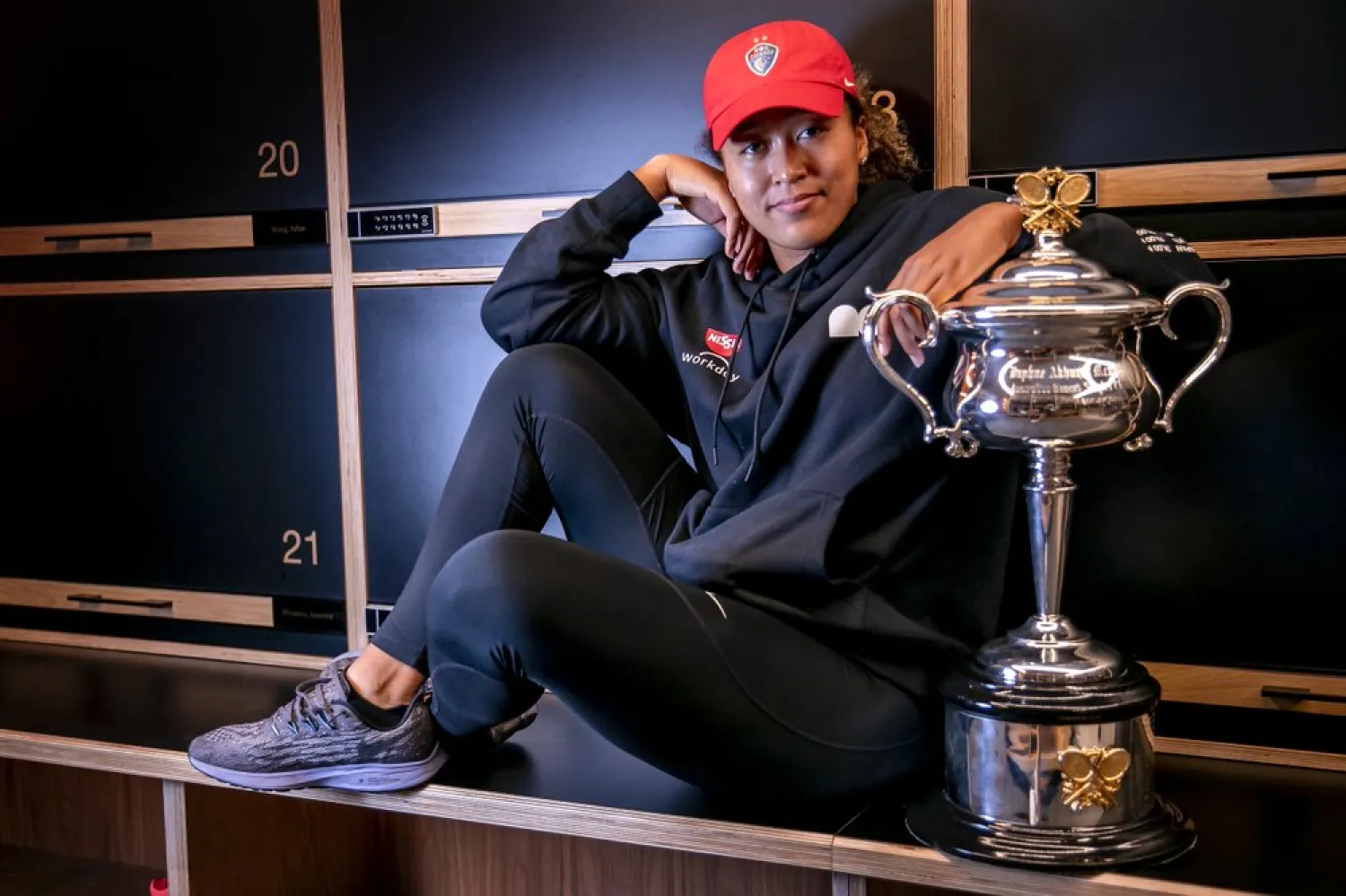
Naomi Osaka with the cup in the locker room in the early hours of Sunday Feb. 21, 2021 after defeating Jennifer Brady in the final at the Australian Open. (Tennis Australia via AP)
TT

Analysis: Already a Star, on Court and off, Osaka Eyes More

Naomi Osaka with the cup in the locker room in the early hours of Sunday Feb. 21, 2021 after defeating Jennifer Brady in the final at the Australian Open. (Tennis Australia via AP)

Naomi Osaka already is a star at age 23. She has the four Grand Slam titles, the record-breaking endorsement deals and the willingness to speak her mind to prove it.

Now the question is: Where does she go from here?

It was telling that the second question posed to Osaka at the news conference following her 6-4, 6-3 victory over Jennifer Brady in the Australian Open final Saturday was about turning in better performances at Wimbledon and the French Open.

After all, each of her major championships so far came on hard courts at Melbourne Park (2019, 2021) or the US Open (2018, 2020). She never has been past the third round at the All England Club or Roland Garros.

Even more revealing was Osaka’s response.

Asked whether her first non-hard-court Slam trophy will come on clay or grass, she said: “Hopefully clay, because it’s the one that’s sooner.”

She is not about biding her time or patient improvement.

And she’s been thinking about where she needs to improve.

“It was one of her goals this year to play well outside of the hard courts. She’s still very young. It’s time to grow on those surfaces. She also believes she can do well and, I’m sure, with the right preparation, with a few, maybe, tactical (and) technical adjustments, we’re going to do well,” said her coach, Wim Fissette. “She’s the person that wants to grow.”

Part of what makes Osaka special is embracing challenges and knowing what she stands for.

That’s been the case off the court and on.

With a racket in her hand, it’s about, as Fissette put it, being able to “love big matches and big moments.”

Osaka wanted to face 23-time major champion Serena Williams in the semifinals, for example.

No fear there.

“She was like when I bring my kids to the toy store: They are very excited. And Naomi was excited to go on court with Serena. It’s just beautiful to see,” Fissette said. “At the end, this is what you train for, right? To be on the biggest stage with the best player of all time, Serena.”

Away from the game, Osaka says, it took time to find her voice and express her views.

She was born in Japan to a Japanese mother and Haitian father, and she moved to the United States when she was 3. Last August, she was the first tennis pro to join athletes from other sports in walking out to protest the police shooting of a Black man in Wisconsin.

“Before I am an athlete,” Osaka tweeted at the time, “I am a black woman.”

On her way to the US Open title in September, Osaka wore masks bearing the names of seven Black victims of violence to draw attention to racism and police brutality.

On Saturday, Osaka was asked whether there was a message she wanted associated with her latest triumph, which made her 4 for 4 in Slam finals.

“Honestly, for me, when everything happened in New York, I got really scared, because I felt like it put me into this light that was a non-athletic light that I’ve never been in before,” she said. “So I feel like there is a lot of topics that people suddenly started asking me about that I completely didn’t know about at all. For me, I only like to talk when I’m knowledgeable about the subject or at least know, like, one tiny grain of what I’m about to start talking about. So for me, I just came into this tournament just thinking purely about tennis.”

And yet, in the aftermath of winning the trophy, she was ready to think about a larger role, too.

Many looked at her win against Williams as a passing of the mantle. Osaka also won their meeting in the 2018 US Open final — who could forget that one? — and has eclipsed the 39-year-old American as the highest-earning female athlete because of millions in sponsorship deals.

But to Osaka, Williams is still, and always will be, an idol and an inspiration, a player whose example she wanted to follow.

And the best way to repay that, Osaka figures, is to hold that role for others.

“Hopefully I play long enough to play a girl that said that I was once her favorite player or something,” Osaka said. “For me, I think that’s the coolest thing that could ever happen to me. ... That’s how the sport moves forward.”




Second Season of ‘Kings League–Middle East' to Kick off in March in Riyadh 

The second season of the Kings League-Middle East will kick off in Riyadh on March 27. (Kings League-Middle East on X)
TT

Second Season of ‘Kings League–Middle East' to Kick off in March in Riyadh 

The second season of the Kings League-Middle East will kick off in Riyadh on March 27. (Kings League-Middle East on X)

The Kings League-Middle East announced that its second season will kick off in Riyadh on March 27.

The season will feature 10 teams, compared to eight in the inaugural edition, under a format that combines sporting competition with digital engagement and includes the participation of several content creators from across the region.

The Kings League-Middle East is organized in partnership with SURJ Sports Investments, a subsidiary of the Public Investment Fund (PIF), as part of efforts to support the development of innovative sports models that integrate football with digital entertainment.

Seven teams will return for the second season: DR7, ABO FC, FWZ, Red Zone, Turbo, Ultra Chmicha, and 3BS. Three additional teams are set to be announced before the start of the competition.

Matches of the second season will be held at Cool Arena in Riyadh under a single round-robin format, with the top-ranked teams advancing to the knockout stages, culminating in the final match.

The inaugural edition recorded strong attendance and wide digital engagement, with approximately a million viewers following the live broadcasts on television and digital platforms.


Shakhtar Boss Pays Ukrainian Racer $200,000 After Games Disqualification

Ukrainian President Volodymyr Zelenskiy holds helmet as he meets with a Ukrainian skeleton racer Vladyslav Heraskevych , who was disqualified from the Olympic skeleton competition over his "helmet of remembrance" depicting athletes killed since Russia's invasion and his father and coach, Mykhailo Heraskevych, amid Russia's attack on Ukraine, in Munich, Germany February 13, 2026. (Ukrainian Presidential Press Service/Handout via Reuters)
TT

Shakhtar Boss Pays Ukrainian Racer $200,000 After Games Disqualification

Ukrainian President Volodymyr Zelenskiy holds helmet as he meets with a Ukrainian skeleton racer Vladyslav Heraskevych , who was disqualified from the Olympic skeleton competition over his "helmet of remembrance" depicting athletes killed since Russia's invasion and his father and coach, Mykhailo Heraskevych, amid Russia's attack on Ukraine, in Munich, Germany February 13, 2026. (Ukrainian Presidential Press Service/Handout via Reuters)

The owner of ‌Ukrainian football club Shakhtar Donetsk has donated more than $200,000 to skeleton racer Vladyslav Heraskevych after the athlete was disqualified from the Milano Cortina Winter Games before competing over the use of a helmet depicting Ukrainian athletes killed in the war with Russia, the club said on Tuesday.

The 27-year-old Heraskevych was disqualified last week when the International Bobsleigh and Skeleton Federation jury ruled that imagery on the helmet — depicting athletes killed since Russia invaded Ukraine in 2022 — breached rules on athletes' expression at ‌the Games.

He ‌then lost an appeal at the Court ‌of ⁠Arbitration for Sport hours ⁠before the final two runs of his competition, having missed the first two runs due to his disqualification.

Heraskevych had been allowed to train with the helmet that displayed the faces of 24 dead Ukrainian athletes for several days in Cortina d'Ampezzo where the sliding center is, but the International Olympic Committee then ⁠warned him a day before his competition ‌started that he could not wear ‌it there.

“Vlad Heraskevych was denied the opportunity to compete for victory ‌at the Olympic Games, yet he returns to Ukraine a ‌true winner," Shakhtar President Rinat Akhmetov said in a club statement.

"The respect and pride he has earned among Ukrainians through his actions are the highest reward. At the same time, I want him to ‌have enough energy and resources to continue his sporting career, as well as to fight ⁠for truth, freedom ⁠and the remembrance of those who gave their lives for Ukraine," he said.

The amount is equal to the prize money Ukraine pays athletes who win a gold medal at the Games.

The case dominated headlines early on at the Olympics, with IOC President Kirsty Coventry meeting Heraskevych on Thursday morning at the sliding venue in a failed last-minute attempt to broker a compromise.

The IOC suggested he wear a black armband and display the helmet before and after the race, but said using it in competition breached rules on keeping politics off fields of play. Heraskevych also earned praise from Ukraine President Volodymyr Zelenskiy.


Speed Skating-Italy Clinch Shock Men’s Team Pursuit Gold, Canada Successfully Defend Women’s Title

 Team Italy with Davide Ghiotto, Andrea Giovannini, Michele Malfatti, celebrate winning the gold medal on the podium of the men's team pursuit speed skating race at the 2026 Winter Olympics, in Milan, Italy, Tuesday, Feb. 17, 2026. (AP)
Team Italy with Davide Ghiotto, Andrea Giovannini, Michele Malfatti, celebrate winning the gold medal on the podium of the men's team pursuit speed skating race at the 2026 Winter Olympics, in Milan, Italy, Tuesday, Feb. 17, 2026. (AP)
TT

Speed Skating-Italy Clinch Shock Men’s Team Pursuit Gold, Canada Successfully Defend Women’s Title

 Team Italy with Davide Ghiotto, Andrea Giovannini, Michele Malfatti, celebrate winning the gold medal on the podium of the men's team pursuit speed skating race at the 2026 Winter Olympics, in Milan, Italy, Tuesday, Feb. 17, 2026. (AP)
Team Italy with Davide Ghiotto, Andrea Giovannini, Michele Malfatti, celebrate winning the gold medal on the podium of the men's team pursuit speed skating race at the 2026 Winter Olympics, in Milan, Italy, Tuesday, Feb. 17, 2026. (AP)

An inspired Italy delighted the home crowd with a stunning victory in the Olympic men's team pursuit final as

Canada's Ivanie Blondin, Valerie Maltais and Isabelle Weidemann delivered another seamless performance to beat the Netherlands in the women's event and retain their title ‌on Tuesday.

Italy's ‌men upset the US who ‌arrived ⁠at the Games ⁠as world champions and gold medal favorites.

Spurred on by double Olympic champion Francesca Lollobrigida, the Italian team of Davide Ghiotto, Andrea Giovannini and Michele Malfatti electrified a frenzied arena as they stormed ⁠to a time of three ‌minutes 39.20 seconds - ‌a commanding 4.51 seconds clear of the ‌Americans with China taking bronze.

The roar inside ‌the venue as Italy powered home was thunderous as the crowd rose to their feet, cheering the host nation to one ‌of their most special golds of a highly successful Games.

Canada's women ⁠crossed ⁠the line 0.96 seconds ahead of the Netherlands, stopping the clock at two minutes 55.81 seconds, and

Japan rounded out the women's podium by beating the US in the Final B.

It was only Canada's third gold medal of the Games, following Mikael Kingsbury's win in men's dual moguls and Megan Oldham's victory in women's freeski big air.